

Liquidity API For Crypto Exchange Development: Integration Guide
The guide explains how crypto exchanges access liquidity and how to integrate it via API. It covers integration models, the technical flow, and how these choices impact trade execution and product growth.

Liquidity is the foundation of any exchange. It determines whether trades happen there at all. It also shapes pricing and shows how the product holds up under real market pressure. Without consistent access to liquidity, nothing else will save a crypto product.
In this guide, we’ll explain how exchanges access market depth in current conditions, break down the available models, show how a single API connects a product to a fragmented market, and walk through what it takes to integrate it into a working system.
Key Takeaways
- Aggregation APIs stop the requirement to develop internal matching engines and order routing, offering a faster path to market than direct venue integration.
- Insufficient liquidity depth creates slippage that alienates high-volume traders, effectively limiting an exchange's ability to scale beyond retail users.
- If your UI isn't perfectly synced with the API, users end up clicking on "ghost" prices that don't exist anymore.
- Implementing failover logic and redundant endpoints is necessary to mitigate the risks of provider downtime and extreme market volatility.
- Utilizing a unified liquidity layer improves capital efficiency by removing the need to manage and collateralize multiple separate accounts.
Types of Crypto Liquidity APIs
Crypto exchange liquidity is never a single stream: it is a patchwork of sources, each governed by its own execution model. An exchange can connect to each venue directly, or use an aggregation layer that brings the market together in one place. These models directly affect price formation, order execution, and the level of control over trading infrastructure. Knowing each approach clarifies your available options.
CEX/DEX Liquidity API
Direct integration means building a bridge to each liquidity provider, centralized or decentralized, one at a time. Each connection brings its own order book or pool with distinct pricing and volume. The result is a mosaic, not a unified market.
Order books are organized by price levels, each displaying available volume. Larger orders execute across multiple levels, which can change the final price and introduce slippage. Since each venue operates independently, the exchange inherits the limitations of all connected sources.
To build a crypto exchange, this model requires core trading infrastructure: order routing, order management systems, and execution logic across connected venues.
A matching engine is only needed if the platform runs its own order book.
Possible difficulties:
- complex integration across multiple venues
- have to maintain the internal tradinginfrastructure
- high development requirements and latency-sensitive systems
Best for:
- large centralized exchanges
- trading platforms with their own order books
- exchanges that require full control over execution
Liquidity Aggregation API
A liquidity aggregator in crypto attempts to solve fragmentation by connecting to multiple sources and presenting them as a single, coherent interface. The API retrieves order books from various venues and merges them into a single layer. This structure features multiple price levels with actual volume, and pricing reflects the combined market rather than a single source.
Execution shifts from isolated trades to intelligent routing. The system examines markets across all venues, splitting orders as needed to sustain consistency and minimize slippage. The result is execution that adapts to market reality, not the constraints of a single provider.
Integration is faster than with direct connections. A liquidity aggregation API can be integrated within days, while building and stabilizing multiple direct connections may take weeks or longer, depending on infrastructure complexity. Tech overhead is lower as there is no need to maintain multiple venue connections, monitor market availability, manage provider failures, or else. The aggregation layer manages these tasks.
This model removes the need to build and maintain an internal trading infrastructure. Managing order books, liquidity pools, or matching engines is not required.
Best for:
- instant crypto exchanges
- crypto wallets
- fintech applications
- payment providers
- small and mid-size exchanges
ChangeNOW API is the best liquidity API because it brings together what an aggregation layer should deliver in practice: unified access to 1500+ assets and 110+ networks, sourced from both CEXs and DEXs. It removes the need to maintain trading infrastructure, keeps execution stable with 99.99% availability and ~350 ms response time, and supports both fixed-rate and floating flows.
A Practical Guide for Integrating a Liquidity API for a Crypto Exchange
Step 1: Choose a Liquidity Model
Everything starts with a product decision. Before writing a single line of code, you need to decide how your exchange will access market depth. This core choice sets the boundaries for execution logic, infrastructure complexity, and how fast you can get to market, making it a first step.
You typically choose between direct integration with exchanges or connecting through an aggregation API. Direct integration offers full control over routing and execution but increases infrastructure overhead. Aggregation shifts complexity outside your system and provides access to a distributed market through a single connection.
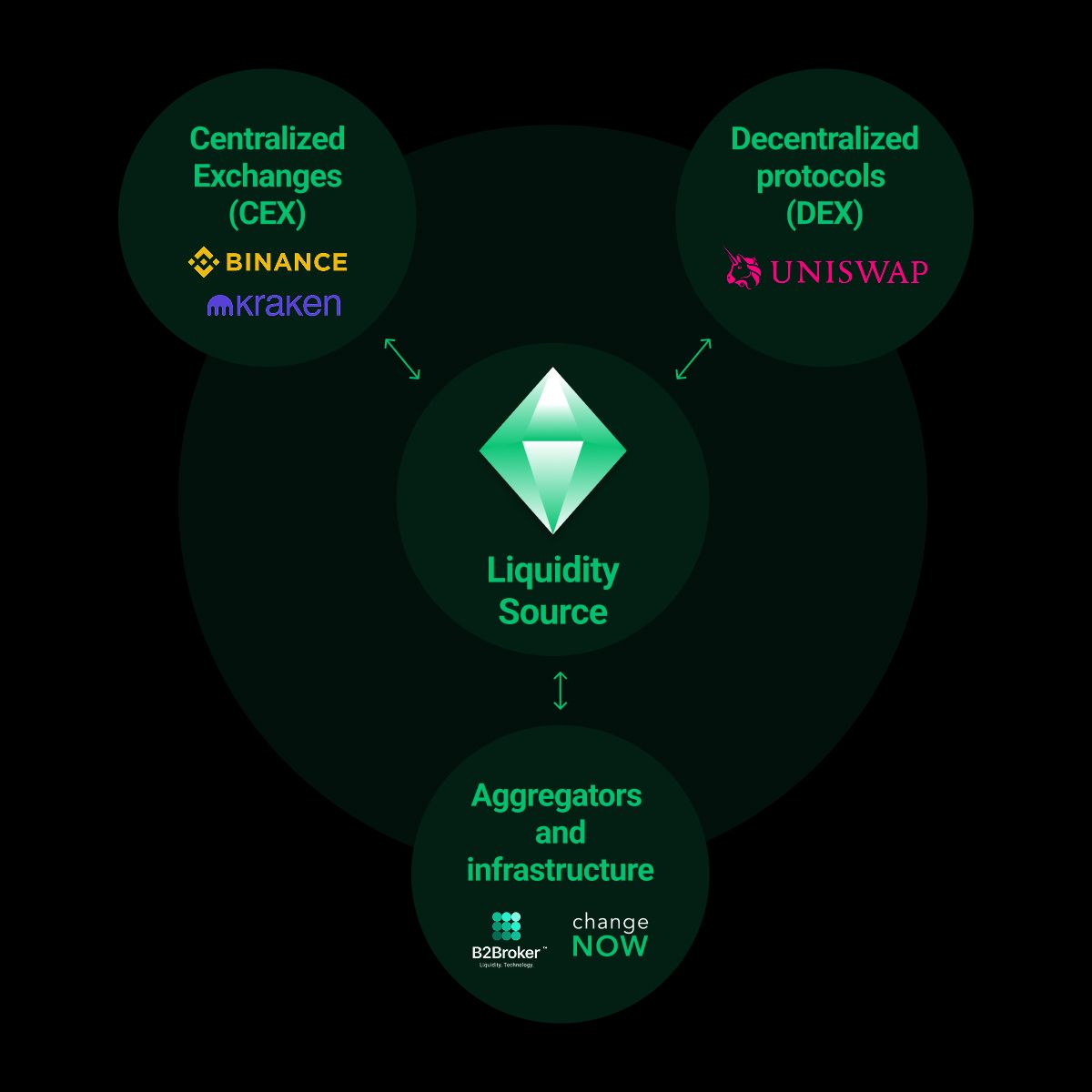 Liquidity is always fragmented across venues — this is what your integration will need to handle from day one.
At this point, think of an API as your entry point into liquidity providers in crypto. It connects your exchange to external providers, including institutional brokers, market makers, and crypto liquidity providers. Through that connection, you get access to tradable assets, live pricing, and executable quotes that your product can surface to users. Also you can learn more about the best crypto liquidity providers in this article.
Step 2: Get API Access
Once the model is clear, the process becomes more mechanical. You onboard with a provider, generate API keys, and start working with their documentation. This stage is less about decisions and more about how cleanly your system can connect to theirs.
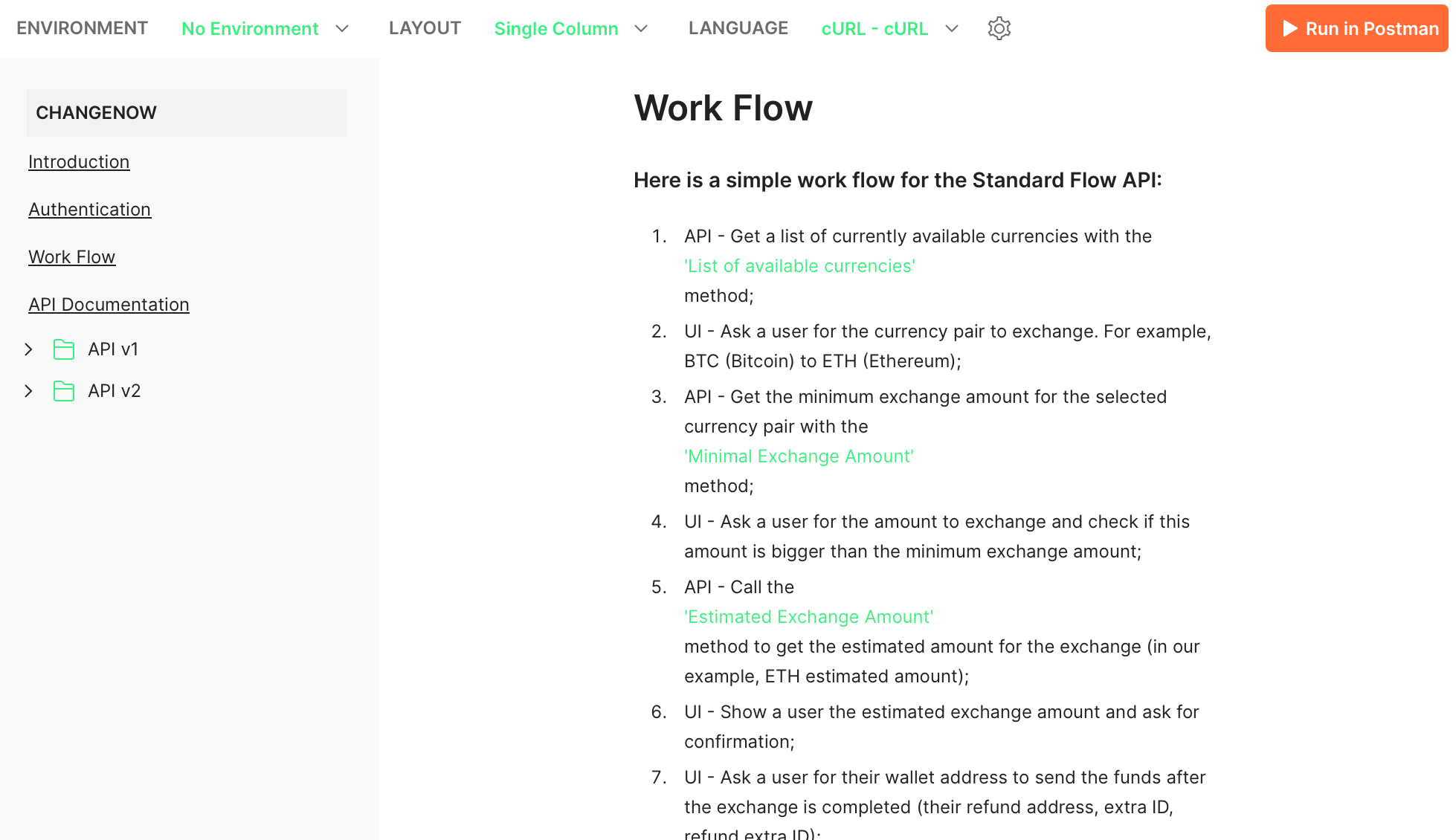 If you prefer to work things out on your own, every modern crypto API comes with detailed documentation. This is what it looks like in practice
Most providers offer a standard structure, including REST endpoints for requests, webhooks for event delivery, rate endpoints for price discovery, and swap endpoints for execution. These components define how your backend retrieves data, responds to changes, and submits trades.
From here, everything works on live data. The API streams price feeds, executable quotes, order book snapshots, and settlement details. Updates happen in real time, so your frontend reflects the actual market conditions when a user makes a decision.
API constraints define the first boundary when providers impose request and transaction limits. Exceeding them leads to slow responses, stale quotes, and degraded execution when demand jumps. Be sure to check this.
Step 3: Connect Exchange Backend to the API
With access secured, integration becomes a matter of live interaction: the backend pulls prices, submits trades, and tracks execution as it happens. The system queries endpoints for executable quotes, each defined by volatility, order book state, market depth, trading activity, and provider latency. The price a user sees can be close to the price they receive; under stable conditions.
Next comes transactions. A user starts a swap, your backend builds the request and sends it to the API. From there, the order is routed across available markets and filled against the best available liquidity.
Matching spans multiple providers, removing dependence on any single venue. Orders are routed across available market as it shifts, allowing execution to continue without relying on a single source. This model becomes more complex in cross-chain environments, where liquidity is fragmented across networks — see here. After execution starts, the system polls for status: processing, completion, or failure. The API returns these states, keeping the frontend synchronized with real execution.
Step 4: Implement Risk Management and Monitoring
Once this flow is live, the focus moves to control. Markets change fast, providers fail, execution quality can drop without warning. Start with availability. A production setup requires redundant endpoints and failover logic. If a provider degrades or goes offline, traffic shifts to another route to maintain service.
Timeouts, failed requests, and partial fills are normal in live trading. Your system needs to catch them, retry where possible, and reroute when conditions change. Track order flow, error logs, transaction latency, and provider response times. These metrics show when routing slows or liquidity quality declines. Always maintain a fallback path in production. Without it, a single provider issue can lead to wider spreads and failed execution during high load.
Step 5: Optimize User Experience
At this stage, the system functions, but user perception depends on the trading experience. Execution quality is only apparent if the interface communicates it clearly. Start with pricing, quotes need to refresh fast and stay in line with live market conditions. When a user sees a rate, they expect it to match execution. Live price feeds, trading volumes, and market depth data keep that alignment and prevent stale pricing.
Displaying bids and asks shows where liquidity sits and how each trade may move the price. As trade size grows, this explicitness becomes critical.
After a trade starts, users need clear status updates, from submission to confirmation. If the system goes silent, trust drops even when the backend works correctly. Fees must stay visible at every step. The user must see the full cost before confirming the trade, including spreads and final amounts, including spreads and final amounts. Ensure your UI updates as frequently as your API data refreshes. If the interface lags behind the backend, users may trade on outdated prices, causing failed or repriced transactions.
To understand how to drive user acquisition for your crypto exchange, see here.
Why Exchanges Need Liquidity Providers
Orders fill quickly when there are enough buyers and sellers. If market depth is low, orders may be delayed, only partly filled, or fail during volatile times. Even small delays can lead to worse execution when the market moves.
Market depth impacts spreads and trading costs; a tight bid-ask spread signals strong depth and better pricing. When depth drops, spreads widen, and users pay more per trade.
It also supports price stability, because high trading activity absorbs large buy and sell orders without sharp price movements. In thin markets, even small trades can push prices around and distort execution. It also becomes easier for large players to move the market. User experience depends on these mechanics. Fast fills and reliable pricing keep users in the flow. Failed trades, price jumps, and inconsistent execution break it.
Market capacity limits how much an exchange can grow: exchanges with more trading pairs and higher volumes need steady access to tradable assets. Institutional traders want to make large trades without moving the market. If liquidity is lacking, big trades shift to OTC desks and other off-exchange execution channels.
Conclusion
Aggregation models combine liquidity from multiple sources into one execution layer. Orders are routed across venues based on available depth and price. This leads to tighter spreads, more consistent fills, and the ability to handle larger trades without notable slippage.
Better execution changes user behavior. Trades complete faster, pricing stays stable, and outcomes remain predictable. Better execution tends to increase trading frequency and average trade size.
High-value traders gravitate toward platforms where execution remains stable under load. Platforms that fail to deliver consistent execution often lose volume when it matters most.
FAQ
How much liquidity does a new crypto exchange need to launch?
There’s no fixed liquidity requirement to launch a crypto exchange, but you still need enough depth to make trading viable from day one. Most platforms either work with market makers or commit their own capital to keep spreads tight and execution stable.
What is the difference between a crypto market maker and a liquidity provider?
Market makers keep trading active by constantly quoting buy and sell prices and managing spreads. Liquidity providers is a broader term that includes anyone supplying capital to the market. Market makers are part of that group, but with a more active role in pricing and execution.
Can liquidity APIs support both fixed-rate and floating-rate swaps?
Yes, enterprise-grade APIs, such as ChangeNOW, support both fixed- and floating-rate swaps, giving clients a choice between price certainty and market-based execution. This allows platforms to offer locked rates for user-facing transactions while using floating rates for higher-volume flows.
What compliance requirements should be considered when integrating crypto liquidity APIs?
Integrating crypto APIs starts with compliance. KYC/AML requirements and the FATF Travel Rule are typically part of keeping transactions traceable. With direct exchange APIs, the provider’s licensing framework may cover parts of the execution layer, but it does not replace your own compliance obligations. You are still responsible for KYB, KYC/AML controls, and transaction monitoring.
Aggregator APIs can increase operational complexity, as liquidity is sourced from multiple venues, requiring additional oversight and risk controls.