No private key = no access. That’s Bitcoin’s #1 rule. Set in stone. Monumental. Unbreakable.
Doesn't matter who you are, what you claim, or how good your lawyer is. The math behind the blockchain doesn't negotiate.
That rule is what makes Bitcoin work. And that’s exactly what's under attack in 2026.
Quantum computing isn't coming for your wallet the way hackers do. Because it's not a breach. It's something quieter, more boring, and way harder to fix: it’s the ability to run certain math problems backwards. The kind of math Bitcoin's entire ownership model is built on.
When (and we really mean ‘when’ because it’s the matter of time) this superpower becomes real at scale, the "no key - no access" rule doesn’t work anymore. It gets replaced by a question of who gets to the stash first.
We get 2.3 million Bitcoin sitting in wallets with no owner to defend them. Let that thought sink in.
Key Takeaways
Bitcoin's security is built on math that only runs one way. Quantum computers can run it backwards.
Current state: 96 logical qubits exist. Breaking Bitcoin needs ~1,200.
2.3 million BTC sit in dormant, vulnerable wallets with no active owner to protect them. That includes Satoshi's.
Active wallets have a fighting chance if post-quantum encryption rolls out in time. Dormant ones don't.
It doesn't stop at Bitcoin. Stablecoins and real-world assets run on the same cryptographic assumptions.
There are three proposed solutions for what to do about vulnerable dormant coins. None of them are clean.
What Is Quantum Computing, Explained Simply
Most people picture quantum computers as regular computers, but faster. Like, absurdly, sci-fi fast.
That's not really it.
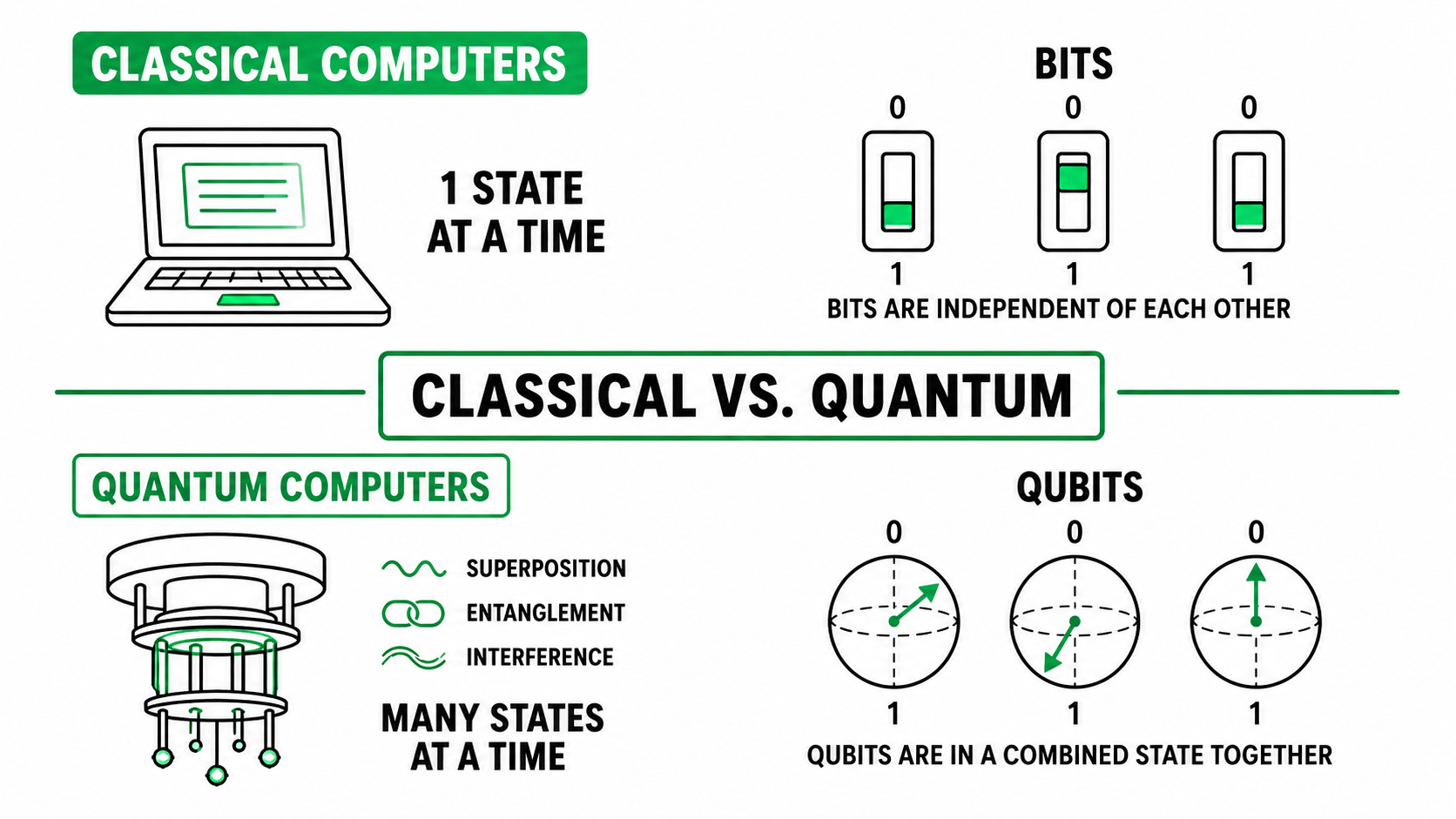
Classical computers think in bits. Every bit is either 0 or 1 - that’s called a binary code.
Quantum computers think in qubits. A qubit can be 0, 1, or both at the same time until you check it. This is called superposition. And It sounds like a physics party trick.
It has one very practical consequence though.
Certain math problems that only run in one direction for classical computers, quantum computers can run backwards. Not faster. Backwards.
That's the whole threat in one sentence. It’s not about speed or brute forcing the code. But reversibility.
Bitcoin's security is built entirely on math that was only ever designed to work one way.
How Quantum Computing Threatens Bitcoin
Here's how Bitcoin ownership works in a nutshell.
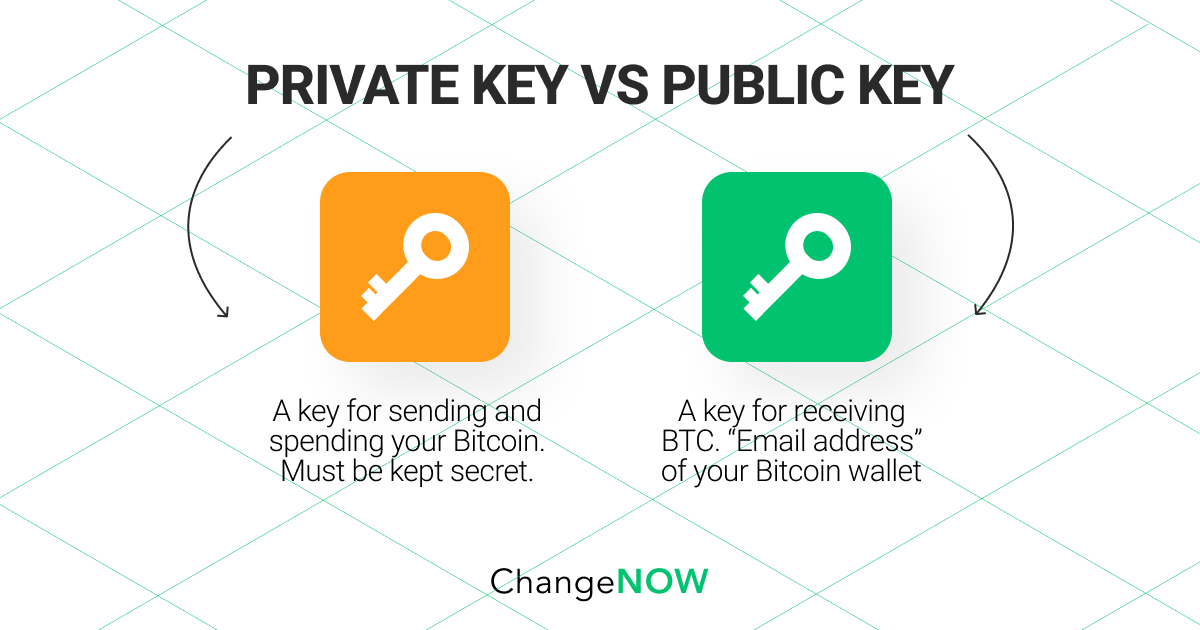
You have a private key. It generates a public key. The public key is visible to everyone on the blockchain. From the public key, you create a digital signature to authorize transactions.
The system works because the math only runs one way. Generating a public key from a private key is easy. Going backwards, like deriving the private key from the public key, is computationally impossible.
For classical computers, anyway.
But they have CRQCs now. Cryptographically Relevant Quantum Computers that can run that math in reverse. Derive the private key from the public key. And once you have the private key, you have the wallet.
Google's quantum research team described it like this:
"To own bitcoin means to know the private key associated with the public key to which it is locked. CRQCs enable one to derive the private key from any public key, thereby upending Bitcoin's current cryptographic model of ownership."
This is not some kind of hack. Nobody's breaking down a door. The same door just becomes openable by anyone with the right machine.
Remember James Howells, an IT specialist from Newport, and his hard drive buried in a landfill with 7,500 BTC? His coins were safe because nobody could reverse the math. But now we wouldn't be so sure about that.
Quantum Computing: Where Are We in 2026?
Two numbers are worth knowing here.
Where quantum computing stands right now. And where it needs to be to break Bitcoin's encryption.
But first, the right metric. You might not know this, but not all qubits are equal.
Physical qubits are unstable and error-prone. Logical qubits are what you get after error correction. They're the ones that do the actual work. And they're much harder to build.
Right now, QuEra holds the record: 96 verified logical qubits, extracted from 448 physical ones.
Until recently, the math said we’d need around 1,200 logical qubits to crack Bitcoin's elliptic curve encryption. That put us at about 8% of the way there, if you wanted a precise number.
Then, the math changed.
Recent leaks revealed that Google Quantum AI discovered a way to make the decryption algorithm up to 10x more efficient.
While the US government reportedly tried to keep this under wraps, the breakthrough made its way into the wild. Now, independent researchers and open-source AI are already iterating on it.
Because the algorithm is suddenly much more efficient, that 1,200 logical qubit requirement is drastically shrinking.
This fundamentally alters the timeline.
Ethereum researcher Justin Drake recently highlighted a 50% probability that "Q-Day" (the point when quantum computers can shatter current cryptography) will hit by 2032.
For a closer look at how blockchain networks are actively building post-quantum defenses is available here:
It was built to protect you from people: the guy who claims your coins are his, the platform that freezes your account, the government that orders a seizure.
The whole point of cryptographic ownership is that none of that matters without the key.
Math was supposed to be the neutral party, but quantum computing removes math from the equation. Pun 100% intended.
When private keys can be derived from public keys, ownership becomes a race: whoever runs the computation first, wins everything.
Active wallets have a fighting chance. If post-quantum encryption gets rolled out in time, they can adapt and move funds to safer addresses.
The wallets that can't fight back are the ones nobody's watching, like old addresses with lost keys, coins that belong to people who are no longer around to move them, or coins that haven't moved in years. Like Satoshi Nakamoto’s…
2.3 Million Bitcoin With No One Home
Satoshi Nakamoto hasn't touched their Bitcoin since the earliest days of the network. The coins just sit there untouched for over 15 years.
Nobody knows if Satoshi is alive. Nobody knows if the keys still exist somewhere. What everyone knows is that those wallets use exactly the format most vulnerable to a quantum attack: P2PK scripts, where the public key is directly exposed on the blockchain.
Satoshi is the most famous case, but they’re not the only ones.
Over 1.7 million BTC are locked in old P2PK scripts.
Add other dormant vulnerable addresses, and the number climbs to an estimated 2.3 million.
2.3 MILLION (!) of Bitcoin with no active owner and nobody to migrate them.
And here's where it gets politically ugly.
"The Bitcoin community might not be enthusiastic to have quantum computers salvage the lost Satoshi era coins. Any sudden increase of total Bitcoin supply would likely lead to a decrease in the value of Bitcoin." - Google Quantum AI Whitepaper, 2025
A sudden flood of previously untouchable Bitcoin is a huge supply shock. The kind that rewrites the scarcity narrative Bitcoin's entire value proposition is built on.
The community knows this. The conversation about what to do with dormant vulnerable coins is already happening. And there are three proposed solutions on the table.
But that’s a long story for another article.
Final thoughts
Bitcoin's math held for 15 years. It was elegant, simple, and for a long time, it was enough.
But times change.
Once the foundational rule of crypto ownership is undermined, everything built on top of it is undermined too.
The 2.3 million dormant BTC is just the beginning of that conversation. The harder questions are about what the Bitcoin community decides to do about it, and whether they can agree before the timeline forces their hand.
That's the next story: three proposed solutions, zero easy answers, and one very inconvenient ghost named Satoshi.
And if you think this stops at Bitcoin, well, it doesn't. Stablecoins, real-world assets, the smart contracts running the financial infrastructure you probably use without knowing it.
All of it sits on the same cryptographic assumptions. And the quantum threat comes for them too.
Bitget has confirmed a major security breach affecting approximately $387.5 million in assets across its hot and warm wallet infrastructure. Private-key compromise has been ruled out.


 It has one very practical consequence though.
 The system works because the math only runs one way. Generating a public key from a private key is easy. Going backwards, like deriving the private key from the public key, is computationally impossible.

