In 2026, the blockchain narrative shifted. Scaling and throughput – while still important – are no longer the final goals. They’re now prerequisites for something much bigger: fundamentally changing how money itself moves in the digital age. This is the promise of Polygon’s Open Money Stack – an ambitious, modular, open infrastructure designed to reshape the global financial plumbing.
To truly understand why this matters, we need to think beyond blockchains, consensus models, and transaction speeds. We need to think about money as programmable, global, instant, and user-centric – and how Polygon Labs is attempting to build the rails, switches, and interfaces that make that possible.
A Shift in Narrative: From Blockchain to Money Infrastructure
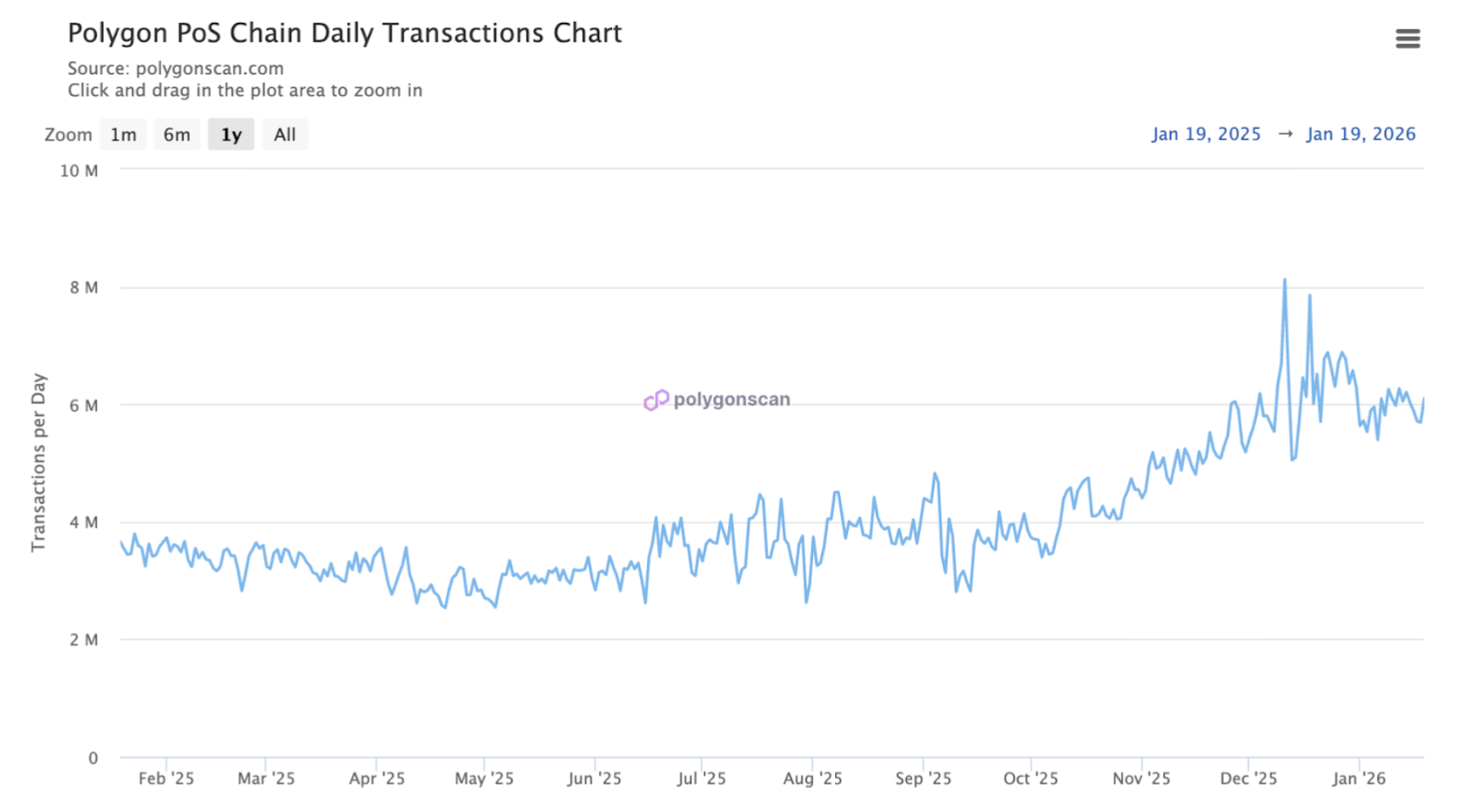
For years, blockchains competed on technical metrics: TPS, finality, cost, smart contract flexibility. Polygon Labs not only participated in that race but delivered tangible results.
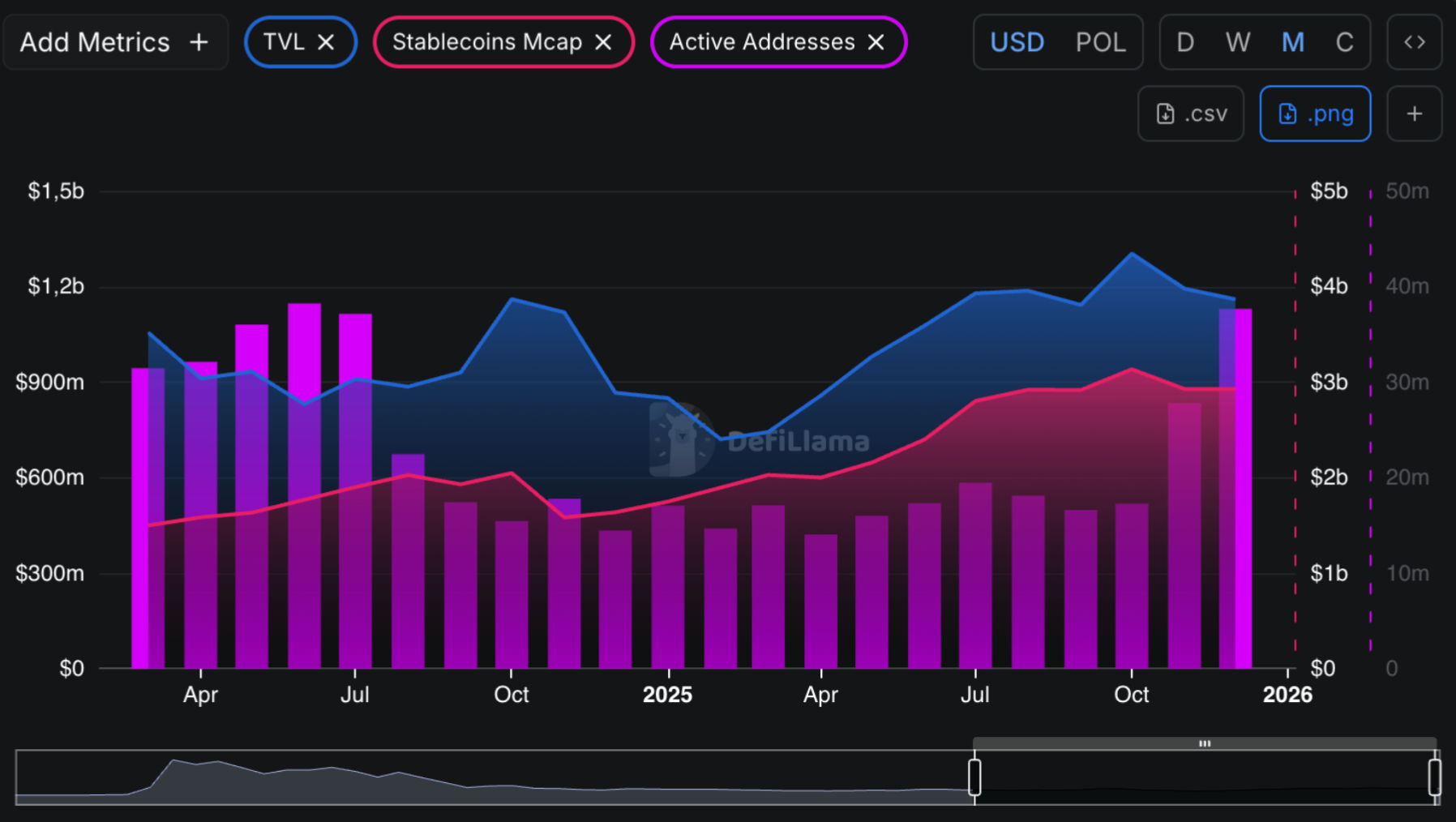
The Polygon ecosystem has seen steady growth in stablecoins and user activity. Stablecoin market capitalization increased from $1.7B in 2023 to $2.9B in 2025, while the number of active addresses reached a peak of 38.3M.
That era birthed DeFi and NFTs, but didn’t solve the core inefficiencies of traditional finance. When businesses needed to move money across borders, they still fell back on SWIFT, ACH, correspondent banking networks, or proprietary payment rails – slow, expensive, and opaque.
Polygon Labs’s founders framed this in their Open Money Stack vision:
We freed information first with the internet. Money is next.
It’s a clear statement of intent: money movement should be as frictionless and universal as email or file transfer. Today, transferring money internationally can take days, cost high fees, and involve multiple intermediaries. Tomorrow, Polygon Labs intends for that to happen in seconds, at near-zero cost, anywhere in the world.
This is where the Open Money Stack (OMS) comes into play.
What Is the Open Money Stack?
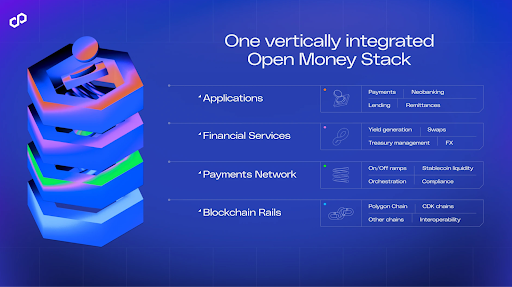
At its core, the Open Money Stack is a vertically integrated ecosystem of modular money movement primitives and services built for global, programmable, compliant money flows – combining the best of blockchain rails with real-world financial requirements.
“Our mission is to move all money on-chain,” – states the Polygon team.
Instead of thinking about blockchains as isolated rails, OMS treats them as components in a broader money stack that includes:
Blockchain rails for settlement, compatible with any chain you choose
On- and off-ramps to bring fiat into on-chain ecosystems and vice versa
Wallet infrastructure that abstracts complexity for end users
Cross-chain interoperability and orchestration
Stablecoin and tokenized deposit interoperability
Compliance tooling and on-chain identity primitives
Yield and financial product integrations on-chain
This is not a simple middleware solution. It’s a comprehensive stack designed to replace the fragmented landscape of payment rails, orchestration services, custodian interfaces, and liquidity networks currently operated by banks and fintechs.
Why Open Money Stack can change the world of Web2?
To grasp the ambition behind the Open Money Stack, it helps to look at the scale of the system it aims to reshape. The global payments industry alone processes roughly $2.0 quadrillion in value each year, generating over $2.5 trillion in revenue across an estimated 3.6 trillion transactions worldwide [2].
Traditional infrastructure was never built for instant settlement or programmable flows – it evolved by accretion. OMS proposes a new infrastructure: open, interoperable, and optimized for real-time money movement.
Key Characteristics of the Open Money Stack
Polygon Labs lays out several principles that define OMS:
Money moves anywhere, instantly and reliably – cross-border, cross-currency, cross-chain.
Settlements can happen in on-chain money that stays on-chain – not bouncing back into legacy systems to be used.
Users, businesses, and AI agents don’t have to care about chains, gas, or rails anymore.
Money on-chain should work like information online – seamless and invisible.
This combination is profound: it doesn’t just fix payment speed or cost – it redefines the user experience of money.
A Modular, Open Architecture for Money Movement
Unlike closed or proprietary solutions, the Open Money Stack is modular and open. You don’t have to adopt every component – you can integrate the parts you need and build around them.
At present, the stack includes pieces already operational or rolling out in phases:
Blockchain Rails
These are the settlement layers optimized for low cost, high throughput, and secure value transfer – the base layer for everything else.
Wallet Infrastructure
Turnkey wallets with one-click creation abstract away user friction: no need for private key management, gas tokens, or manual configuration.
On-/Off-Ramps
These bridge fiat and digital money, enabling users to onboard directly from bank accounts, cash, or other traditional channels into on-chain money, and vice versa.
Cross-Chain Interoperability
Unified APIs and orchestration systems allow money to move across different blockchains without forcing users into chain-specific experiences.
Compliant Money Movement
Built-in compliance tools and identity layers help enterprises navigate regulatory requirements without sacrificing decentralization.
On-chain Yield and Financial Products
Idle funds don’t just sit – they can earn yield, participate in card programs, and integrate with broader financial services on a global scale.
Open Money, Not Just Stablecoin Rails
A misconception some observers have is that OMS is “just stablecoin payments infrastructure.” That’s too narrow. While supporting regulated stablecoin payments is a core use case, the stack is designed for all forms of on-chain money: tokenized deposits, programmable assets, and smart contract-native value instruments.
In practical terms, this means senders don’t have to worry about the specific token the recipient wants – the stack handles format negotiation, liquidity routing, and settlement seamlessly. That’s a big shift from current workflows, where the sender must choose a chain and token explicitly.
The Open Money Stack is not theoretical. Polygon Labs has already laid foundations through years of building high-performance blockchain infrastructure that has facilitated trillions in on-chain value transfer [3] – experience few networks can claim.
Now, Polygon Labs is turning that experience into a composable, enterprise-grade money movement platform. The rollout is phased, but many components are either live or rapidly approaching general availability.
This transition from infrastructure to money middleware is not accidental – it’s strategic:
It leverages existing stablecoin liquidity and networks
It embeds compliance and identity layers essential for institutional adoption
It reduces operational complexity for developers
It positions Polygon as the preferred programmable money rails provider in a multi-chain world
What This Means for Developers, Businesses, and Users
Developers
Builders can weave OMS directly into applications, bypassing the need to stitch together multiple fragmented services. Whether creating remittance platforms, consumer wallets, or enterprise payment systems, the stack provides a unified API and SDKs for seamless money movement.
Enterprises and Financial Institutions
Legacy payment systems are slow and costly. OMS offers regulated stablecoin settlement, on/off-ramp integrations, and compliance tooling out of the box – enabling firms to compete with modern fintech disruptors and offer near-instant settlement.
End Users
For consumers, it means money that behaves like data: move it instantly, in any form, to anyone, anywhere – without worrying about chains, wallets, gas, conversions, or intermediary failures.
The Road Ahead: A Decade-Long Transformation
Polygon Labs acknowledges that migrating “all money on-chain” won’t happen overnight. It estimates that full realization could take a decade or more, but emphasizes that the next few years – especially 2026–2028 – will define the infrastructure that dominates the next 30 years of money movement.
This is not just building software. It’s architecting the plumbing of a global programmable economy.
Risks, Challenges, and Realities
Nothing this ambitious comes without challenges:
Regulatory uncertainty remains a real concern for global deployments. Not all regions are ready to face Web3 – in the US, for example, crypto rules are split across agencies like the SEC, CFTC, FinCEN, and IRS. How the US is trying to address these challenges is discussed in our previous article.
Network liquidity and stablecoin regulation vary widely by jurisdiction.
Competition from legacy systems and other blockchain stacks will be fierce.
Yet, the Open Money Stack does more than just propose a solution – it integrates compliance, orchestration, settlement, routing, and yield logic into a single stack. If executed well, it could outpace both traditional systems and siloed blockchain payment solutions.
Conclusion: A New Era for Money
Instead of focusing narrowly on throughput or DeFi mechanics, Polygon is aiming to redefine how value flows across borders and systems. This is about making money instant, programmable, and truly global.
We are witnessing the beginnings of a platform that could become the foundation for the next generation of global financial applications, one where money moves as freely and reliably as information on the internet.