Quick summary: Some blockchains already support post-quantum signatures, while others are testing or preparing upgrades. This guide compares eight networks by signing algorithm, deployment status, and remaining security risks, including XRP Ledger's proposed migration to new keys.
Basically, quantum computers haven't broken the signatures protecting major blockchains yet, but exposed public keys tied to inactive wallets create a migration problem: some owners may have lost access to their keys or may never return to move their coins.
We covered the risks of dormant BTC and older wallets in our Bitcoin quantum threat breakdown. Other networks face additional challenges, from validator keys and bridges to exchange wallets and custody systems.
Some blockchains already support post-quantum signatures, while others are still developing upgrades. Here's where the major networks stand in 2026.
What Quantum Computing Breaks In Crypto
A quantum computer does not need your seed phrase. Once a wallet's public key is exposed, a sufficiently powerful machine could derive the private key and sign transactions without the owner's permission.
The consequences go beyond stolen coins. A bridge could be compromised through an exposed admin key, even if its smart contracts work exactly as intended. Exchanges face a similar problem with custody keys. Upgrading the blockchain alone won't secure infrastructure that still relies on older signatures.
Cold storage remains useful against everyday threats like malware and key theft. But an offline device cannot protect funds if the public key is already exposed and its cryptography becomes breakable.
Project Eleven's 2026 blockchain report calls the point when a cryptographically relevant quantum computer (CRQC) can break existing public-key cryptography Q-Day.
Which Blockchains Look Most Exposed in 2026?
Bitcoin tops the qLABS Layer-1 Quantum Vulnerability Index with a score of 8.33 out of 10. The April 2026 study compares ten major blockchains using five criteria: signature security, public-key exposure, economic value, migration readiness, and the age of their cryptographic exposure.
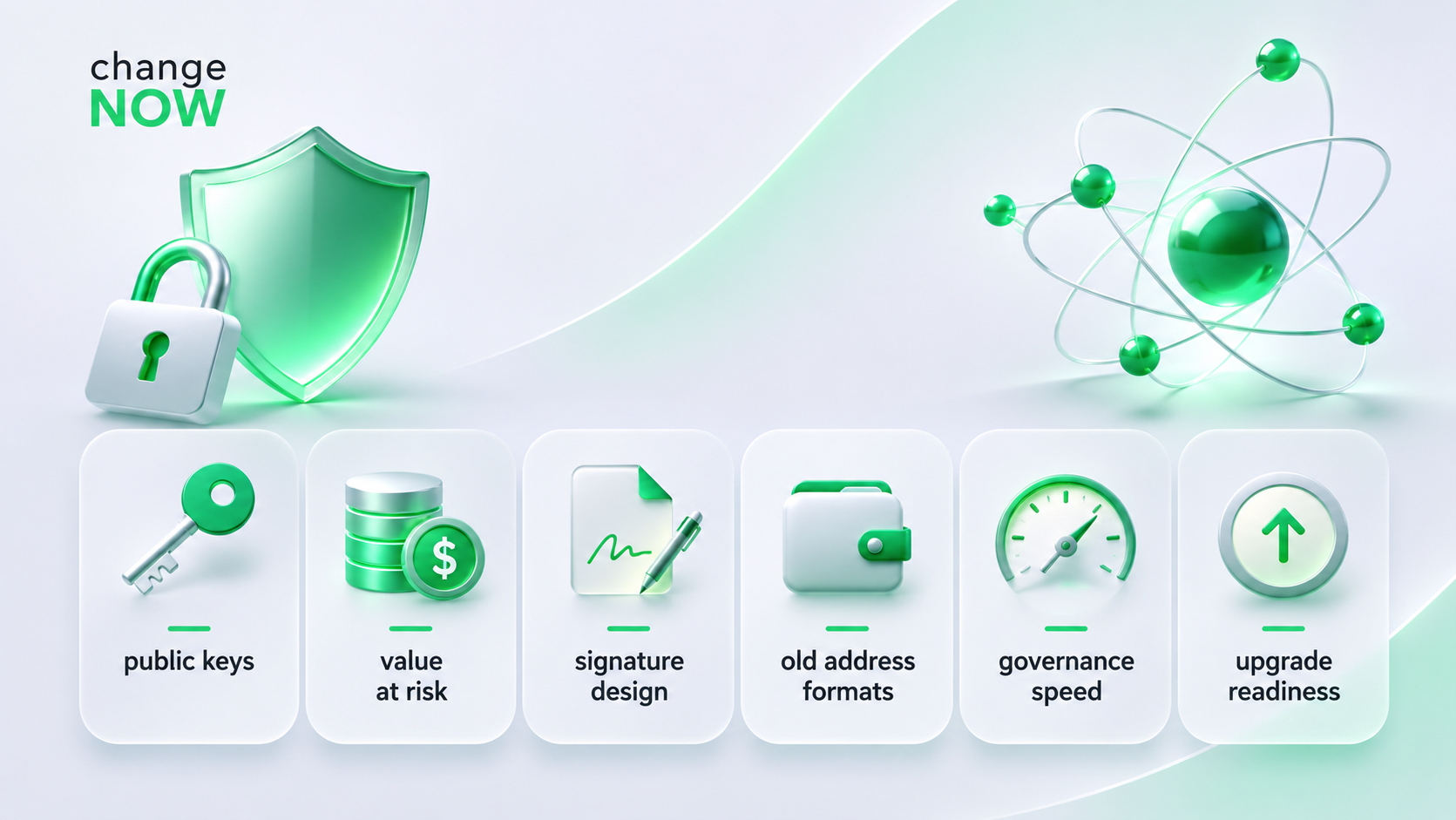
The scores reflect conditions assessed in April, before several networks announced or released further post-quantum upgrades.
qLABS Ranking by Blockchain
| Blockchain | Quantum Vulnerability Score |
|---|
| Bitcoin | 8.33 |
| Hyperliquid | 7.90 |
| BNB Chain | 7.87 |
| Dogecoin | 7.77 |
| Monero | 7.37 |
| TRON | 6.83 |
| Ethereum | 6.80 |
| XRP Ledger | 6.30 |
| Solana | 6.00 |
| Cardano | 5.60 |
Source: qLABS Layer-1 Quantum Vulnerability Index, April 2026. Higher scores indicate greater exposure under the study's methodology.
All ten networks received the maximum vulnerability score for their existing signature schemes and public-key exposure. Much of the difference comes from how prepared they are to migrate, how much economic value they represent, and how long their cryptographic keys have been exposed.
Bitcoin ranks highest partly because of its legacy addresses and the difficulty of coordinating changes across a decentralized network. Ethereum and XRP Ledger scored lower because they already had published post-quantum plans. Cardano received the lowest score in this group, although its existing signatures remain vulnerable to a sufficiently powerful quantum computer.
The ranking measures exposure under qLABS' own methodology. The company also develops quantum-security products, and its scores should not be treated as an independent security certification.
Why Blockchains Still Use Pre-Quantum Cryptography
Post-quantum signatures can be considerably larger than those used today, increasing transaction size and storage requirements. Switching algorithms also affects how transactions are verified and which wallets can sign them. Even after a network upgrade, users may have to wait for compatible hardware wallets and exchange support.
Old balances create another problem. Some owners will never migrate, and lost private keys cannot authorize a transfer. Should a blockchain continue accepting vulnerable signatures or eventually disable them, potentially leaving those funds inaccessible?
The Coinbase Quantum Advisory Council's 2026 research examines this dilemma. The decision requires agreement across the network, and delaying it could leave fewer options as quantum hardware advances.
How To Check Post-Quantum Readiness In Crypto
Start with what's actually running on mainnet. Can users sign transactions with post-quantum keys, or has the network only tested the algorithm? Some upgrades protect specific components, such as state proofs, while ordinary accounts still rely on traditional signatures.
Wallet support is worth checking separately. Even if a blockchain accepts post-quantum signatures, users need compatible software and clear instructions for replacing older keys. For upcoming upgrades, look for a published technical specification and security audits rather than relying on a target launch date.
The NIST post-quantum standards provide a useful reference. FIPS 204 covers ML-DSA and FIPS 205 covers SLH-DSA, both designed for digital signatures. FIPS 203 covers ML-KEM, which is used for establishing shared cryptographic keys.
Using a standardized algorithm is a good sign, but it doesn't tell you how widely the protection has been deployed.
Algorand's Falcon Rollout
Algorand has been using Falcon signatures for State Proofs since 2022. In November 2025, it introduced Falcon-backed accounts on mainnet, followed by native Falcon-1024 accounts in August 2026.
Existing Ed25519 accounts haven't been automatically migrated, and work on quantum-resistant consensus mechanisms is still ongoing. The Algorand post-quantum roadmap explains which parts of the network are already protected.
Post-Quantum Blockchain Updates in 2026
XRP Ledger's Quantum-Resistant Migration Plan
XRP Ledger is preparing to support ML-DSA-44 signatures for accounts and validators, with a broader transition targeted for 2028.
The proposed upgrade would let XRP holders assign quantum-resistant signing keys to existing accounts. But adding a new key alone isn't enough if an older, vulnerable key can still authorize transactions. Users would need to stop relying on their old signing methods to complete the migration.
The XRP Ledger Foundation's roadmap schedules a migration study for the first half of 2027, with development and security reviews expected in late 2027 or 2028.
Larger signatures also raise practical questions. The draft specification doesn't change the existing fee schedule, although future adjustments may be needed to account for additional network storage.
The upgrade isn't active on mainnet, and existing accounts won't migrate automatically. Wallet support and clear key-rotation instructions will be essential once the amendment is approved.
Algorand's Falcon Rollout
Algorand has used Falcon signatures for State Proofs since 2022. Its first Falcon-backed accounts appeared on mainnet in November 2025, followed by native Falcon-1024 accounts in August 2026.
The newer accounts can authorize transactions directly with post-quantum signatures. Existing Ed25519 accounts remain supported, and users can move their signing authority to Falcon where compatible tools allow it.
The Algorand post-quantum roadmap still includes research into consensus signatures and the verifiable random function (VRF) used for validator selection.
NEAR Adds ML-DSA Account Signing
NEAR introduced ML-DSA support in 2026, allowing users to secure their accounts with post-quantum signatures. Meteor Wallet already supports the signing option, while compatibility across other wallets continues to develop.
The more difficult upgrade concerns consensus. Validators can protect account transactions with ML-DSA, but block production still depends on traditional cryptography.
According to NEAR's August 2026 roadmap, post-quantum consensus is targeted for the end of 2027. Cross-chain signing through NEAR Intents and related infrastructure also needs further work.
Ethereum's 2029 Quantum-Resistance Target
The Ethereum Foundation has set December 2029 as its target for quantum resistance across Ethereum's execution, consensus, and data layers.
The work includes replacing vulnerable validator signatures with hash-based alternatives such as leanXMSS, developing proof-based signature aggregation, and enabling accounts to adopt new signing methods.
These changes are still being developed. The Ethereum Foundation's September 2026 priorities describe a sequence of protocol upgrades leading toward the deadline, with a minimum viable post-quantum fallback also under consideration.
Our Lean Ethereum roadmap breakdown covers the wider technical changes behind this transition.
Zcash Ironwood and Quantum-Recoverable Funds
Zcash activated Ironwood on July 28, 2026, introducing a new shielded pool after a critical vulnerability was found in Orchard.
One feature is particularly relevant to quantum security. Ironwood creates notes that can be recovered through a future post-quantum shielded protocol if today's elliptic-curve cryptography becomes unsafe.
Speaking to ChangeNOW at TOKEN2049 Singapore, Tom Howard, CEO of Zcash Labs, described the benefit:
"That pool could be recovered to a post-quantum pool in a way that’s provable."
The Ironwood technical documentation makes an important distinction: quantum recoverability doesn't make current shielded transactions fully quantum-resistant. It prepares eligible funds for a future recovery mechanism that still needs to be developed.
For details on the upgrade and its onchain effects, see Zcash Ironwood: Onchain Data Before & After the Upgrade.
Nervos CKB and Cryptographic Agility
Nervos CKB takes a different approach through programmable Lock Scripts. Developers can introduce new signature-verification methods without changing the network's core consensus rules each time.
Its SPHINCS+ Lock Script supports post-quantum transaction authorization and has undergone an independent security audit. The community-developed Quantum Purse wallet provides a way to use this protection on mainnet.
The Nervos documentation explains how the implementation works.
Protection remains optional. Users must choose compatible scripts and wallets, while other parts of the network may continue relying on traditional cryptography.
How Traders And Holders Can Track Quantum Risk
A blockchain may introduce quantum-resistant signatures before every wallet or exchange supports them. During a migration, some platforms could temporarily suspend deposits and withdrawals, while older address formats may eventually lose support.
For holders, the first thing to check is whether their wallet requires a key update or a transfer to a new address. Traders should also watch exchange announcements and available liquidity. A token with limited trading volume could become harder to sell if withdrawal routes are restricted during an upgrade.
Follow official wallet instructions and be cautious of messages offering urgent quantum-security upgrades. Never share your recovery phrase or connect your wallet to an unverified migration website.
Explore secure crypto management tools in ChangeNOW Account
When Could Q-Day Arrive?
Nobody knows when a quantum computer will become capable of breaking today's public-key cryptography. The 2026 Project Eleven report estimates 2033 as its baseline scenario, with an earlier possibility in 2030 and a later one in 2042. These are model projections, not confirmed deadlines.
Progress in quantum error correction and fault-tolerant computing will help researchers judge whether those estimates remain realistic. For blockchains, the timing matters because replacing vulnerable signatures across a live network can take years.
Regulatory timelines are already taking shape. Under US federal requirements described in NIST's October 2026 guidance, certain high-value and high-impact federal systems must migrate key-establishment mechanisms by 2030 and digital signatures by 2031. The broader federal migration target remains 2035.
These requirements don't directly impose the same deadlines on public blockchains. They do explain why post-quantum compatibility is becoming relevant to financial institutions and infrastructure providers years before a practical quantum attack.