A transaction can be signed and broadcast, yet still fail at the service level. It may not be detected in time, may be tracked incorrectly, or may be executed based on outdated network data. These issues do not originate from the interface. They originate from how a system interacts with blockchain nodes.
For ChangeNOW, this is not an edge case. It is the core constraint.
As a non-custodial platform, ChangeNOW does not maintain internal balances. Every action depends on real on-chain state. If the system reads the network incorrectly, execution fails. There is no internal layer that can compensate for this.
Infrastructure is therefore not a supporting component. It defines the outcome.
What This Looks Like in Practice
A user sends funds to complete a swap. The transaction is broadcast and confirmed on-chain.
However, the system does not detect it immediately because the node it relies on has not yet received the transaction.
From the user's perspective, the funds are sent, but nothing happens.
From the system’s perspective, the transaction does not exist yet.
Execution is delayed not because the transaction failed, but because the system is working with an incomplete view of the network.
What Breaks in Real Conditions
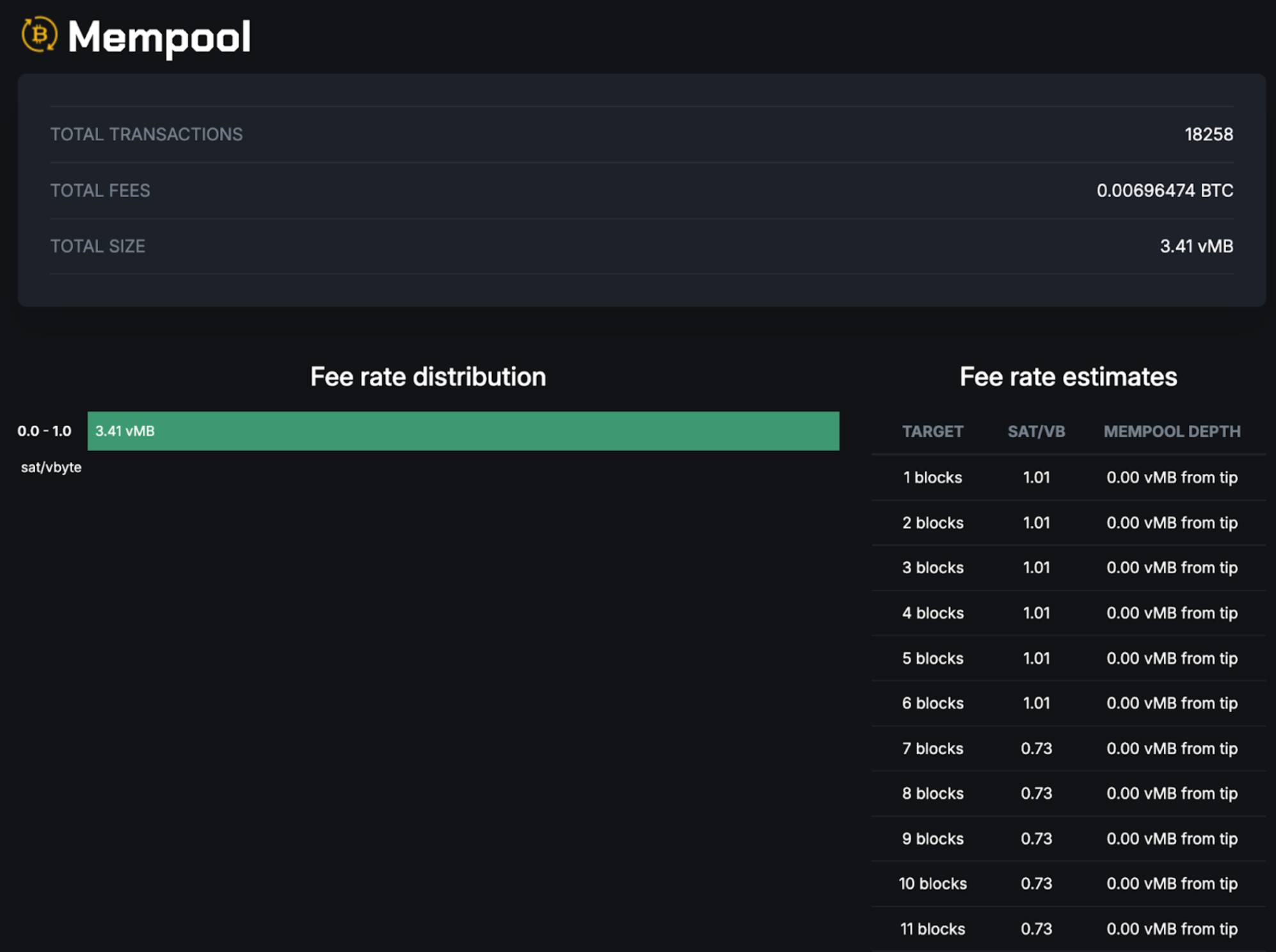
Before looking at node-level behavior, it is important to understand how transactions compete for inclusion in a block. Network conditions are not static. Fees, transaction queues, and confirmation times change continuously depending on demand.
The example below illustrates how transactions are distributed across fee levels under real network conditions.
Under these conditions, transaction visibility and confirmation timing depend on which node is used for detection.
Different nodes can have different views of the network at the same moment. In production, this leads to familiar patterns:
Transactions can be broadcast but remain invisible on specific nodes.
Nodes may return outdated block data due to synchronization lag.
Underestimated fees can leave transactions stuck in the mempool.
RPC requests may fail under load.
Even confirmed transactions can be affected by chain reorganizations.
Different nodes can return different views of the same transaction [5]. A transaction may already be valid on-chain while remaining undetected by the system [6].
Inconsistent data is normal in blockchain networks. The problem is how the system reacts to it.
Reality Check: Different nodes can report different states of the same transaction at the same moment. A transaction may be visible on one node and missing on another, delaying detection despite being valid.
The Limits of Single-Endpoint Design
Public RPC endpoints are often:
rate-limited
overloaded during peak activity
inconsistent in their data
temporarily unavailable
When execution depends on a single endpoint, any issue at that layer directly affects the entire execution flow.
a delayed response postpones detection.
outdated data leads to incorrect decisions.
a failed request interrupts execution entirely.
Critical Insight: A single RPC endpoint becomes a single point of failure. Any delay or inconsistency directly impacts detection, confirmation tracking, and transaction execution.
What Happens Without a Distributed Node Layer
When execution depends on a limited set of nodes, failures are not always visible.
The system may:
miss incoming transactions
operate on outdated block data
underestimate fees
fail to broadcast transactions
These issues do not always result in immediate failure.
Instead, they create delays, retries, and inconsistent execution – issues that users experience as unreliable service.
For the user, this looks like a stuck transaction or a delayed swap.
What Changes With NOWNodes
To operate reliably under real network conditions, access to blockchain data must be consistent.
This is where infrastructure providers like NOWNodes become critical.
Instead of relying on a single endpoint, ChangeNOW uses NOWNodes to maintain stable and scalable access to blockchain data across multiple networks [2].
This changes how execution is handled.
Instead of relying on a single endpoint, the system can:
query multiple nodes
validate responses across sources
switch endpoints when needed
maintain access during partial outages
Unlike public RPC endpoints, which are often rate-limited or unstable, infrastructure providers like NOWNodes offer more consistent and scalable access to blockchain data [1].
This limits the impact of node-level failures on execution.
Strategic Insight: By integrating NOWNodes, ChangeNOW operates across multiple nodes instead of relying on a single data source. This reduces the risk of delayed detection and incorrect network state during execution.
Detection begins at the mempool level. A transaction can appear on one node while remaining invisible on another due to propagation delays [7]. If detection relies on a single node, execution is delayed even though the transaction is already valid.
Confirmation tracking introduces additional risk. Nodes that are out of sync may report outdated block data, leading to incorrect assumptions about finality.
Execution adds further constraints. On EVM networks, transactions depend on gas estimation and nonce handling. Underestimated gas can leave transactions stuck in the mempool, while incorrect nonce values can cause rejection [6].
In practice, this leads to delays, retries, or failed execution. These issues are part of normal operation under real network conditions.
How NOWNodes Supports Execution
NOWNodes does not execute transactions.
It provides the data layer that execution depends on.
ChangeNOW uses this data to:
detect incoming transactions
track confirmations
estimate fees
broadcast outgoing transactions
If the data layer is inconsistent, execution breaks in subtle ways. Transactions are delayed, misread, or retried. When the data layer is stable, execution becomes predictable.
Handling Inconsistency
The difference between fragile and reliable systems is how they handle inconsistent data.
ChangeNOW uses a distributed approach to node access:
data is requested from multiple endpoints
responses are compared
inconsistencies are detected
alternative sources are used when needed
If one node is delayed or out of sync, another can provide a more accurate view.
Interaction with nodes is handled through JSON-RPC interfaces, which define how data is queried and transactions are broadcast [4].
Consistent access to these interfaces across networks is what enables stable execution.
This approach shifts the system from a single-source model to a validation model, where data is not assumed to be correct but verified across sources.
Different approaches to node access lead to different execution outcomes. This becomes especially visible under load.
The difference becomes clear when comparing approaches.
Architecture Model
Data Consistency
Behavior Under Load
User Outcome
Single RPC Endpoint
Depends on one source
Sensitive to delays and failures
Slower detection, possible missed transactions
Multiple Nodes (no validation)
Partial consistency
Conflicting data possible
Inconsistent execution
Distributed Node Access with Validation
Cross-checked data
More stable under load
Faster detection, more predictable execution
The difference is not in how transactions are created. It is in how reliably the system interprets network state before acting.
What Happens Under Network Congestion
Infrastructure differences become visible during network congestion.
When activity increases:
fees change rapidly
mempools grow
confirmation times become unpredictable
Under these conditions, timing becomes critical. Even slightly outdated data can lead to incorrect decisions about fees, confirmation status, or execution readiness.
Transactions with insufficient fees may remain unconfirmed for extended periods [6]. At the same time, node responses become slower and less consistent. Systems relying on a single data source begin to degrade in subtle but critical ways.
By using scalable node infrastructure through NOWNodes, ChangeNOW maintains access to blockchain data even during peak activity.
This allows execution decisions to be based on current network conditions rather than outdated data.
Why Non-Custodial Changes the Model
In custodial systems, execution can be abstracted. Internal balances allow platforms to proceed even when on-chain data is delayed or temporarily inconsistent.
ChangeNOW does not have that layer.
Execution is directly tied to blockchain state. Each step must be validated against real network data before proceeding.
This changes the risk model:
if detection is delayed, execution does not start
if confirmation data is incorrect, execution becomes unsafe
if broadcasting fails, the transaction must be retried on-chain
There is no internal buffer that can compensate for incorrect or missing data. Errors cannot be masked or resolved off-chain.
As a result, infrastructure accuracy becomes a requirement rather than an optimization. The system must operate on reliable data at every stage of execution.
Why This Partnership Matters
The integration between ChangeNOW and NOWNodes changes how execution is handled at the infrastructure level.
ChangeNOW focuses on transaction execution – detecting deposits, validating confirmations, and broadcasting swaps. NOWNodes provides stable, scalable access to blockchain data across multiple networks.
ChangeNOW does not rely on a single node or public endpoint. Data is checked across multiple sources before execution.
This lowers the risk of delayed detection, inconsistent network views, and execution failures.
Fewer transactions are missed, delayed, or processed using outdated data.
This separation of responsibilities improves reliability at the layer where most failures originate – access to blockchain state.
What This Means for Users
Users do not interact with nodes directly.
They experience the result:
deposits are detected without delay
confirmations are tracked correctly
swaps complete without unexpected retries
When the infrastructure layer is stable, execution feels seamless. When it is not, every delay becomes visible.
Conclusion
Blockchain data is not consistent.
Different nodes can return different data, sometimes at the same moment.
Relying on one source of truth breaks in these conditions. Systems that work with multiple data sources handle this more reliably and keep operating even when the data doesn’t fully match.
By combining execution logic with distributed node access, ChangeNOW shifts from a dependency model to a validation model. This is what keeps execution stable under real network conditions.