Tokenized finance promises to unite traditional assets with the speed and security of blockchain. Lumia is building infrastructure that makes real-world asset (RWA) tokenization safe, scalable, and fully compliant from day one.
In our conversation with the Lumia team, we explored how their innovative, institution-ready approach is making tokenization truly practical for institutions.
Key Takeaways
Lumia is built around the full lifecycle of an asset. Issuance, compliance, settlement, and post-issuance activity are treated as one continuous process rather than separate steps stitched together later.
Regulatory and privacy requirements are not added on top of the system. They are part of how the platform operates from the start, which makes the setup workable for institutional standards without extra layers of control.
The platform is designed to be adopted without friction. Tools, SDKs, and integrations are structured so institutions can work with tokenized assets using familiar operational logic instead of learning an entirely new model.
The infrastructure is already being used in practice. Real estate structures, metals exposure, energy-linked assets, and short-term credit provide concrete examples of how the system performs outside of pilot environments.
Lumia is being developed with long-term use in mind. Standardized rwaTokens, expanding interoperability, and a growing application layer are intended to support scale without forcing institutions to rebuild their workflows over time.
Lumia: Making Real-World Asset Tokenization Practical
While many platforms talk about tokenization, Lumia delivers – building infrastructure that makes real-world assets work on-chain from day one.
The team is focused on removing operational complexity that has traditionally slowed adoption. Lumia provides a smooth, fully integrated asset lifecycle that institutions can trust.
Lumia Hub simplifies onboarding for issuers and investors, standardizing processes and minimizing errors, so participants can focus on growth rather than paperwork.
The full-stack solution enables near-instant settlement while maintaining full compliance and privacy. With Lumia Stream, liquidity is unified and rules are automatically enforced, making tokenization suitable for institutional use.
Institutions can quickly launch structured fundraising events through Lumia Hub, with protections for both issuers and investors. Developers and institutional teams can effortlessly integrate Lumia’s modules via SDKs.
Early implementations in real estate, metals, energy, and short-term credit are already showing demonstrable benefits by making operations easier, making things more visible, and minimizing the risk of execution.
Lumia controls real-world assets on-chain from start to finish, bringing together onboarding, settlement, and liquidity in one flow. The team says that real scale and operational dependability only happen when each step is intimately linked and made for institutional usage.
Core Pillars
Lumia manages the complete asset lifecycle on-chain:
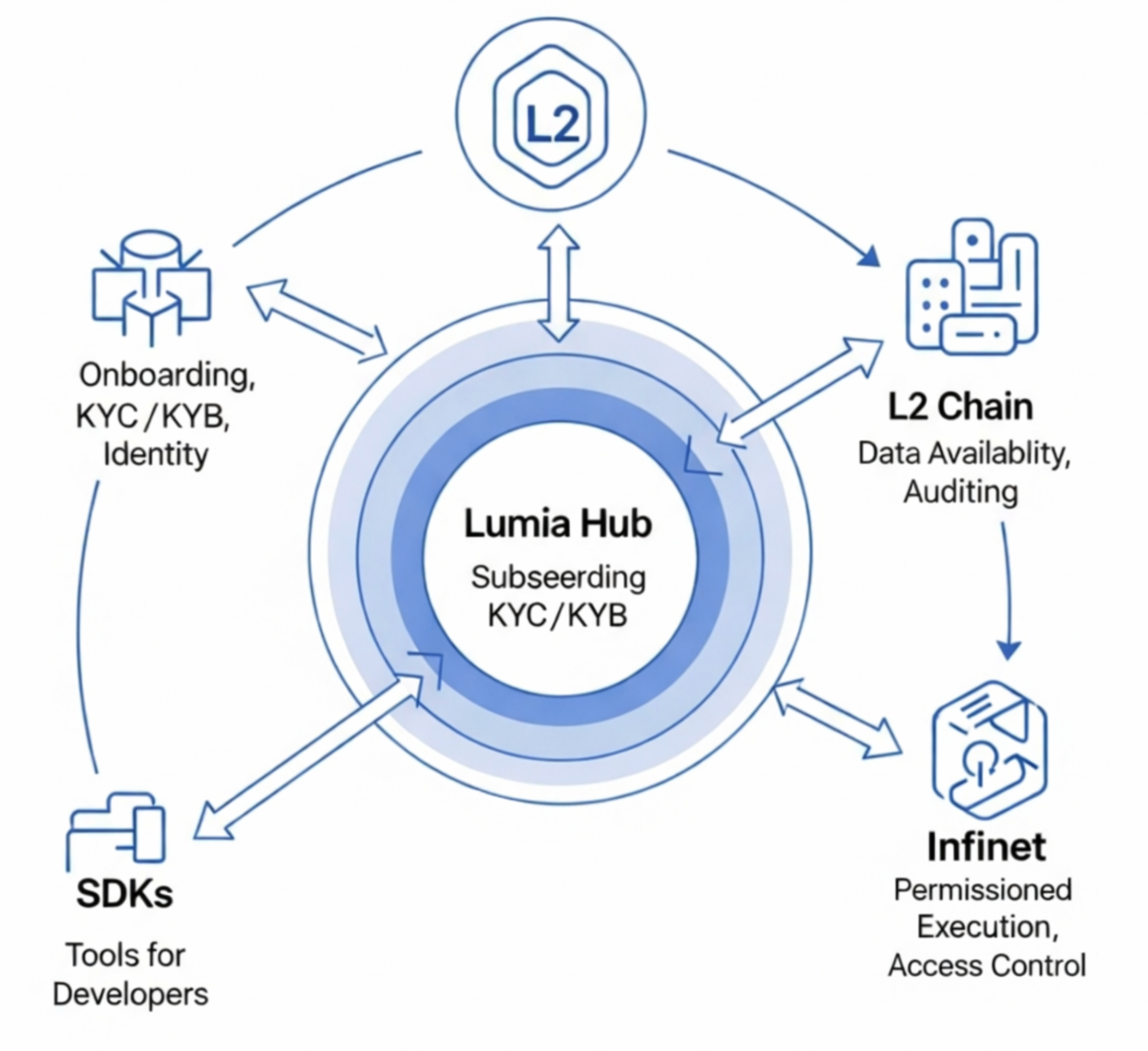
Lumia Hub standardizes issuer and investor onboarding, reducing errors and accelerating approvals.
Lumia chain delivers near-instant settlement with compliance and privacy built in.
Lumia Stream connects liquidity venues, allowing assets to move freely while enforcing rules automatically.
Together, these pillars form a practical, scalable, institution-ready model for real-world asset tokenization.
The team explains:
Lumia is designed for the full lifecycle of an asset, from compliant issuance to trading and settlement. We focus on three things institutions actually need: standardized onboarding and disclosures through Lumia Hub, low-fee high-throughput settlement on Lumia Chain with privacy controls, and liquidity pathways via Lumia Stream that connect to both on-chain and off-chain venues so assets don’t stall after launch.
Tackling the Hardest Part: Regulation
Regulation is often the toughest barrier to bringing RWAs on-chain, but Lumia integrates compliance into its system architecture. Lumia guarantees that every transaction adheres to institutional standards while being efficient, smooth, and trustworthy.
Compliance Features
AML/CFT Integration
TradFi rules are directly embedded in code, enabling AML/CFT screening at the sequencer level so every transaction, issuer action, and investor interaction meets rigorous institutional standards.
Audit Trails
Transactions are fully traceable and verifiable. Audit trails provide regulators and institutional partners with clear, verifiable logs, while zero-knowledge proofs confirm identity without exposing personal data.
Verified Identity
Zero-knowledge proofs ensure privacy while strengthening trust and compliance throughout the asset lifecycle.
The team notes:
The hardest part has been regulation. Bringing TradFi on-chain requires mapping AML/CFT rules, securities and commodities frameworks, transfer restrictions, and reporting obligations into code and workflows. We’ve built issuer flows that capture the necessary representations and disclosures, integrated verified identity providers with zero-knowledge attestations, and added audit-ready event trails supported by indexers and oracle feeds so records hold up under scrutiny.
Solving Identity and Operational Hurdles
Lumia turns identity from a roadblock into a reusable credential. After an entity completes KYC/KYB, its status may be checked several times using zero-knowledge proofs. This lets institutions establish authenticity without having to store sensitive information again and over again. This lowers risk, speeds up the onboarding process, and makes sure that compliance is always the same throughout the life of the asset. Here’s what’s on offer:
Operational Tools: Fast, structured data retrieval for institutional workflows. Lumia’s indexing layer provides the speed and reliability expected from market-grade infrastructure, indexing transactions, disclosures, and state changes for real-time analytics, reporting, and monitoring.
Oracle integrations: Real-time connection to off-chain data. Real-time connection to off-chain data. Market, legal, and compliance data are built right into the platform's logic. This makes sure that assets stay in sync with outside needs, from price feeds to regulatory criteria.
Infinet: It allows institutions create permissioned or hybrid chains with customizable compliance standards, access controls, and governance settings. This flexibility makes sure that on-chain execution is in line with off-chain legal and operational needs. This lowers operational risk and makes sure that behavior is the same across issuance, settlement, and secondary market activities.
Together, these components create an operational environment where institutions may take part without any problems or hidden dangers. This gets rid of the technological problems that have previously slowed down RWA tokenization.
Building User Confidence in On-Chain Assets
For valuable real-world assets to move on-chain, both retail and institutional users need absolute trust in the supporting environment. Lumia establishes this trust through predictable workflows, verifiable proofs, and seamless integrations that align with established financial controls.
Trust Mechanisms
Predictable Workflows: Standardized disclosures and privacy-preserving execution. Lumia Hub enforces structured disclosures and full lifecycle documentation. Combined with its zkEVM-based L2 privacy layer, users interact with assets through a consistent, secure process that mirrors mature financial infrastructures.
Lumia Hub enforces structured disclosures and lifecycle documentation. Combined with its zkEVM-based L2 privacy layer, users interact with assets through a consistent, protected process that mirrors mature financial infrastructures.
Custody Integration:
Compatibility with institutional controls: Lumia works with custody partners and transfer-agent tools, ensuring assets can be handled, transferred, and verified in line with institutional standards. This alignment with familiar TradFi practices is critical for building user confidence.
The team explains:
Confidence comes from predictability and proof. Issuers onboard through Hub with standardized disclosures, role-based controls, and clear corporate actions so the lifecycle is auditable from day one. Trading and settlement run on a zkEVM-based L2 with a privacy layer and Hypernodes that verify data availability. We integrate custody partners, transfer-agent tooling, and reporting hooks so back-office and compliance teams can reconcile positions without changing their existing workflows.
Regulatory readiness alone isn’t enough to drive adoption – accessibility and liquidity are the real enablers. Lumia reduces friction across issuance, access, and trading, making real-world assets as intuitive as the modern fintech experience.
Getting institutions on board, Lumia focuses on removing operational friction and creating a natural, streamlined process. With Lumia Hub, issuing tokenized assets becomes a smooth, structured experience where both issuers and investors know exactly what to expect.
Meanwhile, Lumia’s SDKs and plug-and-play integration kits allow developers and institutions to connect directly to identity, settlement, and liquidity modules effortlessly.
These technologies make tokenized assets useful, efficient, and ready for institutional workflows by getting rid of technical problems and speeding up the issuing process. The effects are already seen in real estate, metals, energy exposure, and short-term lending, which shows that Lumia may provide genuine operational advantages.
The team notes:
Adoption takes off when issuing is quick, access is painless, and secondary trading actually works. Hub shortens time-to-market, and stream distribute assets in DeFi. Under the hood, Lumia Chain provides low fees, sub-second blocks, and privacy controls, while our SDKs, indexers, and reporting endpoints let teams integrate directly with existing systems.
What’s Next for Lumia?
Looking forward, Lumia is moving beyond incremental features toward full platform maturation. The team is putting together a whole ecosystem where tokenized assets may work smoothly in all markets, platforms, and regulatory settings. This is exactly what institutions need. The main goals are to make infrastructure function together, make it easier for different systems to operate together, and provide predictable, end-to-end processes.
Roadmap Highlights
Standardized rwaTokens
Rules and rights follow the asset wherever it goes. Lumia’s standardized rwaToken format embeds restrictions and investor rights directly into the token, allowing automatic transfers, ownership updates, and compliance checks, even across different platforms or liquidity venues.
Interoperability
Bridging more chains, tools, and liquidity. Expanded network connections enable rwaTokens to circulate across blockchains and DeFi environments, making them easier to trade and integrate. For institutions, this reduces fragmentation, a major obstacle for RWA scaling.
New dApps
Practical tools for issuing, trading, earning, and reporting. Lumia is developing applications that cover the everyday operational needs of issuers and investors, including issuance tools, trading modules, yield products for tokenized assets, and reporting dashboards for regulatory and operational teams. Instead of leaving institutions to stitch solutions together, Lumia provides core workflows out of the box.
The team puts it:
We’re preparing to launch several dApps that will complete the ecosystem and allow RWAs to move through the full Web3 and DeFi lifecycle – from issuance and fundraising to trading, leverage, and yield. The aim is to make Lumia the connective layer that supports these markets at scale.
Conclusion: The Operational Layer for Tokenized Finance
Lumia is building institutional-grade infrastructure that allows organizations to operate confidently and efficiently in the tokenized finance landscape. By combining end-to-end onboarding, near-instant settlement, and deep liquidity with built-in compliance and privacy, the platform eliminates the friction that has historically slowed real-world asset tokenization.
Lumia serves as the operational backbone for a new era of finance. Its full-lifecycle approach ensures every step, from issuance to trading is auditable, secure, and scalable.
With standardized rwaTokens, expanded interoperability, and practical dApps on the horizon, Lumia is bridging the gap between traditional markets and blockchain efficiency, making institutional adoption practical and trustworthy.


 Compatibility with institutional controls: Lumia works with custody partners and transfer-agent tools, ensuring assets can be handled, transferred, and verified in line with institutional standards. This alignment with familiar TradFi practices is critical for building user confidence.

