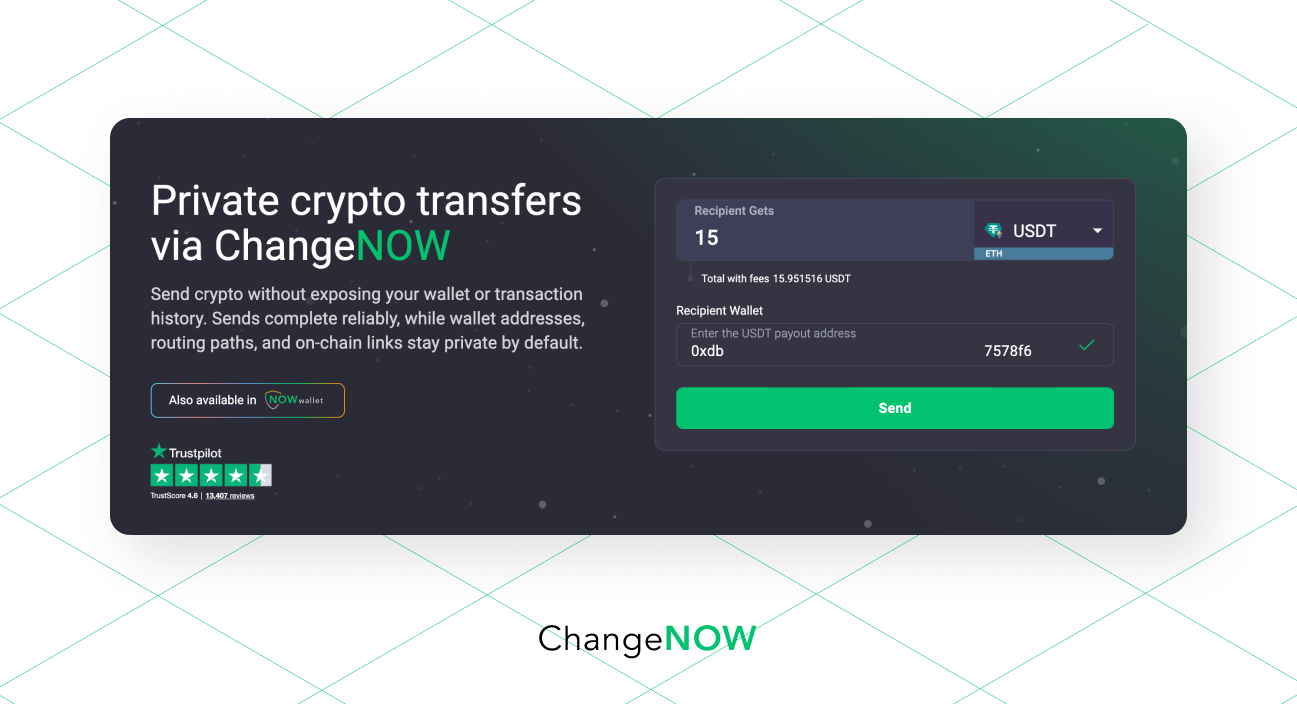
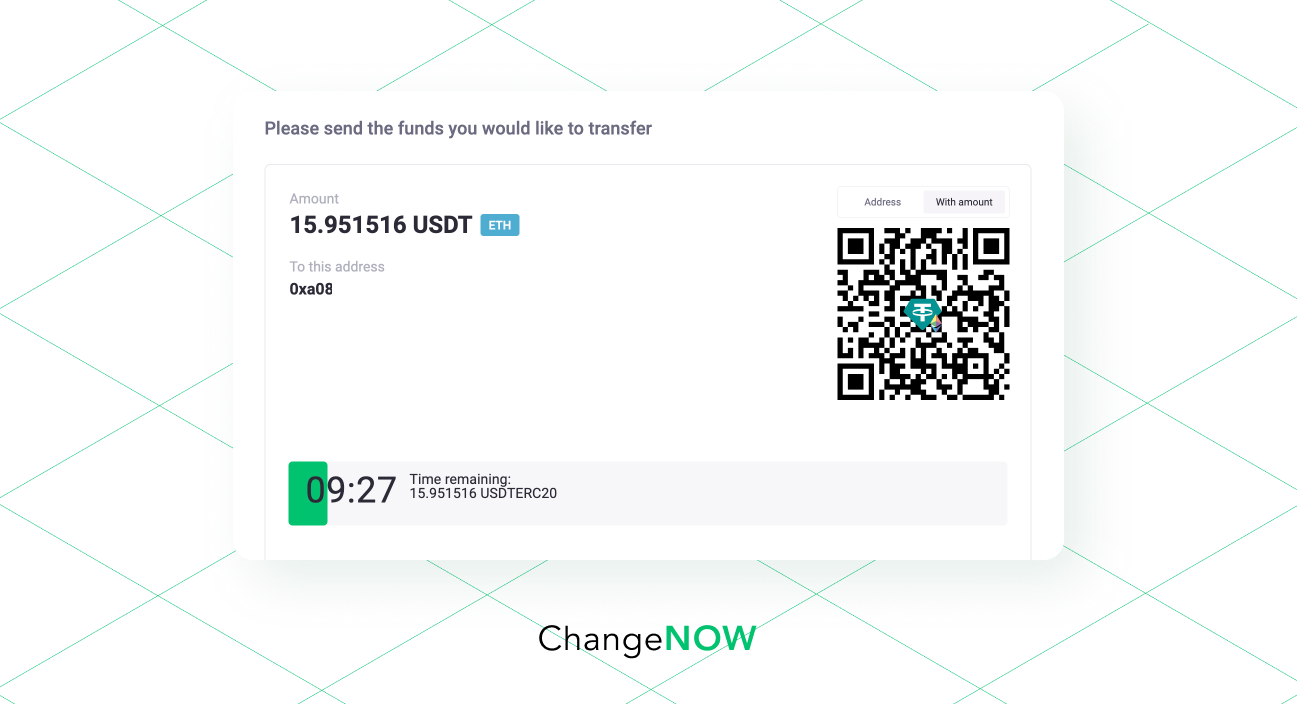
How to Send Crypto Privately in 2026

Most crypto losses start with small process shortcuts. Explore how wallet reuse, rushed approvals, and weak controls undermine privacy in practice

How to Send Crypto Privately in 2026.

Privacy has become one of the most fragile resources in modern finance.

Every time you send money through a bank transfer, use a card, or make an online purchase, you create data that may be saved, analyzed, and connected over time. What started off as openness has slowly morphed into a place where people's financial conduct is always being watched and recorded.

A crypto transaction can be valid, confirmed, and successfully delivered – while still revealing operational structure, counterparties, and behavioral patterns. In 2026, private crypto transfers are no longer about hiding activity. They are about controlling how easily that activity can be linked over time.

For a detailed explanation, please take a look at the article ChangeNOW Launches Private Crypto Transfers. Break On-Chain Address Connections.

TL;DR

You can’t hide a transaction on a public blockchain. You can only reduce how clearly your wallets connect over time.

Most privacy failures come from routine habits – wallet reuse, predictable payments, rushed approvals – not from technical flaws.

How To Send And Receive Crypto Privately

A private crypto transfer starts with structure, not tools.

First, decide whether the payment is one-time or recurring. Mixing personal and operational wallets quietly builds long-term traceability. Separation reduces future correlation.

Second, avoid direct wallet-to-wallet repetition. When the same sender and recipient interact repeatedly, visible relational maps form over time. Routing or internal balance management reduces obvious wallet linkage in recurring flows.

Third, confirm details outside the primary communication channel. Address substitution rarely looks suspicious in the moment. A quick secondary verification prevents most avoidable losses.

Receiving follows the same logic. Reusing one public address indefinitely creates a behavioral pattern. Periodic address rotation and internal reconciliation reduce long-term exposure.

Private transfers do not make transactions invisible. They reduce how easily behavior becomes structured over time.

How Privacy Breaks Down on Public Blockchains

On public blockchains, transactions stay visible, and privacy weakens as repeated actions begin to reveal patterns that connect wallets and behavior over time.

To understand the risks, we need to look at how private transfers actually work.

Private Crypto Transfers in Practice

Public blockchains are transparent by design. Transaction amounts, timestamps, and asset movements remain observable on-chain. This structural transparency defines the limits of blockchain transaction privacy in real-world operations. Privacy does not remove this data. It changes how easily separate transactions can be correlated into a coherent picture [1].

Operationally, privacy focuses on reducing linkability. A privacy-aware transfer makes it harder to determine:

  • which wallet is operational,
  • who receives funds regularly,
  • when assets typically move,
  • how different transactions relate to each other over time.

This is not secrecy. It is friction against correlation. In real workflows, that friction shows up first in repeated payouts and shared treasury wallets.

Blockchain transaction privacy is about lowering linkability pressure while maintaining operational integrity.

Privacy and Anonymity in Crypto Workflows

The terms privacy and anonymity are often used interchangeably, but they describe different goals.
Blockchain Privacy Definition.

Privacy makes correlation harder.
In crypto discussions, anonymity is often misunderstood – it aims to prevent reliable identification altogether.
What is anonymous?

That definition sets a very high bar.

On public blockchains, full anonymity through standard transfer workflows is rare. What is realistic is meaningful privacy improvement when transfers are executed with discipline and structure [2].

When people ask for “anonymous transfers,” they are usually reacting to practical issues:

  • repeated wallet reuse,
  • predictable payout schedules,
  • personal and operational funds mixing,
  • weak internal records.

Treating privacy workflows as anonymous systems creates false confidence and encourages shortcuts exactly where caution is needed.

Critical warning: Treating privacy workflows as anonymous systems increases operational risk rather than reducing it.

Why Successful Delivery Does Not Reduce Risk

Most private crypto transfer failures do not happen because blockchains malfunction. They happen because people relax too early.

The transaction settles. The funds arrive. The process feels complete. That is usually the point where intuition stops being reliable.

Wallets are reused because it is convenient. Transfers cluster around fixed dates. Approvals get rushed when urgency comes from senior stakeholders. None of these choices look dangerous in isolation. Over time, they quietly compound. In post-incident reviews, this assumption appears far more often than any protocol failure or network issue.

If you send crypto occasionally, this may not matter. If you run recurring payouts, treasury settlements, or partner transfers, privacy becomes operational hygiene rather than a feature.

How Wallet Linkability Forms Through Repetition

Wallet linkability almost never comes from a single transaction. Over time, wallet linkability forms through repetition, not exposure.

It forms when small conveniences stack up:

  • the same payout wallet reused repeatedly,
  • transfers happening on predictable dates,
  • amounts falling into familiar ranges,
  • direct wallet-to-wallet paths repeated over months.

Blockchain Transaction Linkability Over Time.

Individually, these patterns appear harmless. Together, they describe an organization’s financial behavior with surprising clarity [3].

Routing can blur parts of the picture. Behavior still draws the outline.

What Private Routing Actually Does

Private routing can reduce obvious, repetitive sender-to-recipient paths. This is valuable in recurring operational flows.

However, routing is often misunderstood as a safety net. It does not protect against:

  • copying the wrong address under pressure,
  • approving exceptions without context,
  • social engineering attacks,
  • compliance or reporting obligations.

Routing changes how activity looks externally. It does not compensate for weak internal discipline.

Verdict: Routing lowers exposure. Process determines whether that reduction matters.

When Private Routing Adds Real Value

Private routing adds value when:

  • the same counterparties are paid repeatedly,
  • payout timing follows a recognizable pattern,
  • operational wallets are reused,
  • transfers are visible to external partners.

It adds little value when:

  • transfers are rare and ad-hoc,
  • timing and amounts are unpredictable,
  • there is no repeated wallet interaction.

Why Private Crypto Transfers Fail Despite Tooling

A Common Operational Failure Pattern

This scenario is unremarkable – and that is precisely why it repeats.

A small team runs monthly contractor payouts. One wallet is used because it is simple. Everything works for months. Patterns form. Urgency increases. One month, an updated address arrives via chat and there is pressure to move quickly.
Example of Address Poisoning in Recurring Crypto Payments. Example of Address Poisoning in Recurring Crypto Payments

The transaction settles instantly.
To the wrong address.

No exploit. No protocol failure. No recovery.

Large-scale incident reports consistently show that human error and process breakdowns dominate losses, rather than blockchain bugs [7].

Designing Crypto Transfer Workflows for Real-World Pressure

Resilient workflows assume people will be distracted, tired, or rushed.

Effective crypto operational security is designed around that assumption.

Crypto operational security is rarely about complex tools. It is about repeatable execution under stress.

A practical structure includes:

  • classifying transfers before execution,
  • verifying destinations outside the main communication channel,
  • avoiding improvisation during exceptions,
  • logging transactions immediately,
  • reviewing patterns, not just incidents.

Near-misses often reveal more than quiet months.

Sequential Failure Patterns in Real Teams

Privacy setups rarely fail all at once. They tend to fail in sequence:

  • Verification steps get skipped,
  • Exceptions become routine,
  • Logs lag behind execution,
  • Ownership becomes unclear.

The 10-Minute Pre-Send Verification Checklist

  • Confirm recipient identity in a trusted channel
  • Validate network compatibility
  • Verify first and last 6 address characters
  • Execute test transfer for new counterparties
  • Require dual approval above thresholds
  • Record transaction hash and purpose

Most teams that lose funds did not skip these steps out of ignorance. They skipped them because everything felt routine.

Verdict: Consistency outperforms sophistication when money is moving.

Why Custody Becomes Critical As Operations Scale

Routing affects external visibility. Custody governs internal behavior.

Once more than one person can touch funds, ambiguity becomes risk. Most custody problems do not start with theft – they start with unclear ownership during perfectly ordinary weeks, from SEC Investor Bulletin – Crypto Asset Custody.

Clear ownership and role separation reduce silent failure.

Self-custody vs. Custodial Setups Without Ideology

Operational Trade-Offs Between Custody Models

Self-custody keeps key control inside the team. It works when roles are clear, approvals are documented, and recovery procedures are tested in advance.

Criterion Self-custody Custodial setup
Key control Team-held keys Provider-managed infrastructure
Recovery Fully internal Structured recovery mechanisms
Workflow enforcement Manual Policy-driven
Operational load Higher Lower
Best fit Security-mature teams Teams prioritizing consistency

As transaction volume grows, coordination risk often overtakes technical risk. The practical question is not which model sounds better. It is which one reduces ambiguity in your specific operating environment.

The better choice is not philosophical. It is the model your team can execute reliably under stress [4].

Where ChangeNOW Pro Custody Actually Helps

Structured custody reduces internal execution risk. But operational efficiency matters as well.

When teams handle recurring transfers, settlements, or treasury movements, cost structure and execution speed become part of the privacy equation. Delays, fragmented interfaces, and manual reconciliation increase pressure — and pressure increases mistakes.

Inside the ChangeNOW Pro environment, teams can:

– execute off-chain swaps to reduce unnecessary on-chain exposure
– manage balances before withdrawal instead of routing every action directly on-chain
– convert assets internally without generating repeated wallet-to-wallet trails
– operate within a single dashboard instead of switching between tools

Off-chain conversions allow teams to manage balances internally before final settlement, reducing repetitive on-chain traces in high-frequency workflows.
ChangeNOW Pro Dashboard with Internal Balance Management ChangeNOW Pro dashboard with off-chain swap functionality.

Off-chain conversions do not hide activity from compliance or reporting. They reduce redundant on-chain traces that form through repetitive operational flows.

Pro plans also introduce structured features such as cashback limits, staking access, and private payment pages – but for teams managing transfers, the key value is consolidated control [6].

When custody, routing, and execution live in one account environment, coordination friction drops. And when coordination friction drops, privacy discipline becomes easier to maintain.

Verdict: Routing reduces visible wallet linkage. Custody reduces approval chaos. Pro infrastructure reduces operational friction that leads to mistakes.

Where Seams Still Lose Money

Most incidents follow familiar patterns. These losses rarely come from sophisticated exploits. They follow predictable operational shortcuts:

  • address substitution via social engineering,
  • wrong network selection under time pressure,
  • operational wallets reused indiscriminately,
  • exception approvals treated casually,
  • devices trusted longer than they should be,
  • reconciliation postponed and forgotten.

Recovery is rare once funds leave the chain to an unintended destination.

Frequently Asked Questions

Are private crypto transfers anonymous?

No. They reduce linkability but do not provide anonymity on public blockchains. Transaction histories remain observable, and behavioral patterns can still form over time.

How do I transfer coins to another person?

To transfer crypto, send funds from your wallet to the recipient’s address on the correct blockchain network. Once confirmed, the transaction is irreversible. You can verify the transfer using a TXID on a blockchain explorer.

Does private routing remove compliance obligations?

No. Reporting, tax, and legal responsibilities still apply.

Is self-custody always better for privacy?

Not necessarily. Control increases, but so does operational risk if discipline is weak.

What breaks privacy outcomes most often?

Behavioral patterns such as address reuse, predictable schedules, and rushed approvals.

What should small teams implement first?

Role permissions, approval thresholds, a pre-send checklist, and transaction logging.

Teams that manage recurring transfers or treasury flows often outgrow informal wallet setups. A structured Pro environment becomes relevant once approval control, routing, and internal balance management need to operate together.

Choose your plan.

Final Thoughts

Private crypto transfers reduce exposure, but they do not remove visibility. On a public ledger, repetition leaves structure. The same wallets, the same cadence, the same approval habits eventually map how a team works.

Routing helps externally. Internally, the same approval habits still decide outcomes. When exceptions are handled informally, when approvals move to chat, when logs are delayed, privacy erodes long before anyone notices.

Most losses do not begin at the moment of transfer. They begin in the days and weeks before it – in small shortcuts that become routine.

The practical question is simple: can the team execute its process the same way under pressure as it does on a quiet day?

Privacy is the result of that consistency. Without it, no tool holds.

This approach is also available in NOW Wallet, where funds and balances can be managed within a single environment, reducing repeated on-chain patterns in everyday use.

Resources

The analysis in this article draws on official documentation, institutional research, and established educational materials related to blockchain transparency, privacy mechanics, transaction tracing, and crypto asset custody.

  1. Investopedia — Blockchain Definition
  2. Chainlink — Blockchain Privacy vs. Anonymity
  3. Bitcoin Wiki — Address Reuse
  4. Chainalysis — Blockchain Tracing Basics
  5. Bank for International Settlements — Crypto Asset Custody and Risk
  6. ChangeNOW Pro
  7. Chainalysis Crypto Crime Report