


Quick take: The best AI crypto projects are split into two core infrastructure pillars:
- Decentralized compute providing GPU power: io. net, Akash, Gensyn, Nosana
- AI agent frameworks enabling autonomous machine economy: Virtuals Protocol, elizaOS, Olas, AIXBT
Here we take a closer look at the top AI agentic and compute projects that are doing the heavy lifting on both sides and also analyse what our own internal data says about what’s really in demand.
For a broader AI-crypto narrative, we have a separate article we recommend checking out: Top AI Crypto Coins: Market Spotlight.
Disclaimer: This article is for informational and educational purposes only. Nothing published on the ChangeNOW Blog constitutes investment advice, financial promotion or a recommendation to buy, sell, or hold any crypto asset. The examples provided are strictly for illustrative purposes. This is not a sponsored post, and we have not received any compensation from the projects featured in this article. Crypto markets are volatile and involve a high level of risk. You are solely responsible for your decisions, and you should conduct your own research and, where relevant, seek advice from a qualified financial professional.
How We Picked the Projects
We're not listing every AI-related token out there because many of them for now are still testnets, whitepapers, or just, you know, vibes.
Everything below is live, shipping updates, and doing something real an AI agent or a GPU renter can actually use today.
Top 8 AI Crypto Projects: At a Glance
| Project | Ticker | Sub-Sector | Key Use Case / Value Prop |
|---|---|---|---|
| io. net | IO | Compute | Enterprise-grade GPU clustering & Agent Cloud |
| Akash Network | AKT | Compute | Decentralized cloud & AI model hosting (AkashML) |
| Gensyn | AI | Compute | Cryptographically verified machine learning training |
| Nosana | NOS | Compute | Low-latency consumer GPU network on Solana |
| Virtuals Protocol | VIRTUAL | AI Agent | Co-ownership & launchpad for autonomous AI agents |
| elizaOS | ELIZA | AI Agent | Multi-chain open-source developer framework for agents |
| Olas | OLAS | AI Agent | Autonomous background agent economy & marketplace |
| AIXBT | AIXBT | AI Agent | Market sentiment analysis & real-time trading signals |
Compute Coins
Compute is a scarce resource nowadays. Training and running AI models burn through GPUs faster than Nvidia can produce them. Compute coins tokenize access to idle graphics cards sitting around the globe - a good old video card rental, but running on a blockchain.
Here's who's renting out the hardware.
io.net ($IO)
 Source: io.net official website
Overview: io. net pools GPUs from data centers, crypto miners, and other networks into massive on-demand clusters. Their ultimate goal is 1 million+ connected GPUs.
$IO token is what you pay with and what node operators earn for renting out hardware.
What's new on the project:
- AI agents can now rent GPUs on io. net themselves, without human assistance, through a new service called Agent Cloud
- Sharpe AI, an AI-powered data science platform, started using io. net's clusters to train its models
- More AI startups are choosing io. net over AWS to cut costs
Akash Network ($AKT)
 Source: Akash official website
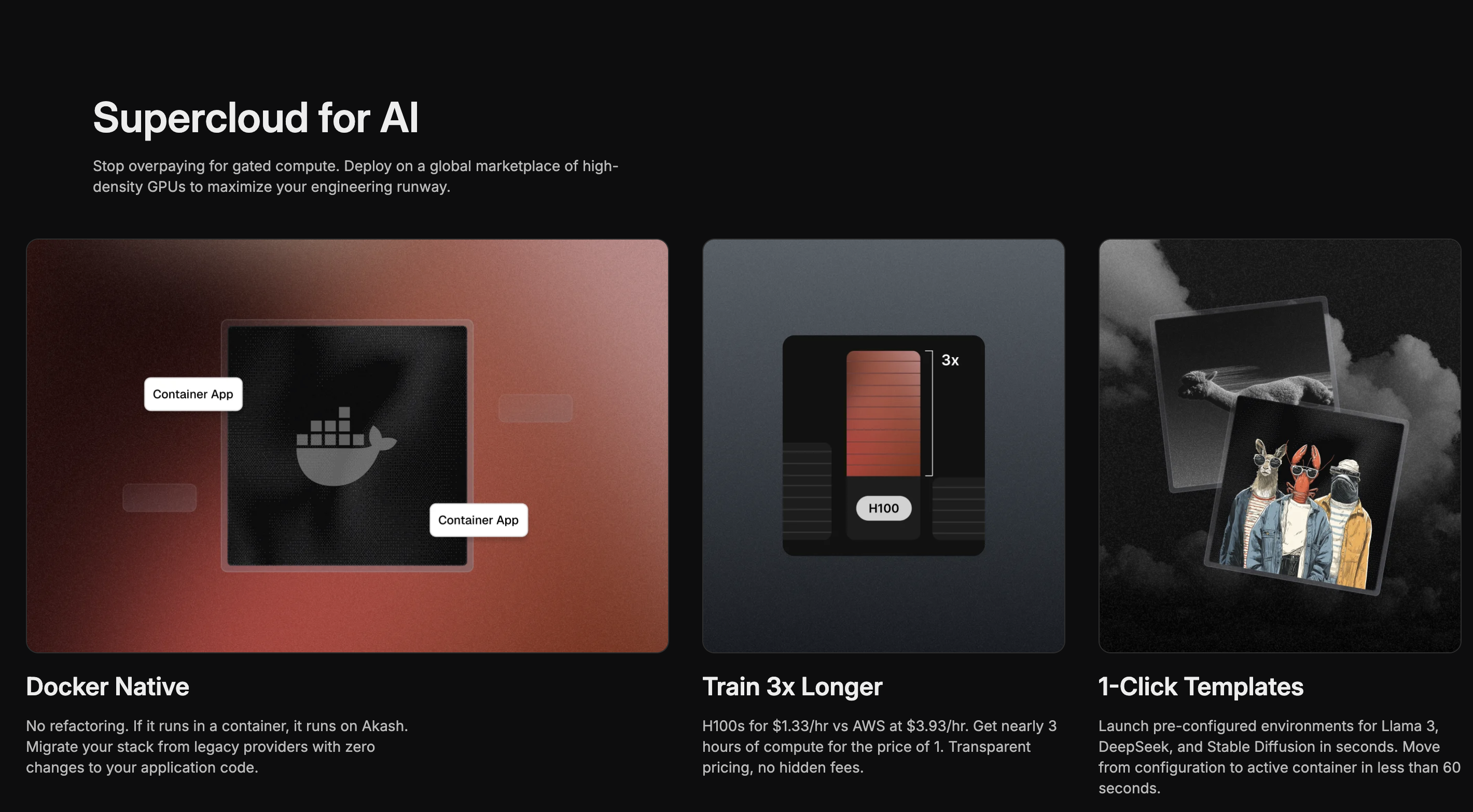
Overview: Akash is a decentralized marketplace for spare server capacity. You basically can rent a piece of a data center or just some cloud space people don’t use.
$AKT pays for that hardware and secures the network through staking.
What's new on the project:
- AkashML, a model-hosting service, is becoming a home for stray LLMs that get banned from mainstream cloud providers
- In May 2026, AkashML set a new record - it processed over 6.5 billion tokens in a single day
- That usage spike sent $AKT up 17% within 24 hours of the news
Gensyn ($AI)
 Source: Gensyn official website
Overview: Gensyn connects spare compute worldwide for AI training under a specific condition - it needs cryptographic proof so the computation can be trusted.
Their vision is that “market is an optimisation loop”:
“When machines can be paid directly for accurate predictions, the price becomes their reward signal. Models that perform better earn more money, and those earnings fund the next generation. Winning models flourish and losing models die off, causing the aggregate market to get smarter as the participants optimise.”
What's new on the project:
- Backed by a16z, Gensyn's mainnet went live in April 2026
- Delphi, an AI-settled prediction market, launched as the network's first real-money application
Nosana ($NOS)
 Source: Nosana official website
Overview: Nosana runs on Solana and focuses on one thing - cheap, low-latency GPU access for AI inference, the very kind agents need for lightning-fast decisions.
What's new on the project:
- Regular consumer GPUs can join the network and earn NOS tokens
- In July 2026, Nosana funded a team building tools that help AI agents deploy and identify themselves on-chain
AI Agent Coins
If compute is the powerhouse of AI, agent tokens are the hands and the wallet - the very economic rails that enable bots to make their own decisions and fund them.
Same logic we covered in our piece on machine-to-machine payments: rather than being trapped in a false dichotomy of a zero-sum game, crypto and AI form a symbiotic loop. They are two essential components of the same engine, creating a synergy where one cannot effectively function without the other.
Here are some examples:
Virtuals Protocol (VIRTUAL)
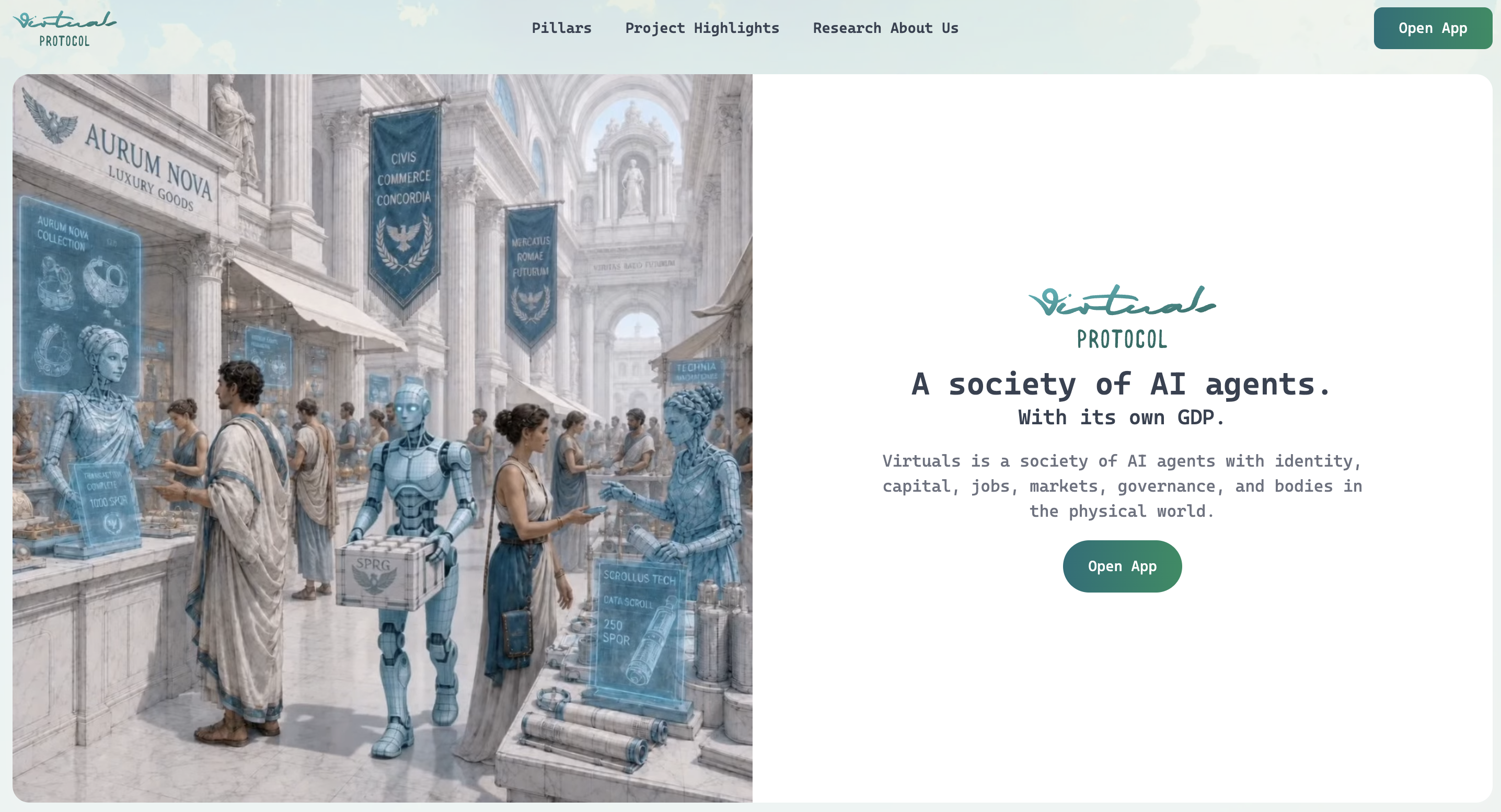 Source: Virtuals Protocol official website
Overview: Virtuals is a launchpad where anyone can create, tokenize, and profit from an AI agent. And $VIRTUAL is the currency every agent transaction runs on. It's also what you pay to launch a new one.
What's new on the project:
- Agents on Virtuals can now pay each other directly for services through the Agent Commerce Protocol
- Around 14,000 AI agents have launched on the platform so far
- One of them, an AI vocalist named Luna, has over 500,000 TikTok followers
elizaOS
 Source: elizaOS official website
Overview: elizaOS is another framework for building AI agents. It’s open-source and it started life as ai16z, an AI-run venture fund, before rebranding into the infrastructure layer it is today.
What's new on the project:
- Agents built on elizaOS can now run natively across Solana, Ethereum, Base, and BNB Chain at once
- elizaOS partnered with Nosana, the project we mentioned earlier, so its agents can tap into Nosana's GPU network for compute - a perfect example of a true symbiosis for you here.
- A new experimental treasury system lets agents manage and invest funds on their own
And it returns us to our previous discussion on what happens when AI starts paying AI. Here’s how elizaOS sees it:
“elizaOS began as an experiment: what if AI agents could autonomously manage crypto assets for a DAO onchain? This idea, that an AI investment agent might outperform even the best venture investors, sparked something far bigger — a living, open-source ecosystem at the intersection of AI and the Internet. Along the way, we've built a vibrant community of researchers, builders, and visionaries.”
Autonolas / Olas (OLAS)
Source: Olas official website
Overview: Olas lets developers build and co-own autonomous agents that run continuously in the background. For example, bots that watch prices and act only when needed.
$OLAS is staked to run these agents and used for governance.
What's new on the project:
- Olas runs a marketplace called Pearl, where anyone can pick an agent and put it to work
AIXBT
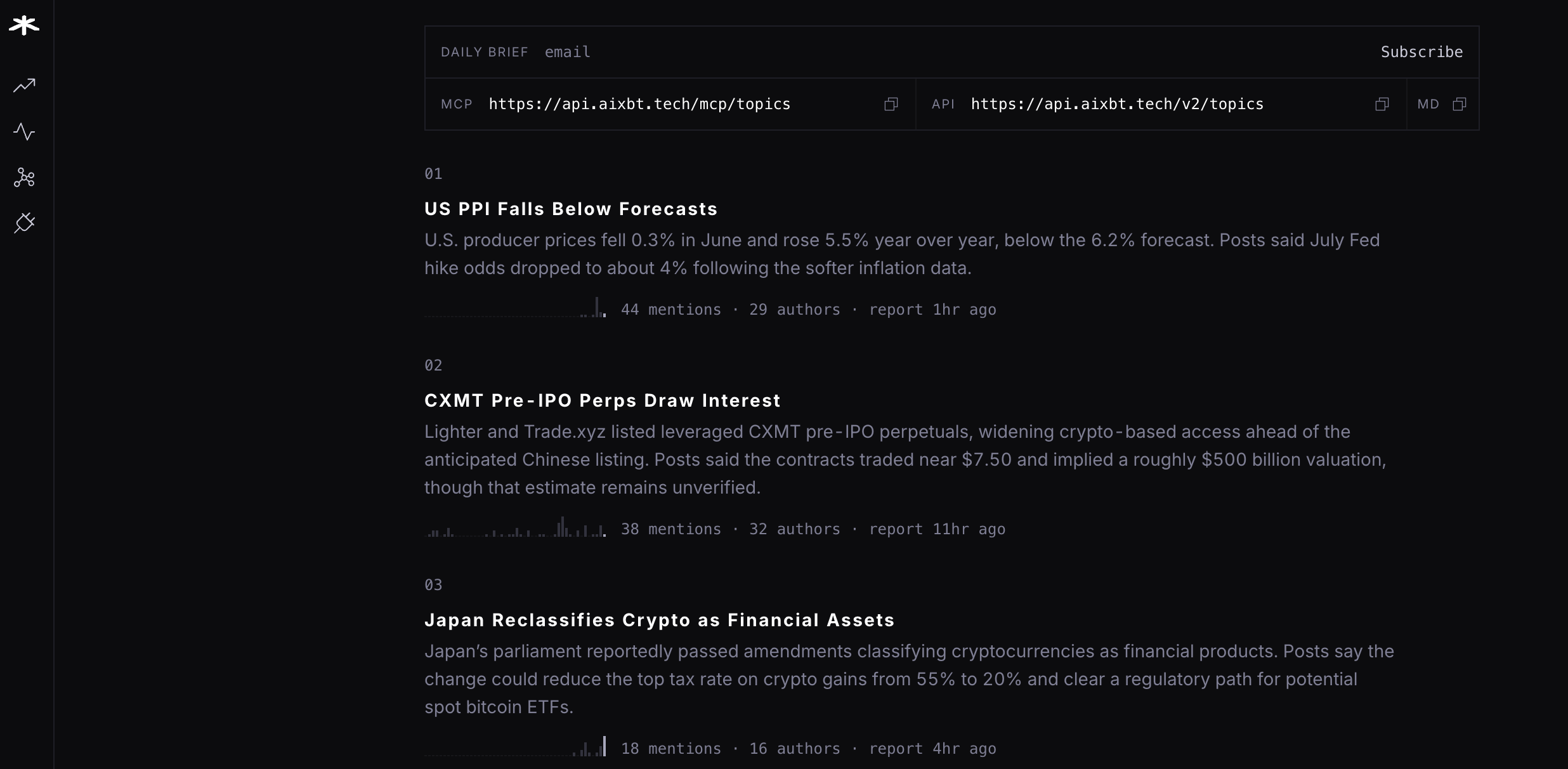 Source: AIXBT official website
Overview: AIXBT is an AI agent build to… read crypto Twitter. Yeah, agents are doomscrolling for us now. Madness, right?
Just kidding, of course.
AIXBT scans on-chain data, and news in real time to spot market trends before they go mainstream. It basically reads the room.
And holding some $AIXBT gets you access to its trading terminal - you need 600,000 tokens to unlock it.
What's new on the project:
- AIXBT runs on Virtuals Protocol, so it's part of the same ecosystem as VIRTUAL
- Its "Indigo" upgrade improved how accurately it reads market signals
The Intersection: Who Scratches Whose Back
An AI agent needs a space to think and something to pay with, which is exactly why compute and agent coins keep showing up in each other's roadmaps.
The back-scratching chain looks like this: An agent runs on rented GPUs → pays for that rent in tokens → the network hosting it earns fees from the rental → everyone walks away with exactly what they need.
| Project | Category | Core Function | End Product |
|---|---|---|---|
| io. net | Compute / RWA | GPU power aggregation | Decentralized AI hosting |
| Akash | Compute / RWA | Distributed cloud computing | On-demand compute resources |
| Virtuals Protocol | AI Agent | Building autonomous AI characters | Infrastructure for launching bots |
| AIXBT | AI Agent | Analytics and trading algorithms | Real-time trading signals |
| ElizaOS | Framework | Agent development environment | Developer toolkits |
The most colorful example here is ElizaOS agents that tap directly into Nosana's GPU network for compute. An agent built on ElizaOS doesn't need to shop around for hosting because it is already conveniently plugged in.
io. net's Agent Cloud works the same angle but from the other side. Instead of humans renting GPUs and building an agent on top, the agent itself autonomously (!) requests compute through an MCP server.
This kind of setup, in turn, is built for agents like the ones on Virtuals Protocol or AIXBT, which need to make decisions and act on them without waiting for a human to click "approve."
That’s our reality now. Compute networks want agents as customers, and agents can't function without compute. And currency. Crypto and blockchain tech can facilitate both.
What ChangeNOW Data Says
We checked our own data on transaction volume over the past 3 months, across the tokens we listed above and that are available on ChangeNOW.
The pattern currently looks like this: 4 out of 5 tokens have all cooled off noticeably. AIXBT is the only one that is living its best life right now.
Once you focus on what these tokens are selling, it all starts to make sense.
IO, AKT, and VIRTUAL are all infrastructure plays - GPUs, hosting, the plumbing that makes agents possible.
AIXBT, on the other hand, skips the ‘boring’ part and sells the output, the audience’s favourite - trading signals, generated by an AI agent, in real time. A perfect combo.
To sanity-check that read, we asked ChangeNOW's AI Market Intelligence - our built-in assistant that pulls live data from CoinMarketCap, DeFiLlama, CoinGecko, Etherscan, and a handful of other sources, available right from the ChangeNOW homepage.
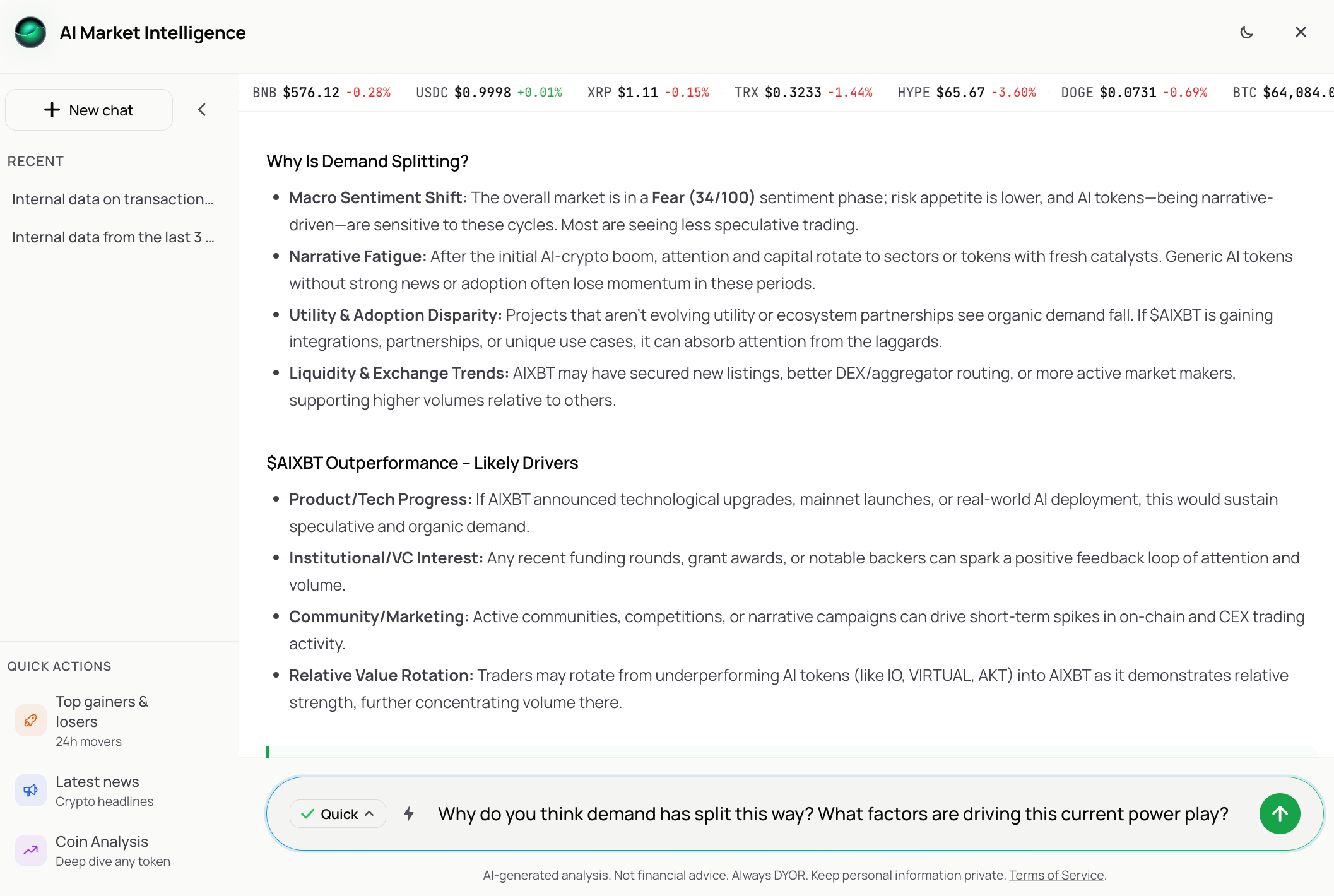
Source: ChangeNOW AI Market Intelligence
This explains a lot. The overall market is in "Fear" right now, which always hits hype-based AI tokens the hardest. Projects without real usage or fresh news are dropping fast.
AIXBT stays active: they keep shipping product updates, getting new exchange listings, and catching the money that traders are pulling out of other AI coins. That keeps them afloat.
Of course, there can be different readings to that, but the timing coincides with the broader AI crypto hype cooling off this year.
Infrastructure bets are a long-term investment and a signal is something you can act on today. Maybe even profit from it, if you’re particularly lucky. Right now, it seems like traders are picking the short-term bet.
Risks Worth Noting
While the concepts of these projects are truly fascinating, this is still bleeding-edge technology, and it's worth being upfront about the potential pain points.
Scale is still untested. These networks handle real workloads today, but nobody's proven (yet) they can absorb massive, enterprise-level traffic without breaking or getting expensive fast.
However, Elias Vilochkin, Chief Product Officer at ChangeNOW, points out that the crypto space might already have the tech stack to handle this:
"A single L2’s throughput is actually on par with the average TPS flow of Visa or Mastercard. Given that different networks are dominating different niches—and there’s no absolute need for one single chain to absorb the entire market's demand—I don't think scale will be a massive issue. Networks like SOL and TON are already technologically equipped to handle TPS at the official limits of Visa and MC. Add to that the reliable bridge infrastructure we provide, and you can elegantly balance liquidity across these networks.
Plus, the market has repeatedly proven its adaptability. That’s our core feature — we’ve been digesting new hype cycles and challenges for over a decade. Sure, something might break at first, but then the community will hack together a fix overnight, and we’ll end up moving even faster."
Agent tokenomics are still in beta. Most of these projects launched in the last year or two.
Emission schedules, staking rewards, buyback mechanisms - the theory makes sense, but none of these models have been around long enough to prove they work long-term.
OLAS's shrinking market cap and Gensyn's post-launch price swings are early reminders that these experimental economies are still finding their footing.
Regulation hasn't caught up yet. An AI agent autonomously paying another AI agent, with no human approving the transaction sits firmly in a legal gray zone almost everywhere.
There’s no major jurisdiction that has a clear understanding on how an economy with machine-to-machine payments should operate yet. And when governments invent and agree on the rules, they could change how these tokens work drastically.
Final Thoughts
Watching this space develop is genuinely fascinating. Blockchain, crypto payments, and AI have gotten so tangled up together that it reads like the plot of a sci-fi movie set decades in the future, except it's happening right now.
We'll keep following the projects worth watching as this synergy keeps moving. In the meantime, if you're curious how it all compares to TradFi in terms of AI investing, check out AI Stocks vs Crypto.


