Crypto marketing now uses “AI trading bot” for almost everything: grid bots, DCA bots, AI dashboards, no-code tools, and agent-style trading interfaces. That label does not say much until you check what the tool actually controls.
A grid bot is not an AI agent. A DCA bot is not reading the market. Most crypto bots still run on rules, settings, exchange APIs, and strategies chosen by the user. They can keep execution steady, reduce hesitation, and stay active when the trader is away from the screen. The risk starts when traders confuse that discipline with market judgment.
AI agents sit higher in the stack. They work with goals, market context, connected tools, and permissions. Once trading API access enters the setup, the main question becomes simple: what can the system read, what can it decide, and what can it execute?
The Difference Between Crypto Bots And AI Agents
Under the hood, most trading tools fall into separate layers: automation, bot logic, AI-assisted setup, and agent-style workflows.
Auto trading is the broad category. Software places or manages orders without the trader clicking every action manually.
Crypto trading bots sit inside that category. They run strategies such as grid trading, DCA, arbitrage-style execution, rebalancing, trailing orders, or signal-based trading.
AI trading bots add an AI layer. The AI may read market data, tune settings, generate strategy ideas, summarize signals, or help the trader compare scenarios.
AI agents go further. They take a broader request, split it into tasks, check connected data, select tools, and prepare a workflow. In crypto, that may involve funding rates, recent market news, wallet flows, exchange liquidity, and manual confirmation before execution.
Category
What It Does
Is It AI
Auto Trading
Executes trades automatically based on predefined settings
Not by default
Crypto Trading Bots
Run rules such as grid, DCA, arbitrage, or rebalancing
Usually no
AI Trading Bots
Use AI for analysis, optimization, signals, or strategy support
Partly
AI Agents
Interpret intent, check context, choose tools, and coordinate workflows
Yes, if the system has enough tool access and autonomy
A preset action is automation. Tool selection, context checking, and multi-step planning move the system closer to agent territory. That distinction decides how much access the tool deserves.
Features & Limits
Many tools get marketed as “AI trading,” but they are not the same:
FAQ
No, most crypto trading bots do not need withdrawal access. A bot may need trading permissions to place orders, but withdrawal permissions create a much larger security risk. Traders should usually keep withdrawals disabled, use limited API keys, test with a smaller balance, and keep a manual pause option.
A trading bot stops at predefined execution logic. It follows rules, signals, or parameters already set by the user. An AI agent begins when the system interprets a goal, chooses between tools, checks live context, and builds a workflow before action.
Only if the strategy includes rules for that scenario. A bot can pause, hedge, reduce size, or exit during volatility if those conditions are built into the setup. Without those rules, it may keep executing while the market regime has already changed.
The biggest risk is tool access. An AI agent connected to market data only can advise. An agent connected to trading APIs can prepare or place orders. If permissions are too broad, one bad prompt, stale data point, or weak workflow can create real losses.
Yes, AI trading bots can work in live markets, but profit is never guaranteed. Results depend on the strategy, market conditions, data quality, fees, spreads, liquidity, order execution, leverage, and position size.
A bot can follow the setup correctly and still lose money when the market changes. An AI-assisted tool can support analysis, but the trader still carries the execution risk.
Check what AI actually controls. If it only writes summaries or helps configure a bot, it is AI-assisted automation. If it selects tools, checks context, builds a workflow, and asks for approval before action, the agent label becomes more credible.
an agent checks market signals and prepares the next step.
Where AI Agents Begin
AI agents become useful when the trading question is bigger than one trigger.
A bot might receive a fixed rule: “Buy ETH if price drops 4% and sell if price rises 6%.”
An AI agent might receive a broader request: “Check whether ETH looks overheated, compare spot volume with derivatives activity, review recent market drivers, and tell me whether I should wait or reduce risk.”
What Crypto Bots Can Do
A crypto bot works best when the rules are clear before the market moves.
It can:
monitor price, volume, or indicators;
place and cancel orders;
follow stop-loss and take-profit logic;
run while the trader is offline;
connect to exchanges through API keys;
reduce hesitation and emotional mistakes.
What Crypto Bots Can’t Do
A bot can execute a bad idea perfectly.
It cannot:
guarantee profit;
fix a weak strategy;
read every news event;
adjust to every liquidity shock;
protect the trader from bad risk settings.
If the rule says “buy every dip,” the bot may keep buying through a collapse. Automation does not reduce risk by itself. It only speeds up execution.
Bot Execution Vs AI Agent Coordination
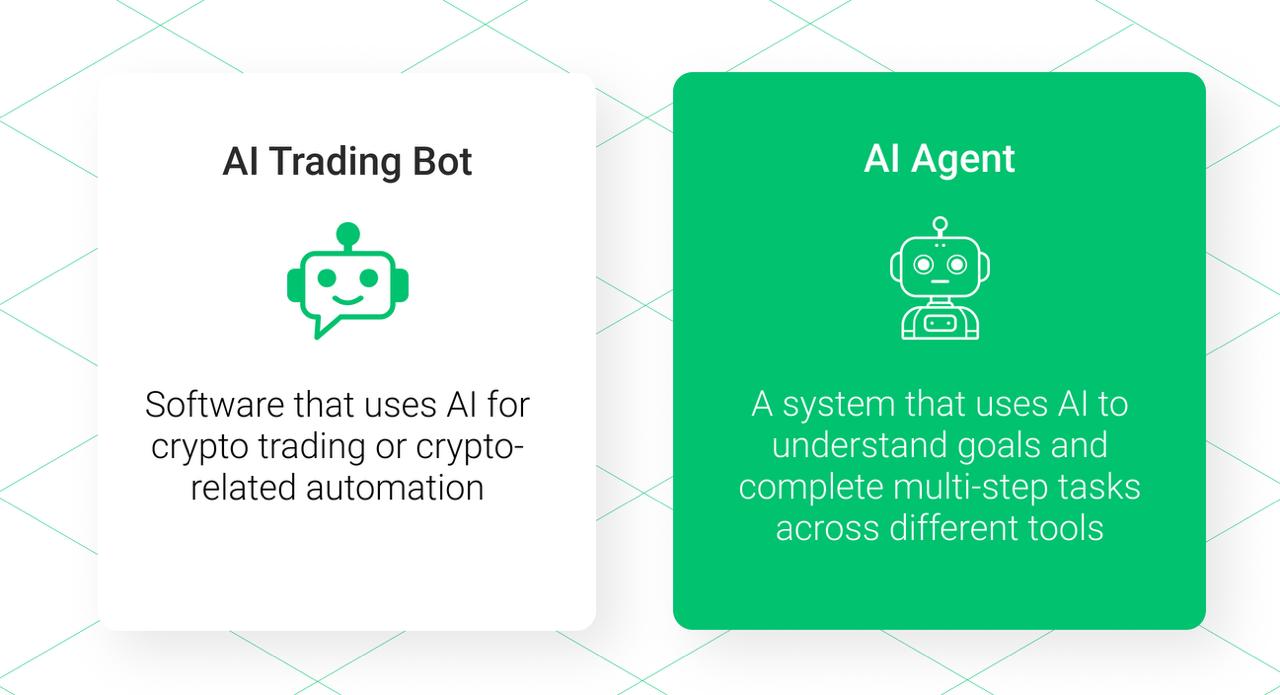
An AI trading bot usually starts from a strategy. An AI agent starts from a task.
The bot’s job is narrower: monitor conditions, adjust or repeat trading logic, and execute according to a setup.
The agent’s job is wider: read a request, gather context, select tools, and prepare a path for action.
Feature
AI Trading Bots
AI Agents
Main Role
Automate or optimize a trading strategy
Understand intent and coordinate tasks
Typical Input
Bot settings, indicators, strategy rules
Natural-language prompt or high-level goal
Execution Style
Repeats or adjusts trading logic
Plans a sequence of actions
Best Use
Grid, DCA, signals, rebalancing, execution
Research, decision support, multi-step workflows
Main Risk
Bad strategy runs automatically
Bad reasoning or broad tool access creates wider damage
Human Role
Configure and monitor
Set limits, verify logic, approve actions
A bot may be fast and disciplined. An agent may be flexible and context-aware. Neither deserves blind trust. Look at what the system decides, what it executes, and how quickly the user can stop it.
Scenario 1: a trader launches a grid bot on SOL while price moves inside a range. The bot buys lower and sells higher within the selected band. That is automation.
Scenario 2: SOL breaks below the range, liquidity dries up, and the same grid keeps buying into weakness. The bot is not “wrong” in a technical sense. It is doing exactly what it was told to do.
Scenario 3: the trader asks an AI agent to check SOL funding, recent news, whale activity, and liquidity before deciding whether the grid still makes sense. That is closer to an AI-assisted workflow.
Scenario 4: a Telegram “AI profit bot” asks for wallet access and shows screenshots of daily returns. That is not proof of intelligence. It may be a high-risk product or a scam wearing trading language.
Basic Bots, AI-Powered Bots And AI Agents Compared
Not every “AI trading” tool works the same way. Some tools only automate preset rules. Others add AI features around the strategy. A smaller group can plan multi-step workflows with connected tools.
Tool Type
What It Does
Example
Basic Crypto Bot
Follows preset rules without an AI layer.
A bot buys ETH after a 4% drop and sells after a 6% rebound because the trader set that rule in advance.
AI-Powered Bot
Uses AI to explain, tune, or optimize a predefined strategy.
The tool may summarize market conditions, suggest parameter changes, or flag higher risk, but the core strategy still stays inside fixed boundaries.
AI Agent
Interprets a broader goal, checks context, selects tools, and prepares actions.
An agent may compare funding rates, spot volume, headlines, and portfolio exposure before suggesting whether to wait, reduce risk, or confirm a trade.
This is where many “AI trading” claims become blurry. Repeating a rule is automation. Explaining or adjusting a setup is AI assistance. Planning a sequence of tool-based actions moves the product closer to an agent.
Where Automated Trading Platforms Fit
Cryptohopper, 3Commas, and Coinrule are useful examples because they show the middle ground between classic bots and AI-assisted trading. They should not be casually described as autonomous AI agents.
3Commas offers crypto trading bots and automation tools, including grid-style and automatic trading approaches. It also describes an AI Assistant that helps turn a trading idea into a bot, run backtests, and tune settings.
Coinrule
Coinrule focuses on no-code trading bots built around conditions and actions. In plain English: if this happens, do that.
Platform
What It Is
What It Is Not By Default
Why It Matters
Cryptohopper
Automated trading platform with bots, DCA, trailing tools, copy trading, and AI-related features
Not automatically an autonomous AI agent
Shows that AI features can sit on top of bot automation
3Commas
Trading bot and automation platform with DCA, grid, backtesting, and AI-related tools
Not automatically a self-directed trading agent
Separates AI optimization from full agent autonomy
Coinrule
No-code rule-based automation platform
Not AI by default
Best example of automation without AI
Auto trading platforms may include AI features, but every running bot still needs its own workflow check. The workflow comes first. The label comes after.
Examples of AI Agents And Automated Crypto Trading Platforms
Automated crypto tools are easier to compare through real product examples. The examples below show how different tools are positioned, not which one is “best.”
Basic bot tools focus on rule-based execution. The trader sets the logic first, and the bot executes inside those limits. Examples include:
AI-assisted bot tools add AI around strategy setup or optimization. These tools may suggest settings, score strategies, or help pick a setup, but they still stay close to bot logic. Examples include:
AI agent tools work with broader goals and connected actions. Examples include:
Anon by HeyAnon, which handles CeFi and DeFi actions such as swaps, bridges, deposits, and trades
Avo, which positions itself around AI trading agents and on-chain portfolios
TradingAgents, which fits better as a research example, since it is not a retail crypto trading app
The more control the tool gets, the more carefully traders need to limit access. A basic bot executes the plan. An AI-assisted bot helps refine it. An agent may start shaping the workflow itself.
AI Trading Bot Red Flags
Before connecting funds, look less at the “AI” label and more at what the tool can actually access.
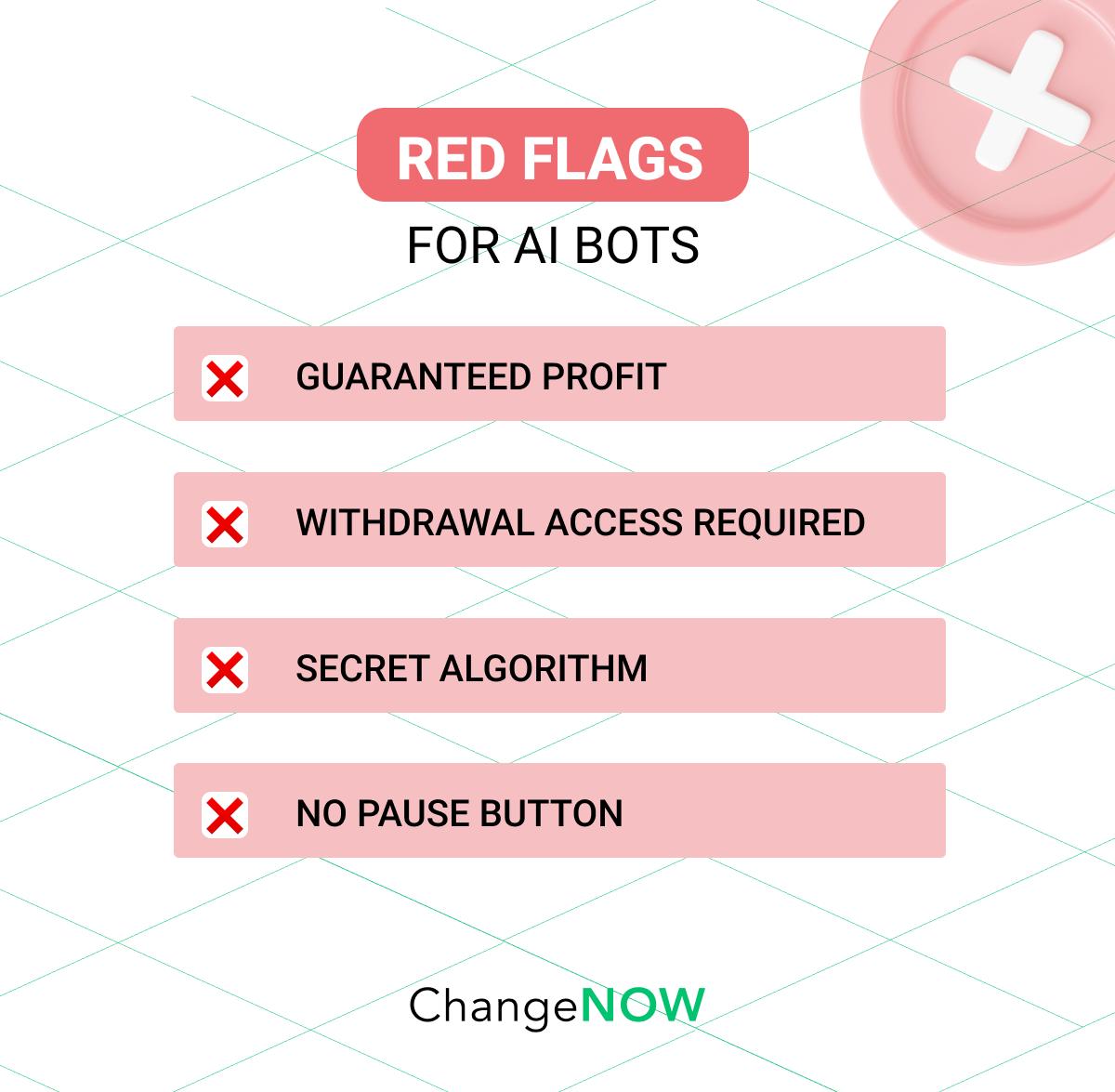
Red flags for AI trading bots including guaranteed profit, withdrawal access required, secret algorithm, and no pause button.
Guaranteed profit claims are the first warning sign. No bot, signal tool, or AI agent can remove market risk. Withdrawal access is another major red flag. Most trading tools do not need permission to move funds out of an account.
“Secret algorithm” language should also raise questions. If the platform cannot explain the strategy logic, risk settings, or data sources, the setup is hard to audit.
A safer tool should give traders control. That means limited API permissions, clear order limits, stop-loss logic, slippage settings, and a manual pause button during volatility or exchange outages.
Before connecting funds, check withdrawal restrictions, supported exchanges, API permissions, maximum order size, leverage access, and manual override options.
If a platform promises guaranteed returns, skip it. If it asks for withdrawal access without a clear reason, skip it faster.
Main Risks To Check Before Using AI Trading Bots
Trading bots and AI agents fail in different ways. A bot usually fails when the strategy is weak. An AI agent fails when the reasoning, data, or tool access is wrong.
The main risks to check are:
Strategy risk: a bot can follow bad rules perfectly.
Data risk: an AI agent may treat stale signals as current.
Execution risk: fees, slippage, latency, and thin liquidity can damage live results.
Leverage risk: one wrong setting can turn a small error into liquidation.
API risk: broad permissions give the tool more access than it needs.
Security risk: fake “AI bots” may hide wallet-draining flows behind a trading dashboard.
User risk: traders may overtrust AI explanations and stop monitoring the setup.
Backtests can also mislead. A grid bot may look profitable on old data and still fail when spreads widen or the market trends one way. AI-assisted optimization can create the same problem by fitting a strategy to past conditions.
Before connecting capital, check withdrawal restrictions, maximum order size, leverage access, stop-loss logic, slippage controls, supported exchanges, and manual override options.
If a platform promises guaranteed returns, skip it. If it asks for withdrawal access without a clear reason, skip it faster.
Main Risks To Check Before Using Crypto Agents
With crypto AI agents, the risk works differently. The danger is not only a bad setup, but a bad chain of data, tools, and decisions.
The main risks to check are:
Intent risk: the agent may misunderstand the trader’s request and prepare the wrong action.
Data risk: delayed prices, old headlines, stale funding rates, or weak wallet-flow signals can distort the whole output.
Reasoning risk: a confident explanation may connect signals that do not belong together.
Tool-access risk: connected exchanges, wallets, APIs, and portfolio tools give the agent more room to make a costly mistake.
Permission risk: read-only access is very different from trading access. Withdrawal access is a major red flag.
Workflow risk: one bad step can affect everything that follows, especially when the agent chains several tools together.
Execution risk: a suggested trade may ignore slippage, thin liquidity, partial fills, funding costs, or leverage exposure.
Security risk: fake “AI agent” products may push wallet connections, seed phrase requests, or withdrawal permissions.
Overtrust risk: traders may accept a polished answer without checking the data behind it.
A crypto agent should show its data sources, tool access, API scope, and the action it wants approved. Check wallet permissions, leverage limits, slippage controls, stop-loss logic, and manual override options before connecting funds.
Final approval stays with the trader. Guaranteed returns are enough to walk away. Withdrawal access without a clear reason is an even stronger warning sign.
Final Verdict
AI trading bots and AI agents belong to the same automation conversation, but they should not be used as synonyms. Control is the filter that matters.
What does the tool decide? What does it execute? What permissions does it need? How fast can you pause it? Does the system explain its logic clearly enough for a human to reject it?
Start there.
Verdict: A bot works best when the trader already knows the rules. An AI agent works best when the trader needs context before choosing the next step. Trouble starts when either tool gets treated like a money printer.


 The bot’s job is narrower: monitor conditions, adjust or repeat trading logic, and execute according to a setup.
The agent’s job is wider: read a request, gather context, select tools, and prepare a path for action.
The bot’s job is narrower: monitor conditions, adjust or repeat trading logic, and execute according to a setup.
The agent’s job is wider: read a request, gather context, select tools, and prepare a path for action.