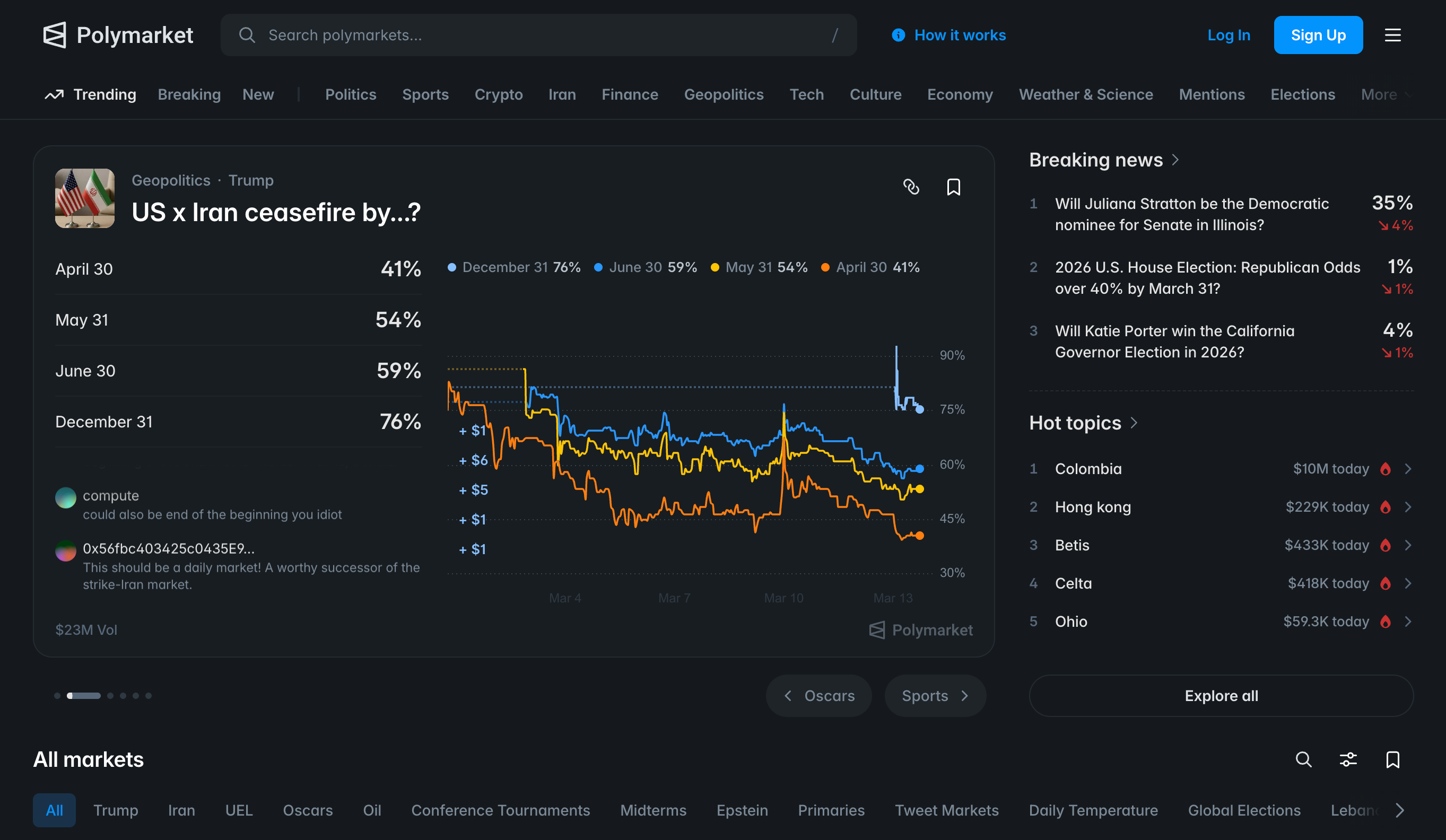
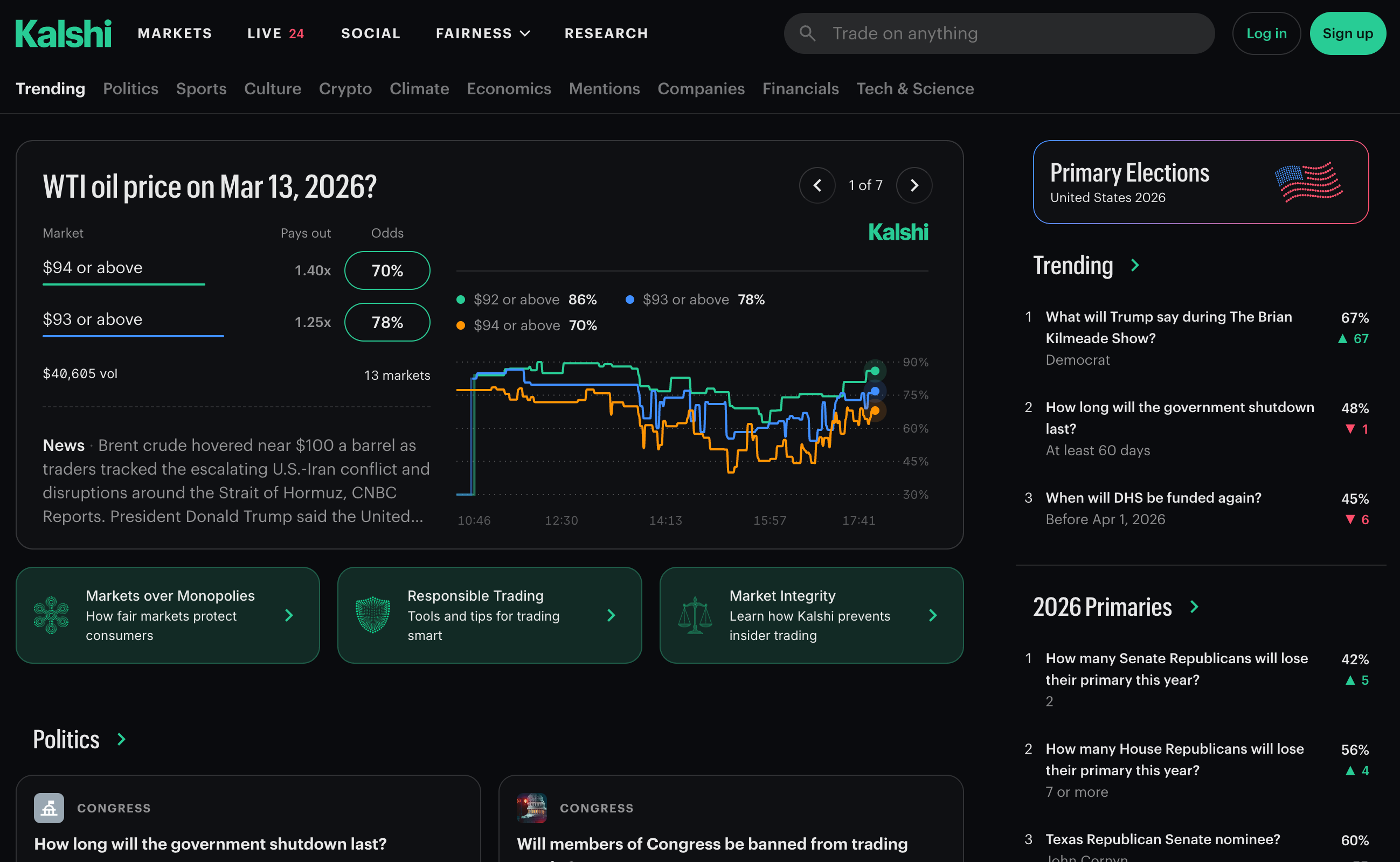
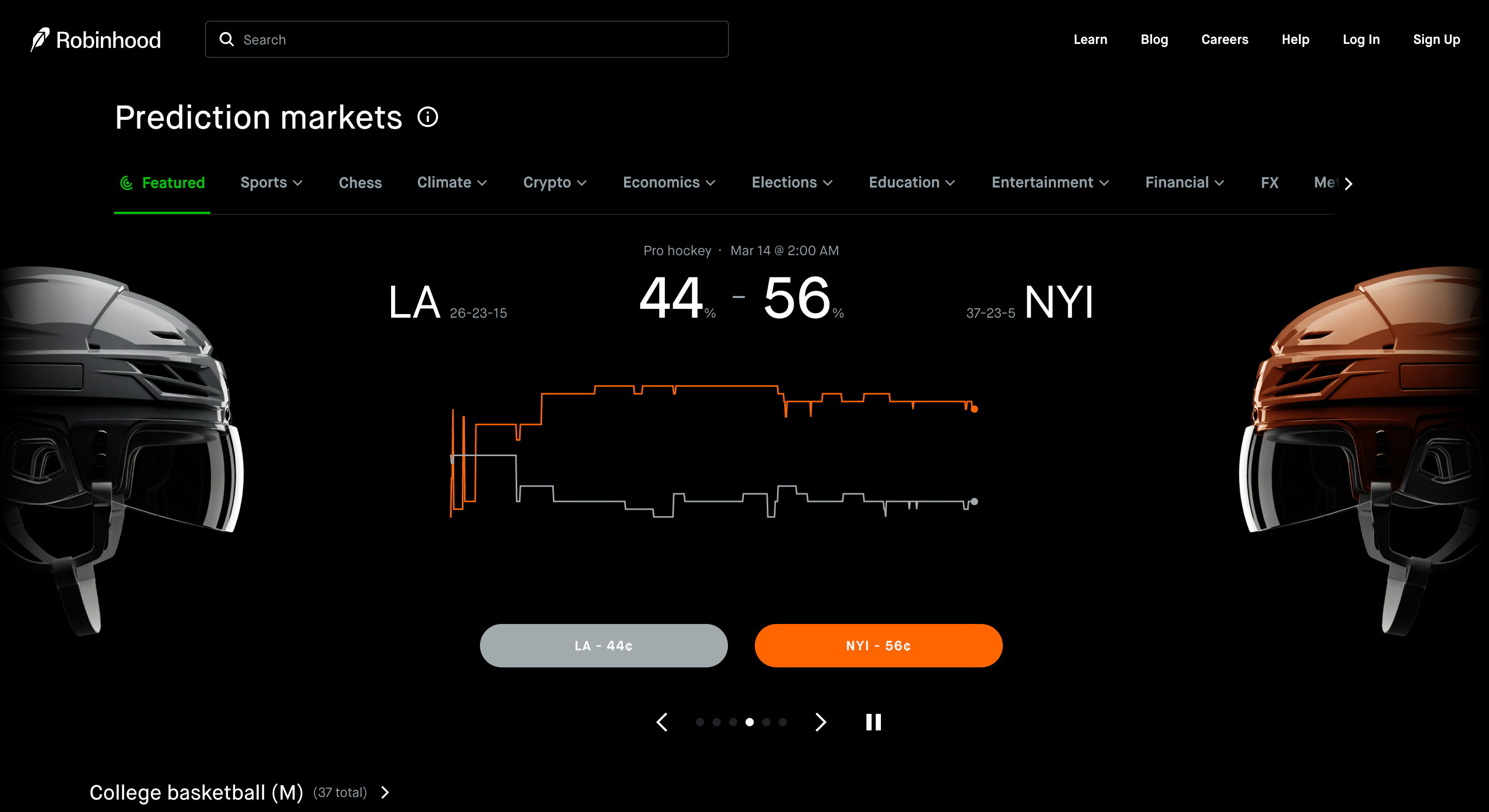
Welcome to live prediction markets, with real money, real prices, and thousands of people staking their conviction on the outcome. An infinite scroll of real-world events, each one priced by the collective intelligence of everyone willing to put skin in the game.
Spoiler: The crowd tends to be right more often than you'd expect.
According to the latest report by Birdseye, prediction markets' all-time notional volume exceeded $150 billion and grew 13x within six months, while open interest increased 6x over the past year.
Key takeaways
Prediction markets let people trade on the outcomes of real-world events: elections, sports, economic data, crypto, and more
Contract prices are live probability estimates, updated in real time as new information comes in
The crowd tends to outperform individual experts, and polls, when liquidity is strong and incentives are clear
Major platforms include Polymarket, Kalshi, and Robinhood
Prediction markets aren't gambling in the traditional sense - there's no house, no fixed odds, and the primary output is a forecast
Regulation varies by jurisdiction and is still evolving. Always check local rules before trading
What is a prediction market?
A prediction market is a platform where people trade on the outcomes of future events.
Each outcome is represented as a contract: if you think something will happen, you buy YES. If you think it won't, you buy NO.
A platform where people trade on the outcomes of future events. Each outcome is represented as a contract with a price that reflects the crowd's collective estimate of probability. Winning contracts pay $1 at resolution, losing ones go to $0.
Same core idea, different angle: a prediction market is a mechanism for aggregating information. The price is a forecast, continuously updated by everyone willing to put money behind their opinion.
Polymarket is the most widely known. Others include Kalshi, Manifold Markets, and Metaculus. Robinhood also launched event contracts in late 2024, bringing the format to mainstream retail users.
The largest decentralized prediction market by volume, built on Polygon. Users trade with USDC, everything settles on-chain, no account required. It peaked during the 2024 US election cycle with hundreds of millions in volume on presidential race contracts alone.
A DeFi-native prediction market focused on accessibility and transparent settlement. One of the newer platforms building in the space as the category matures.
Polymarket leads on volume and name recognition. Kalshi leads on regulatory legitimacy in the US. Neither has fully won the category yet - the space is still early.
By the market price. A contract trading at $0.68 implies a 68% chance of the outcome happening. That number shifts in real time as traders buy and sell based on new information.
Polls measure what people say. Markets measure what people are willing to bet on. When money is on the line, people think harder, update faster, and bring better information to the table.
Depends on the jurisdiction. In the US, Kalshi operates legally under CFTC authorization. Polymarket blocked US users after regulatory pressure in 2022. In many countries the rules are still unclear or actively contested. Always check local regulations before trading.
Technically, there's overlap: both involve money and uncertain outcomes. The structural difference is that prediction markets are peer-to-peer, prices are set by the crowd rather than a house, and the primary output is a forecast, not entertainment. Whether that distinction matters legally depends on where you are.
Thin liquidity on niche markets, price manipulation in low-volume contracts, regulatory uncertainty depending on jurisdiction, and the baseline risk that the crowd gets it wrong. It happens.
The price of that contract reflects what the market collectively believes the probability is at any given moment. A contract trading at $0.70 means the crowd gives it a 70% chance of happening. When the event resolves, winning contracts pay $1, losing ones go to $0.
The incentive is simple: be right, get paid.
How the crowd beats the expert
Imagine you need to guess how many jellybeans are in a jar. Your single guess will probably be off. But average out 500 guesses, and you'll land surprisingly close to the real number. That's the wisdom of crowds, and it's the engine behind prediction markets.
Everyone brings different information to the table.
A political scientist, a data analyst, a local journalist, and someone who just read three good articles will all price the same election differently.
When they trade against each other, those differences get absorbed into a single number, updated in real time. No pundit required.
Prediction markets vs. betting
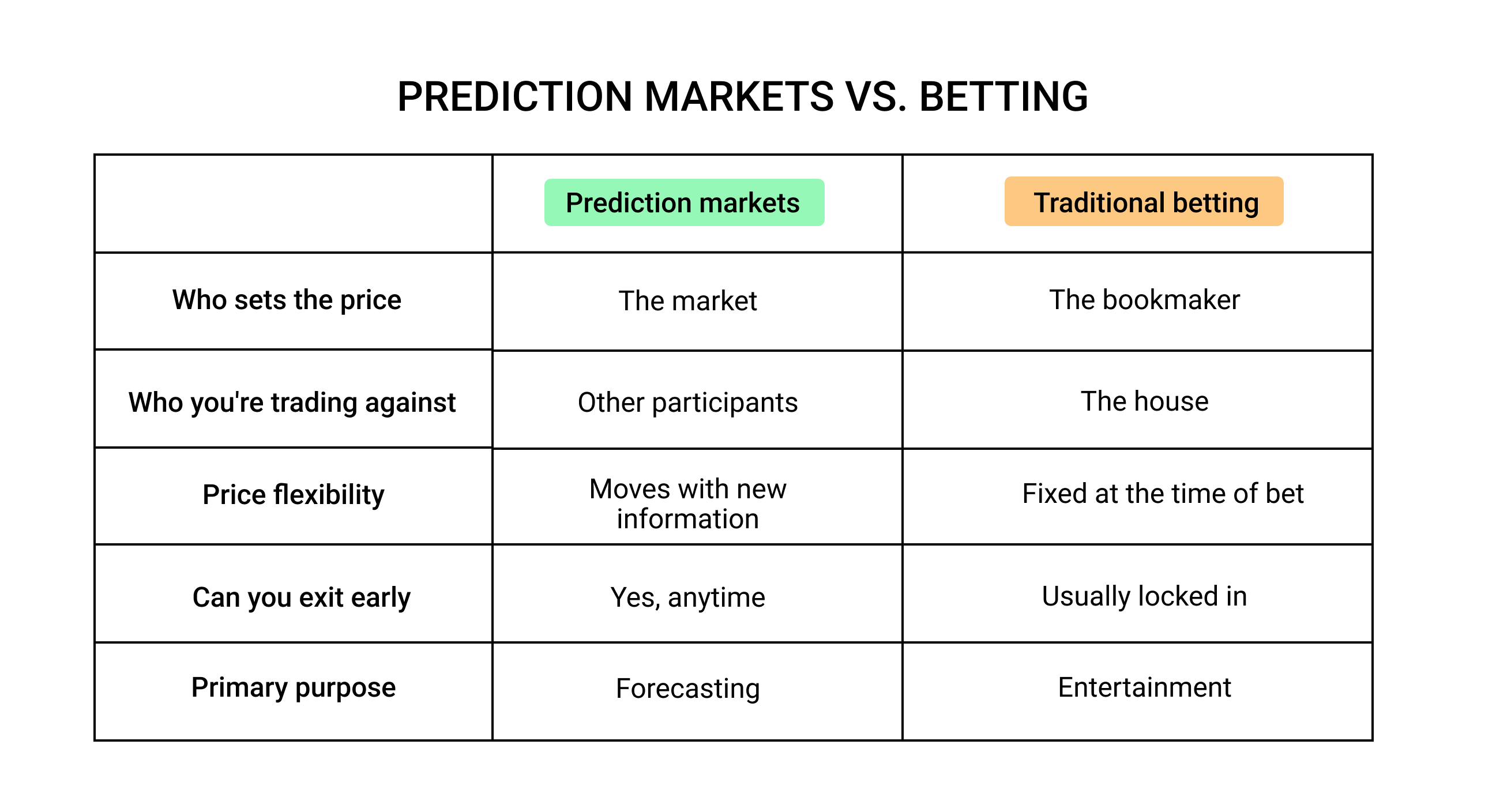
People mix these up all the time, and it's understandable: both involve money and uncertain outcomes. But the structure is different enough to matter.
In traditional betting, the house sets the odds and always has an edge.
In prediction markets, the crowd sets the price, and when new information drops, the price moves immediately.
A candidate gets caught in a scandal, a company misses earnings, an unexpected tweet lands: the market reacts before the headlines do.
How prices reflect probability
Price in a prediction market is probability. Literally.
A contract trading at $0.73 means the market gives that outcome a 73% chance of happening. At $0.20 - 20%.
The math is straightforward because contracts always settle at exactly $1 (win) or $0 (loss), so the price at any moment represents the crowd's best estimate of the likelihood.
This is what makes prediction markets useful beyond just trading.
The price is a live, continuously updated forecast - one that reacts to breaking news, shifts in sentiment, and new data faster than any poll or analyst report.
How prediction market works
Every trade in a prediction market follows the same basic logic: you find an event, pick an outcome, and buy a contract that pays out if you're right.
Most contracts are binary - YES or NO, $1 or $0 at resolution. The current price is the market's live probability estimate.
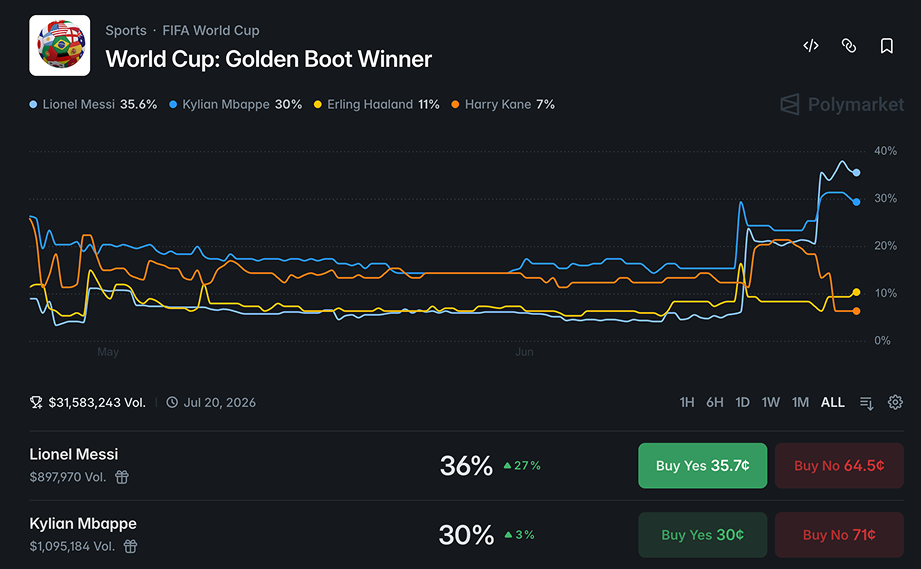
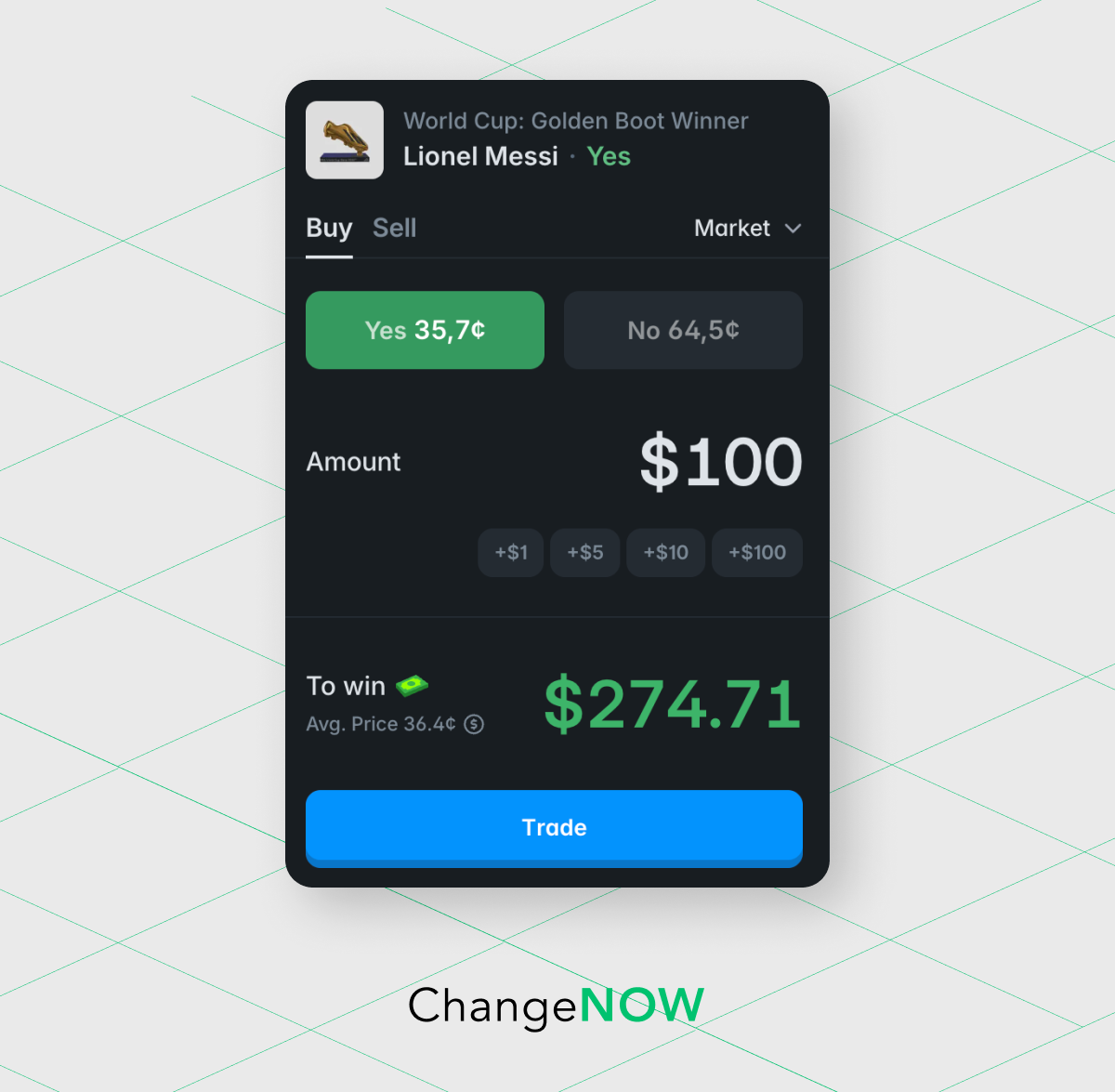
Buy YES on a contract priced at 35.7¢, and you're saying: 'I think Lionel Messi winning the Golden Boot is more likely than a 35.7% chance.' If you're right and the event happens, you collect $1. If not, you're out your 35.7¢.
You don't have to hold until resolution either. Positions can be opened and closed anytime, so if you bought YES at $0.35 and the price moves to $0.65, you can sell and pocket the difference without waiting for the outcome.
Prediction market glossary
Event contract: a tradeable instrument tied to a specific outcome. Pays $1 if it happens, $0 if it doesn't.
Order book: the live list of buy and sell offers at different prices.
Liquidity: how easily you can enter or exit a position without moving the price.
Spread: the gap between the best buy and sell price. Smaller spread = more liquid market.
Slippage: when your order fills at a slightly different price than expected.
Market order: buy or sell immediately at the current price.
Limit order: buy or sell only at a price you set. Execution isn't guaranteed.
Market maker: a participant who keeps trading smooth by placing both buy and sell orders at all times.
Resolution oracle: the data source that verifies the outcome and triggers settlement.
Settlement: the final payout after an event resolves.
What you can trade on
Prediction markets cover pretty much any event with a definable outcome. If you can answer it with a yes/no or pick one option from a list, someone's probably already opened a market on it.
Prediction markets called the 2024 US election results faster and more accurately than most major polling aggregators. When the stakes are high and information is everywhere, the crowd tends to be sharp.
Crypto and tech
Will Bitcoin hit $150k this year? Will this protocol launch on time? Will this founder step down?
Crypto-native audiences were early adopters of prediction markets, and the overlap between the two spaces is still massive. These markets move fast and react to news in real time.
Economic data
CPI prints, Fed rate decisions, unemployment numbers - you can trade on the exact outcome before official data drops.
Very useful as a live barometer of what informed people actually expect.
Sports
Super Bowl, UFC title fights, March Madness, the Champions League final, Formula 1 championship standings - literally anything that has a result and a fanbase, it has a market.
Lower information asymmetry here than in politics, but high liquidity and high volume, especially around major events.
Pop culture and entertainment
Oscars, Grammys, reality TV finales, you name it. Stakes are lighter, but markets are surprisingly active. Also, an easy entry point for people new to the space.
Corporate and internal forecasting
Companies use private prediction markets to aggregate honest forecasts from employees: things like product launch timelines, sales targets, and project completion dates.
People tend to be more accurate when money is on the line than when filling out a survey.
Prediction markets in finance
Prediction markets and traditional financial markets look similar on the surface, but they serve a different function.
Traditional markets price assets → companies, currencies, commodities.
Prediction markets price outcomes → events, decisions, moments in time.
The underlying logic is the same: aggregate information, update in real time, but what you're actually buying is different.
How markets aggregate information
Every trade is a signal.
When someone buys YES on a Fed rate cut at $0.30 and drives the price to $0.45, they're not just making a bet, they're injecting information into the market.
Maybe they read a leaked memo. Or they built a better model. Or they just have better intuition. The market doesn't care why they're right. It just updates.
This is what makes prediction markets genuinely useful as forecasting tools, not just trading venues. The price at any moment reflects the combined knowledge of everyone with skin in the game: economists, traders, journalists, insiders, and people who are just very online.
Stock prediction market: where it fits
The term "stock prediction market" comes up a lot in search, and it points to a real use case: using prediction markets to forecast company-level events. Will this CEO step down? Will this merger get approved? Will earnings beat estimates?
These aren't the same as trading the stock itself.
You're not betting on price movement, you're betting on a specific event that might affect the price. It's a more precise instrument, and in liquid markets, often a more accurate one.
Economic and political forecasting
Central banks, hedge funds, and policy researchers increasingly watch prediction market prices alongside traditional indicators.
When a market prices a recession at 68% six months out, that number carries weight, because the aggregate tends to track reality better than models built on historical data alone.
For political forecasting, the track record is hard to ignore.
In the 2024 US presidential election, Polymarket had Trump winning with ~65% probability in the final days before the vote, while most major polls showed a near-perfect toss-up.
Trump won.
The market didn't just get the direction right; it got the confidence level right too.
The leading prediction market platforms
The space has a few clear names, each with a different angle on what a prediction market should look like.
Polymarket
Polymarket is the biggest decentralized prediction market by volume, built on Polygon.
You trade with USDC, everything settles on-chain, and the market catalog covers everything from elections to crypto prices to pop culture.
It blew up during the 2024 US election cycle. At peak, it was processing hundreds of millions in volume on presidential race contracts alone.
Kalshi
Kalshi is the regulated alternative. The first prediction market officially authorized by the CFTC to operate in the US. That's a big deal. It means US users can trade legally, with real dollar contracts, on a platform that's gone through serious regulatory scrutiny.
The tradeoff is a narrower catalog and more friction to get started. But for users who want compliance over anonymity, Kalshi is the serious option.
Robinhood
Robinhood prediction market launched event contracts in late 2024, letting users trade on outcomes like election results and economic data directly in the app.
The play is obvious: take the prediction market format and drop it in front of 20+ million existing retail users who already know how to tap "buy."
Frictionless onboarding, familiar interface, the volume will follow.
Other prediction market apps worth knowing
Metaculus: more forecasting community than trading platform, but one of the most accurate track records in the space. No money involved, just reputation and scoring. Good for calibration.
Manifold Markets: play money, real forecasting. Popular in rationalist and tech communities. Low stakes, surprisingly high signal.
prediction.market, Augur, and others: earlier DeFi attempts with varying degrees of adoption. The infrastructure they built laid the groundwork for what Polymarket and others run on today.
Risks and limitations
Prediction markets are a genuinely useful tool, but they're not a crystal ball, and a few structural issues are worth knowing before you put money in.
Thin liquidity in niche markets
The accuracy of a prediction market depends on how many informed people are trading it.
In a US presidential election with $500M in volume, the price is meaningful. On a market about whether a mid-tier crypto protocol hits a specific TVL by Q3, maybe less so.
Low liquidity means wider spreads, more slippage, and prices that can move on small orders.
Pro tip: Always check volume before reading a price as gospel.
Manipulation
It happens, but it's harder than it looks.
In 2024, a trader reportedly spent around $48M trying to push Trump's Polymarket odds higher - the market absorbed it, corrected, and ended up accurate anyway.
Deep, liquid markets are expensive to manipulate and tend to self-correct. Shallow ones are more vulnerable.
Questionable marketing
While prediction markets are structurally different from gambling, some platforms have faced criticism for utilizing aggressive promotional methods.
Recently, Polymarket has been accused of paying influencers and bloggers to showcase fake, highly lucrative winning bets to project an illusion of easy, guaranteed success.
These kinds of deceptive marketing practices can blur the line between analytical trading and pure gambling, misleading newbies into severely underestimating the risks.
Regulation: where things stand
The legal landscape is still uneven.
Polymarket blocked US users after CFTC pressure in 2022.
Kalshi spent years in regulatory battles before getting the green light. In most jurisdictions, the rules around prediction markets sit somewhere between "unclear" and "actively contested."
That's changing, but slowly.
When the crowd gets it wrong
The 2016 US election. Brexit. Both were priced as unlikely by prediction markets right up until they weren't.
The crowd can be systematically wrong when information is sparse, when key groups are underrepresented in the market, or when a genuinely unprecedented event is on the table.
Aggregate intelligence is only as good as the information flowing into it.
Ethical questions
Some markets make people uncomfortable, and not without reason. Betting on natural disasters, assassinations, or geopolitical crises raises real questions about incentives.
If someone holds a large YES position on a catastrophic event, do they have reason to want it to happen?
Most platforms moderate their catalogs, but the line isn't always obvious.


 Source: