


AI agents can manage tasks.
AI agents can trade crypto.
AI agents can pay each other without human supervision.
=== you are here now ===
Coinbase, Stripe, and Mastercard have all shipped infrastructure for machine-to-machine (M2M) payments in the past few weeks. And now the real test of whether blockchains can handle thousands of small, constant payments a second begins.
Together with Elias Vilochkin, ChangeNOW's Chief Product Officer and an outspoken AI enthusiast, we try to figure out how developing M2M solutions will impact the payment environment and which infrastructure can handle them better.
Key Takeaways
- Blockchains are ready for the workload: Modern networks like Solana and TON already have the speed and capacity to handle massive volumes of automated AI payments.
- Smart limits can keep budgets safe: Using programmable smart wallets, developers can set strict daily spending caps and rules so AI agents can't accidentally drain funds.
- Traditional finance and crypto are teaming up: Giants like Visa and Mastercard are working with Web3, and not against it, to build the infrastructure for autonomous machine-to-machine transactions.
- Seamless integration is the ultimate goal: The real breakthrough will be a unified system where AI agents can move money effortlessly between crypto and traditional payment rails without human input.
Scalability
VisaNet can potentially handle up to 83,000 transactions per second. Its actual daily volume is much lower, averaging between 1,700 and 2,000 TPS. Meanwhile Mastercard operates up to 5,000 TPS.
Blockchains need to get close to that range, at least during traffic spikes, if they want their M2M payments to work at scale.
Some L1 networks like Solana and TON are already very close to those benchmarks. Solana’s theoretical maximum reaches 65,000 TPS with real-world average fluctuating between 2,000 and 4,000 TPS.
There’s no need for a single chain to carry the whole market, though. Different networks already each take their own niche: some are tuned for DeFi traffic, others for fast, cheap transfers.
If M2M payments grow the way Coinbase, Stripe, and Mastercard are predicting they will, that load will likely spread across multiple chains instead of piling onto one.
“The throughput of a single L2 network is already comparable to the average flow of Visa or Mastercard. Considering that different networks dominate different tasks, trying to cover the entire market's demand with one chain isn't the goal, so I don't see that becoming a big issue. Networks like SOL and TON are technologically ready to sustain TPS at the official limits of Visa and Mastercard. Reliable bridge infrastructure, like the one we provide, allows for elegant liquidity balancing across these networks. Plus, the crypto market has repeatedly shown its adaptability to new challenges. It's our key feature — we've been adapting to new hype cycles and tasks for over 10 years. Something might fall off at first, but then the community will hack together a solution overnight, and we’ll move even faster.”
Elias Vilochkin, Chief Product Officer at ChangeNOW
Whether this holds up once millions of agents flood into the market transacting nonstop, only time will tell.
Security: Keeping AI Agents from Draining Budgets
Integrating AI into financial workflows brings a new set of risks.
Everyone who has used AI knows it can hallucinate. Trading agents can misinterpret market signals or execute unintended transactions. Seems like giving AI unrestricted access to a main treasury is a fast track to draining the budget.
Good thing that there’s no problem in tech that can’t be solved, especially when money is involved.
Naturally, developers don’t trust AI to make perfect decisions and suggest building strict boundaries around the agent. One reliable approach is to limit its reach on the blockchain mathematically.
Account Abstraction (ERC-4337) provides the necessary infrastructure for this. It allows developers to program smart wallets with custom spending policies.
They can restrict transactions to specific counterparties, whitelist approved operation types, and establish hard daily spending caps.
As Elias Vilochkin points out, this approach changes how teams handle autonomous systems:
"Technologies like account abstraction (ERC-4337) already let us set highly flexible restrictions on counterparties, operation types, and so on. On-chain limits don't just cap potential losses; they minimize the actual risk of unplanned operations. Not to mention, you probably shouldn't be handing private keys directly to agents anyway. It makes more sense to route them through a middle layer with hardcoded checks. And the biggest advantage crypto has over TradFi here? You literally cannot spend more than what is physically in the wallet."
TradFi vs. Web3: Cooperation, Not a War
Mastercard shipping infrastructure for AI agent payments may look like TradFi muscling into Web3 territory.
But in reality, both sides are converging on the same outcome: provide opportunity for agents to pay autonomously.
TradFi and Web3 simply have different starting points.
Some of that build-out will likely run through TradFi rails, because Visa and Mastercard already have the compliance relationships agents will need at scale.
That won't hold Web3 back though. When the big card networks and crypto infrastructure show up at the same table, it usually means the tech has matured enough to be used.
Speaking of tables, those sure have turned: a decade ago traditional finance aggressively dismissed crypto as too volatile and too tied to illegal activity to take seriously.
We asked for Elias’ opinion on the seeming confrontation: will giants like Mastercard just absorb everything on the M2M market?
“On the ‘will they just absorb everything’ question, I think that's a false dichotomy. Some of the momentum, things like x402, will get folded into what they're building, but that's convergence, not a takeover. I still remember the damage Ajay Banga's crusade against crypto did to the market about ten years ago. The fact that financial giants are now working hand in hand with crypto people is, overall, good for the market.”
For context: in 2018, Mastercard's then-CEO Ajay Banga publicly called cryptocurrency “junk” citing volatility and its use in illegal operations.
Binance founder CZ makes a similar case, but from a purely functional angle: crypto isn't just philosophically aligned with AI agents, it's structurally better suited to the job.
"I think AI will help in multiple fronts. Number one is that AI agents are going to transact 10, 100, 1,000 times more transactions than humans can do. And AI's gonna use crypto. They're not use Swift or Visa cards. They may use some parts of the traditional financial system, but if you're gonna interact with a person on the opposite end of the world from you, in different country, crypto is so much much easier."
That's the crux of the convergence argument: TradFi rails will absolutely be part of the agent economy, but for high-volume, cross-border, machine-speed transactions, crypto is winning by default.
Privacy: Trade Secrets on a Public Blockchain
Every transaction an AI agent makes on a public blockchain is visible to anyone who looks. For M2M payments, the value that matters most lives in the timing and the logic behind each decision, the part nobody can see just by scanning the chain.
That's the framing Elias leans on when asked about agent-to-agent commercial secrecy:
“As things keep speeding up past what a human brain can actually track, the real trade secret will be the reasoning behind a decision and how fast you can act on it before everyone else. Bottom line: wherever this becomes an actual problem, a tool shows up to fix it, programmable privacy, extra encryption, whatever's needed. And in most cases, pseudonymity alone will be plenty.”
If pseudonymity ever stops being enough for certain use cases, the tools to go further already exist.
Privacy-focused chains like Monero have been around for years, just waiting for enough demand to justify the overhead of deploying them.
Final Thoughts: Who Wins the M2M Race?
Or rather will there be a winner at all?
Solana and TON can already handle the volume and Account Abstraction can handle the risk.
Visa and Mastercard are actively building toward the same outcome. Each piece seems to be already solved on its own.
What's still open is what happens once all of this has to work together at the same time: an agent pays through a TradFi rail one minute, then a Solana validator the next, and nobody notices the switch.
Whoever builds that connection, the part that moves money across chains and rails without making the agent choose one, is solving the problem that actually decides how fast this grows.
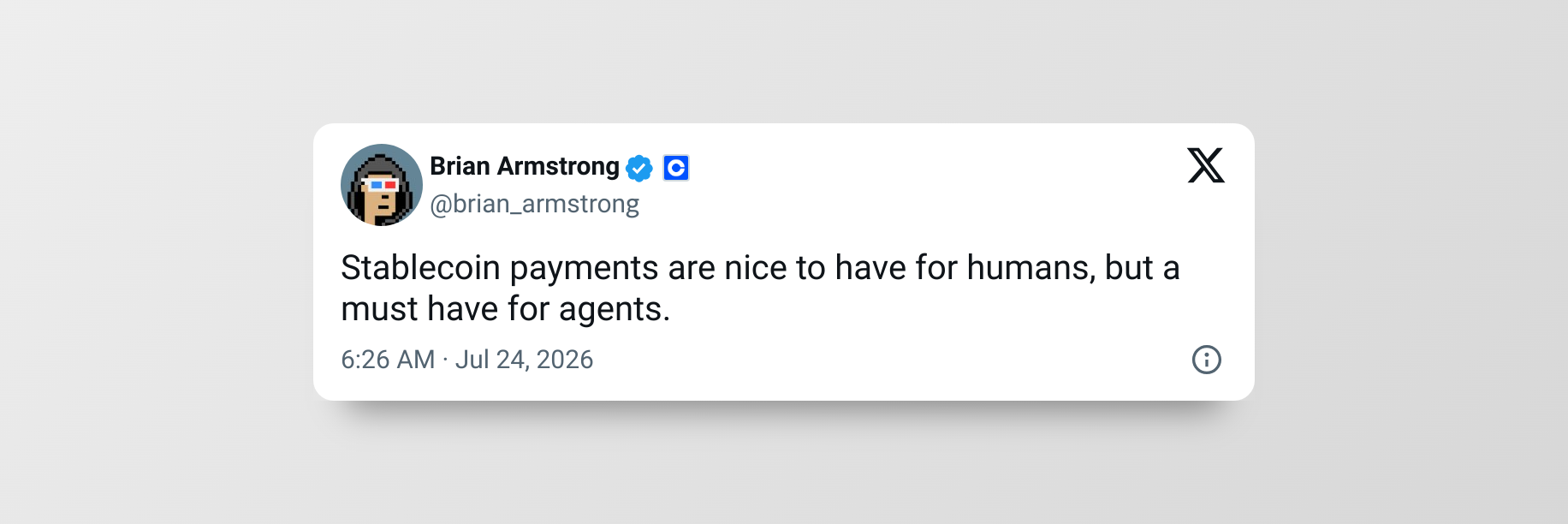
I'll leave the last word to Brian Armstrong, Co-founder & CEO of Coinbase:
Next Read: Crypto Perpetual Futures: Instrument Everyone Has An Opinion On


