The most prevalent comparison among consumers seeking a fiat-to-crypto on-ramp is MoonPay vs Transak.
Both services allow you to purchase cryptocurrencies with a debit card, credit card or bank transfer from within a wallet or dApp. Both support hundreds of millions of transactions, both are regulated in numerous countries, and both have developer SDKs for integration.
MoonPay is focused on a polished consumer experience with major payment brands like PayPal and Apple Pay. And Transak is targeting developers and global markets with 17+ payment methods, lower starting fees and modular infrastructure.
We break down MoonPay vs Transak prices, MoonPay vs Transak supported countries, KYC and transaction limitations in this article to help you decide.
Disclaimer:The information provided in this article is for educational and informational purposes only and should not be construed as financial or investment advice. Exchange fees, features, and policies are subject to change. Readers should conduct their own research and verify details on the official platforms before making any trading decisions.
Key Takeaways
Fees: MoonPay charges a fixed 4.5% for cards, up to 1% for bank transfers. Fees range from 0.99% to 5% depending on payment method and location. MoonPay is cheaper for bank transfer customers, Transak for card users.
Country coverage: MoonPay is available in over 180 countries. Transak is available in 169 countries. Both exclude the same high risk jurisdictions like Russia, Iran, North Korea, etc).
Crypto selection: Transak supports 136-173 cryptocurrencies. MoonPay offers 80+ cryptos directly and 2,000+ through exchanges. Transak leads the direct listings.
KYC approach: Transak delivers structured multi-level KYC with upfront tier choosing. MoonPay has incremental KYC because of transaction restrictions.
Developer tools: Both offer SDKs for React, iOS, Android, and Web. 500+ integrations with MoonPay 600+ integrations on Transak
User satisfaction: Transak 4.2/5 on Trustpilot with 22K+ ratings) MoonPay has a 4.1/5 rating with 86K+ reviews. Both sites get similar concerns about costs and KYC delays.
Comparison Methodology
We compare on a fixed set of criteria including pricing, speed, security, user experience and customer support. We evaluate them using data that is publicly accessible, like user reviews and official documentation. ChangeNOW is compared to the same criteria as anyone else on this list when it is among the services compared to.
Launched in 2019, these services have developed to become the two most commonly integrated fiat-to-crypto on-ramps in Web3. Neither platform holds user monies in trust. Your crypto gets directly to the wallet address you enter. Both are integrated into popular wallets such as MetaMask, Trust Wallet, Ledger Live and Uniswap.
Transak was more of a developer first infrastructure whereas MoonPay has a customer facing product ecosystem. MoonPay has invested substantially in a single brand experience like Balance, Trade, Commerce, Deposits, whereas Transak is focused on creating modular products for developers and corporations.
MoonPay
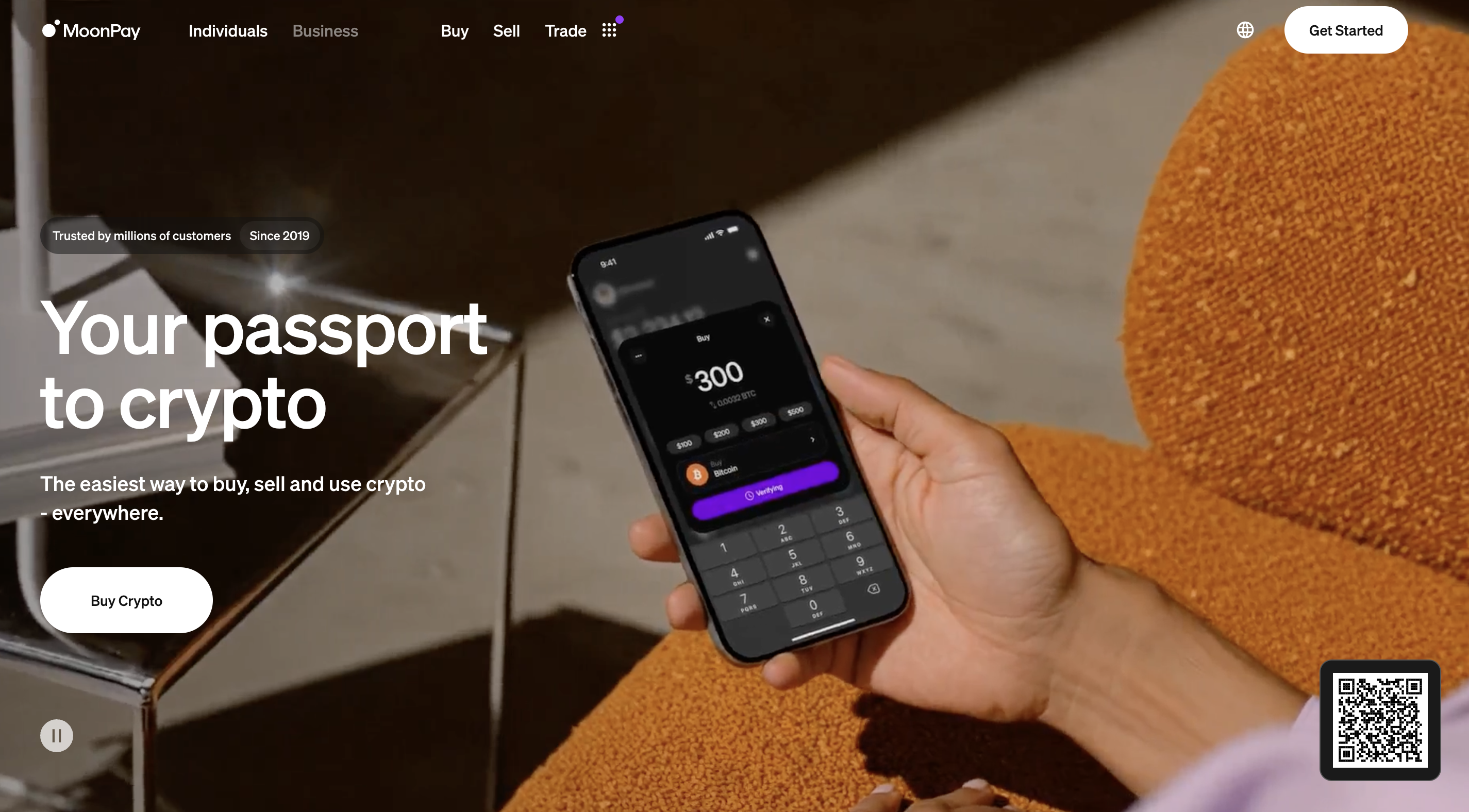
MoonPay was founded by Ivan Soto-Wright, Victor Faramond and Maximilian Crown in 2019 in Miami and has since built a community of 35 million verified members across 180 countries.
The company is licensed under MiCA in the EU through its Dutch entity (MoonPay Europe B.V., registered with AFM), is registered as an MSB in the USA and is registered with the FCA in the UK.
MoonPay raised $200 million from Galaxy in 2025 and acquired two companies — Helio ($175 million) and DFlow ($100 million). The startup was ranked #21 on CNBC’s 2025 Disruptor 50 list and has been in talks to fund ICE at a $5 billion value.
Transak
Founded in Miami in 2019 by Sami Start and Yeshu Agarwal, Transak presently supports 10 million+ users on 600+ apps.
The platform is registered with the UK FCA, US MSB (NMLS ID 2362652), FINTRAC in Canada and has Money Transmitter Licenses in 11 US states as well as Australia, Singapore and Hong Kong.
Transak raised $16 million from IDG Capital and Tether in 2025. In April 2026, Gobi Partners invested to expand Transak’s payment infrastructure across ASEAN regions.
Data Snapshot
Feature
MoonPay
Transak
Founded
2019
2019
Headquarters
Miami, USA
Miami, USA
Verified Users
35M+
10M+
Country Coverage
180+
169
Cryptocurrencies
80+ direct / 2,000+ swaps
136–173
Fiat Currencies
34
76
Payment Methods
8+
17+
Card Fee
4.5% (min $3.99)
0.99% – 5%
Bank Transfer Fee
Up to 1%
Varies by region
KYC
Tiered, incremental
Multi-level (1–3)
Security Certs
SOC 2 Type 2, ISO 27018, PCI DSS
SOC 2 Type II, ISO 27001:2022
Regulatory
MiCA (EU), MSB (US), FCA (UK)
FCA (UK), MSB (US), FINTRAC (CA)
Integrations
500+ apps
600+ apps
NFT Checkout
Yes (MoonPay Commerce)
Yes (Transak NFT Checkout)
Off-Ramp
Yes
Yes
OTC Desk
No
Yes
Head-to-Head Comparison
MoonPay: Key Features
MoonPay has established a consumer product suite around its basic onramp.
MoonPay Balance allows customers add money to their account via bank transfer, and then buy crypto with 0% MoonPay fees – card network fees still apply. The Balance feature was rolled out across the EU, UK, Australia and expanded to the Netherlands, Malta, Iceland and Liechtenstein in 2025.
MoonPay Trade, announced in 2026, is a DeFi liquidity infrastructure with programmable APIs for AI agents and institutional clients. MoonPay Deposits (February 2026) Users can deposit funds to wallets with crypto from any chain, with MoonPay swapping and bridging behind the scenes.
Transak: Key Features
Transak’s product approach is more modular.
Transak Stream – released in late 2024, provides virtual bank accounts for regular fiat-to-crypto transfers — ideal for payroll systems and fintech enterprises.
NFT Checkout is a widget for marketplace and dApp developers that supports 136+ tokens, has a 95% approval rate, and 100% chargeback protection.
Transak OTC offers specialized account managers and low pricing for large-volume trades ($5,000 minimum).
KYC Reliance, where partners can utilize their own identity verification and Transak takes care of the on-ramp.
Fees and Pricing
Both platforms display a full breakdown of costs prior to transaction confirmation, but they use fundamentally different pricing models.
MoonPay relies on a flat, standardized fee structure, making card purchases consistent but relatively expensive for smaller transactions.
Transak uses a variable fee model based on payment method, currency, and region, which offers lower starting rates for card purchases and local payment rails.
Criterion
MoonPay
Transak
Pricing Structure
Flat rate for all users; no tiered or subscription plans
Variable rate based on payment method, currency, country, and asset
Card Fees
4.5% flat fee (minimum $3.99)
0.99% – 5% variable fee
Bank Transfer Fees
Up to 1%
Varies by region (SEPA usually cheaper in Europe)
Special & Local Options
0% MoonPay fees on MoonPay Balance (network/provider fees still apply)
Specific fee tiers for local rails (UPI in India, PIX in Brazil, SPEI in Mexico)
Minimum Fee Policy
$3.99 minimum on card purchases
No explicit minimum fee (transactions under $50 may have higher effective % rates)
Cost on $100 Card Purchase
$4.50
$1.00 – $5.00 (depending on region)
Cost on $100 Bank Transfer
Up to $1.00
$1.00 – $2.50 (in approved regions)
Fee Breakdown
Displayed prior to confirmation
Itemized breakdown of Transak fee, network/exchange fee, and conversion price prior to confirmation
Transaction Limits and Minimums
Both MoonPay and Transak have different transaction restrictions based on your KYC level.
MoonPay: Basic transactions (minimal KYC) $50-150/day to start. Limits climb to $2,000-4,000 per day as users complete ID and selfie verification and higher for confirmed enterprise customers.
Transak: Level 1 permits small purchases (depends on location, usually starts at roughly $50) Level 2 and 3 (complete ID / document verification) unlocks $5,000-10,000+ limitations per day. Transak has an OTC desk for trading above $5,000 with bespoke limitations.
Speed and Processing Time
Most card transactions are processed within minutes via MoonPay. Bank transfers are as rapid as the underlying financial rail - SEPA Instant, Faster Payments, and ACH are usually fast, whereas regular wire transfers can take 1-3 work days.
According to MoonPay, the success rate of their card transactions is about 92-94%. The most frequent reason for card declines is the card issuer’s fraud filters, not the failure of the MoonPay system.
Transak says its NFT Checkout flow has a 95% approval rate. Standard on-ramp transactions for card and digital wallet payments are finalized in minutes.
Bank transfers are processed at the same time as MoonPay. Transak off-ramp payouts via Visa Instant settlement in most countries in minutes - far faster than MoonPay's normal 1-3 day bank withdrawal window Both services offer instant withdrawals via PayPal and SEPA Instant payments.
Security and KYC
MoonPay: PCI DSS Recertification (2024), SOC 2 Type 2 and ISO 27018 Certifications achieved. The platform is non-custodial, meaning it never holds user coins.
Most new users are required to complete KYC, which involves identity document verification and facial recognition. The transaction limitations will grow when the user completes more verification processes. MoonPay is registered as an MSB in 43 states in the US and licensed as a crypto-asset service provider under MiCA through its Dutch business. KYC Reliance - integrated partners can verify on their end.
Transak: Certified to SOC 2 Type II and ISO 27001:2022. The platform is non-custodial and registered with regulators in over 15 jurisdictions including UK, USA, Canada, Australia and Hong Kong.
Transak’s multi-tier KYC solution gives users the power to choose their verification level up front:
Level 1: Minimum information for modest transactions.
Level 2: Additional document verification for medium limits.
Level 3: Full identity verification for maximum limits. It puts power users in charge of their verification workflow, instead of popping up KYC questions in the middle of a transaction.
Transak now provides KYC Reliance through Sumsub for enterprise partners.
Both platforms perform ongoing AML screening, sanctions list checks and transaction tracking. Not one has experienced a serious public security breach or an event of loss of funds.
User Experience
MoonPay’s consumer interface is elegant and simple. The onboarding sequence prompts for email, uses a third-party KYC provider to verify identification, and shows a simple buy/sell page. The platform offers a standalone software, as well as embedded widgets for partner wallets and dApps.
The MoonPay app allows crypto-to-crypto swaps across more than 2,000 assets, NFT browsing and portfolio tracking. The embedded widget offers a simplified buy button that reduces friction but comes with fewer capabilities.
Common user feedback on MoonPay:
Positive: easy onboarding, common payment methods (paypal, venmo, apple pay), nice layout on mobile app, transparent fee display before confirming
Negative: 4.5% card charge feels expensive for little purchases, KYC might be confusing when incremental verification triggered mid-transaction, limited crypto options for direct buy
The interface of Transak is mostly integrated into partner apps and not available as a standalone consumer product. The solo experience is less refined, but the embedded widget is fully customisable, allowing developers to tweak the color palette, layout and transaction flow. The widget provides 17 on-ramp alternatives including local payment methods like UPI (India), PIX (Brazil), SPEI (Mexico), and regional bank transfers.
Common user feedback on Transak:
Positive: reduced fees on certain payment methods 17+ payment choices including local railroads multi-layered KYC allowing consumers to be in control
Negative: occasional ETH gas related transaction concerns, support response times differ by area, interface consistency depending on the partner app
Customer Support
MoonPay provides consumers and businesses with 24/7 live chat and email service. The support team addresses:
Transaction difficulties
KYC queries
Refund requests
Integration help for partners
Response times for chats are usually under 10 minutes during peak hours. An Account Management Team is assigned to Business users. MoonPay’s partner dashboard enables integration monitoring and webhook settings.
Transak offers:
email assistance
an in-app live chat widget
a dedicated help center with documentation and troubleshooting instructions
Response times depend on traffic and region — the platform says that resolution for routine inquiries is often within 24-48 hours. Enterprise Clients get their own dedicated account manager.
Transak’s complaint process is publicly accessible. Users can raise complaints using the support portal. Each complaint is recorded, categorized, and used to enhance the service. Urgent cases are treated as priority.
Public Reputation and Reviews
On the MoonPay vs Transak review front, social mood on Reddit and crypto communities is comparable for both services. The community does not view any brand as a "scam." Both are seen as legitimate infrastructure tools: The key topics of discussion are pricing transparency and KYC hassle, issues that are universal to all fiat on-ramps, not specific to either platform.
MoonPay has a 4.1/5 rating on Trustpilot from 86,000+ reviews. Good evaluations generally include fast transaction turnarounds, trustworthy fund delivery and easy connection with PayPal and Venmo. Negative reviews mention the 4.5% card cost, occasional delays with KYC, and trouble reaching help in high-volume periods. MoonPay is on CNBC’s 2025 Disruptor 50 list (#21) and has been talking about IPO preparations.
Transak has a rating of 4.2/5 on Trustpilot from 22,000+ reviews. The positive reviews highlight the cheaper rates on bank transfers, the flexibility of local payment methods in emerging areas and the multi-level KYC mechanism. Negative reviews note variable support response times, occasional transaction delays on some networks (especially Ethereum mainnet) and the absence of a sophisticated standalone consumer software.
Why Choose MoonPay?
MoonPay caters primarily to users and applications seeking established payment methods, European regulatory compliance, and a consumer-facing product ecosystem.
Payment Methods & Ecosystem: Integrates with major consumer payment rails, including PayPal, Venmo, and Apple Pay. The standalone MoonPay app includes built-in crypto swaps across 2,000+ assets, portfolio tracking, and NFT features.
Zero-Fee Option: Features MoonPay Balance, allowing zero-fee crypto purchases when funded via bank transfer.
Regulatory Status & Scale: Holds a MiCA license in the EU, serving over 35 million users across 500+ app integrations.
Why Choose Transak?
Transak focuses on global payment method coverage—particularly in emerging markets—alongside flexible KYC options and modular developer tools.
Regional Payment Support: Offers 17+ payment methods, including local rails such as UPI (India), PIX (Brazil), and SPEI (Mexico).
Flexible KYC & Fee Rates: Implements a user-selected multi-level KYC system. Variable fees start at 0.99% depending on the region and payment method.
Developer & Infrastructure Tools: Provides modular tools like Transak Stream, which enables automated recurring fiat-to-crypto transfers via virtual bank accounts.
FAQ
It all depends on what you pay with. MoonPay charges a flat 4.5% cost on card purchases whereas Transak charges a variable fee (0.99%-5%) that could be lower or higher depending on your region. Typically, MoonPay’s charge for bank transfers is up to 1%, much lower than Transak's variable range. MoonPay Balance reduces MoonPay costs for financed purchases.
Both are safe, controlled and non-custodial: MoonPay is PCI DSS, SOC 2 Type 2 and ISO 27018 certified. Transak is SOC 2 Type II and ISO 27001:2022 certified. Both platforms have ongoing AML screening and sanctions checks.
The fundamental difference is in positioning, MoonPay is focused on a more refined consumer experience, working with the biggest payment brands like PayPal, Venmo and Apple Pay, and has a standalone app. Transak is targeting developers and global markets with 17+ payment options (including UPI, PIX), lower startup fees, and modular infrastructure.
Yes. Both platforms demand identification verification. MoonPay is incremental; you can buy modest amounts with little information and will be verified as you raise your limits. Transak offers multi level KYC where you choose your level of verification up front.
Both platforms have dynamic restrictions depending on KYC level. Basic transactions start at about $50-150/day MoonPay: complete verification, enables ~$2,000-4,000/day Transak: $5,000-10,000+/day Transak also has an OTC desk for bigger trades.
Transak frequently charges less for modest card purchases, with a starting rate of 0.99% MoonPay can be cheaper for bank transfers (up to 1%). The zero-fee MoonPay Balance is the cheapest option to buy bitcoin, provided you can fund it by bank transfer.
ChangeNOW at TOKEN2049 Singapore: Where to Find us During This Week
ChangeNOW's guide to its TOKEN2049 Week in Singapore: where to find the booth, when its team speaks, and how to get into its own and partner side events.
Bitget has confirmed a major security breach affecting approximately $387.5 million in assets across its hot and warm wallet infrastructure. Private-key compromise has been ruled out.


 Founded in Miami in 2019 by Sami Start and Yeshu Agarwal,

