Quick summary:Crypto perpetual futures or perps are leveraged contracts on an asset's price that never expire. A funding rate paid between longs and shorts keeps the price close to spot, and it quietly eats into every open position. Kraken and Coinbase brought perps onshore in 2026, and the Nvidia sell-off on Hyperliquid showed what traders like about them: they react to news around the clock.
Kraken and Coinbase officially added perpetual futures to their arsenal.
Backpack just got CFTC approval for its US derivatives exchange and clearing operations. Which means they will officially offer 24/7 leveraged crypto perpetuals to American traders.
And somewhere in the middle, the line between structured trading and pure speculation keeps shifting.
Perps aren't new, but the conversation around them gets louder than ever.
Here we break down how perpetual contracts work and how they differ from standard futures and margin trading. We will also cover the mechanics of funding rates, and contrast of how TradFi leaders and crypto experts from ChangeNOW view this growing market.
Key Takeaways
Perps never expire. There's no settlement date forcing you to close or reassess a trade.
A funding rate keeps the perp price tied to spot, and it's a real, recurring cost: every 8 hours on most big exchanges, every hour on Hyperliquid.
Higher leverage and no checkpoints make perps feel different to trade than margin or standard futures, even when the risk math is similar.
Kraken launched CFTC-regulated perps for US users in June, and Coinbase got CFTC clearance in May to route US clients to them. The instrument is slowly leaving its offshore, "wild west" reputation.
TradFi leaders and crypto experts disagree on what that means: a leverage product with no real hedge value, or a tool that's simply maturing.
Perps vs. Futures vs. Margin: What's Different
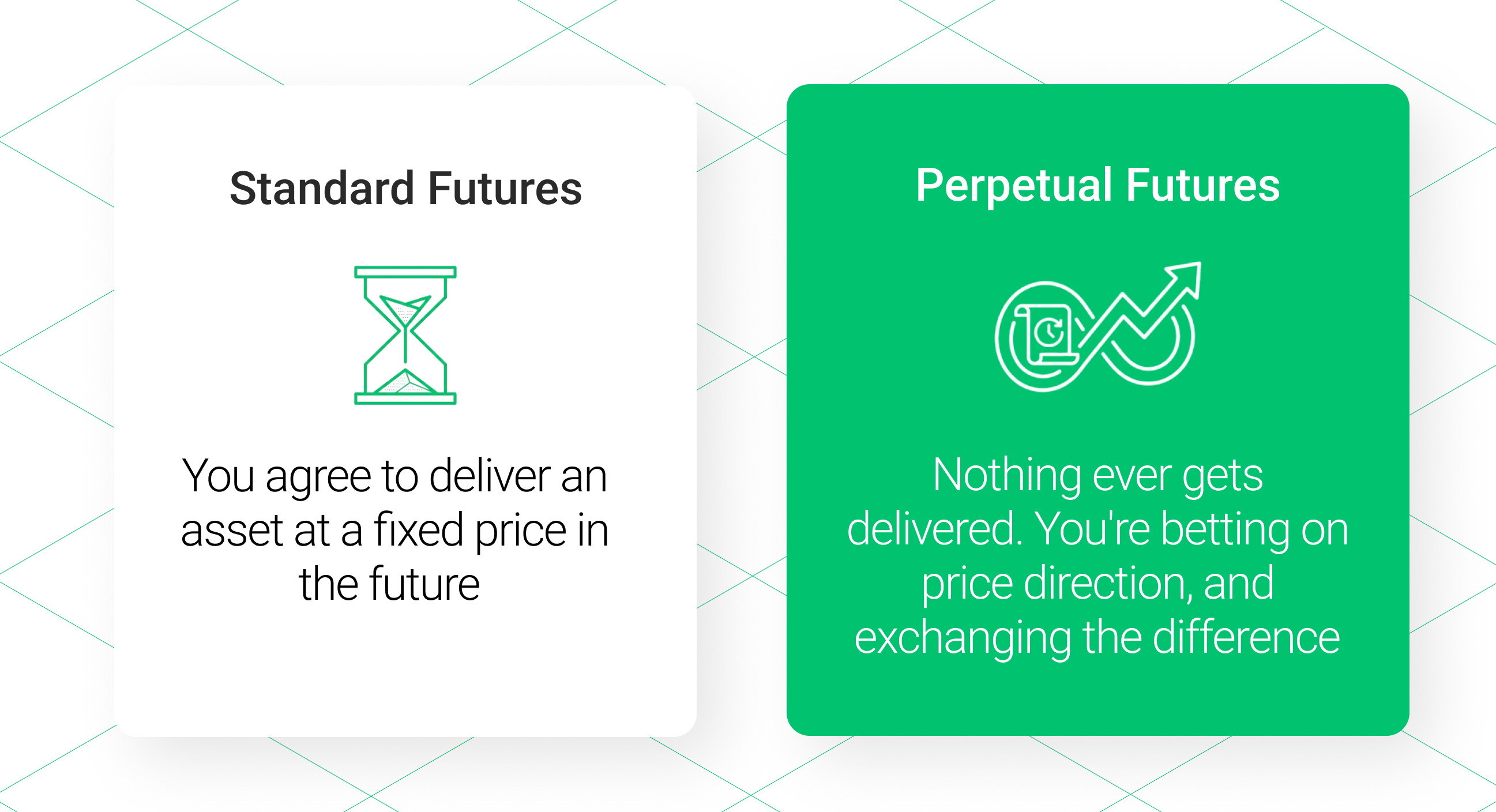
A perpetual future (or perp for short) is a contract on the price difference of an asset, but not on the asset itself.
Let’s say you and your friend bet on Bitcoin's price. You think it's going down (you short), your friend thinks it's going up (they long).
At regular intervals, as long as the bet stays open, one of you pays the other a small amount. On most big exchanges that's every 8 hours, on Hyperliquid every hour.
If most of the market shares your friend's sentiment, longs (including him) pay shorts to keep the perp price tied to spot. If the majority are bearish like you, shorts pay instead.
Without the funding rate, the perp's price could drift too far from the actual spot price, and the contract would stop reflecting reality. That would let arbitrage traders go wild.
As ChangeNOW’s Chief Product Officer Elias Vilochkin explains it:
"Perps definitely have distinct mechanics. No expiry, the ongoing funding mechanism, historically higher leverage, and a market that never sleeps. Combined, it creates an environment where drawdowns can accumulate faster and completely under the radar."
For that matter, perps often get compared to margin trading. They share the same high-risk, high-reward profile, but that's about it.
Margin trading is a whole different story: you're borrowing real funds against a real asset, and paying interest on the loan.
Here are same three instruments, side by side comparison:
Feature
Perps
Traditional Futures
Margin Trading
Expiration
None
Fixed date
None
What you're trading
A contract
A contract
The actual asset
Leverage source
Your margin (no actual loan)
Exchange
Borrowed funds
Price anchor
Funding rate
Settlement date
Spot price
Cost of holding
Funding fees
Priced into contract
Borrowing interest
The Funding Rate as a Hidden Cost
Since perps never expire, they have a mechanism to keep their price from drifting away from the actual spot market. It’s the funding rate we were talking about earlier and it’s essentially a financial tether.
The funding rate isn't a fee paid to the exchange. It’s a P2P rebalancing mechanism that happens directly between traders.
The Cost of Holding Over Time
The real trap is that funding fees feel invisible because they are debited directly from your margin balance - you don’t even need to close out.
It’s incredibly easy to treat a perp position like a spot bag that you can just sit on for months.
And of course, there’s a catch: the funding rate applies to your full position size, not just your collateral.
Say you put up $1,000 and use 10x leverage. You're now managing a $10,000 position. A "tiny" 0.05% funding rate isn't nibbling at $10,000, it's coming straight out of your $1,000. Leverage just made that fee hit ten times harder.
Stay in a high-funding position for too long, and it will quietly eat your profits or trigger a liquidation while the price barely moves.
The other trap is more psychological in nature and we’re covering it in the next section.
Why Trading Perpetual Futures Feels Different
Switching from spot or margin to perps completely changes the daily trading routine. It’s a mix of different mechanics and a subtle shift in trading psychology.
Synthetic Mechanics vs. Real Borrowing
With classic margin trading as we know it, you’re physically borrowing coins from a lending pool. And it leaves you exposed to sudden interest rate spikes and liquidity bottlenecks.
Perps are purely synthetic by nature: you aren't actually borrowing anything, which is why dialing your leverage up or down is so fast and friction-free.
But while crypto-native platforms celebrate this capital efficiency, TradFi icons look at the exact same mechanics with deep skepticism.
Speaking on CNBC's ’s Fast Money in June 2026, CME Group CEO Terry Duffy didn’t mince words, comparing the current retail perp boom to the subprime mortgage crisis: "This is 2007 for retail."
Duffy points out that the built-in auto-liquidation engines of perps can easily trip over each other during high volatility, causing exponential, cascading crashes. He also criticizes the core mechanics of the contracts, specifically, the lack of an expiration date:
"Because a perpetual does not expire... you cannot forward hedge that product with any credibility of a future data delivery or cash settlement. So it’s not a credible product. It’s a leverage product. That’s all it is."
Ultimately, the lack of an expiration date limits a perp’s utility for traditional hedging, making it strictly an instrument for leverage. And this highlights the core structural difference: TradFi derivatives are typically designed for risk management, while crypto perpetuals are optimized for capital exposure.
But it’s not like crypto exchanges are blind to this weak spot.
To avoid unnecessary liquidations during local flash crashes, platforms now use a Mark Price - a smoothed index that is tied to global spot markets, protecting positions from sudden price spikes on a single exchange.
The "No Checkpoint" Psychological Trap
That technical flexibility is great, but losing the expiration date removes a major psychological guardrail.
On Reddit a trader highlighted exactly how this flexibility backfires: without a forced settlement date, you lose the natural checkpoints that make you step back and re-evaluate.
A quick, short-term idea easily blurs into an unplanned, indefinite hold. When the price moves against you, it’s dangerously easy to keep adding margin to a losing trade just to "buy time" and avoid admitting the thesis didn't work out. It also might get expensive because you aren't just sitting in a losing position, you are actively paying a funding rate simply to delay a decision.
A 2025 review in Psychology Today points to a structural reason for this: features like instant mobile access, zero fees, and gamified interfaces make modern trading platforms feel less like investing and more like betting, regardless of the asset being traded.
Perps amplify that dynamic. No expiry date and a recurring funding rate remove the natural pauses other instruments build in by default.
ChangeNOW’s Head of Brand and public speaker, Pauline Shangett notes that this behavioral shift is exactly where the risk lies, rather than in the tool itself:
"Perps are an interesting evolution, but they require a high level of self-control. Because they are so seamless, it’s incredibly easy to slip into a mindset of pure speculation and blow through your capital. They offer way more flexibility than traditional futures, but that comfort can make traders complacent, blurring the line between a structured strategy and a game of chance. There’s no point in demonizing perps. They are a legitimate trading tool used actively across the market. But you have to remember that all this flexibility comes with a very specific set of challenges."
Kraken and Coinbase Enter Crypto Perps: What Changes?
For years, perpetual futures were primarily the domain of offshore, lightly regulated platforms. In 2026, that started to change:
Earlier: Coinbase offered US users "perpetual-style" nano BTC and ETH futures since July 2025, with a 5-year expiry instead of none.
May 29:* the CFTC approved Kalshi's Bitcoin perpetual contract and gave Coinbase a no-action position to connect US institutional clients to global perps through its Deribit unit.
June 15: Kraken launched CFTC-regulated perps for eligible US users on Kraken Pro, listed on Bitnomial (BTC, ETH, SOL, XRP and a few others).
November 17: Backpack secured CFTC approval for its US derivatives and clearing operations, allowing them to bring 24/7 leveraged crypto perps directly onshore.
Coinbase argued that some US institutions had to set up offshore entities just to access these markets, which is the gap onshore perps are meant to close.
Not everyone is convinced. CME Group sued the CFTC over the approvals, arguing perps are swaps rather than futures.
What do ChangeNOW’s experts make of it? CPO Elias Vilochkin:
"It depends on the horizon you're looking at. Cascading liquidations and market manipulation can definitely create short-term chaos. But overall, the democratization of tech and financial tools is a net positive in the long run. Bans and heavy-handed regulation are quick political wins that patch isolated risks. Over the long term, letting the market learn and accumulate experience brings far more benefits to everyone."
Nvidia Weekend on Hyperliquid
The scandal around Nvidia CEO Jensen Huang broke on Sunday, November 8. On Thursday the 12th, Huang was out, and the stock took a hit.
Perps reacted first. Nvidia contracts on Hyperliquid started sliding on Sunday, while the stock market was closed, and dropped nearly 12% on Wednesday night. Trading volume hit a record.
Why the rush? For the reasons we already covered. Perps let you start monetizing the hype instantly, without waiting for the market to open. They are faster than stocks. And traders take the bet despite the fact that perps don't imply ownership of actual shares, despite crazy leverages and underlying risks.
Conclusion: What Kind of Instrument Crypto Perps Are?
The debate keeps splitting along the same line. Traditional finance sees a high-leverage product without the guardrails derivatives are supposed to have. Crypto sees a flexible tool that finally matches how the market actually trades - non-stop.
The mechanics are not what makes perps risky or safe, it’s how someone trades them.
Coming back to where we started, as Elias frames it:
"Gambling is when the outcome is dictated by pure chance. Perps don't change the core reality of trading: you still need a thesis, you still analyze the data, and you still manage the position. High risk doesn't mean it's a game of chance, otherwise, venture capital would be in the same boat. People criticized margin trading for the exact same reasons early on, but the market digested it just fine. It will digest perps, too."
FAQ
Perps, short for perpetual futures, are crypto contracts that let you bet on an asset's price without ever owning it or facing an expiry date. Unlike traditional futures, they never settle. Instead, a funding rate keeps the contract price tied to the spot market.
A perpetual contract is a derivative that tracks the price of an underlying asset, like Bitcoin, but never expires. Traders exchange the price difference between opening and closing a position, and pay or receive a funding fee every 8 hours to keep that price anchored to spot.
You open a position betting the price will go up (long) or down (short). Every 8 hours, whichever side is in the majority pays a small funding fee to the other side. This keeps the perp price close to the spot price, even though the contract itself never expires or settles.
If the market moves against your position and your margin can't cover the losses anymore, the exchange automatically closes it. That's a liquidation. Higher leverage means a smaller price move can trigger one, since there's less margin cushioning the trade.
Trading perps feels less bound by deadlines. With no expiry date, there's no built-in checkpoint forcing you to close or reassess a position, which changes both the mechanics and the psychology of holding a trade.
The underlying mechanics are similar, but Kraken and Coinbase operate as regulated, US-facing platforms. That means more oversight and consumer protections than offshore exchanges that have historically dominated perps trading.