


Consensus is one of those quiet, behind-the-scenes mechanisms that keep a blockchain running. It’s basically how the network decides which transactions are legitimate and which blocks deserve a permanent place in the chain.

Consensus is one of those quiet, behind-the-scenes mechanisms that keep a blockchain running. It’s basically how the network decides which transactions are legitimate and which blocks deserve a permanent place in the chain.
If people scattered around the world couldn’t somehow land on the same answer without trusting each other, the whole idea of decentralized money or digital ownership would fall apart quickly.
The PoW versus PoS debate exists because both aim to secure blockchains differently. PoW relies on intensive computation, while PoS depends on stakeholders. This key difference has sparked ongoing discussions about what defines security, decentralization, and responsibility.
And the choice goes way beyond who gets to add the next block. It shapes the network’s energy footprint, who can realistically participate, how well it withstands specific attacks, and whether regular people feel comfortable using it at all.
How blockchains stay secure: PoW and PoS are two completely different ways to protect a network. PoW relies on raw computing power and electricity, while PoS uses participants’ own crypto as “skin in the game.” Both keep bad actors in check, just in very different ways.
Energy and accessibility matter: PoS is far kinder to the planet and opens the door for more people to join as validators. You don’t need a warehouse of mining rigs—just some crypto and a regular computer.
Incentives shape behavior: PoW miners chase rewards through power and competition, while PoS validators earn by staking and playing by the rules. Cheaters lose their stake, making honesty the easiest path.
The shift is real: Ethereum’s Merge proved PoS works at scale, and more new chains are starting fresh with staking systems. The crypto world is moving toward networks that are faster, greener, and easier for everyday users to engage with.
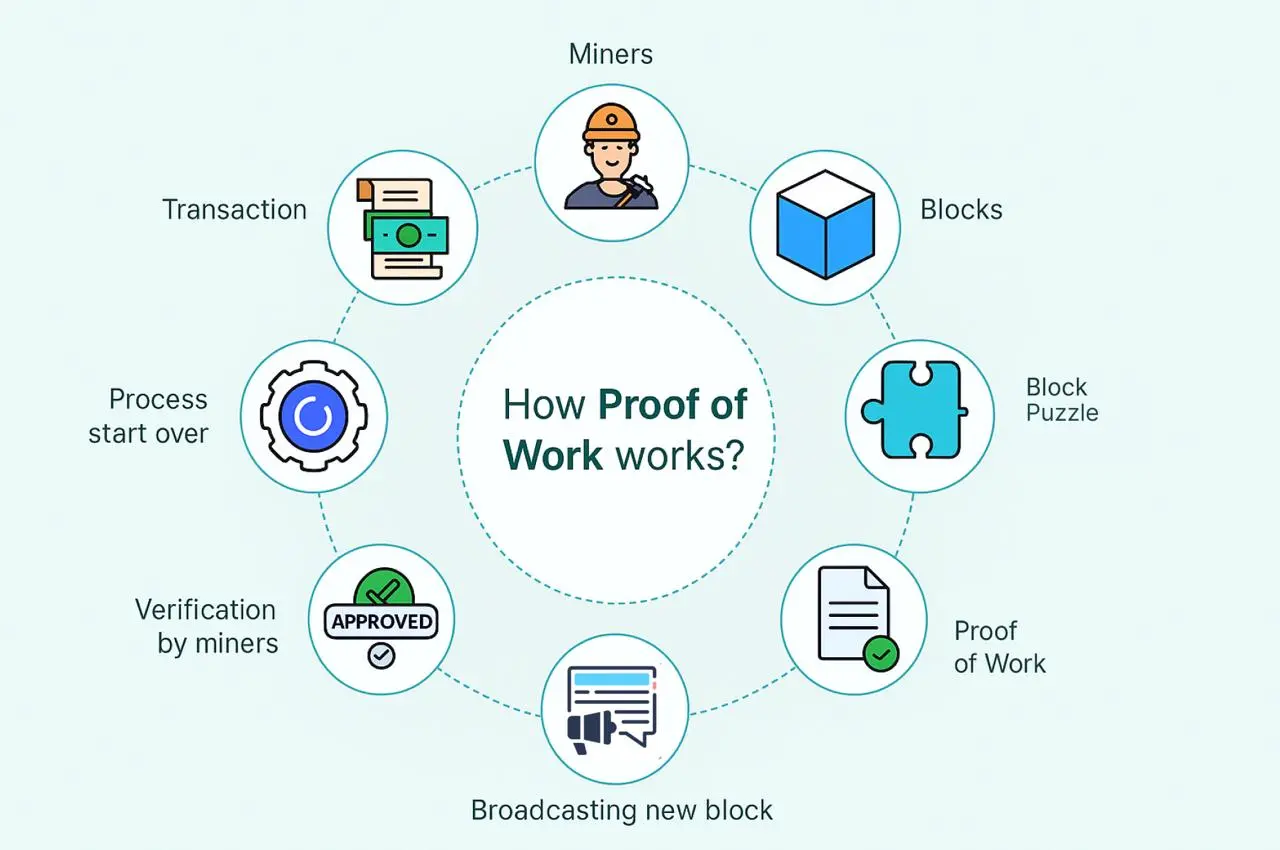
Proof of Work was the first attempt to secure a blockchain without a central authority, relying on miners to compete by solving complex cryptographic puzzles with computing power.
Whoever solves the puzzle first can add the block, collect the reward, and broadcast it for the network to verify. As noted in the Bitcoin whitepaper, this links the currency’s reliability to measurable, machine work.
Meanwhile, an often overlooked but essential aspect is the challenge of adjustment. As miners come and go, the network adjusts the difficulty of the puzzles to keep block times steady, ensuring stability and a consistent flow of coins.
What gives PoW its staying power is how expensive it is to cheat. To overpower the network, you’d need to gather an absurd amount of hardware and electricity, and the cost usually outweighs any benefit. That’s why Bitcoin has held up for well over a decade, and it’s also why networks like Litecoin and Dogecoin still stick with it.
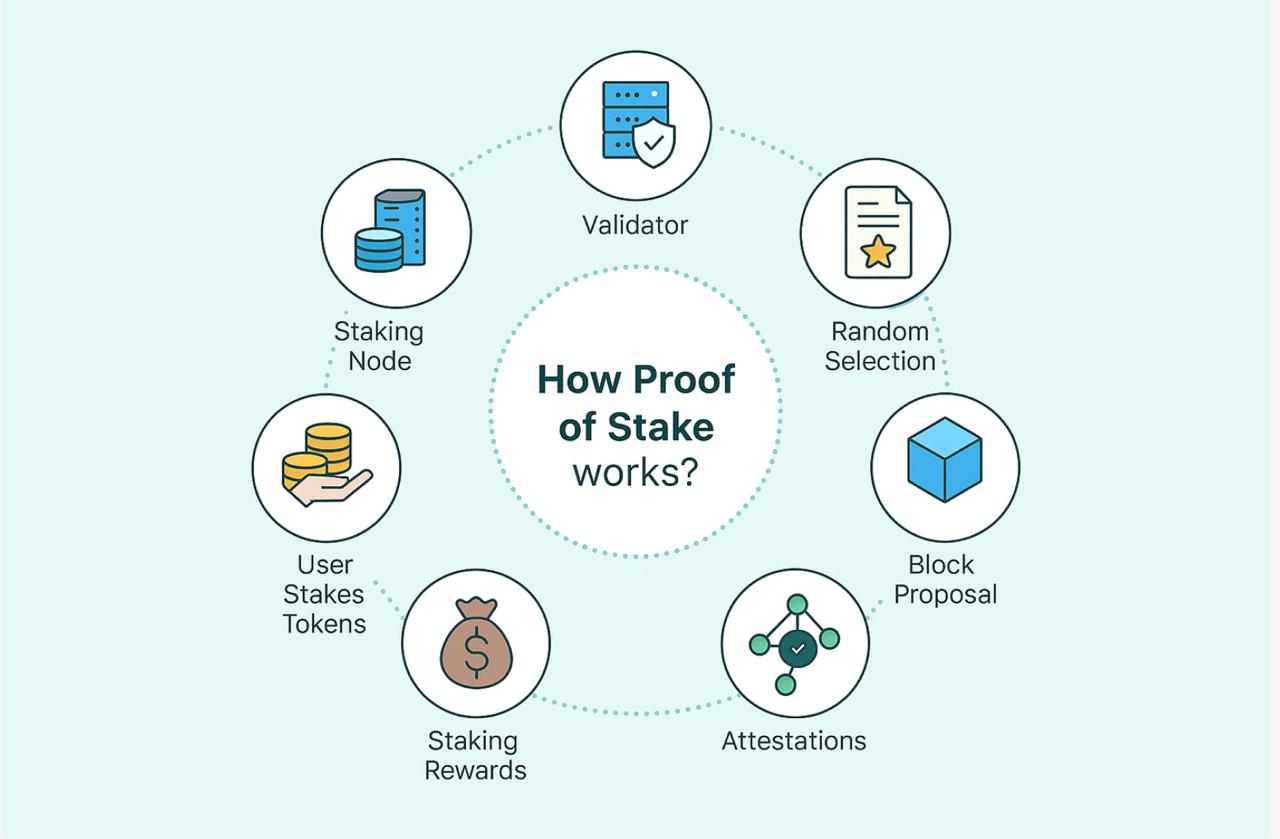
Proof-of-Stake (PoS) approaches blockchain security from a completely different angle. Instead of burning through electricity to win a race of raw computation, PoS basically asks participants to put some of their own tokens on the line. That stake becomes their signal that they’re serious and willing to play by the rules. Read more about how staking works in our article.
Ethereum’s shift to this model, the much-discussed Merge, took place on September 15, 2022. It marked the end of Ethereum’s original Proof-of-Work era. It moved the network to a staking system that had been debated, researched, tested, refined, and argued about for years. The Ethereum Foundation has repeatedly said that the change came from long-standing concerns about energy consumption, specialized hardware, and the need for a more scalable base layer for everything planned for the future.
The staking process itself is simple: you lock up ETH on a validator node, which is basically your way of saying, “I’m committed to this network.” From there, the system uses a mix of how much you’ve staked and a bit of cryptographic randomness to pick who gets to validate the next block. No one can reliably dominate that process, at least not without enormous cost.
If a validator decides to cheat, say, by proposing nonsense blocks, there’s a penalty called slashing. Part of their stake gets cut. It’s harsh by design, and the idea shows up again and again in academic work on PoS security: people behave when misbehavior becomes expensive.
Compared to PoW, PoS networks usually require far less energy and don’t force participants to buy purpose-built hardware. A regular consumer machine can often run a node, which opens the door to a much broader set of people. That combination of lower energy use, lower participation costs, and flexible scaling is a big reason so many newer chains have adopted Proof of Stake as their starting point.
In the early days, blockchain builders didn’t really have much of a menu to choose from. Proof of Work (PoW) was the only effective security model, and everything else stemmed from it. When Bitcoin launched in 2009, it demonstrated that a decentralized network could regulate itself through computational effort.
It wasn’t elegant, but it worked, easy enough to build, difficult enough to attack, and that made PoW the go-to choice for any early chain that needed durability over brilliance.
Proof of Stake showed up in conversations not long after, but most people weren’t buying it at first. The idea that token ownership alone could keep validators honest felt risky, almost too soft compared to the physical grind of mining.
For a long stretch, PoS mainly existed as an idea floating through whitepapers, IRC chats, and forum threads. A few builders still chose to test it in practice. Peercoin, launched in 2012 by Sunny King and Scott Nadal, combined PoW and PoS into one system, while Nxt, which arrived in 2013, fully embraced staking. Neither project was perfect, but they showed that PoS didn’t have to stay just a theory.
Things picked up quickly between 2017 and 2022. More formal research came out, digging into long-range attacks, slashing rules, validator rewards, and all the messy incentive questions people had been arguing about for years.
Around the same time, Ethereum’s core team began publicly outlining its plan to transition away from PoW as part of its long-term scaling strategy. That plan ultimately resulted in The Merge on September 15, 2022, a milestone that the Ethereum Foundation describes as the most complex upgrade ever carried out on a major blockchain.
The split between Proof of Work and Proof of Stake becomes really noticeable once you zoom in on how each one handles the basic job of keeping a blockchain running. They’re both trying to protect the ledger and prevent anyone from muting transactions, but they lean on completely different economic assumptions and day-to-day mechanics.
Because of that, the way people use the network, whether they’re everyday users, validators, or developers building on it, ends up feeling different on each side.
PoW anchors its security in the physical world. If someone wants to attack a PoW chain, they have to get their hands on an enormous amount of mining rigs and a staggering amount of electricity. In most cases, the cost is so high that trying to overwhelm the network just doesn’t make sense financially. That “honesty through expense” idea sits at the heart of Bitcoin’s original design.
PoS works from a different angle: validators lock up tokens, and part of that stake can be slashed if they try to feed the network bad blocks. A lot of security research points out that slashing, combined with finality rules, makes long-range attacks, the kind where old blocks could theoretically be rewritten, much harder to pull off. Both models punish dishonest behavior, but the way they apply that pressure doesn’t look the same.
Proof of Work’s energy footprint is probably the most contentious aspect of it. Critics point out that Bitcoin mining consumes somewhere between 150 and 172 TWh of electricity per year, which is almost what Poland or Argentina uses and roughly half a percent of global electricity consumption. Supporters, on the other hand, say this cost isn’t a flaw but rather what makes PoW dependable.
PoS avoids that entirely. Since there’s no competition for hardware or electricity, energy usage plummets. The Ethereum Core Team has said the switch to PoS cut Ethereum’s energy consumption by about 99.95%.
Chains that employ the PoW consensus mechanism can slide toward centralization as specialized hardware takes over. ASICs aren’t cheap, mining farms get bigger, and affordable electricity tends to cluster in certain regions, so mining power can bunch up whether anyone wants it to or not.
PoS opens the door wider in terms of hardware, as you don’t need a warehouse full of machines, but it brings a different centralization pressure: capital. Large staking pools and liquid staking platforms can aggregate significant voting power.
In PoW, miners earn block rewards and transaction fees, and the whole thing runs on a competitive loop influenced by hash rate, token prices, and the usual market noise. PoS removes the mining race and replaces it with staking rewards paid in the native token.
This shift impacts validator behavior through lockup periods, liquidity issues, and the rise of liquid staking tokens. Additionally, MEV (Maximal Extractable Value) significantly affects reward distribution in busy PoS networks like Ethereum.
| Dimension | Proof of Work (PoW) | Proof of Stake (PoS) |
|---|---|---|
| Security Model | Tied to hardware + electricity costs; resistant to attacks due to high physical expenses | Tied to token ownership, slashing and finality rules discourage dishonest behavior. |
| Attack Cost | Requires majority hash power (51% attack) and massive energy expenditure | Requires majority stake; penalties reduce incentive to cheat |
| Energy Use | High; debated but central to security assumptions | Extremely low; Ethereum saw ~99.95% reduction post-Merge |
| Participation Requirements | Specialized hardware (ASICs); higher barrier to entry | Consumer-grade hardware is possible; open to a wider validator base |
| Economic Incentives | Mining rewards, block subsidies, and the fee market | Staking rewards, lockups, liquid staking, MEV dynamics |
| Centralization Pressure | Mining pools, ASIC dominance, geographic clustering | Large staking pools, capital concentration |
As the industry continues to evolve and more networks experiment with different consensus models, many users explore both PoW-based and PoS-based assets to better understand their practical differences. If you’re interested in making a quick, non-custodial swap between cryptocurrencies — for example, moving from a PoW asset like BTC to a PoS asset like ETH — ChangeNOW provides a fast and registration-free way to do so.
Consensus ultimately shapes almost everything a blockchain can or can’t do, so understanding how PoW and PoS actually work makes it easier to understand the systems people use every day. Both approaches are sticking around; they just solve different problems and attract different kinds of communities.
You can already see the industry leaning more towards PoS. That shift is changing infrastructure choices, validator economics, and how value moves across a network of interconnected chains. Still, the debate over which model is “better” remains unresolved. It keeps coming up as new research emerges, rules shift, and global users seek different things from the networks they rely on.


How Gasless Transactions Work: The Complete Beginner-Friendly Guide
No Gas? How Gasless Blockchain Transactions Work

10 Crypto Mistakes Support Agents Fix Every Day
Wrong network, missed memo, stuck pending: the mistakes support sees daily, and here's how they get fixed

Fixed vs Floating Exchange Rate in Crypto: Which to Choose?
A fixed rate locks your final crypto amount against volatility, while a floating rate executes at live market prices. Learn the difference, risks, and when to use each.


