


Polygon price prediction for 2027, 2028 and 2032 depends on one question: can POL (ex-MATIC) turn record network activity into demand for the token?
The network has processed over 8 billion transactions, yet POL trades near $0.09, about 97% below its 2021 peak, and Reddit threads already call it dead.
To build this Polygon price prediction, we combined technical market data with real-time community sentiment. We analyzed current trading volumes, historical price floors, and active retail discussions across X and Reddit to understand market expectations. Additionally, we stay in close contact with Polygon's team to get their direct perspective on the network's future roadmap.
For the actual price ranges, we reviewed forecasting models from DappRadar, CoinCodex, and Cryptopolitan. These platforms define the baseline and peak targets for each timeframe. We then used our community analysis to map out the specific network catalysts POL needs to actually reach those numbers.
Disclaimer: This article is for informational purposes only and does not constitute investment advice or a recommendation to buy or sell crypto assets. Any views, opinions, or forward-looking statements reflect current market sentiment and publicly available information and should not be relied upon as a basis for investment decisions.
Where POL Stands Right Now
Quick summary: Right now, Polygon's market reality is a bit ironic. Over the last four weeks, three major adoption and tokenomics updates did less for the POL price than one badly timed joke on X. The network is burning supply and securing traditional bank integrations, but traders are currently reacting to macro trends and Bitcoin rather than ecosystem news.
POL Price and Market Activity
Quick snapshot of the current Polygon (POL) position as of Oct, 2026:
- Market cap: $955 million
- Rank: #76 on Coingecko
- 24h Trading volume: ~$50.00M
- Circulating supply: 10.63B POL
- Total supply: 10.64B POL
Recent POL price action has been completely disconnected from the project's fundamental development.
When Polygon closed a major regulatory deal with Coinme in mid-October, the price didn't rally. Instead, it slid 7% over the following days.
Later, when German Sparkassen banks added POL to their trading apps, the market responded with a modest 3.4% bump.
However, social sentiment proved highly fragile.
One awkward joke on X made the price take an immediate 5% price drop.
Right now, the market is trading on emotion and macro conditions, ignoring the actual product updates.
Polygon News: Burns, Banks, and Staking
Behind the choppy price action, the network is actively shifting its tokenomics and expanding its reach:
- Supply burns: On September 23–24, the network burned 100 million POL, which is roughly 1% of the initial supply. These tokens came directly from network fees. Another 22 million POL are already queued for the next burn.
- Staking yields: The PIP-92 upgrade activated on October 1, redirecting 27.3 million POL from recycled fees to stakers. This temporarily pushes the staking rate to roughly 7.7% APR for two months. Additionally, on October 24, a Polygon multisig sent another 52.9 million POL into the staking contract.
- US regulatory access: Polygon closed a major deal with Coinme, securing coverage in 48 US states. This includes 37 money transmitter licenses and FinCEN registration, onboarding initial clients like Tazapay and Mesh.
- European banking: TradFi adoption is growing in Europe. German Sparkassen banks launched retail POL trading directly inside their banking app via DekaBank, with over 230 banks showing interest in the rollout.
- Tech rollouts: The team released Agent payments in the Open Money Stack to handle AI-agent transactions with built-in limits, and announced the CDK Besu upgrade.
Polygon’s Enterprise Strategy: Abstracting the Blockchain
Aishwary Gupta, Polygon Labs Global Head of Business outlined Polygon's adoption strategy and shared their collective vision with ChangeNOW.
The main goal is to make blockchain technology completely invisible to everyday consumers.
"The next wave of mainstream users probably won't know which blockchain they're using and they won’t care. They'll care that the payment goes through, the cost is clear and the experience is seamless."
To do this, Polygon released the Open Money Stack. This framework works in the background for traditional companies. It lets them process crypto payments without locking users into one specific network.
"That's why we’re building the Open Money Stack as 'open.' Businesses can use the network that works best for their customers, while we handle the connections behind the scenes. We're building Polygon to be the best choice for payments, no matter the route, and we want businesses to choose it because it delivers the best experience for customers."
Public blockchains create a problem for standard companies. They need to pass audits, but they cannot expose their cash flow to everyone. Polygon addresses this by letting companies customize their network privacy.
"Businesses already expect financial privacy. Using stablecoins shouldn't mean giving that up. The goal is to let them choose the level of confidentiality they need while supporting their audit and regulatory obligations. On Polygon, it can mean private payments in a wallet or a private blockchain built for an institution. The business can choose what fits."
If this approach works, Polygon will process massive stablecoin volume for standard businesses. Analysts believe this real-world usage is exactly what the network needs to create steady demand for the POL token.
Next read: Stablecoin Payment Infrastructure: Polygon Labs on What’s Holding Stablecoin Adoption Back
Market Sentiment: What the Crowd Is Saying
Quick summary: Social chatter around Polygon (POL) is a mix of sky-high optimism and grassroots frustration. Frustration prevails. While data aggregators show positive engagement, actual threads on X and Reddit reveal a crowd growing tired of the price stagnation and PR stunts.
Social Metrics: LunarCrush and Google Trends
Aggregated social data from LunarCrush paints a surprisingly heart-warming picture. The breakdown by channel shows X (ex-Twitter) accounts for the bulk of mentions, with the algorithm classifying 48% of posts as bullish and only 8% as bearish.
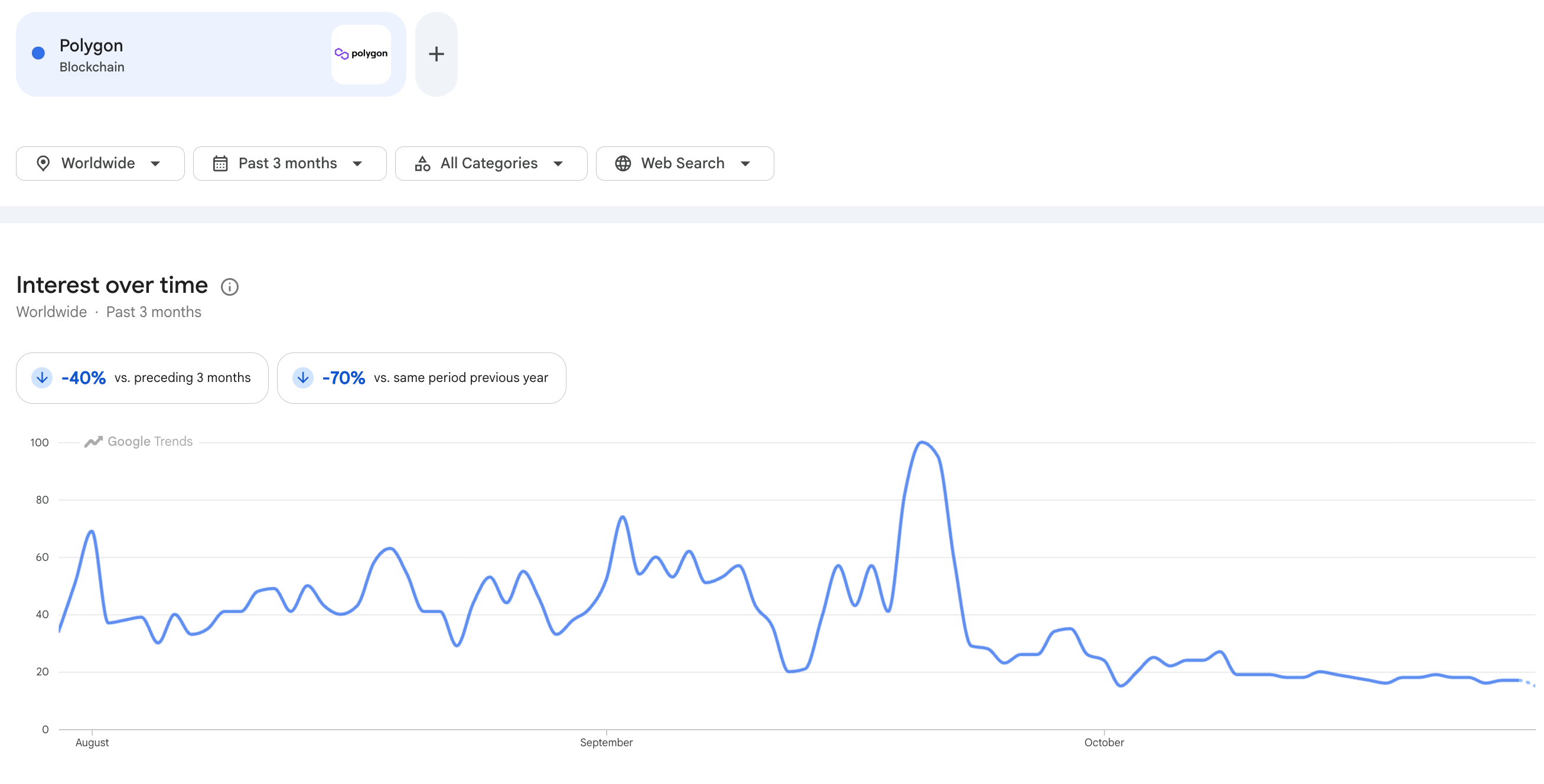
Google Trends data tells a story of fading momentum. Worldwide search interest for Polygon over the past three months is down 40% compared to the preceding period, and down 70% year-over-year, showing that casual retail curiosity has heavily cooled off.
Source: Google Trends
Social Media: X and Reddit
On X, the Polygon team often rolls out loud, attention-grabbing statements.
Recently, the official account posted a dramatic "DEAR EVERYONE" message that sounded like a project shutdown which it wasn’t - it was actually a joke about hitting a record year for payments.
https://t.co/K61bXjE991
— Polygon (@0xPolygon) October 6, 2026
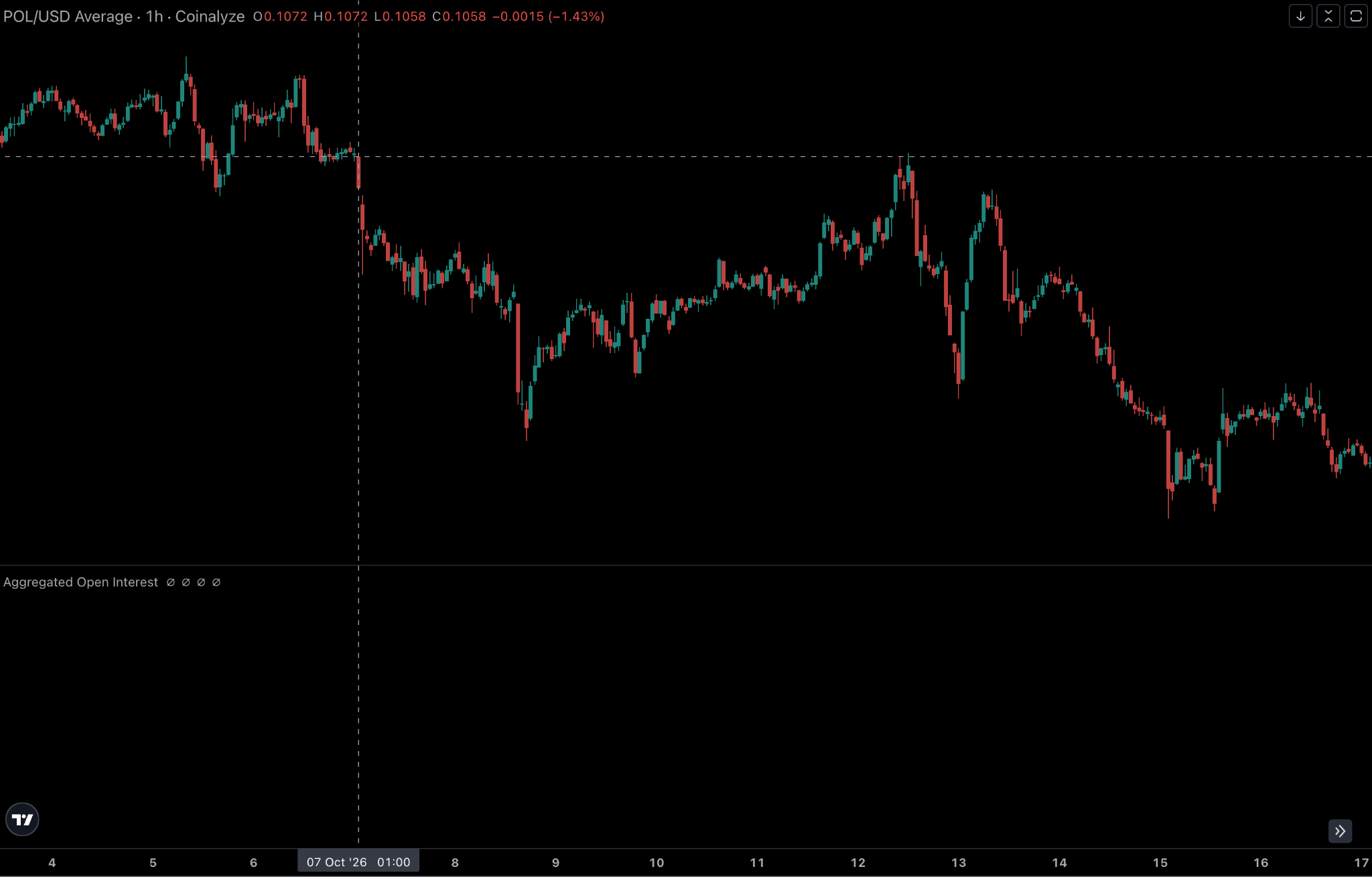
The joke backfired. Users responded immediately by posting screenshots of the token's steadily falling price.
Source: Coinalyze
Open interest fell by 13%, and funding rates flipped negative until founder Sandeep Nailwal had to step in and publicly debunk the rumors.
“I think this didn't land as expected and people conjured up completely different meaning from it. TBH, even when I first saw it my morning in SGP, I was like, "WTF?"
He also said that despite the claims of Polygon being dead, “the fundamentals on Polygon are up and to the right.”
However, active traders are increasingly looking past the marketing metrics. When elaborate roadmaps pitching Polygon as a fully independent L1 appear on the timeline, the community is quick to cut through the jargon suggesting to “Stop confusing buzzwords with reality."
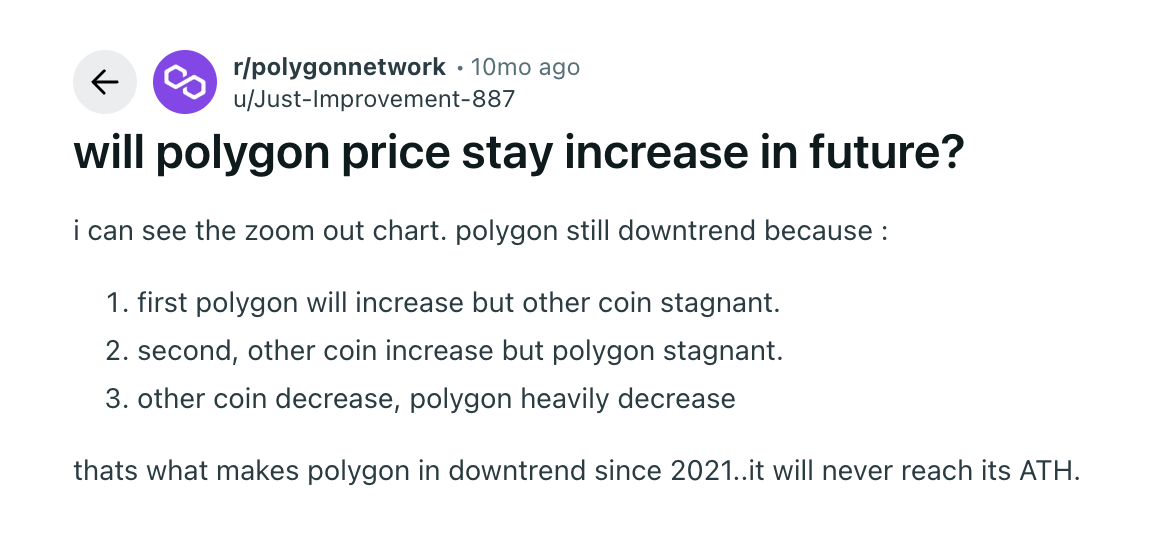
And if you turn to Reddit, here the mood turns deeply skeptical. In threads discussing the asset's future, many users openly call the token dead or point out that it has been stuck in a permanent downtrend since 2021.
Source: Reddit
The more nuanced discussions acknowledge the tech but doubt the timeline.
Redditors note that the rebrand from MATIC to POL and the push for the AggLayer shows Polygon is trying to become foundational infrastructure rather than just another Ethereum scaling solution.
However, the community is exhausted by the wait. As one user summed it up:
“Right now, holding POL is a bet on execution, not tech, and many are unconvinced that the marketing isn't outpacing the actual shipping.
POL (former MATIC) Price History
Quick summary: The price history of Polygon spans two distinct eras: the original MATIC token and the upgraded POL. The asset launched as MATIC in 2019, hit an all-time high of $2.92 in December 2021, completed a 1:1 migration to POL in September 2024, and now trades near $0.09 in late 2026.
Polygon originally launched on the Binance Launchpad in April 2019 as MATIC. The initial sale priced the token at roughly $0.0026. It spent its first year building a baseline before gaining serious traction as an Ethereum scaling solution.
Once deep liquidity entered the market, the chart followed standard crypto macro waves:
- December 2021 peak: MATIC reached its historical all-time high of $2.92. This massive yearly gain was driven by explosive retail demand for DeFi, NFTs, and Layer-2 networks.
- 2022–2023 bear market: The crypto market crash pushed the token down significantly. It lost over 90% of its peak value and traded largely under $1.00.
- September 2024 migration: Polygon officially transitioned from MATIC to POL. The network swapped the assets on a strict 1:1 basis, cementing POL as the native gas and staking token.
- October 2026 consolidation: Under the new POL ticker, the token recorded a localized high of $1.29 before entering a prolonged downtrend.
Polygon Basic Chart Analysis: Price Trend, RSI, and Open Interest
Quick summary: As of October 2026, Polygon price is resting near the $0.09 mark. The momentum has cooled off significantly, and traders are actively closing out their leveraged bets instead of forcing new trades.
Price Trend and Range
The daily chart shows a clear cooldown phase. After pushing above $0.12 earlier in the period, the asset has steadily drifted lower and is now trying to build a new base around $0.09.
The price action is sluggish, hinting that the market is mostly waiting on the sidelines for a stronger fundamental catalyst before picking a clear direction.
RSI Situation
The daily Relative Strength Index currently stays at roughly 39.6. This puts the indicator in the lower half of neutral territory, just above the traditional "oversold" line at 30.
Buyers lack momentum right now, but the reading suggests a slow sell-off.
POL Open Interest
Open interest tracks the total dollar amount of open futures contracts.
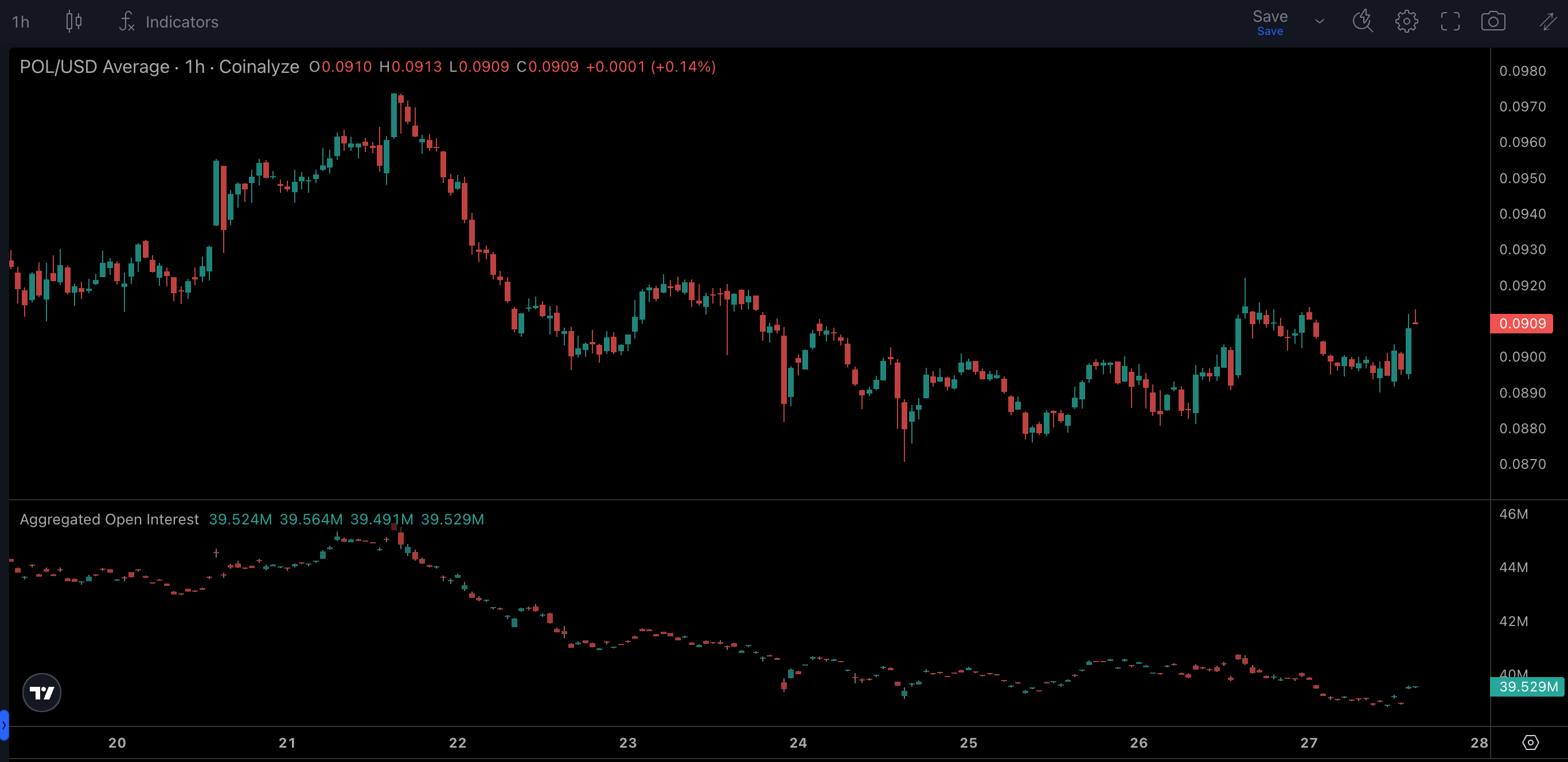
Right now, total POL open interest is at $39.5 million. The vast majority of this liquidity is concentrated on Binance and Bybit.
Source: Coinalyze
When open interest falls alongside a sluggish price, it generally means traders are closing their positions not willing to carry further risks.
Polygon (ex-MATIC) Price Prediction 2027-2032
TL;DR
- Forecasts for POL through 2032 range from a bearish $0.03 floor to a bullish recovery above $1.19.
- Short-term stability in 2027 depends on whether recent banking partnerships can offset a planned drop in staking rewards.
- For the price to grow between 2028 and 2030, Polygon must find a way to turn its massive transaction volume into consistent token burns.
- The most optimistic long-term models require the network to cut its security ties with Ethereum and operate as a fully independent L1.
Some analysts see POL flatlining, while others expect a major recovery.
The reason why their opinions are so polarized is the following contradiction: Trillions in stablecoin volume vs cheap fees.
For the price to go up, the network needs to convert that heavy usage into actual demand for the token.
The Forecasts at a Glance
The baseline numbers track current trading momentum, while the higher targets reflect Cryptopolitan's more aggressive forecasts.
| Timeframe | Bearish Target | Baseline Path | Bullish Target | The Core Condition |
|---|---|---|---|---|
| 2027 | 0.04 - 0.07 | 0.07 - 0.11 | Up to $0.23 | Bank adoption brings fresh buyers to offset the December 1 staking reward drop. |
| 2028-2030 | 0.03 - 0.08 | 0.08 - 0.15 | Up to $0.72 | Polygon Labs uses payment revenue to buy back POL, shrinking the overall supply. |
| 2031-2032 | 0.03 - 0.06 | 0.06 - 0.15 | 0.96 - 1.19 | The network severs its staking ties with Ethereum and becomes a fully independent blockchain. |
The network severs its staking ties with Ethereum and becomes a fully independent blockchain.
Polygon Price Prediction 2027
The story for 2027 starts exactly where we are today. This year, POL has traded between a low of $0.0677 and a high of $0.1237. DappRadar and CoinCodex both see the token staying near the bottom of that range as we move into 2027.
For a baseline scenario, expect POL to hover between $0.07 and $0.11, assuming Bitcoin holds steady around $75,000. The first real test happens on December 1. That is when the temporary 7.7% staking reward drops back to 3%.
If the token closes above $0.1237, the bullish case opens up toward $0.23. That requires new buyers to actually show up following the recent Coinme and Sparkassen bank deals. If it drops below $0.0677, that thesis falls apart, opening a path down to the $0.04 range.
Polygon Price Prediction 2028–2030
The mid-term forecast depends entirely on solving the network's revenue puzzle.
Polygon has processed over $3 trillion in stablecoin transfers. But with fees at roughly $0.002, that traffic adds very little value to POL itself.
The baseline model for 2030 puts the price between $0.08 and $0.15. To reach this, the network just needs token burns to keep pace with new supply.
A more optimistic jump to the $0.21 to $0.72 range requires a structural change.
Polygon Labs needs to start funding its operations through actual payment revenue instead of selling POL. If they do that, and use the profits to buy back tokens, the supply shrinks.
If they don't, we might just see a repeat of 2026 - record transactions, but a stagnating token price.
Polygon Price Prediction 2031–2032
Cryptopolitan is the only major outlet publishing a number here, guessing it could reach $0.96 to $1.19.
That long-term bull case relies on a massive technical shift. Right now, POL's staking contracts and checkpoints still run on Ethereum. For the token to truly break out, Polygon needs to successfully migrate into a fully independent Layer-1 network.
However, making that cut is complicated.
If Polygon stays heavily tethered to ETH and its payment niche doesn't expand, the asset will likely struggle.
The scaling networks that survive the next few years need a real purpose beyond just offering cheaper transaction fees.
Fortunately, Polygon is actively building for this exact future. With tools like the Open Money Stack, the network is turning blockchain into actual financial infrastructure for everyday corporate payments. The only remaining question is how quickly this enterprise adoption will succeed and reflect in the token's price.
If the process stalls, the bearish floor sits around $0.03 to $0.06.
Side note: If you think that bullish scenarios look modest, you’re right but they are this way for a reason. POL starts from a deep lows. It lost about 97% from its 2021 peak, so getting back there takes more than 30 times today’s price. Even a 13x jump to $1.19 would still sit below the old high.
ChangeNOW Internal Stats on Polygon
When we look at what users are actually doing with POL on ChangeNOW, the picture aligns closely with the broader market cooldown.
While late summer brought a temporary spike in interest, the more recent data shows users stepping back from the asset or moving their funds elsewhere.
Overall Swap Trends
The transaction count for POL has bounced around significantly over the last three months.
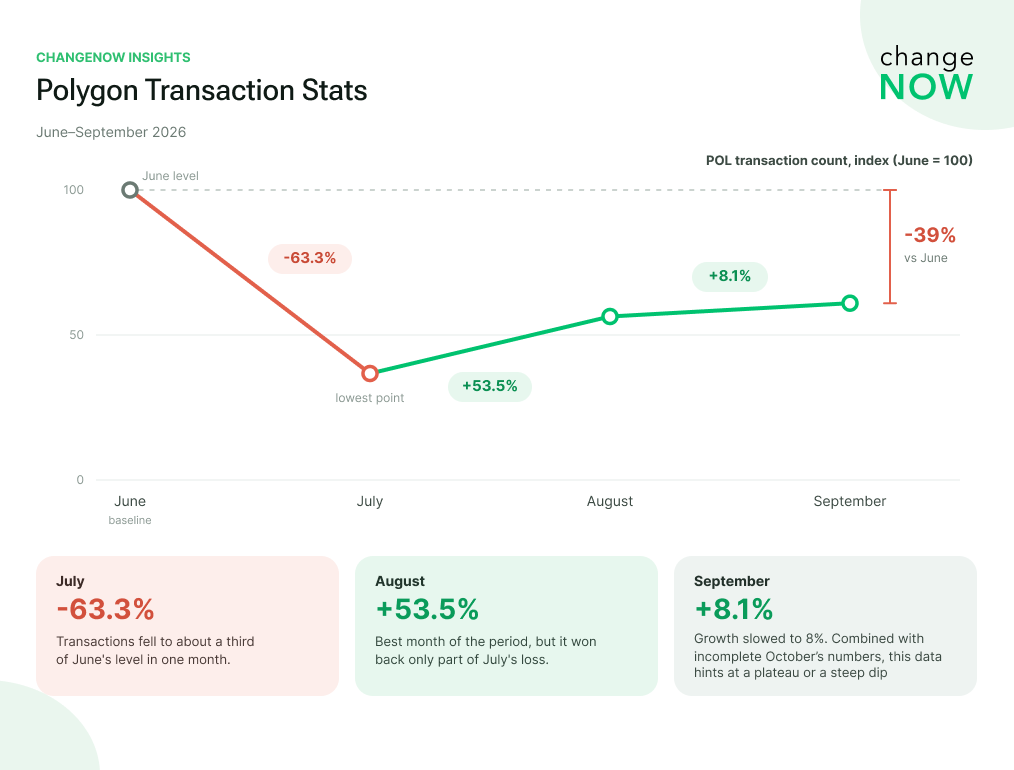
In July 2026, the number of transactions involving the token dropped heavily, falling by over 63%. August brought a sharp recovery with transactions climbing back up by 53%, but that momentum didn't last.
In September, the transaction count slid again, recording nearly a 8% drop. October data is still partial, but the preliminary measures hint that the trend continues with a 18% decrease in transaction count.
Top Trading Pairs
The specific pairs users choose tell a compelling story about where liquidity is going. Right now, Bitcoin is the heavy favorite on both sides of the trade.
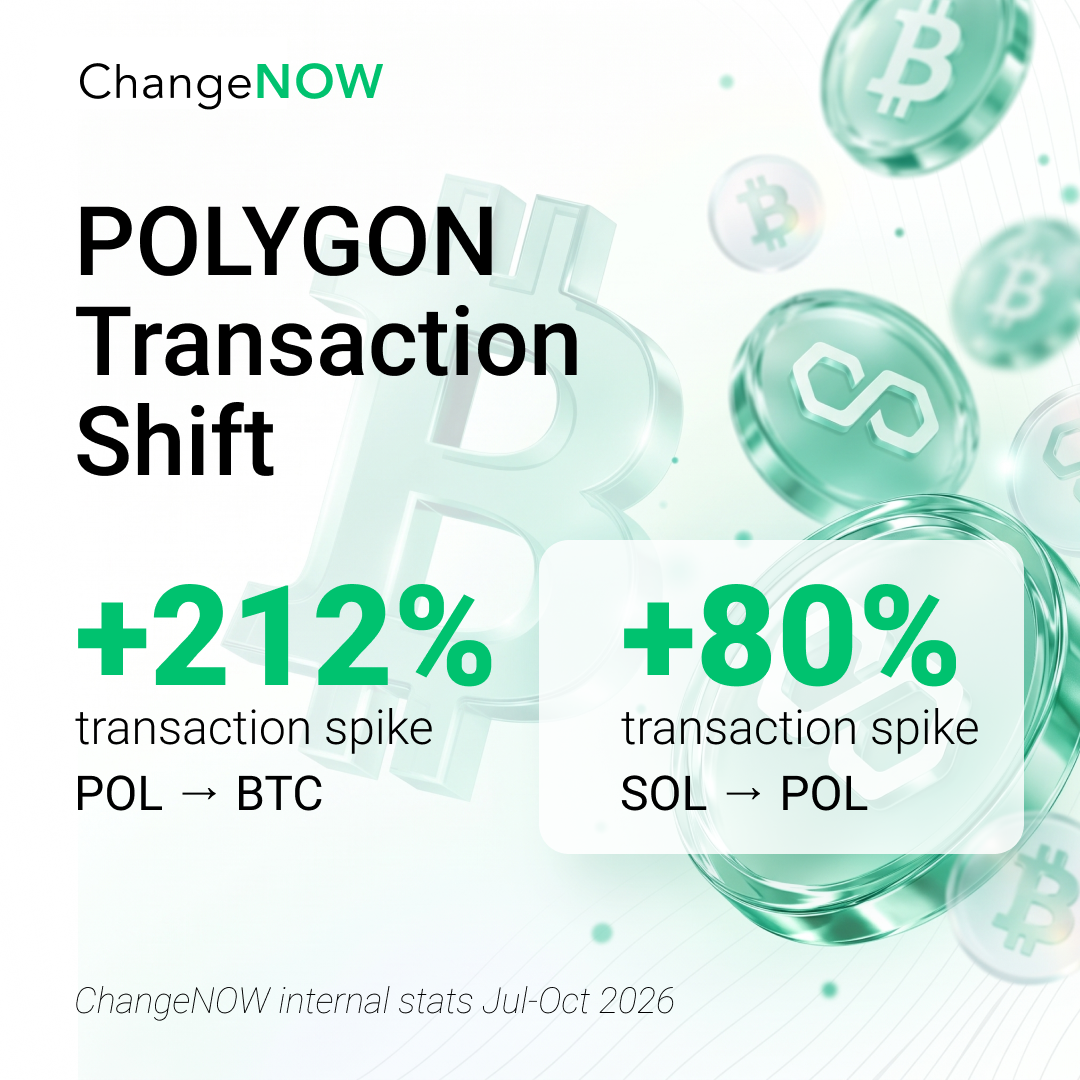
- Users buying POL: When users swap into the Polygon ecosystem, Bitcoin is the most common starting point, making up 16.6% of all incoming transactions. Interestingly, we also saw an 80% jump in users swapping from Solana to POL.
- Users selling POL: The POL-to-BTC pair completely dominates outgoing trades, representing 30.4% of all outgoing transactions. Recently, the number of transactions for this specific pair skyrocketed by 212%, showing a strong move by holders to rotate their POL directly into Bitcoin.
Network Activity
Polygon's native blockchain is also seeing less activity on the platform compared to other major networks. It currently ranks as the 10th most popular network on ChangeNOW, accounting for 2.29% of the overall transaction share.
What Would Actually Need to Happen
Quick summary: POL rises if new buyers show up and falls if the market stays gloomy. Each scenario below has a price level that proves it wrong.
What Needs to Happen for POL Price to Rise
Bitcoin goes first. If it holds around $75,000, POL gets a chance. Then the news has to bring buyers: Sparkassen customers trading POL in their banking app, Coinme’s US licenses bringing paying clients, and holders who stay put after staking rewards drop on December 1.
Polygon Labs has the biggest role. If it pays for its work from payment revenue and buys back POL with part of the profit, the token finally gets a share of the business. Vadim, who built Poltrack, names this as a condition for a rally.
What Needs to Happen for POL Price to Fall
Almost nothing. Bitcoin drops below $75,000, and altcoins usually fall harder. Banks list POL, but their customers barely trade it. Network activity hits records while fees stay tiny, so the token sees little of it.
Polygon Price Prediction: Final Verdict
Polygon price prediction depends on who gets paid when the network grows. Polygon is betting on payments, and the bet matches where the industry is heading, as banks and payment companies move to stablecoins.
Aishwary Gupta notes that the goal is to make the blockchain invisible to everyday users. While this strategy drives network adoption, it creates a structural challenge for the POL token itself.
Users can process stablecoin payments on Polygon without directly interacting with POL. Additionally, current transaction fees remain too low to generate a significant supply burn.
Until that changes, POL likely follows Bitcoin and the mood of the market. If Polygon’s payment business starts to reach the token, the picture changes and it would be a whole different story that we’ll gladly cover.
Next read: Visa vs Mastercard Stablecoin Payments: Who’s Winning in 2026?