TL;DR: Litecoin is mined with Scrypt ASIC miners connected to a mining pool. The same machine can also mine Dogecoin and a few smaller coins like Bellscoin or Pepecoin. This is called merged mining, and it’s a very popular approach among miners in 2026.
Mining has been around almost as long as Bitcoin itself. Miners provide computing power, known as hashrate, to confirm transactions and add new blocks to the blockchain. In return, they receive newly created coins and transaction fees. Litecoin follows the same logic, with its own hardware requirements.
Litecoin mining needs specialized Scrypt ASIC miners. You can technically point a regular PC or graphics card at a pool, but an ASIC is thousands of times faster, so with a PC rewards are close to symbolic. The harder choice is the pool: which coins it mines for you and how it pays them out.
Disclaimer: This article is for informational and educational purposes only and is not financial or operational advice. Crypto mining carries specific risks tied to hardware depreciation, variable energy costs, network difficulty, and market volatility. ChangeNOW does not provide investment or hardware recommendations. Always conduct thorough research and assess local profitability metrics before purchasing mining equipment.
What Is Merged Mining
Merged mining, also called AuxPoW (auxiliary Proof of Work), lets a miner work on several blockchains with the same hashes. One chain is the parent, which here is Litecoin. The others are auxiliary chains, such as Dogecoin, Bellscoin and Pepecoin.
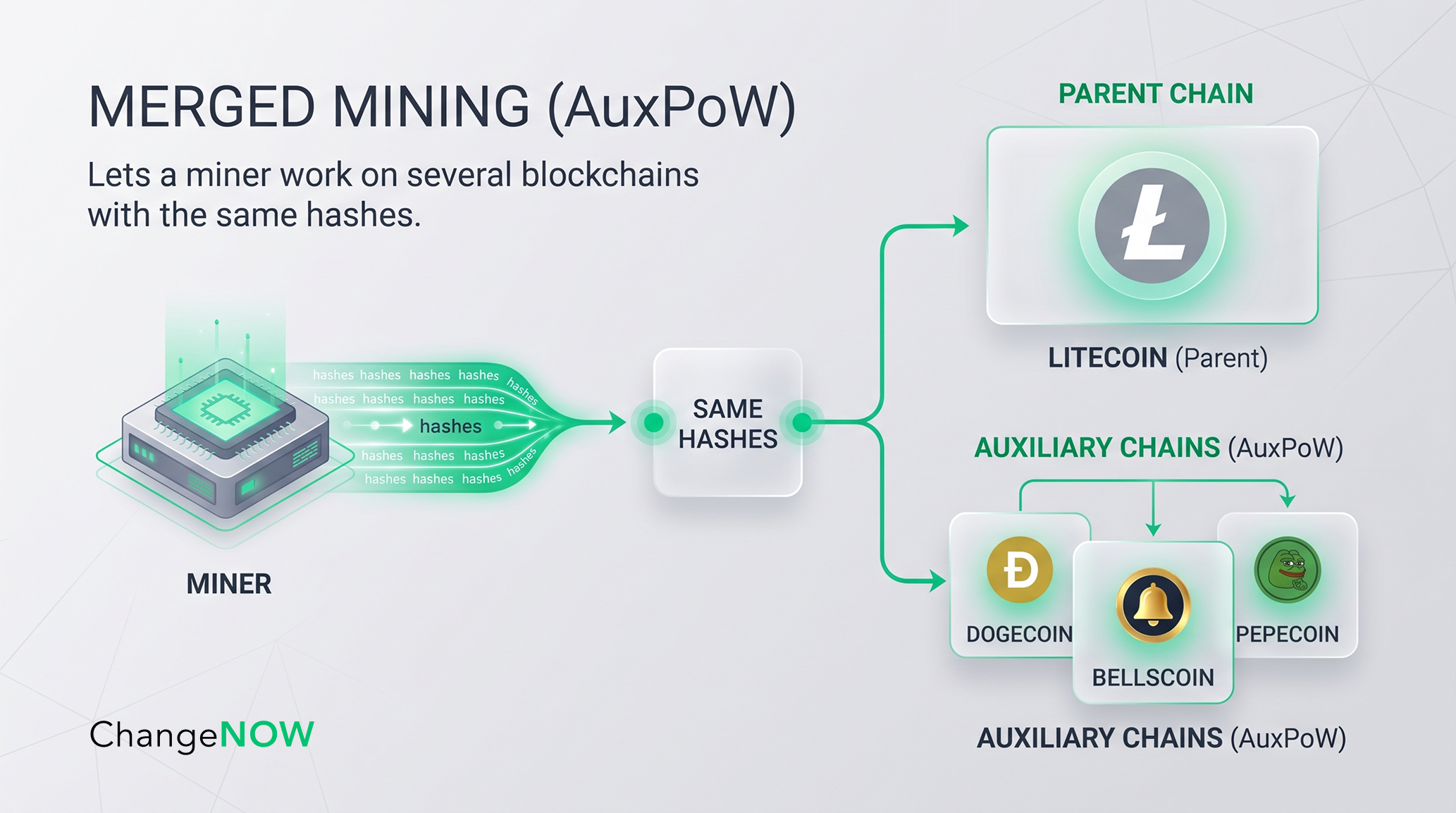
The whole thing works through a mining pool - a group of miners who combine their hashrate and split the rewards by each member’s contribution.
Two conditions apply. The coin has to support AuxPoW, and your pool has to offer it.
The pool gives your miner a task that covers Litecoin together with those auxiliary chains.
Each network sets its own difficulty - how rare a valid solution to a computational problem has to be. When your miner finds a solution that meets a network’s requirement, that network accepts it as a new block. If a solution meets several requirements, several networks accept it.
This way merged mining doesn’t split your hashrate and needs no extra electrical power. Litecoin rewards aren’t affected + the other coins come on top.
Also, auxiliary chains get the security of the bigger network.
Litecoin and Dogecoin Merged Mining: How It Started
Litecoin and Dogecoin’s merge-mining lore goes way back to 2014.
It started in April of that year, when Charlie Lee, Litecoin creator, proposed to combine the mining of two coins since they both use Scrypt, so the same machines could work for both networks.
Dogecoin was still a young coin with a relatively small network. In September 2014, when AuxPoW support was added, its hashrate jumped by about 1,500% within a month.
Smaller Scrypt coins such as Pepecoin and Bellscoin joined the setup in 2024.
Coins You Can Mine Together With Litecoin
If Dogecoin is supported by nearly every Litecoin pool, smaller tokens like Bellscoin and Pepecoin can be there as well, depending on the pool.
So you should check a particular pool’s coin list before picking one.
| Coin | Role in your income | Block reward | Selling it |
|---|---|---|---|
| Dogecoin (DOGE) | Often the largest share, bigger than LTC itself | Fixed 10,000 DOGE, no halvings | Listed on nearly every exchange |
| Bellscoin (BELLS) | Extra on top of LTC and DOGE | Random amounts that shrink over time | Listed on few exchanges, so some pools pay it only to your own wallet |
| Pepecoin (PEP) | Extra on top of LTC and DOGE | Fixed at 10,000 PEP per block after several halvings | Listed on a limited number of exchanges |
Pools that pay BELLS or PEP directly ask for a separate wallet address for each coin. Smaller coins such as Dingocoin, Junkcoin and Luckycoin show up on individual pools.
Helpful tip: Not sure which pool to pick? Cryptohall24 lists Litecoin pools in one place, so you can compare your options. You can enter your miner’s specs into the WhatToMine calculator to see current estimates. Coin prices and network difficulty change often, so check again right before you decide.
Merged Mining Rewards: How Payouts Work
Pools count your work in shares, small proofs that your miner is doing its job. Rewards from every supported coin are calculated from those shares, but each pool decides how to pay them out.
How the pool calculates your earnings. Most pools use one of two schemes:
- Pay Per Share (PPS). You get a fixed amount for every share you submit, whether or not the pool finds a block.
- Pay Per Last N Shares (PPLNS). The pool splits the rewards from blocks it actually finds, so your income changes from day to day.
Some pools use different schemes for LTC and merged coins.
How you receive the coins. Pools usually take one of three approaches:
- Separate payouts. You receive each coin on its own, at the wallet addresses you set up.
- Conversion. The pool exchanges the extra coins for LTC or DOGE and pays you in those.
- Built into the rate. The pool pays out only some coins and uses the rest to raise what you earn per share. Litecoinpool.org pays LTC and DOGE separately, and counts the smaller merged coins at a higher rate, so you get more LTC and DOGE instead of extra coins. They explain it on their Help page.
Most of the details you need are on the pool’s own page.
In the example below, the header lists every coin you get on top of LTC: DOGE, BELLS, PEP and DINGO. On the right, you can see the algorithm, current difficulty, block reward, payout threshold and payment time.
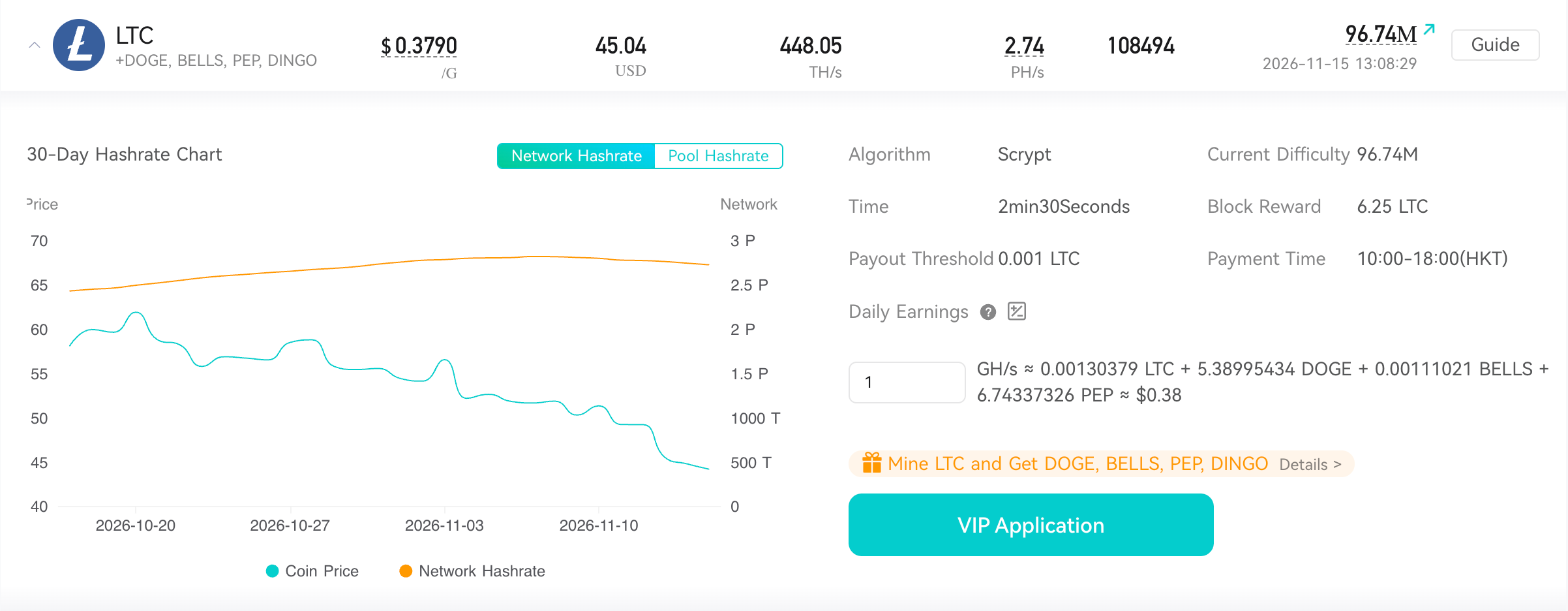
Source: ViaBTC
How to Choose a Litecoin Mining Pool
Reliability, security and clear terms matter more than any single feature. Here’s what to check.
Reliability and uptime. If a pool goes down, your miner’s work goes to waste. Check the pool’s status page and how it communicates during incidents.
In April 2026, a bug in Litecoin’s MWEB layer disrupted major mining pools, and the network reversed 13 blocks to undo invalid transactions. A good pool updates its software quickly and tells users what’s going on.
Security. Turn on two-factor authentication. If the pool lets you lock your payout address, use it, so nobody can redirect your rewards.
Clear payout terms. Check these before you connect your miner:
- Coin list. Make sure it includes the coins you want to receive.
- Payout scheme. PPS or PPLNS, and whether the pool uses the same one for LTC and merged coins.
- Fees. They can differ by coin, so look at each one.
- Minimum payout and schedule. Some pools set a low threshold, such as 0.001 LTC, and send payments at fixed hours each day. Smaller coins may take longer to reach their thresholds.
- Hashrate. Look at the figure on the pool’s dashboard, not on your miner’s screen. The pool pays for the shares it records, and the miner’s own number fluctuates.
Risks & Drawbacks of Litecoin Mining
Hardware costs, electricity and scams are common risks of any mining process and Litecoin is no exception.
Here are the ones specific to Litecoin:
- The 2027 halving. Litecoin’s block reward is cut in half every 840,000 blocks, about every four years. The next cut, expected in 2027, takes it from 6.25 to 3.125 LTC. So, your miner will do the same work and earn less LTC per block.
- Reliance on Dogecoin. Dogecoin has no halvings, so after Litecoin’s reward is cut, DOGE counts for even more of what a Scrypt miner earns. That ties your results to another coin’s price and network.
- Few coins to fall back on. A Scrypt ASIC mines only Scrypt coins, and the list is short: Litecoin, Dogecoin and a handful of smaller ones. You can’t point the machine at Bitcoin if conditions change.
- Small merged coins. They trade in low volumes, and in theory, attacking a small chain is cheaper than attacking a large one.
What to Do With Mined LTC (and DOGE)
Most pools send payouts to a wallet address you set, so mined coins land in your own wallet.
From there, you can hold them, spend them or swap them for another asset.
On ChangeNOW, you can easily swap LTC or DOGE for hundreds of other tokens, RWAs, or memecoins. You don’t even need to get an account for basic swaps.
Not sure whether you should keep your DOGE? Check this article for helpful insights: Is DOGE a Good Investment?