


We used to think buying a cold wallet from an official reseller was fine, as long as the site listed it as authorized. A recent case involving Ledger devices sold through one Southeast Asian reseller says otherwise. For the full story, see our breakdown of the Ledger CryptoBilis hack.
Buying directly from the manufacturer's official store removes the middleman from that chain. Taking care of the rest yourself – generating your own recovery phrase and checking the device before you fund it – closes a lot of what's left.
Key Takeaways
- A hardware wallet can be altered before it ever reaches you. That can mean a recovery phrase someone else generated in advance, firmware that's been quietly modified, or, in rare cases, a physical implant hidden inside the device.
- "Authorized reseller" isn't a guarantee of a clean supply chain – ownership, suppliers, and storage practices can change behind the scenes in ways a buyer never sees.
- Checking the device after it arrives helps, but it isn't a complete safety net on its own – where you buy still matters.
- Buy from the manufacturer's own website and generate your own recovery phrase on the device. Never use one that comes pre-written in the box.
Why Should You Buy a Hardware Wallet Directly From the Manufacturer?
A hardware wallet's whole point is keeping your keys offline, away from anything connected to the internet. But that only works if the device itself is trustworthy from the moment you open the box.
The path from factory to buyer typically runs through several hands – manufacturing, a distributor's warehouse, a reseller, then you. Each step is a window where a device could be opened, altered, and resealed. Buying directly from the manufacturer's official store minimizes the number of intermediaries involved. It does not eliminate every risk, but it reduces reliance on third-party inventory handling and resale practices.
Where Can You Buy a Hardware Wallet? 5 Official Stores
The safest place to buy a hardware wallet is the manufacturer's own online store. Below are the official stores of five widely used brands. Type the address in manually instead of following an ad or a search result, because fake store and "support" pages regularly show up in search.
- Tangem official store
- Trezor official store
- Ledger official store
- Keystone official store
- SafePal official store
How Can a Hardware Wallet Be Tampered With Before It Reaches You?
This falls under what security researchers call a supply chain attack – compromising a product somewhere between manufacturing and delivery, rather than attacking the finished device directly. With hardware wallets, that tends to take one of three forms:
- a recovery phrase generated in advance and written into the box before you ever open it,
- firmware quietly modified to leak keys or weaken randomness,
- a physical implant added inside the device itself.
A recent Ledger case shows what that last scenario can actually look like in practice.
According to a technical breakdown published by Ledger's in-house security team, Donjon, the implant sat inside the device's casing and optically read what was displayed on the screen. Every device shows its recovery phrase on-screen once, during setup – the implant was built to detect exactly that screen, decode the words with a small embedded microcontroller, and transmit them out over a mobile network using a pre-installed eSIM. It left the device's secure chip and operating system completely untouched, which is exactly why it didn't trip any of the device's own integrity checks.
Counterfeits are a related but separate problem: devices built to look legitimate that aren't genuine hardware at all. Inspecting the packaging on arrival catches some of this, but a well-executed implant or firmware modification can pass a visual check without any trouble.
Is It Safe to Buy a Hardware Wallet From an Authorized Reseller?
It's safer than an anonymous marketplace listing, but "authorized" isn't a guarantee. The recent Ledger case shows why: the reseller involved was listed on Ledger's own distributor page as an authorized seller for its region, which is precisely what made the compromised devices look trustworthy to the people who bought them.
Our take: an authorized reseller is a real step up from a random marketplace seller, but it's not a zero-risk option, and as a buyer you have essentially no visibility into how that reseller actually handles its inventory day to day.
Is It Safe to Buy a Hardware Wallet on Amazon or eBay?
Marketplaces add another layer of uncertainty on top of the reseller question. Even an official manufacturer storefront hosted on a marketplace can end up with mixed inventory through warehousing or returns processes you can't see from the listing page, so a "sold by" label isn't the same guarantee it would be on the manufacturer's own site.
A few categories are worth avoiding outright regardless of platform: used devices, sellers reached through Telegram or social media DMs, local electronics shops with no direct manufacturer relationship, and bundles sold at a steep discount to the manufacturer's listed price. One rule covers almost all of it: the box should never contain a recovery phrase already written down. If it does, treat the device as compromised before you even plug it in.
Can a Hardware Wallet Bought Directly From the Manufacturer Be Tampered With?
In theory, yes – interception during shipping is possible even on a direct order. In practice, buying straight from the manufacturer removes the step where the recent tampering case actually happened, which meaningfully lowers the risk without reducing it to zero.
Worth knowing honestly: a sophisticated implant that leaves the secure chip and operating system untouched, like the one described above, could still pass all of these checks. That's one more reason the purchase channel itself carries real weight, alongside everything you do afterward rather than instead of it.
How to Check if Your Hardware Wallet Was Tampered With
Four checks cover most of what you can verify yourself:
- Where you bought it. The manufacturer's own site is the baseline; anything else raises the bar for the checks below.
- Who created the recovery phrase. It should be generated on-screen, by the device, during your own setup – never found already written in the box.
- Packaging integrity. Check tamper-evident seals and stickers for anything that looks disturbed, re-glued, or misaligned.
- First-boot behavior. A new device should guide you through the initial setup, allowing you to create a new wallet or restore an existing one. One that already shows a wallet, a balance, or a pre-filled recovery phrase has been compromised.
Manufacturers also offer their own authenticity tools worth running before funding a device: Ledger's Genuine Check, Trezor's authenticity check, and Tangem's own attestation process. Their capabilities vary.
A successful check should not be interpreted as proof that every component of a device is physically unmodified
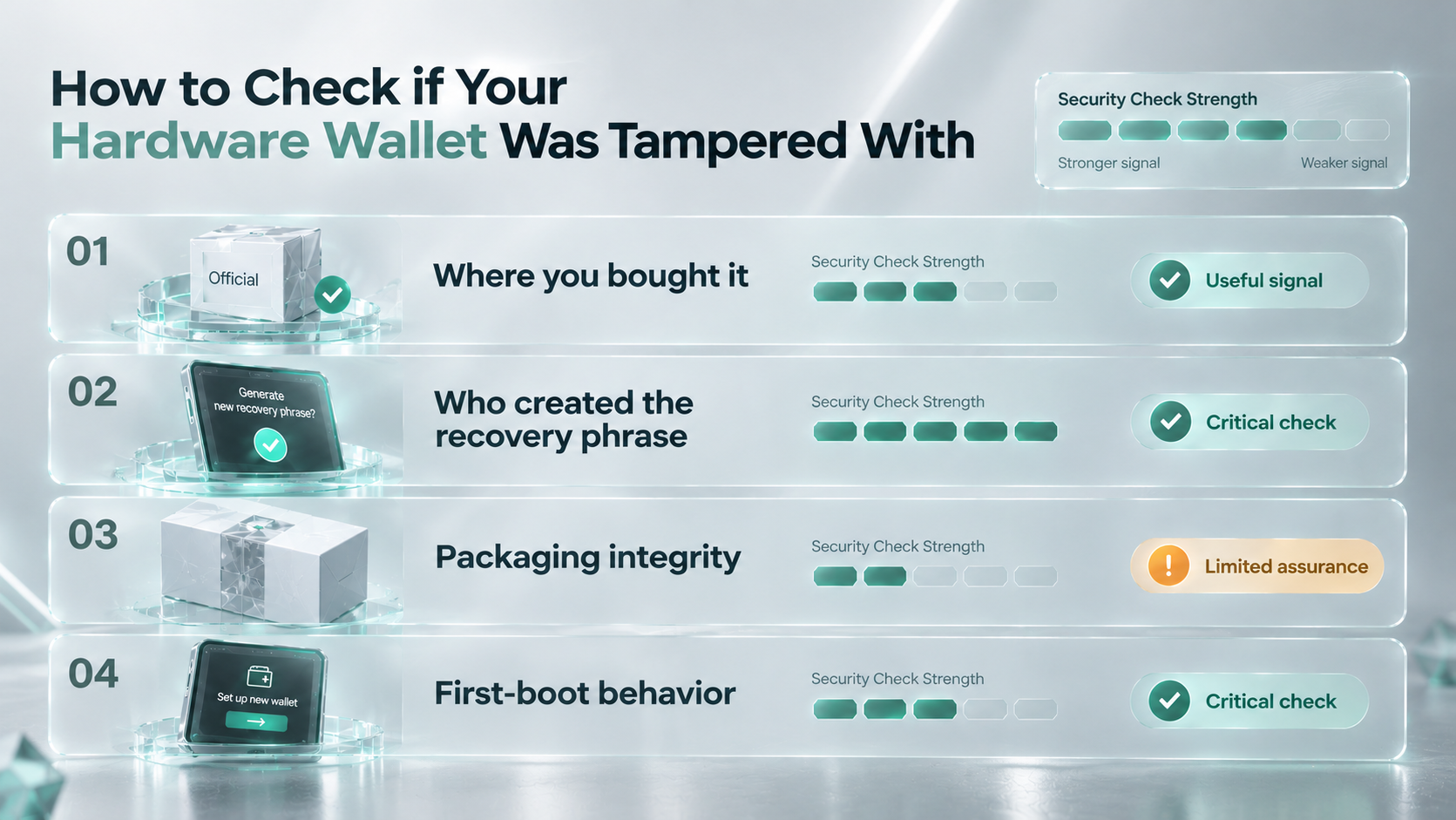
These checks have real limits. A sophisticated implant, like the one Ledger found in the CryptoBilis devices, can leave the Secure Element and operating system untouched and still pass a standard authenticity check – which is exactly why where you bought the device matters more than any check you can run afterward.
What to Do if You Bought a Hardware Wallet From CryptoBilis or Another Reseller
Ledger's guidance for anyone who bought through CryptoBilis in the last 90 days: if you haven't set up the device yet, don't. If you suspect your recovery phrase has been exposed, create a completely new wallet using a trusted device and transfer your remaining assets to its new addresses. Do not restore the compromised recovery phrase on the replacement device.
In either case, never enter the old recovery phrase into a new device – treat it as burned, and buy the replacement directly from the manufacturer this time. If funds have already moved out of your control, contact the manufacturer's support team and file a report with local law enforcement, and hold on to the relevant transaction IDs for both.
If your device didn't come from CryptoBilis, there's no reason to panic – but it's a reasonable moment to run the checks above calmly, just to confirm everything's as it should be.
How to Buy a Hardware Wallet Safely
A short checklist that covers the setup end to end:
- Type the manufacturer's official URL in manually rather than clicking through an ad or a search result.
- Order directly from that official store.
- Inspect the packaging and tamper seals as soon as it arrives.
- Generate the recovery phrase on the device itself, never use one that's already written down.
- Write it down by hand, offline, and nowhere else.
- Install the wallet's companion software only from the official site or app store.
- Run the manufacturer's authenticity check before funding the device.
- Send a small test transaction before moving anything significant.
For larger holdings, a passphrase or a multisig setup adds another layer on top of all of this – worth knowing about, though a full breakdown is its own topic.
Hot Wallet vs Cold Wallet: Which One Is Safer?
Hardware wallets keep private keys on a separate device, reducing the risk of exposing them to malware on a connected computer or phone. For a closer look at how to get the most out of that advantage, see our guide on whether cold wallets are really as safe as they're made out to be. They do not eliminate every security risk: phishing, social engineering, malicious transaction approvals, supply-chain tampering, and recovery phrase exposure can still put funds at risk. A hot wallet is convenient for everyday transactions, while a hardware wallet can provide an additional layer of protection for longer-term holdings.
Whichever type you choose, the important thing is doing what you reasonably can on your end to lock it down, since neither one takes care of that for you by default.
Should You Use a Hot Wallet and a Hardware Wallet Together?
People who've been in crypto for a while tend to land on the same answer: split by purpose rather than pick one and stop there. Everyday spending stays in a hot wallet; long-term savings move to cold storage. Each wallet gets its own, separate recovery phrase – never reuse one across devices.
If the hot wallet side of that setup is what you still need, that's exactly the gap NOW Wallet is built to fill. It's fully non-custodial and keeps keys on your own device, with access sitting behind Face ID. Like any wallet, download it only from the official site or an official app store – the same rule that applies to hardware.
Conclusion
Hardware wallet security starts before you ever power the device on – with who you bought it from. Everything covered here, from generating your own recovery phrase to running a genuine check, narrows the gap that's left once that first decision is made.
Sources
- Gizmodo, Ledger Confirms How 'Spy Implants' Steal Crypto From Its Devices as Cases Spread
- KuCoin, Ledger Wallet Hack: What Happened in the CryptoBilis Incident and What Users Should Do
- Ledger, Ledger's Response to the Hardware Implant Attack
- Ledger, Best Practices To Securely Buy Your Ledger Signer
- ChangeNOW, The Ledger CryptoBilis Hack: Full Breakdown