TL;DR: Wrapped Bitcoin (WBTC) is a token backed by Bitcoin (BTC) at a 1:1 ratio. It was first launched on Ethereum as an ERC-20 token. WBTC lets users access decentralized finance (DeFi) apps with Bitcoin's value, even though BTC runs on a different blockchain.
The Bitcoin backing WBTC is held by custodians. This allows WBTC to be used on other blockchain networks, but it also comes with extra risks compared to holding BTC directly.
What Is Wrapped Bitcoin (WBTC)?
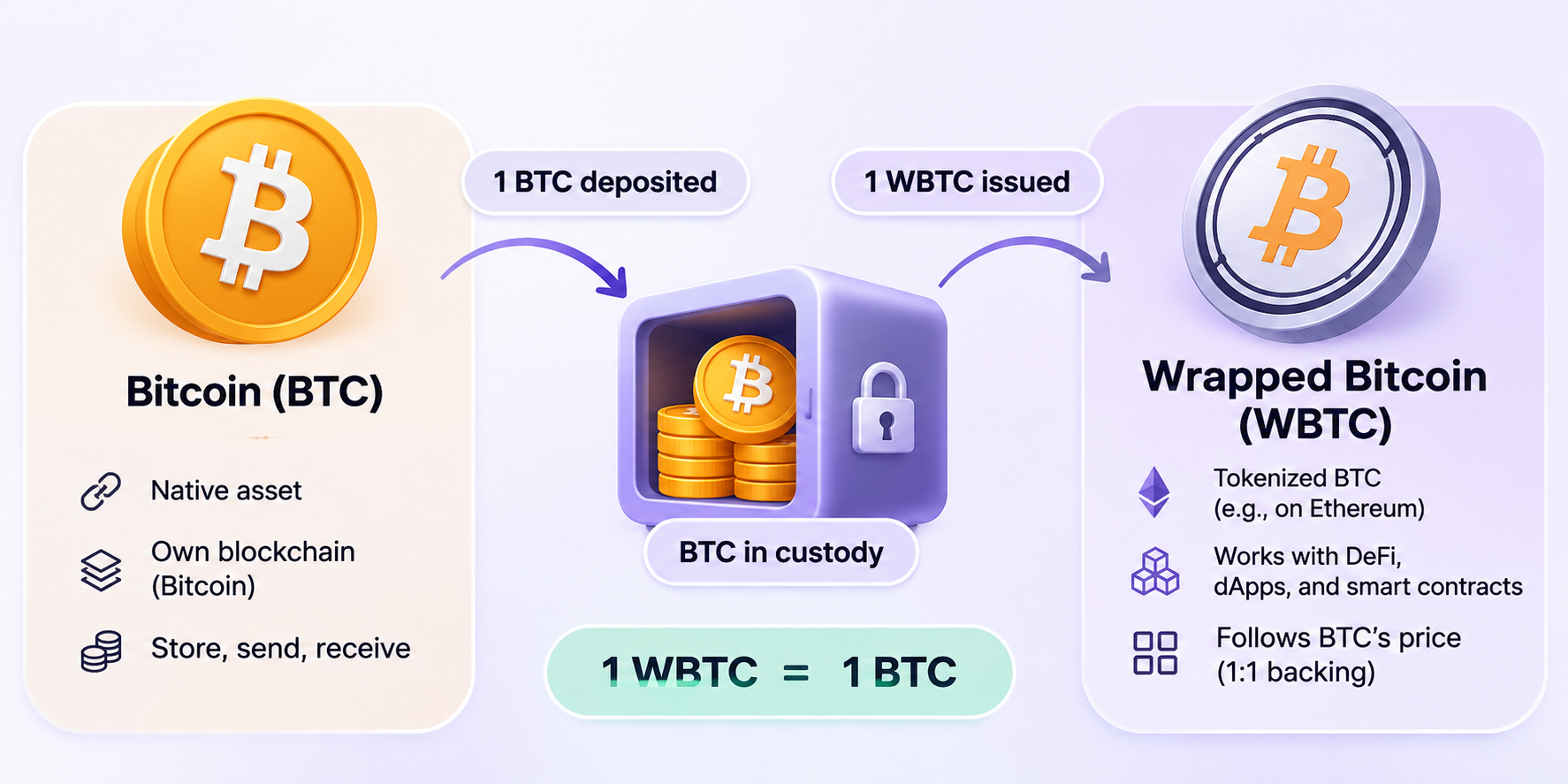
Wrapped Bitcoin (WBTC) is a tokenized representation of Bitcoin. It was launched in January 2019 as a joint project by BitGo, Kyber Network, and Ren.
The idea is simple: 1 WBTC is backed by 1 BTC held by a custodian.
For example, when 10 BTC are deposited through the official minting process, 10 new WBTC can be created. The original Bitcoin stays with the custodian, while the WBTC can be used on other blockchains.
WBTC is designed to have the same value as Bitcoin, but their prices can sometimes differ slightly due to market conditions.
WBTC doesn't create new Bitcoin. It simply represents BTC that already exists.
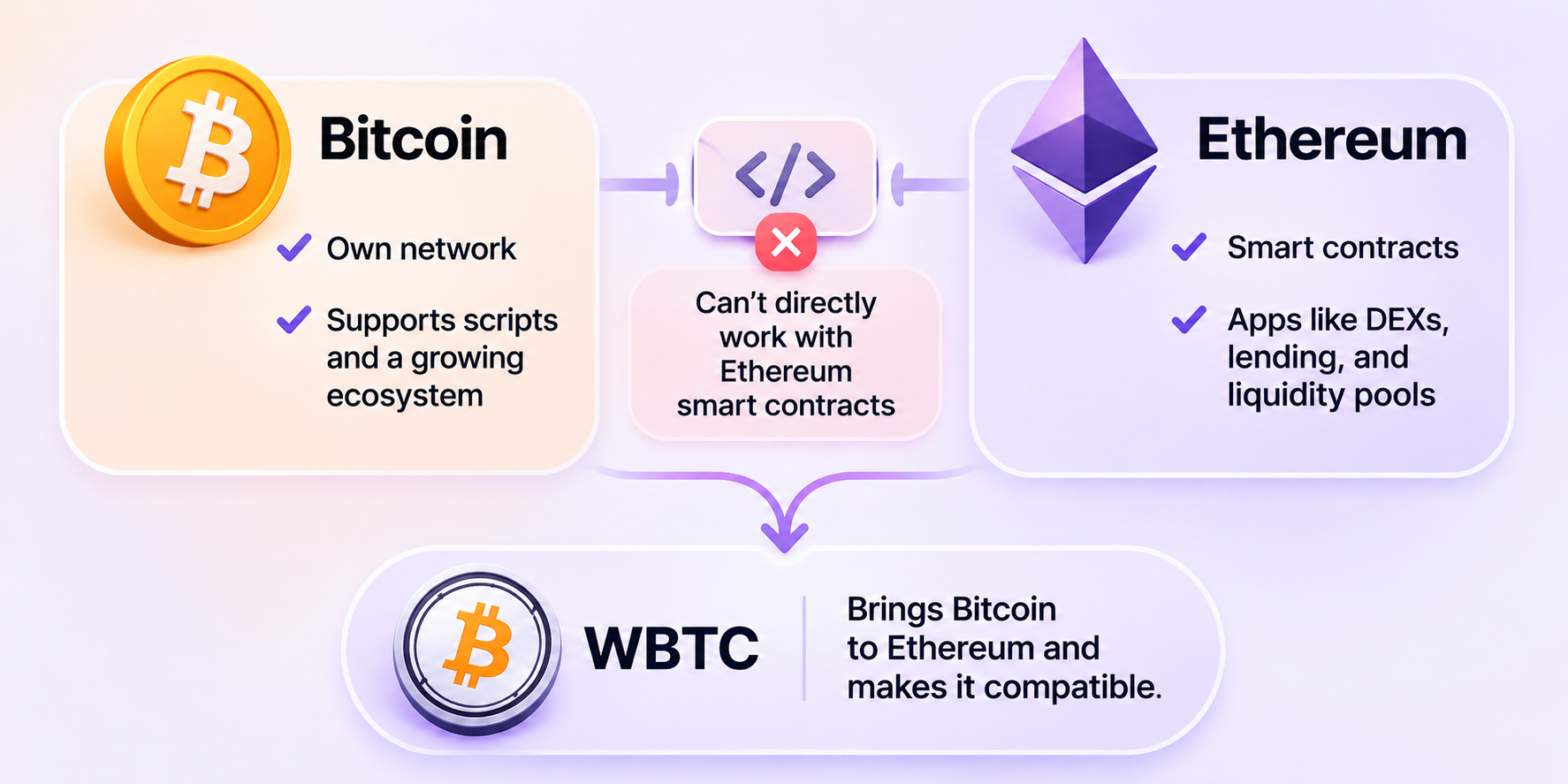
Bitcoin lets people send and hold BTC without relying on centralized financial institutions.
Ethereum allows developers to build apps using smart contracts (e.g. decentralized exchanges or liquidity pools).
Although Bitcoin supports scripting and has its own expanding ecosystem, native BTC can't be used directly in Ethereum's smart contracts.
WBTC was developed to address this compatibility problem.
“WBTC allows Bitcoin holders to access DeFi and benefit from programmable smart contracts on Ethereum and other supported networks.” – ChangeNOW Product Team.
This is the broader purpose of wrapped tokens: representing an asset in a format compatible with another blockchain.
However, they also introduce extra risks because users depend on the system that backs the tokens.
How Does Wrapped Bitcoin Work?
Wrapped Bitcoin (WBTC) FAQ
No. BTC is the native cryptocurrency of the Bitcoin network, while WBTC is a token backed 1:1 by BTC held in custody. See our WBTC vs BTC comparison above.
It depends on what you want to do. Native BTC lets you hold and transfer Bitcoin without relying on a WBTC custodian. WBTC lets you use Bitcoin's value in DeFi apps for lending, borrowing, and trading.
1 WBTC is designed to be worth approximately 1 BTC. However, its market price can sometimes be slightly higher or lower.
The official process involves burning WBTC and releasing the BTC held in custody. This is generally handled by authorized merchants.
Regular users can also swap WBTC for BTC through an exchange service.
Coinbase Wrapped Bitcoin (cbBTC) is a token issued by Coinbase and backed 1:1 by Bitcoin held in its custody. The main difference is that cbBTC uses Coinbase's custody and redemption system.
You can store WBTC in wallets that support its blockchain, such as NOW Wallet and MetaMask.
NOW Wallet supports WBTC on the same chains as ChangeNOW and lets you store, send, receive, and swap tokens.
No. WBTC cannot be mined like native Bitcoin. New WBTC is created through minting.
Custodians: Hold the Bitcoin that backs WBTC and approve minting and burning.
Merchants: Request the creation or burning of WBTC and work with users.
WBTC DAO: Historically managed the system and approved participants.
This system separates those who hold Bitcoin from those who request a new WBTC.
There are two main processes: minting and burning.
Minting: How BTC Becomes WBTC
Minting creates new WBTC when an equal amount of BTC is deposited with a custodian.
An authorized merchant requests the creation of WBTC.
The required BTC is sent to the custodian.
The deposit is verified. The custodian confirms that the required BTC has been received.
WBTC is minted. An equivalent amount of WBTC is issued on the relevant blockchain.
WBTC is distributed. The merchant can deliver the tokens to the intended recipient.
Regular users don't need to go through this process. They can simply get WBTC through a crypto exchange or swap service.
Burning: How to Redeem WBTC for BTC
Burning is the opposite of minting. WBTC is removed from circulation, and the same amount of BTC is released.
An authorized merchant submits a redemption request.
The corresponding WBTC is transferred for burning.
The tokens are permanently removed from circulation.
The custodian verifies the burn and authorizes the release of BTC.
The underlying Bitcoin is transferred to the designated recipient.
The amount of WBTC in circulation decreases as the corresponding BTC is released.
Burning WBTC is different from swapping WBTC for BTC.
When you swap WBTC for BTC through an exchange service, you receive existing BTC. The service uses available liquidity, so no WBTC needs to be burned.
What Backs WBTC? Custody and Proof of Reserves
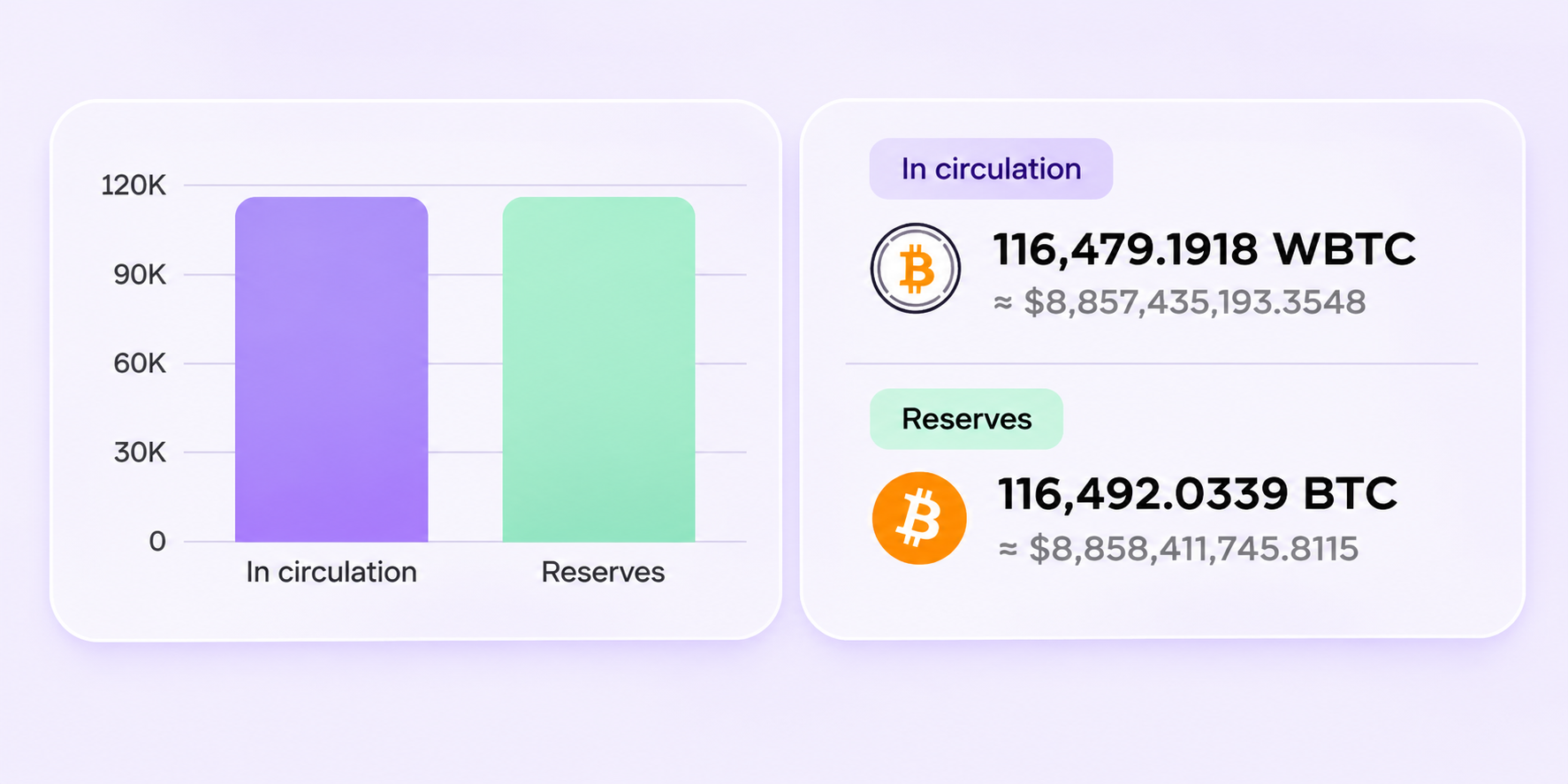
Each WBTC is backed by BTC held by institutional custodians. The amount of Bitcoin in reserves must be at least equal to the total WBTC in circulation.
Unlike native BTC, WBTC depends on these institutions to keep the underlying Bitcoin safe.
Who Holds the Bitcoin Backing WBTC?
BitGo was the original WBTC custodian.
In August 2024, BitGo partnered with BiT Global to expand WBTC custody across different jurisdictions.
In March 2026, BiT Global announced plans to manage WBTC reserves using BitGo's wallet infrastructure. Under this plan, BiT Global would control two of the three keys needed to manage the reserves, while BitGo would hold the third.
This setup uses multi-signature security, meaning multiple keys are involved in authorizing transactions. However, users still need to trust the institutions holding those keys.
In October 2026, WBTC announced that it was exploring a multi-custodian model to reduce reliance on a single provider. The company has not yet announced which additional custodians it will select.
As of November 5, 2026, WBTC had slightly more BTC in reserves than WBTC in circulation.
This small difference may be caused by the timing of minting and burning operations.
To examine WBTC reserves:
Open the official WBTC transparency dashboard.
Compare the total BTC reserves with the total WBTC supply.
Review the listed Bitcoin custody addresses.
Check the minting and burning records for recent changes.
Verify relevant transactions and token contracts using blockchain explorers.
Wrapped Bitcoin vs Bitcoin (WBTC vs BTC): What's the Difference?
WBTC and BTC are designed to have the same value, but they work differently.
Feature
Bitcoin (BTC)
Wrapped Bitcoin (WBTC)
Asset
Native cryptocurrency
BTC-backed token
Original blockchain
Bitcoin
Ethereum
Token standard
Native BTC
ERC-20 on Ethereum; other formats on supported networks
Backing
Not backed by another asset
Intended 1:1 BTC reserves
Custody
Can be self-custodied directly
Underlying BTC held by custodians
Smart contract compatibility
Limited on native Bitcoin
Compatible with supported smart contract platforms
DeFi applications
Requires compatible infrastructure
Supported by various DeFi protocols
Transaction fees
Paid in BTC
Paid in the network's gas asset
Main additional risks
General cryptocurrency risks
General cryptocurrency risks, plus custody and depegging risks
The main difference is who holds the Bitcoin.
When you keep BTC in your own wallet, you control it directly through your private keys.
When you hold WBTC, you control the tokens, but the actual Bitcoin is held by a custodian.
What Can You Do With Wrapped Bitcoin?
WBTC allows Bitcoin holders to use their assets in DeFi apps.
Use WBTC as Collateral for Loans
Some DeFi platforms let users deposit WBTC as collateral to borrow other cryptocurrencies.
For example, you can deposit WBTC on Aave and borrow stablecoins, depending on the platform's requirements.
This lets you access other assets without selling your Bitcoin exposure. If the value of your WBTC falls too much, the platform may sell your collateral to cover the loan.
Platforms like Aave or Compound may allow users to lend WBTC and earn interest.
It works as with any other crypto – users deposit WBTC, which other people can borrow. Interest rates change based on demand and available liquidity.
Trade WBTC on Decentralized Exchanges
Native BTC can't be traded directly on Ethereum-based exchanges like Uniswap because Bitcoin and Ethereum use different networks.
WBTC makes this possible by allowing users to trade Bitcoin's value on Ethereum.
For example, users can swap WBTC for ETH on Uniswap without leaving the Ethereum network.
Provide Liquidity
WBTC holders can add their tokens to liquidity pools on DeFi platforms. In return, they may earn a share of trading fees or other rewards.
WBTC cannot be staked directly because it is not a proof-of-stake cryptocurrency. Any rewards come from DeFi platforms or other third-party services, not from staking on the Bitcoin network.
Which Networks Support Wrapped Bitcoin?
WBTC was first launched on Ethereum but is now available on other networks.
As of November 2026, the official WBTC dashboard lists the following networks as authorized:
For the full list of supported networks and integrations, explore the official WBTC ecosystem.
Before sending WBTC, verify the exact token contract and destination network. A wallet supporting Ethereum WBTC does not automatically support every token named WBTC on another blockchain.
How to Move WBTC Between Networks
WBTC can be moved between supported blockchains using cross-chain bridges or swap services.
A traditional crypto bridge may lock tokens on one network and issue an equivalent amount on another. Some bridges also use burning and minting.
Other services, like ChangeNOW, use available liquidity to exchange tokens between networks instead.
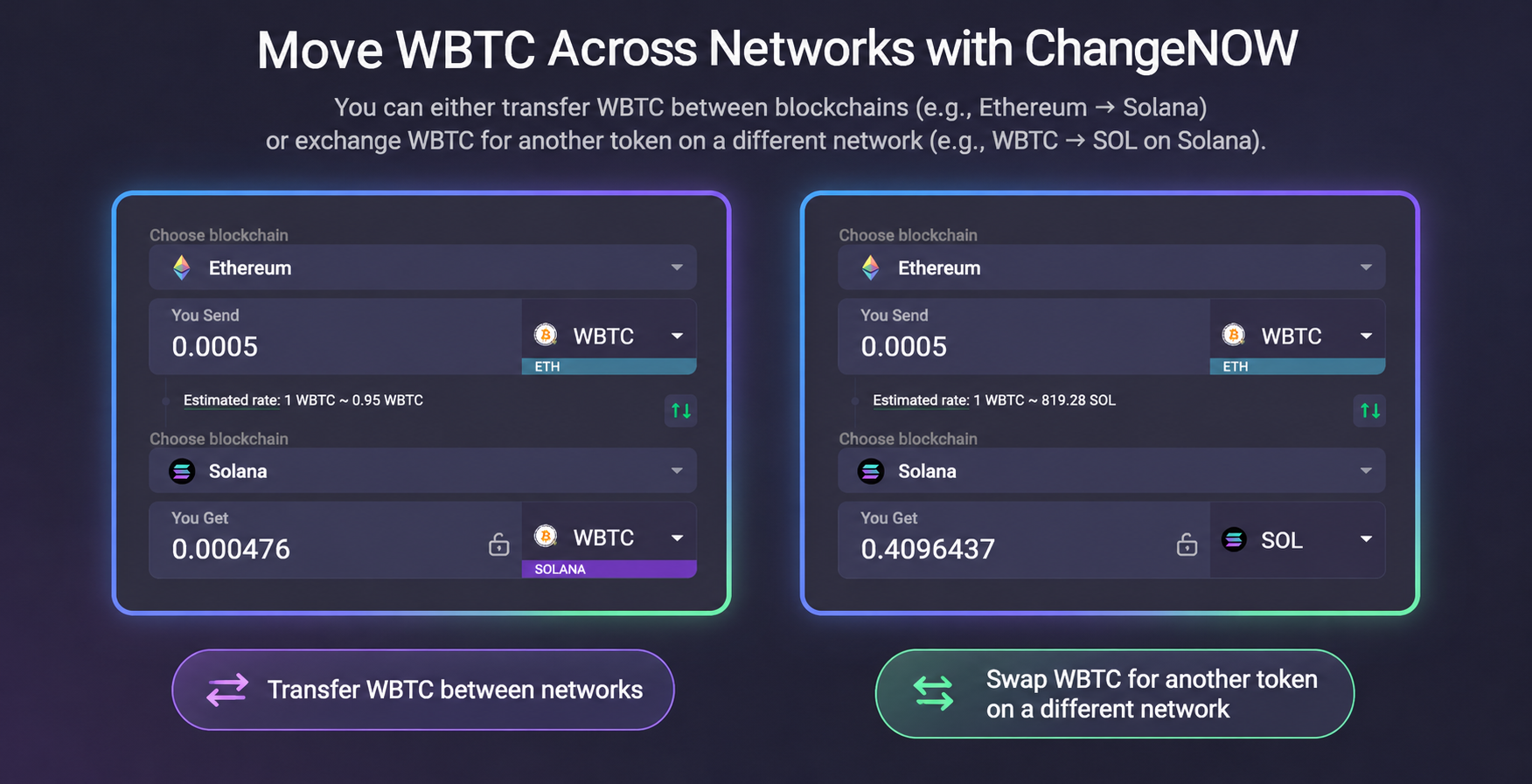
For example, if you want to move WBTC from Ethereum to another supported network through ChangeNOW, here's how it works:
Choose your networks. Open ChangeNOW and select WBTC on Ethereum as the asset you want to send. Then choose the asset and network you want to receive.
Enter the amount. Check the estimated amount you'll receive and the exchange rate.
Add your wallet address. Enter the receiving wallet address on the destination network.
Send your WBTC. Transfer WBTC to the deposit address provided by ChangeNOW.
Receive your tokens. ChangeNOW processes the exchange using available liquidity and sends the output asset to your wallet on the destination network.
Unlike a traditional lock-and-mint bridge, ChangeNOW doesn't directly issue new WBTC as part of this swap.
ChangeNOW currently supports WBTC on Ethereum, Arbitrum One, Polygon, Optimism, and Solana.
Before making a transfer, always check the destination network, token contract, exchange rate, fees, and whether your wallet supports the receiving asset.
WBTC has many advantages, but it also comes with extra risks compared to holding native BTC.
Here are the main risks to know before using WBTC.
Custodial and Centralization Risk
The Bitcoin backing WBTC is held by custodians. If a custodian gets hacked, loses access to funds, or faces legal restrictions, users may have problems converting WBTC back to BTC.
Multi-signature security and public reserve data help reduce some risks, but users still depend on the institutions holding the Bitcoin.
In November 2022, BitGo declined a request from Alameda Research to redeem 3,000 WBTC (around $50 million) because the required security checks were not completed. The BTC remained safely in custody. The case shows an important difference: sending BTC from your own wallet doesn't require a custodian's approval, while redeeming WBTC through the official process does.
Smart Contract Risk
WBTC exists as a token governed by smart contracts on supported networks.
A vulnerability in a token contract, DeFi application, or related integration could result in unauthorized transactions or loss of funds.
In March 2023, hackers exploited a vulnerability in the Euler Finance lending protocol and stole around $197 million, including approximately $19 million in WBTC. The issue was in Euler's smart contracts, not WBTC itself. The stolen funds were later recovered.
Even if the underlying BTC reserves remain secure, a failure in an application using WBTC can still affect users.
Depegging Risk
WBTC is designed to have the same value as BTC, but their prices can sometimes differ.
If users become worried about WBTC's reserves or the ability to exchange it back to BTC, its price may fall below Bitcoin's.
For example, in November 2022, WBTC traded at a discount of up to 1.5% after the FTX collapse. Users were concerned about its backing, even though BitGo confirmed that WBTC was still fully backed by Bitcoin.
This shows that WBTC can temporarily lose its price peg to BTC even when its reserves are safe.
Cross-Chain Bridge Risk
Moving WBTC between blockchains can involve bridges, which may have security vulnerabilities.
An exploit could compromise the assets backing a bridged representation.
In that situation, the tokens can remain visible in users' wallets while losing some or all of their backing.
This is why checking token balances alone is not enough to determine whether a bridged asset remains fully redeemable.