There are better-looking Layer 1s, louder Layer 1s, and ones with more liquidity. NEAR's pitch is different: it wants to be the one you never notice. Whether that's a feature or a warning sign depends entirely on execution.
NEAR was founded by Illia Polosukhin and Alexander Skidanov. Unlike many “AI-native blockchain” projects that added the AI narrative later, NEAR’s founders had real machine learning experience from the start.
That background influences how NEAR positions itself today, as infrastructure for AI agents. Polosukhin co-wrote the 2017 paper Attention Is All You Need, which introduced transformers architecture, the foundation of modern AI models. Skidanov previously worked at MemSQL, focusing on database scalability.
The real question is simple: does that expertise actually lead to a product developers and users choose?
NEAR's answer is that the next generation of blockchain infrastructure should feel less like crypto software and more like invisible internet plumbing. Most users shouldn't need to think about wallets, bridges, gas fees, or even what chain they're interacting with.
Nightshade sharding splits transaction processing across parallel lanes rather than running everything through a single queue.
NEAR has achieved 600-millisecond block times and approximately 1.2-second finality. By May 2026, the network operated nine main shards alongside a separate private shard supporting Confidential Intents.
For comparison:
Ethereum takes ~12 seconds per block
Solana runs ~400ms but with no sharding.
On raw throughput, NEAR sits in competitive territory. NEAR demonstrated 1 million TPS in an experimental benchmark, but that figure does not represent sustained mainnet throughput. Real-world performance depends on network demand, transaction complexity, and available capacity.
But raw speed alone stopped being enough years ago. Nearly every major Layer 1 now claims low fees and high throughput. NEAR's broader strategy is reducing complexity for end users rather than simply winning benchmark wars.
2. Chain Abstraction Through NEAR Intents
NEAR Intents shifts the user experience away from manual blockchain coordination.
Instead of managing wallets, bridges, and gas fees across six different chains, you describe what you want. For example, swap $200 from Bitcoin into a Solana token. And the protocol routes execution automatically.
The important shift is conceptual: users interact with outcomes instead of manually coordinating blockchain operations across multiple ecosystems.
By late October 2026, NEAR Intents had processed approximately $35.6 billion in cumulative DEX volume, according to DefiLlama. The protocol recorded around $3.75 billion in trading volume over the preceding 30 days, generating approximately $5.97 million in fees and $2.16 million in protocol revenue.
In October 2026, NEAR announced that Chain Signatures operations had moved into Trusted Execution Environments (TEEs). The MPC network also reached 17 signers, strengthening the security of cross-chain signing. However, post-quantum threshold signing remains an unresolved technical challenge.
3. Private AI Infrastructure and Autonomous Agents
Shade Agents and privacy infrastructure are where NEAR's AI story gets concrete. These are autonomous agents capable of executing DeFi strategies or booking real-world services.
A Trusted Execution Environment (TEE) isolates sensitive computations from the host system, helping protect data while it is being processed.
In February 2026, NEAR launched IronClaw, a security-focused AI assistant that operates inside isolated WebAssembly environments.
In March, Venice (an AI platform) integrated with NEAR AI for verifiably private model inference. Your prompts go into a hardware-isolated environment, get processed, and return. According to NEAR AI, the integration enables confidential inference designed to prevent infrastructure operators from accessing user prompts during processing. It is a practical step toward NEAR's vision of user-owned AI.
In practical terms, NEAR is betting that future AI products will need privacy guarantees similar to financial systems. Especially if autonomous agents begin handling payments, trading strategies, or personal data on behalf of users.
4. Post-Quantum Cryptography
NEAR began implementing post-quantum security upgrades in Q2 2026, introducing support for ML-DSA (Dilithium) signatures to protect user accounts against future quantum threats.
However, the upgrade does not make the entire NEAR ecosystem quantum-resistant. Validator consensus, wallet integrations, and threshold signing infrastructure still require additional work. NEAR's roadmap targets broader post-quantum readiness over the coming years.
The update matters because NEAR already handles wallets, Intents, AI infrastructure, validators, and cross-chain routing. Any cryptography change has to work across that whole stack.
The real checks are practical:
wallet signing;
validator updates;
exchange deposits and withdrawals;
custody support;
old-account migration.
A post-quantum announcement is easy to publish. Production support is the part that counts.
Two structural changes happened in quick succession in late 2025 and early 2026.
In late October 2025, NEAR reduced its maximum annual inflation rate from 5% to 2.5%, halving the protocol's issuance rate. The change slows the creation of new tokens and could reduce selling pressure from validator rewards, although actual selling depends on validator behavior.
In February 2026, NEAR activated the Intents fee switch, introducing a revenue-sharing mechanism with ecosystem partners and directing captured protocol revenue toward NEAR buybacks. However, not all transaction fees are used for buybacks, and token purchases do not automatically reduce circulating supply.
The combination matters. Reduced issuance plus fee-driven buy pressure is a structural shift. But it only works if volume keeps growing.
Growing Intents activity could strengthen demand for NEAR through fee-funded buybacks, while reduced issuance slows supply growth. However, neither mechanism guarantees token deflation or long-term price appreciation without sustained revenue growth and effective supply management.
But changing token economics exposed a deeper question underneath the technical roadmap: who ultimately controls protocol direction when economic incentives begin to tighten?
In October 2026, NEAR's House of Stake introduced HSP-029, proposing to reduce maximum annual token issuance from 2.5% to 1.6% over 24 months. The proposal remained subject to governance approval and implementation.
NEAR Protocol Governance
The inflation halving above wasn't a smooth process.
The decision to halve NEAR's inflation sparked a governance dispute. Critics questioned whether the reduction adequately reflected community preferences, while the development team defended implementation through the network's established protocol upgrade process.
Chorus One, a staking provider managing over $2.3 billion in assets across different networks, said the move "sets a dangerous precedent and undermines the integrity of NEAR."
NEAR co-founder Illia Polosukhin's response was direct. The 80%-validator upgrade threshold has been NEAR's standard governance mechanism since mainnet launch in 2020. He explained this mechanism has been used for NEAR Protocol governance since its mainnet launch five years ago, calling it normal procedure.
Chorus One's broader concern was economic sustainability: reducing staking rewards while network fee revenue remained relatively low could weaken incentives for validators, particularly smaller operators with tighter margins. Their argument was that cutting validator rewards while the network generates minimal fee revenue creates a risk of validators migrating to more economically active chains.
Both sides have a point. The co-founders aren't wrong that this was the established process. Chorus One isn't wrong that cutting rewards while on-chain revenue is still nascent concentrates risk on smaller validators.
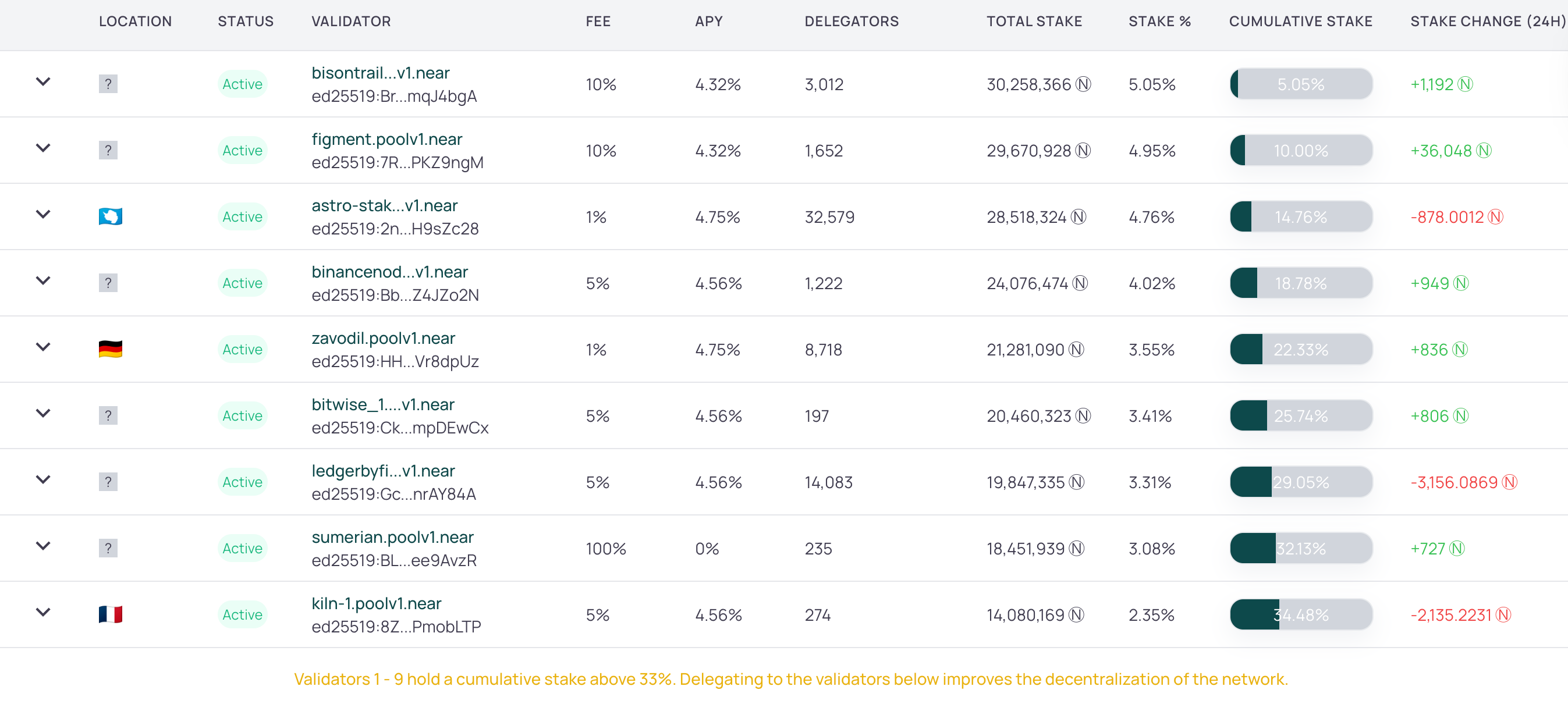
Validator concentration remains an important measure of NEAR's decentralization. If lower staking rewards disproportionately affect smaller operators, the network could become more dependent on larger validators.
This story matters for anyone evaluating NEAR seriously. "Decentralized" is a spectrum, not a binary, and governance under pressure reveals a lot about where a protocol actually sits on that spectrum.
The tension here reflects a broader issue across crypto: scalability, decentralization, and sustainable validator incentives rarely improve simultaneously without tradeoffs.
Institutional access to NEAR expanded significantly in September 2026, when Bitwise launched the Bitwise NEAR ETF (NYSE Arca: NRR), the first U.S. spot exchange-traded product providing direct exposure to NEAR. The fund aims to incorporate staking rewards, while Bitwise also offers a NEAR staking ETP in Europe. Separately, Grayscale provides exposure through its OTC-traded Grayscale Near Trust (GSNR).
OceanPal (NASDAQ: SVRN) became a NEAR treasury company, giving traditional brokerage investors indirect exposure through public equity. The launch gives U.S. investors regulated exchange-traded access to NEAR without directly managing wallets or staking infrastructure. However, institutional availability alone does not guarantee sustained demand or greater network adoption.
The bigger question is whether these narratives translate into actual usage. Infrastructure only matters if developers and users consistently build on top of it.
What's Actually Live in the Ecosystem
Beyond its core infrastructure, NEAR supports applications spanning decentralized trading, cross-chain liquidity, AI tools, and digital asset services. Examples include:
Ref Finance / RHEA Finance. The primary DEX, now combining exchange and lending into a chain-abstracted liquidity hub connecting Bitcoin, NEAR, and Ethereum.
MemDex launched an AI-driven cross-chain portfolio dashboard in April 2026 built on NEAR Intents.
Mintbase, NFT infrastructure used by artists and galleries internationally.
Confidential Intents.
In July 2026, NEAR made Confidential Intents generally available to developers, allowing third-party applications to offer confidential cross-chain execution through the NEAR Intents API. At launch, NEAR reported that Confidential Mode accounted for approximately 42% of near.com trading volume, while confidential balances exceeded $30 million.
Most of these products are more focused on infrastructure, interoperability, and consumer-facing usability. That aligns closely with NEAR's broader positioning as an invisible coordination layer rather than a crypto-native destination chain.
NEAR has reported substantial on-chain activity, but wallet addresses and transaction counts should not be treated as direct measures of unique human users. A reliable assessment of adoption requires looking at active addresses alongside transaction quality, application usage, fees, and sustained economic activity.
The Real Risks
The benchmark-to-mainnet gap. NEAR demonstrated 1 million TPS in an experimental environment, but benchmark capacity should not be confused with sustained mainnet throughput. Real-world scalability must be evaluated through actual network demand, transaction complexity, and performance under load.
Revenue vs. validator incentives. NEAR's inflation reduction lowered the rate of new token issuance, but the network still needs sustainable economic activity to support validator incentives. Growing Intents revenue could improve token demand, although application-level revenue and base-layer transaction fees should be evaluated separately.
The halving addressed part of this math. Intents fees are meant to address more of it. But the economics are still tight.
Cross-chain exposure. In April 2026, a coordinated attack caused a 13-block reorganization of the Litecoin blockchain, exposing NEAR Intents to approximately $600,000 in potential losses. The team pledged to cover the exposure, highlighting how cross-chain systems can inherit security risks from the networks they connect.
The team pledged to cover losses. The response was responsible, but chain abstraction that connects 25+ networks inherits the failure surface of all of them.
Competitive pressure. Chain abstraction is no longer a NEAR-only concept. Solana has been expanding its own cross-chain capabilities. Ethereum has third-party abstraction layers. The window for differentiation on this narrative is narrowing.
Price volatility. NEAR remains exposed to broader crypto market cycles, competition among Layer 1 networks, and changes in investor sentiment. Its price has historically experienced substantial drawdowns, meaning technological progress does not necessarily translate into token price appreciation. The live chart below shows the latest NEAR price:
NEAR Intents exploit. Between September 29 and October 1, 2026, attackers exploited a vulnerability in the NEAR Intents contract, withdrawing approximately $3.8 million through artificially credited balances. According to the project's postmortem, 23 failed deposit transactions created unbacked internal balances that were later withdrawn to other networks through Omni infrastructure.
Whether NEAR is undervalued depends on future adoption, sustainable protocol revenue, token supply dynamics, and competition. A substantial decline from previous highs is not, by itself, evidence of undervaluation.
That duality defines NEAR in 2026. The protocol is simultaneously one of the more ambitious infrastructure projects in crypto and one still searching for proof that its economic model can scale alongside its technical vision.
Bottom Line
NEAR has made measurable progress in cross-chain infrastructure, confidential execution, and post-quantum security in 2026. The launch of a U.S. spot ETF and growing Intents activity strengthen its position, but protocol exploits, validator economics, and governance tensions remain important risks. The long-term test is whether technical adoption translates into sustainable revenue and security.