


Hyperliquid seems to be the most hyped crypto after Bitcoin right now, dominating recent Hyperliquid news and social media feeds.
Crypto users are ecstatic over the new $$97.98 ATH, and CoinGecko is naming HYPE one of crypto’s top revenue-generating projects. The sentiment is a chaotic mix of pure FOMO and subdued anxiety over the upcoming October 6 token unlock.
At ChangeNOW, we aren't particularly fond of guessing games. So, we took a research approach: comparing this social media frenzy against our own exchange data to see what retail is actually doing with their money.
Key Takeaways
- Social media is super bullish. Over 95% of HYPE mentions come from X, with sentiment at 86% positive, roughly six bullish posts for every bearish one.
- ChangeNOW swap data shows no exodus. HYPE's platform rank climbed from #44 to #39, and its share of total swap volume nearly doubled, from 0.13% to 0.29%.
- Buying is spread across multiple pairs. SOL, USDC, and USDT all posted strong growth on the incoming side. Ethereum is the only pair losing volume.
- The last HYPE unlock triggered the same concerns, and the price held through it.
Latest Hyperliquid News & What to Make of Them
Here’s a shortlist of major things that happened to Hyperliquid in September 2026.
-
New all-time high: HYPE hit $97.98 raising a perfect storm of delighted tweets about how HYPE will soon reach $200. But we shouldn’t forget that most of the supply is still locked, so there’s a concern shared among the general public that the upcoming token releases will crash the price.
-
#1 on-chain earner in crypto: According to Coingecko’s report, $429.04 million in revenue for 2026 put Hyperliquid on the pedestal of crypto’s top revenue generators. It even left Pump.fun behind with only $322 million, not mentioning established heavy-weights like Polymarket and World Liberty Financial. And that makes Hyperliquid one the few crypto assets printing actual cash flow from real trading fees right now.
-
$3.76M burned HYPE: The platform used its fee revenue to buy back and burn about 40k HYPE in one day. Meaning that the platform is using its own profits to eliminate the tokens people are afraid will flood the market.
-
FalconX moved $50M worth of HYPE: Named institutional broker moved 533,250 HYPE between internal addresses. The main hypothesis here is that they’re likely prepping liquidity for clients ahead of October’s unlock.
The better a token performs, the more anxious traders get that the rally could snap at any moment. The stakes are simply too high.
Price drops following major token unlocks are a predictable cycle, and the market has seen this play out before. A prime example is Arbitrum in March 2024, when a massive cliff unlock of over 1 billion tokens triggered a severe, months-long downtrend.
Does the upcoming HYPE unlock actually justify this level of panic? Let’s look at the numbers and find out.
Social Media Context: What Crypto X Is Posting About HYPE
Mentions are up 13.1%, engagement is up too, and sentiment is at 86% positive which means for every negative post about HYPE, there are about six positive ones.
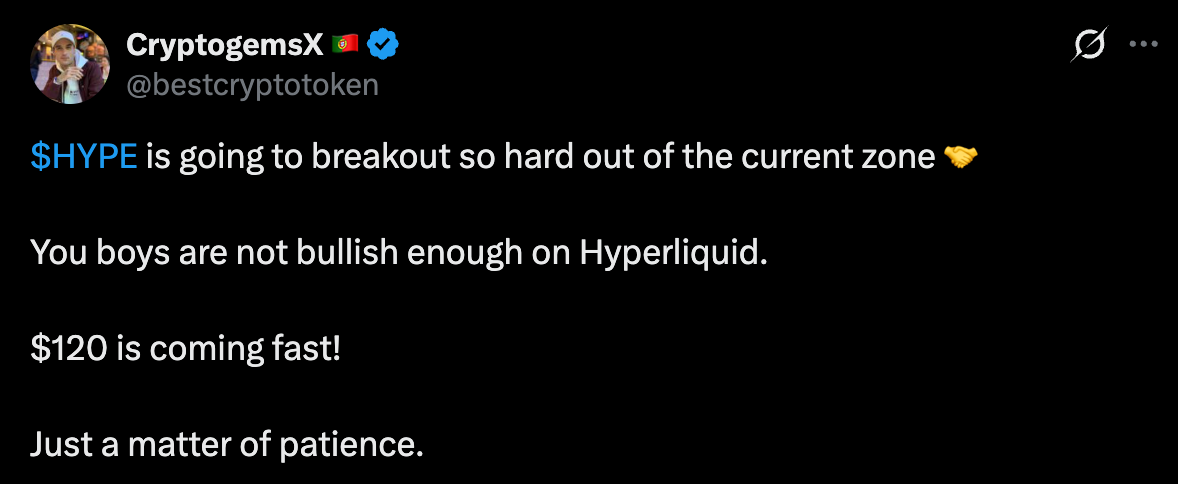 Source: @bestcryptotoken on X
See the post above? Multiply that by a few thousand accounts - there's your 86% of LFG posts.
And HYPE delivers: the token broke its own ATH twice during the time it took to draft this article. The current price has a short shelf life here.
The shadow of October 6 unlock looms over all this celebration of success and lambo dreams. For the record, this isn't the first HYPE unlock to spook the timeline. The last one triggered the same wave of concerns. The price didn't crash though, holders kept holding, and the token moved on like nothing happened towards the next ATH.
Want more insights on the previous Hyperliquid unlock? Read our analysis here: Hyperliquid Token Unlock: Claim Dynamics, Price Action and Swap Stats
ChangeNOW Swap Stats: What Retail Is Doing With Its Money
Quick insight: ChangeNOW swap data from June–September 2026 shows HYPE holders are actively consolidating. The asset climbed up our leaderboard from #44 to #39, more than doubled its share of total swap volume, and transaction growth is broad-based across pairs.
Swap activity itself moved in a boom-bust-boom pattern: June up 120.5%, July down 47.88%, August up 94.02%. September is down 39.21% so far, but the month isn't over, so that's not the full story.
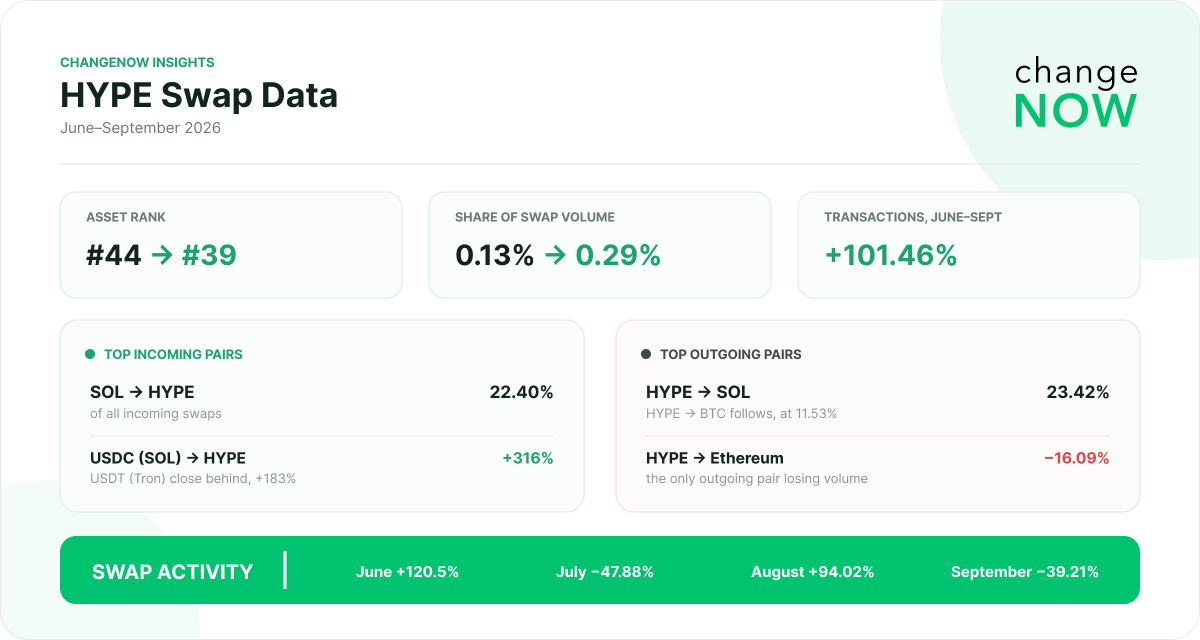
SOL is the main entry point into HYPE on our platform - 22.40% of incoming swaps. The fastest growth is in stablecoin pairs: USDC via Solana is up 316% in transaction volume, USDT via Tron up 183%.
On the way out, SOL and BTC lead, at 23.42% and 11.53% of outgoing swaps. HYPE-to-Ethereum is the only outgoing pair losing volume, down 16.09% in transactions and down from 13.68% to 6.58% of outgoing share.
HYPE-to-HYPE swaps rose on both sides too, holders repositioning the asset rather than cashing out. Every pair but Ethereum grew this period.
Conclusion
Short answer: Pre-unlock concerns dominating recent Hyperliquid news are not backed by the data. Social media sentiment on HYPE is 86% bullish, and ChangeNOW's internal swap data shows no sign of retail rushing for the exits ahead of the October 6 unlock.
If anything, the numbers point the other way: holders are consolidating tokens.
HYPE's platform rank climbed from #44 to #39, its share of total swap volume nearly doubled, and buying spread across SOL, USDC, and USDT pairs rather than piling into one panicked trade. The only pair losing volume is HYPE-to-Ethereum, down 16.09%, which looks like a shift in preferred exit route, not an exit from the asset.
The last HYPE unlock produced the same kind of anxious threads, and the price held through it. That's one data point, not a guarantee for October 6, though it does put the burden of proof on the people calling for a crash.
Disclaimer: This article is for informational purposes only and does not constitute investment advice or a recommendation to buy or sell crypto assets. Any views, opinions, or forward-looking statements reflect current market sentiment and publicly available information and should not be relied upon as a basis for investment decisions.


