On November 11, OKX and Intercontinental Exchange (ICE), the parent company of the New York Stock Exchange, announced plans to launch 24/7 trading of tokenized U.S. securities on November 23. The venue is expected to offer more than 70 assets. Days earlier, Ava Labs announced that Avalanche would power settlement for a separate planned NYSE-affiliated platform.
Wall Street wants blockchain's speed and lower costs. But does it want decentralization too?
In an exclusive interview with ChangeNOW at TOKEN2049, Injective CEO Eric Chen talks about what brought institutions on-chain, why small businesses could benefit, and what DeFi risks losing if it tries too hard to please Wall Street.
Want to hear the full conversation? Watch our exclusive interview with Injective CEO Eric Chen at TOKEN2049 on YouTube.
Key Takeaways
- According to Eric Chen, institutions are moving on-chain primarily for faster transactions and lower costs, not decentralization.
- Tokenization could open new markets to smaller businesses, but it doesn't remove legal requirements or the risks associated with asset issuers.
- As Wall Street adopts blockchain technology, Chen believes DeFi must preserve decentralized infrastructure and user control to remain meaningfully different.
Why Is Wall Street Moving On-Chain Now?
Institutions are drawn to blockchain by faster transactions and lower costs. Chen says this shift didn't happen overnight. Blockchain teams spent roughly a decade persuading financial institutions to test the technology and run pilots. Now, he says, institutions are racing to build products while regulation begins to catch up.
"... We're at a stage where every single institution is trying to do something on chain. We're trying to out-innovate each other and trying to come up with different, very unique products to be on chain."
On November 12, the Depository Trust & Clearing Corporation (DTCC) also announced plans to connect its tokenization service to Solana, with eligible assets expected to become available there in the second half of 2027.
According to Chen, decentralization isn't what attracts institutions to blockchain. They're more interested in faster transactions and lower costs.
He says traditional companies can spend tens of millions of dollars getting assets ready for broad market access. In contrast, some basic on-chain asset issuance or fundraising tools, he claims, can cost less than $10. These aren't like-for-like costs: launching a token is not the same as meeting the legal and operating requirements of a public offering. But the gap captures his argument about barriers to entry.
"The friction that goes into it, it's manual. There's a whole discovery process and oftentimes there's also just a barrier entry."
Chen says banks can charge 1% to 10% for an IPO, while on-chain fundraising costs could fall close to zero. That's his forecast, not an established comparison between equivalent offerings. Even so, he believes simpler infrastructure could open access to capital for people who currently find traditional finance too expensive.
Tokenization Isn't Just About Stocks
When asked what institutions could bring to DeFi, Chen doesn't choose credibility or capital. He chooses more kinds of assets. The idea is to bring businesses and investment opportunities into markets that are currently difficult to reach.
"There are thousands and millions of small businesses, exciting assets, exciting goods and new commodities. They're just out there in the world, ready to have their prices be truly discovered instead of being extremely localized in a small region."
Chen sees this as a potential benefit for ordinary users, not just institutions.
"I think it's really about benefiting the ordinary users. When you have proper price discovery for things, when you bring the world on-chain, it means that there's going to be the abundance of supply for the goods that you're looking for. And at the same time, there's going to be extremely competitive pricing."
The example is an oyster farmer who created a meme coin on Injective. The farmer proposed buying back tokens with proceeds from his business and shared videos of the farm's expansion. It wasn't a conventional real-world asset (RWA) token backed by farm ownership, as Chen himself points out. It was a creative attempt to raise money outside traditional channels.
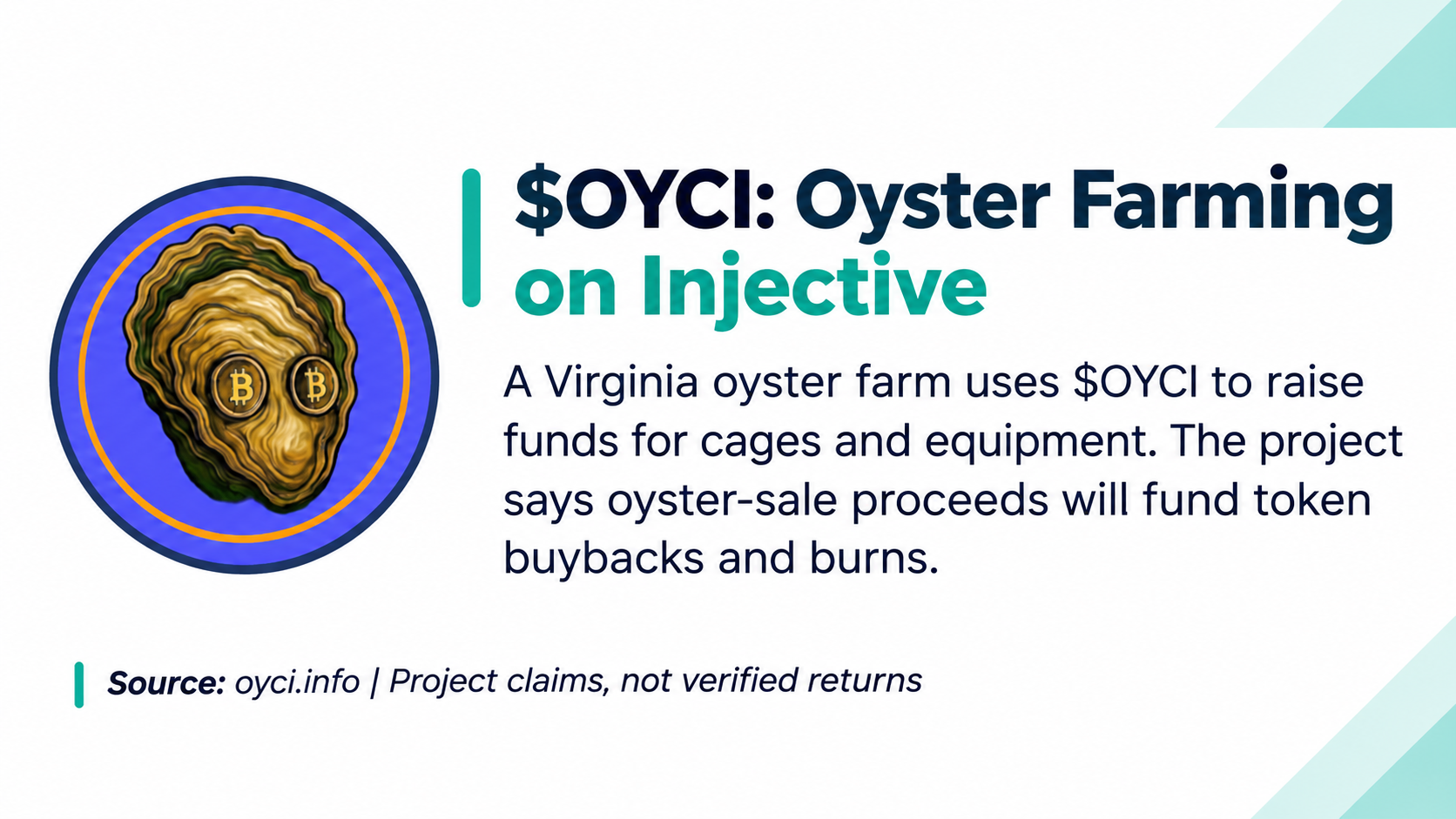
For a restaurant or small farm, Chen says, finding $10,000 or $20,000 could mean opening another location or expanding operations.
DeFi vs TradFi: The Risk of Rebuilding Wall Street On-Chain
For Chen, the biggest risk is that DeFi projects will change themselves so much to attract institutions that they lose their purpose.
"Because when DeFi teams or projects appeal too much to institutions, you become an institution yourself with a crypto rail, which isn't really offering the unique benefits or the promises of the on-chain world and DeFi world."
DeFi teams, he argues, should keep building useful products, grow their audience, and make institutions feel they're falling behind.
"It's just about sticking with your mission, grow faster, and just having so much traction and so much activity, so that institutions are the ones who are feeling like they're being late, like they need to get ahead with the times."
But what must stay decentralized? Chen starts at the network level.
He warns about Layer 2 blockchains with a single sequencer that can order transactions or censor addresses. He also criticizes networks that call themselves blockchains but depend heavily on centralized AWS infrastructure. And he sees a familiar cycle: people leave a centralized system after something goes wrong, only to choose another one because it promises better speed.
"I think no matter what, the infrastructure has to be decentralized. Nothing else really matters. If you're working with a centralized infrastructure, it doesn't matter whether you're non-custodial because the chain can just roll back."
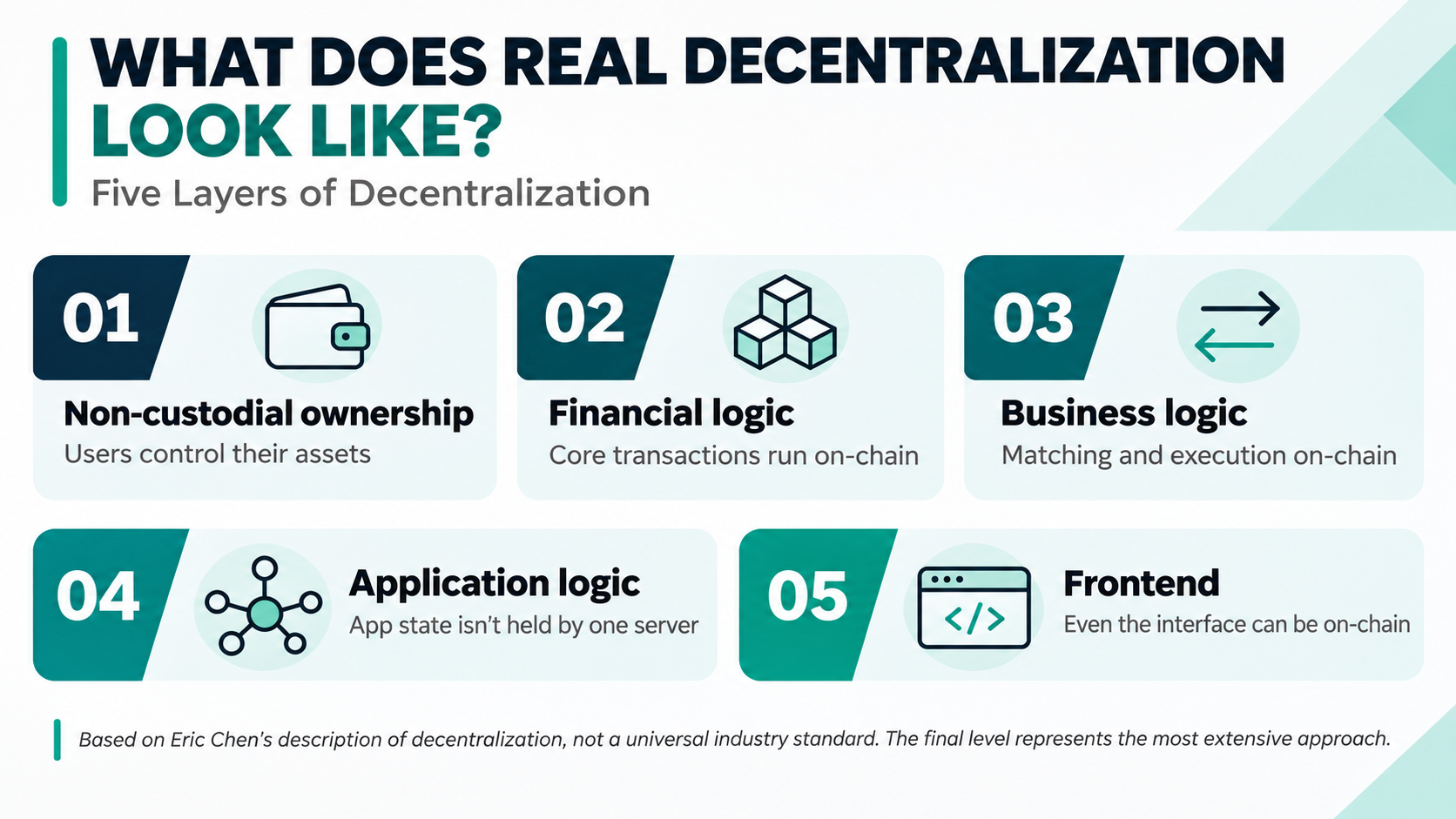
Beyond that foundation, he describes progressively deeper levels of on-chain control:
- non-custodial asset ownership;
- critical financial logic;
- business functions such as order matching;
- application logic;
- and, at the furthest end, even the frontend.
Not every app needs to reach the final level. But users should know which parts still depend on someone else's server.
RWAs Aren't Automatically Safe
Established institutions may have direct links to the assets behind their tokens, but that doesn't mean every future issuer will be trustworthy.
"Oftentimes, as this industry grows, you're going to see issues of RWA tokens that's not necessarily fully backed because of fraudulent activity."
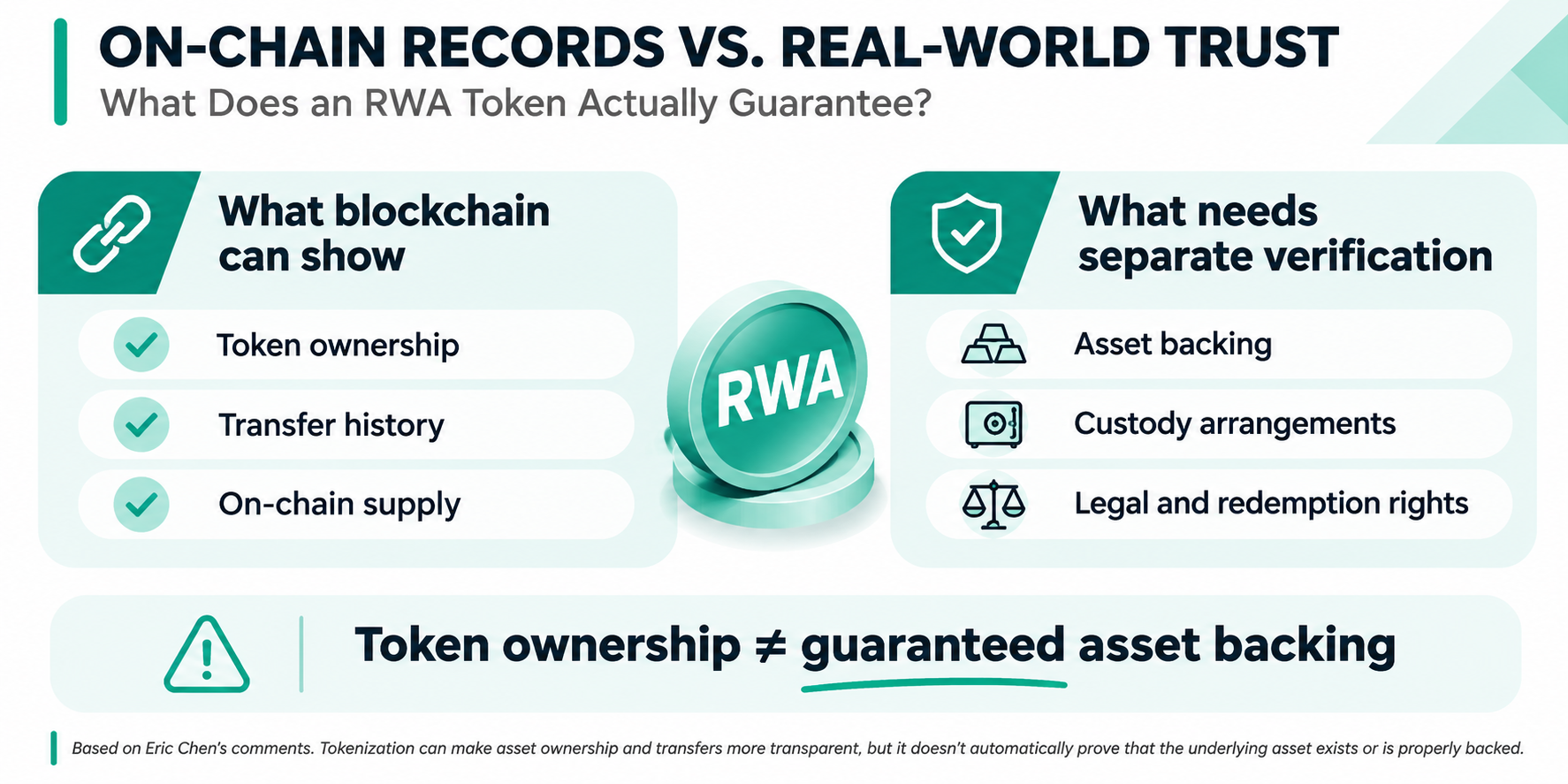
That's why tokenized assets still require trust in their issuers, custodians, and legal protections. As Chen puts it, this market is no different from any other when it comes to fraud.
How Injective Is Preparing for Institutional Finance
Built for Financial Transactions
Financial transactions can't always wait behind less urgent blockchain activity. Chen gives the example of a busy NFT mint delaying liquidations on a lending platform. If those liquidations arrive too late, the platform could face losses.
Injective addresses this with built-in financial modules, including an order book and oracles, alongside dedicated transaction lanes. According to its official website, the network produces blocks in roughly 600 milliseconds and has processed around 3 billion transactions as of November 18, 2026.
Its MultiVM architecture supports both WASM, which lets developers build smart contracts in languages like Rust, and EVM, which runs Ethereum-compatible smart contracts.
Bringing Institutions On-Chain
Major companies like Google Cloud and NTT Digital help secure Injective as validators. However, their participation alone doesn't mean the network is fully decentralized.
In November, Injective also introduced Institutional Rail. It gives financial institutions a dedicated way to submit transactions, though keeping final validation with the network's validators.
The project is making progress on the regulatory side, too.
In August 2026, Injective Institutional Services became an SEC-registered transfer agent. The Injective Foundation also published a MiCA white paper for INJ.
The SEC registration covers securities recordkeeping, the MiCA white paper provides regulatory disclosures for INJ.
Together, they show how Injective is combining on-chain financial tools with the infrastructure and regulatory processes institutions need.
Faster Markets Without the Old Friction
Chen believes traditional markets have grown complicated partly because old infrastructure is expensive to replace. Banks and exchanges have spent decades building extra processes around systems that were never designed for instant, always-on settlement. He describes the result as legacy finance held together by "credit glues."
In the U.S., stock trades generally settle one business day after execution. Blockchain-based systems could shorten that wait.
Trading around the clock could also reduce gaps between closing and opening prices. Chen argues that some large trading businesses profit from those gaps and that more continuous markets could return some of that efficiency to everyday investors. That's his view, not a guarantee that 24/7 markets will be cheaper or more liquid.
The trust people place in banks, he adds, comes from institutions, rules, and legal protections. It doesn't mean the technology beneath them must stay the same forever.
Make DeFi Easier Without Bringing Back the Gatekeepers
For all the talk of new financial infrastructure, Chen sees one especially stubborn obstacle for newcomers: wallet addresses.
He compares DeFi with card payments. A purchase involves banks, payment networks, and processors, but the customer only sees a tap or a swipe. Crypto users, by contrast, still have to deal with addresses, networks, and bridges themselves.
Looking ahead, Injective wants to bring crypto futures, equity and commodity perpetuals, options, pre-IPO opportunities, and other products into one experience. Chen also hints at projects the team isn't ready to announce.
"I think Injective wants to be in a position where if you go on Injective, the user uses an app on it, they instantly can trade anything."
A similar challenge came up in ChangeNOW's TOKEN2049 talk on crypto super apps: making crypto easier to use without taking control away from users.
ChangeNOW's Vision for Simpler Crypto
Conclusion
We asked Chen whether Wall Street moving on-chain means DeFi has won or TradFi has simply upgraded.
"Both. It's a win-win situation."
For Chen, the future of finance has room for both. The challenge is making sure DeFi keeps what makes it different as traditional institutions move on-chain.