


Disclaimer: This review is educational and rests on public data and fixed criteria. It describes how each service works and serves information purposes only. Details change, so verify them on the official platforms before acting.
This Banxa review covers who owns the provider, which licences it holds, what a purchase costs and what customers report. Wallets and exchanges embed Banxa's checkout, so many buyers meet it inside a partner app. Data comes from Banxa's own pages, company announcements and Trustpilot, checked between 9 and 22 October 2026.
Key Takeaways
- Who you deal with: a card purchase started in a wallet or on ChangeNOW may be processed by Banxa, which then runs its own ID check.
- Legitimacy: OSL Group owns Banxa, and its entities hold licences or registrations in five regions, while customer reviews point to slow orders and holds.
- Cheapest route: bank transfers skip the card processing fee, and only the checkout quote shows what a purchase costs in total.
- Refunds: Banxa's documentation says refunds of cancelled orders are always for the full amount, and some have taken several weeks.
- Comparing providers: MoonPay, Transak and Ramp Network show fees and margins in different ways, so compare quotes for the same payment method.
How We Reviewed Banxa
The review looks at five things: ownership and licences, fees, payment methods and limits, verification and refunds, and customer feedback. For MoonPay, Transak and Ramp Network we checked published fees, registrations and real user experience on Trustpilot. Full criteria are in our review methodology.
What Is Banxa and How Does It Work?
Banxa is a fintech platform that builds fiat-to-crypto payments for businesses such as wallets, exchanges and payment apps.
Their customers buy and sell crypto inside the partner's app, while Banxa handles the payment, the ID check and the delivery. In a typical order, you pick an amount, a coin and a payment method in the partner app, Banxa checks your identity and the coins arrive at the wallet address you entered.
According to its security page, Banxa is a non-custodial agent that transfers assets directly to customer-directed wallets.
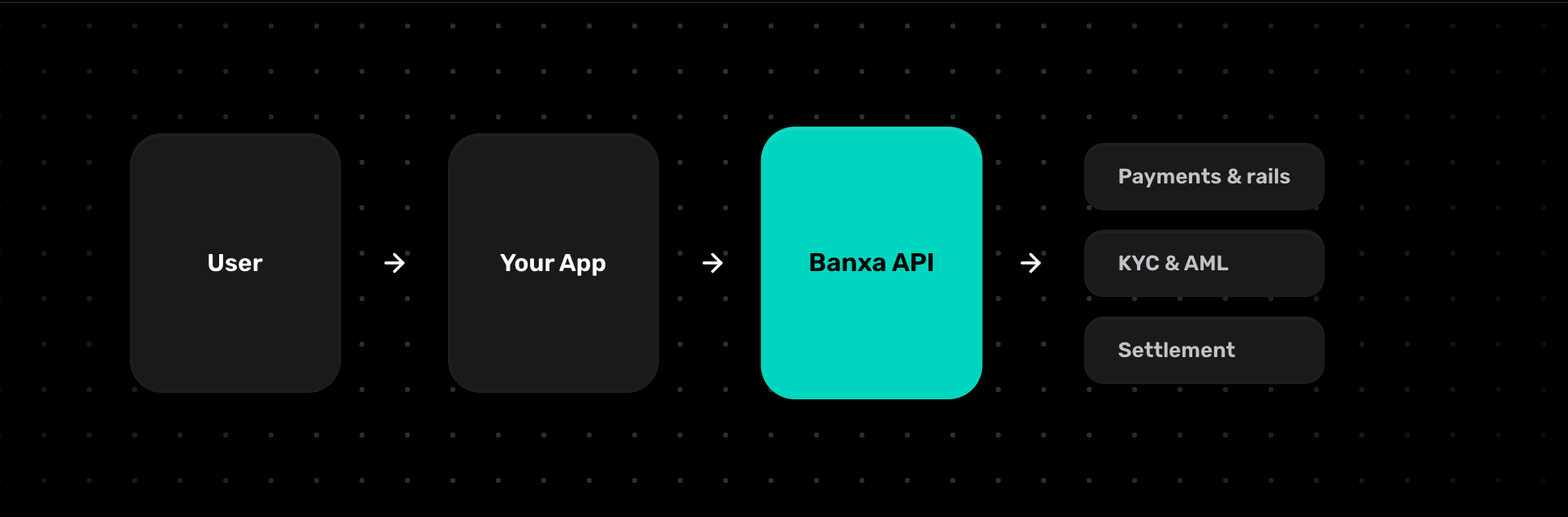
Source: Banxa developer documentation, 22 October 2026
Banxa's help centre lists five order stages: creating the order, checking it, an ID check for first-time customers, confirming the payment, and then delivery, cancellation or a refund.
Banxa on ChangeNOW
Banxa is one of our fiat partners. Card purchases on ChangeNOW go through Guardarian, Banxa or Transak, so a card order can be handled by Banxa.
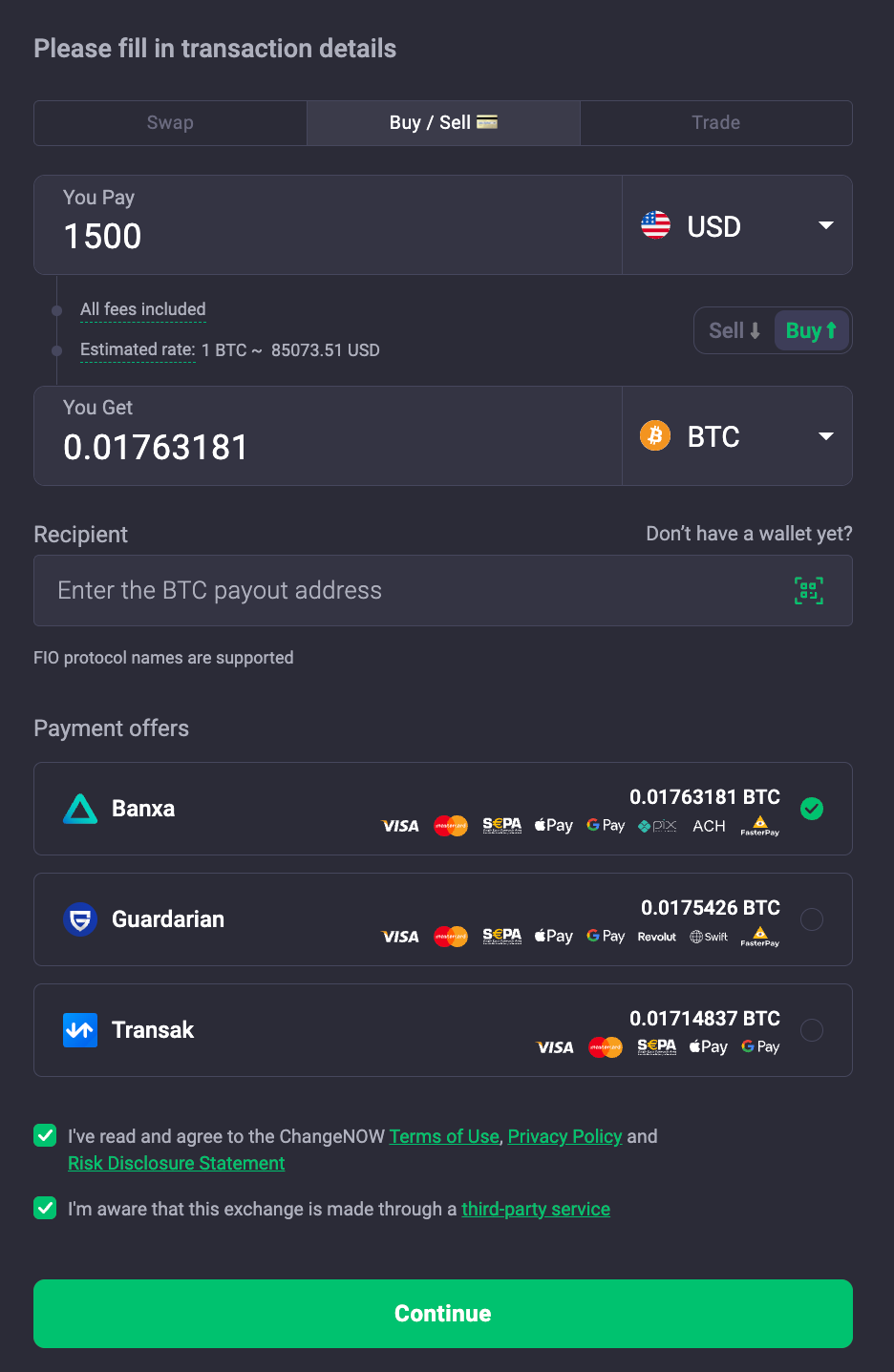
Source: ChangeNOW buy page, October 2026.
Is Banxa Legit? Ownership and Licences
On the public record, Banxa is a licensed fiat-to-crypto provider, and its status differs by market.
Source: Banxa developer documentation, 22 October 2026
Who Owns Banxa?
OSL Group completed its acquisition of Banxa on 2 January 2026 through OSL BNXA Acquisition Inc. Shareholders got C$1.55 in cash per share, and Banxa became a wholly owned subsidiary of the buyer. OSL Group confirmed it in its own press release, dated Hong Kong, 2 January 2026.
Which Licences Does Banxa Hold?
- Europe: EU Internet Ventures B.V. received a MiCA authorisation from the AFM, announced in October 2025. It covers 30 EEA countries. Our guide to MiCA regulation explains the EU rules.
- United States: BNXA USA MTL Inc. is registered with FinCEN. Its licence list shows 37 jurisdictions as of 13 November 2025.
- United Kingdom: BNXA UK VASP Limited has a cryptoasset service provider registration with the FCA that covers cryptoasset exchange services.
- Canada: Richmond Internet Ventures Corporation is registered with FINTRAC as a money services business and holds a Revenu Québec permit.
- Australia: Global Internet Ventures Pty Ltd is registered with AUSTRAC as a digital currency exchange.
The entries for the Netherlands, the UK, Canada and Australia come from a global licence list dated 21 September 2026. Banxa's safety guide suggests checking licences in the regulators' public registers. Its risk summary adds that Banxa is not an FDIC-insured bank, and crypto in a non-bank wallet is not FDIC insured
Banxa News in 2026
Banxa's press page lists releases from May to August 2026 about partner integrations, payment methods and product launches. All of them are company statements.
- 28 May: BitMEX added Banxa for buying and selling crypto. The release gives two date ranges for its 0% card-fee promotion: 28 May to 28 June in the text and 4 June to 4 July in the terms.
- 20 July: Banxa added VietQR bank transfers for buyers in Vietnam.
- 14 August: a 0% fee campaign run by Banxa and Trust Wallet for EUR purchases made through PayPal in 30 EU and EEA countries ended.
Banxa Fees Explained
Banxa’s pricing can include a processing fee, a network fee and a spread incorporated into the quoted asset price. The final cost depends on the transaction, payment method, currency, asset, blockchain and partner arrangement.
What Is Banxa’s Spread?
Banxa’s spread is a markup of typically 2-4% on the crypto price in your quote, with an optional 0-1% partner spread on top.
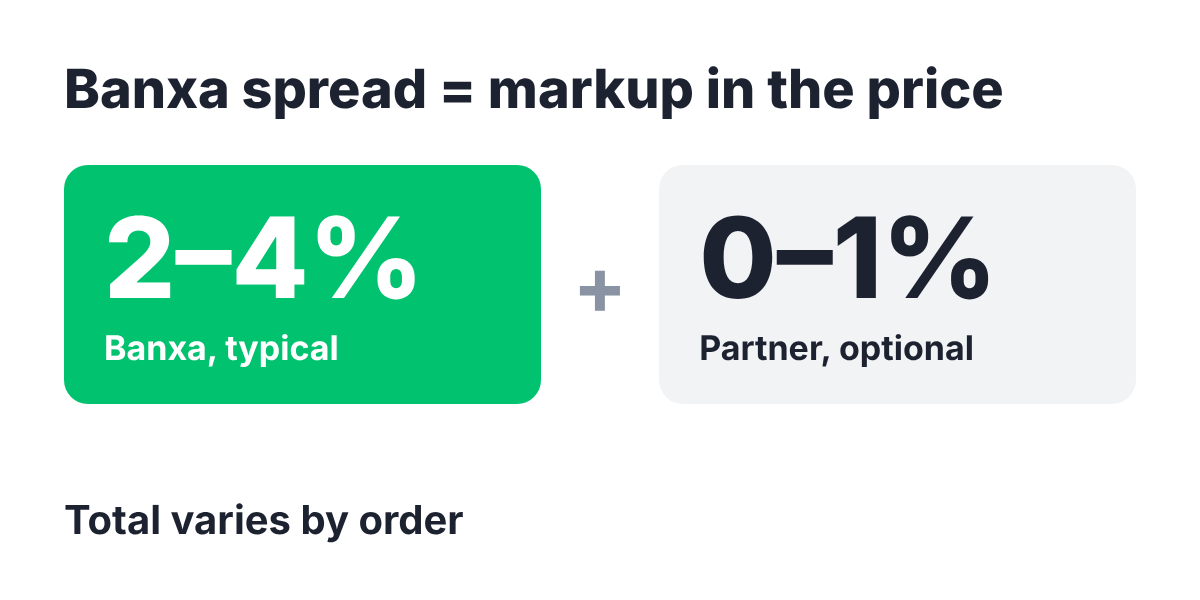
Banxa takes the base price from third-party pricing providers and adds the spread before showing the quote, so the total varies by order.
How Can Users Check the Total Cost?
Use the final checkout screen to evaluate the transaction. Compare the amount of crypto offered with the fiat amount you will pay, and check any displayed processing or network fees.
Your bank or payment provider may also charge its own fee. If the quoted price changes because of a significant market movement or another transaction-specific issue, review the updated terms before proceeding.
What Processing Fees Does Banxa Charge?
Banxa’s published pricing page lists the following processing fees:
| Transaction type | Published processing fee |
|---|---|
| Buy crypto with a card | 1.99% |
| Buy crypto with Apple Pay | 1.99% |
| Buy crypto using other listed payment methods | 0% processing fee |
| Sell crypto through SEPA | 0% processing fee |
These figures refer to the processing fee described in Banxa’s published pricing information. They do not mean that every transaction is free of other costs. A network fee, spread or charge from the bank or payment institution may also apply.
Check the official Banxa pricing explanation before relying on these figures, as fees and available payment methods may change.
Important Note: Banxa's pricing page was last modified on 15 May 2025, and the safety guide says quotes lock for roughly 3 minutes. The quote on the final checkout screen is the figure to compare. Our article on why ChangeNOW rates differ from exchange prices shows how to read such quotes.
Which Payment Methods and Countries Does Banxa Support?
Banxa accepts cards, Apple Pay and Google Pay in 28 fiat currencies, plus regional bank payments. Availability depends on region, currency and order type, and the table below shows buy methods by region.
| Region | Buy methods |
|---|---|
| Worldwide | Debit and credit cards, Apple Pay, Google Pay |
| EU and EEA | SEPA, PayPal in EUR, Klarna Pay Now in 7 countries, iDEAL in the Netherlands |
| United Kingdom | Faster Payments |
| Canada | Interac |
| Australia | PayID, NPP Direct Entry |
| Other markets | SPEI in Mexico, Khipu in Chile, local bank transfer in South Africa, VietQR in Vietnam |
Source: Banxa payment methods reference
Selling works through SEPA, Faster Payments, Interac and NPP Direct Entry. US customers can sell by ACH, and some European countries offer card payouts.
Banxa Supported Countries and Restrictions
The restrictions page lists 34 entries, including Afghanistan, Belarus, China, Cuba, Iran, Russia, Syria, Ukraine and Venezuela. Banxa checks the IP address when an order is created and blocks VPN traffic. Stablecoins are unavailable in Canada under local law. In the US, Banxa restricts some chain combinations for stablecoins in specific states.
Verdict: Banxa may fit buyers who want to pay by card or a local bank method in a supported region. Buyers in a restricted country may need another provider.
Does Banxa Require KYC? Limits by Region
Yes. Banxa asks first-time customers to verify their identity. Customers give a name, date of birth and address, upload an identity document and record a short liveness video, which Banxa's verification documentation says runs through Sumsub. According to the help centre, the person who pays must be the person who receives the crypto, and the card must be personal rather than a business card. Our article on why KYC and AML matter in crypto explains the reasons behind these checks.
Banxa KYC Limits by Region
Order limits follow a regional tier. Express covers small first orders, Standard covers mid-sized ones and Additional covers the largest.
| Region | Express | Standard | Additional |
|---|---|---|---|
| Europe | Up to €500, first order only | €501-9,000 | Above €9,000 |
| United States | Up to $760 | $761-15,000 | Above $15,000 |
| United Kingdom | – | Up to £8,000, with proof of address from £8,001 | Above £15,000 |
| Canada | Up to C$600, 5 orders maximum | C$601-15,000 | Above C$15,000 |
| Australia | – | Up to A$15,000 | Above A$15,000 |
Source: Banxa Global KYC Framework
Summary tables add period caps. Standard accounts in Europe, the US and Canada are capped at 30,000 per week and 100,000 per month in the local currency (EUR, USD or CAD), and Australia caps every period at A$15,000.
US Express accounts also have a $1,000 monthly cap and a $12,000 annual cap. Some orders get extra checks, and Banxa may ask for more details.
Banxa's own page shows two figures for the European Standard band: €501-9,000 in the tier table and €15,000 per transaction in the summary table. The page leaves the difference unexplained, and the table above follows the tier table.
Verdict: The checks may suit buyers who are comfortable sharing an ID and a short video at the first order. Buyers planning larger purchases may want to prepare their documents in advance.
How Long Does a Banxa Order Take?
On ChangeNOW, orders processed through Banxa take about 20 minutes on average. Some finish faster and some take longer, depending on third-party factors such as the ID check, the bank and the blockchain.
Banxa's own documentation gives longer figures. Card and instant payments usually complete within 90 minutes after the payment clears, according to Banxa's article on slow orders. Bank transfers by SEPA or ACH take 1 to 3 business days.
Delays come from an ID check on a first order, slow settlement on the payment method or a manual compliance review. Standard verification is usually completed quickly after the order is placed. If Banxa needs more information, it emails you, so check your inbox and spam folder.
If your order is still not done after 2 hours for card payments or 3 business days for bank transfers, contact Banxa Support, which is available 24/7, and give the order ID. Delivery on the blockchain can add time, and our guide to crypto confirmations explains how fees and network load affect speed.
In one r/ProtonWallet thread, a buyer asks how long settlement takes when buying through Banxa. Forum posts reflect individual cases.
Is Banxa Safe? What Customers Report
Banxa operates under the licences described above, and Trustpilot shows 3.9⭐ out of 5⭐from 76,422 reviews. Banxa replies to 97% of negative ones.
Banxa Trustpilot Rating
- Stars: 71% of reviews give five stars and 13% give one star.
- Volume: 8,721 reviews arrived in the past 12 months.
- Replies: Banxa typically answers negative reviews within a week, and Trustpilot notes that replies may use AI assistance.
Source: Trustpilot, Banxa profile, 22 October 2026
What Do Critical Reviews Report?
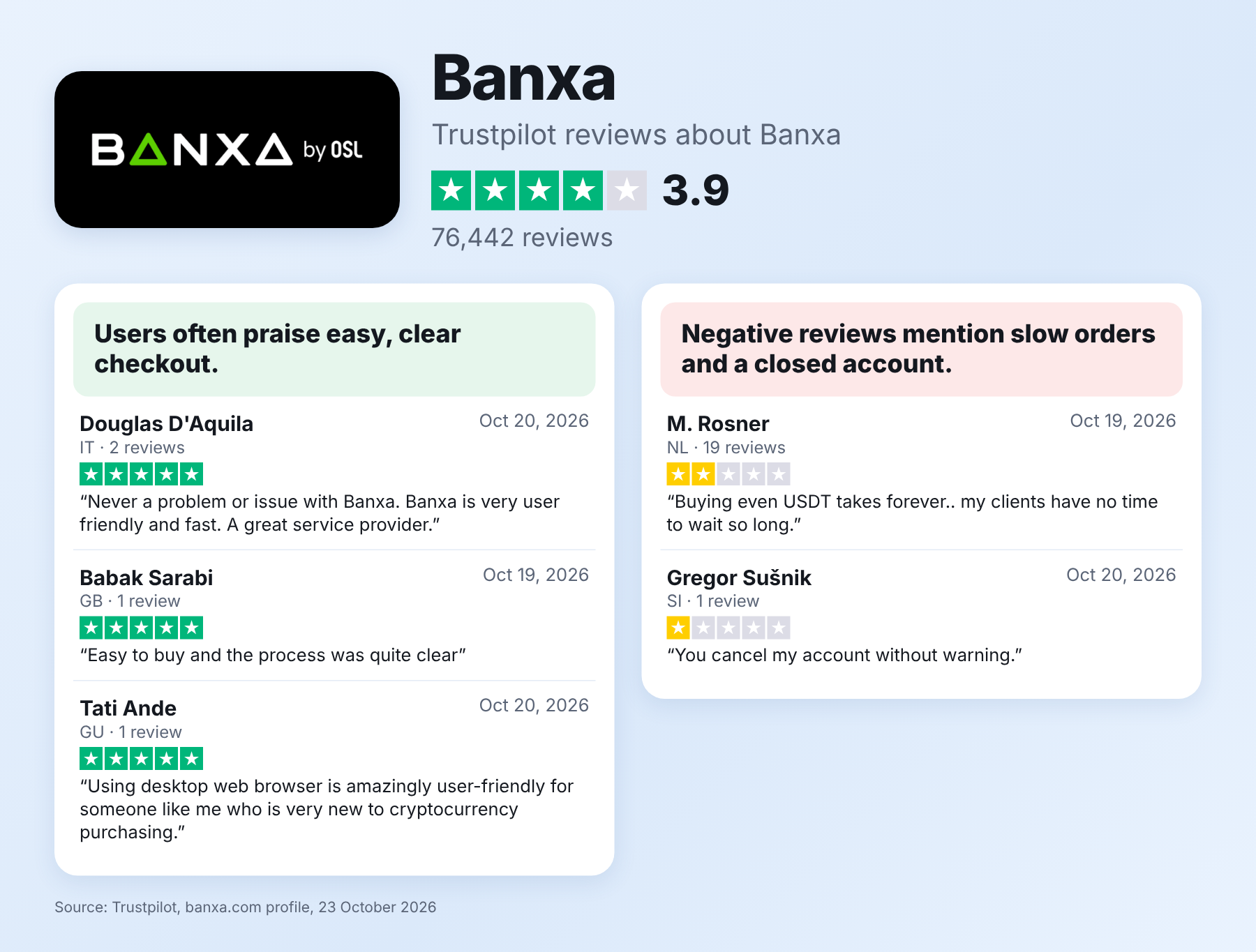
Recent critical reviews on the same profile mention slow processing, delayed funds, a 24-hour hold on funding requests, fee and refund disputes and one fraud concern. They cover only a handful of reviews and show themes, not counts. Trustpilot adds a notice that the company may be associated with high-risk investments and says individual reviews stay unchecked for accuracy.
A five-star review from 18 October praises step-by-step updates on the payment, while a one-star review from 20 October describes $270 leaving a bank account for an order that Banxa's risk controls declined, with support replying by automated emails.
Imitation checkout pages are a separate risk, and our article on punycode phishing shows how one changed character can lead to a fake site.
Verdict: Regulated status may weigh more for some buyers and review scores for others. A small first order may let a buyer see the process before a larger one.
What to Do If a Banxa Payment Fails or a Refund Is Late
If your money has not come back, open a ticket in the Banxa help centre and include the order ID. Banxa aims to resolve it or ask for more details within 10 business days. First, allow the normal refund time. Cancelled orders are refunded in full to the card or bank account that paid, according to the refund reference. If you were charged but the order failed, it takes 7-10 business days, and a separate help article says some refunds have taken up to 28 days.
If an order is flagged as fraud, Banxa takes no money and leaves only a temporary hold. You can cancel an order until payment validation finishes, but crypto already sent on the blockchain cannot be reversed. If the refund window has passed, the help centre sends you to your bank or card issuer.
Banxa Pros and Cons
Pros
- 150+ countries and regions in the documentation
- Local bank methods next to cards, such as SEPA, Faster Payments and Interac
- Regulated entities in five jurisdictions
- A 0% processing fee on bank transfers and sell orders
Cons
- A typical 2-4% spread on top of the 1.99% card fee
- A photo ID and sometimes a liveness video at the first order
- 34 restricted countries and VPN blocking
- Reviews that mention slow orders and holds
Verdict: Regulated entities and local bank methods weigh against a spread and an ID check, so the balance depends on the buyer. Buyers who prefer a different fee structure may compare the alternatives below.
Banxa Alternatives: MoonPay, Transak and Ramp Network
MoonPay, Transak and Ramp Network also sell crypto for fiat, and their Trustpilot scores run from 3.8 to 4.1.
MoonPay
MoonPay's Europe pricing disclosure lists up to 4.5% for card and PayPal purchases and up to 1% for bank transfers. The page adds that the price may include a spread but gives no figure for it. Below a certain amount, a €3.99 minimum fee applies.
Its licence page shows a MiCA authorisation through the AFM for MoonPay Europe B.V. and an FCA registration for MoonPay (UK) Limited. MoonPay USA LLC holds a New York virtual currency licence. Our list of MoonPay alternatives compares more providers.
Transak
Transak's fee page lists these buy fees:
- Cards and Apple Pay at 3.99% plus $1
- Google Pay at 3.99%
- Bank transfers at 2% plus $1
The same page says the quoted rate is based on CoinGecko pricing plus a spread of 0% to 2.5%, which is built into the price before you confirm.
Beyond fees, the website cites 136+ assets across 45+ networks and names registered entities in the USA, the UK, Canada, Australia and Hong Kong. ChangeNOW's announcement about adding Transak describes it as one of our fiat-to-crypto providers.
Ramp Network
Ramp Network's fee schedule shows up to 1.40% for manual bank transfers and up to 3.9% for cards in USD, EUR and GBP. Cards in other currencies cost up to 5.45%. The page says the fee covers Ramp's margin and the cost of the payment method.
On the regulatory side, Ramp received a MiCA authorisation from the Central Bank of Ireland, announced on 4 December 2025. It covers buying and selling crypto across the EU under one licence.
Quick Comparison Table
| Provider | Published buy fees | Licences and registrations the provider states | Trustpilot |
|---|---|---|---|
| Banxa | 1.99% on cards and Apple Pay plus a 2-4% typical spread, 0% processing on bank transfers | MiCA (NL), FinCEN, FCA, FINTRAC, AUSTRAC | 3.9⭐, 76,442 reviews |
| MoonPay | Up to 4.5% on cards and PayPal, up to 1% on bank transfers; the price may include a spread, no figure given | MiCA (NL), FCA, New York licence | 4.1⭐, 115,695 reviews |
| Transak | 3.99% plus $1 on cards, 2% plus $1 on bank transfers, plus a 0-2.5% spread in the rate | Entities in the US, UK, Canada, Australia, Hong Kong | 4.1⭐, 56,884 reviews |
| Ramp Network | Up to 1.40% on manual bank transfers, up to 3.9% on cards; the fee covers Ramp's margin | MiCA (IE) | 3.8⭐, 11,495 reviews |
Source: provider pages above and Trustpilot profiles of MoonPay, Transak and Ramp Network, 22 October 2026
How to Choose Between Banxa and Its Alternatives
- Bank transfers and cards have separate figures for each provider, so compare like with like.
- Margins sit in different places. Banxa and Transak list a spread, MoonPay says a spread may be included in the price and Ramp builds a margin into its fee.
- Registrations in the third column differ by region, so check the one that covers your country.