


Zcash price prediction right now depends on whether the market treats ZEC as a mature, private competitor of Bitcoin or a compliance headache facing exchange delistings.
Zcash is a privacy-focused L1 blockchain. It combines Bitcoin’s hard supply limit with zero-knowledge cryptography. Unlike Monero, Zcash’s privacy is optional. It lets users decide whether they want to reveal their transaction details or hide them.
Short-term yearly forecasts for 2026 focus on upcoming network speed upgrades. Projections for 2027 through 2030 weigh rising mainstream privacy demand against the threat of tighter global regulations for privacy coins.
Disclaimer: This article is for informational purposes only and does not constitute investment advice or a recommendation to buy or sell crypto assets. Any views, opinions, or forward-looking statements reflect current market sentiment and publicly available information and should not be relied upon as a basis for investment decisions.
Where Zcash Stands Right Now
Quick summary: Zcash now trades around $1,200 as of October, 2026. It has pulled back after peaking near $1,660. If we zoom out a little, ZECUSD has more than doubled since January. For a ZEC price prediction, 3 things are important to watch right now: speed upgrades, the regulatory developments in Washington and market sentiment.
Zcash Price and Trading Activity
Trading volume runs in the hundreds of millions of dollars a day, so ZEC is liquid enough for most traders to get in and out safely. Deep liquidity and recent ecosystem improvements have brought ZEC to the TOP-10 global crypto assets on TradingView.
Quick snapshot of the current Zcash position:
- Current price: ~$1,200
- Market cap: $20.5 billion
- Rank: #10
- Total supply: 16.90 M
- Max supply: 21.00 M
- Open interest: $1.6 billion
Zcash News: NU7 Upgrade, Coinbase Loans, Policy
Speed upgrade: The biggest technical change is NU7. It cuts the target block time from 75 to 25 seconds, so transactions should confirm noticeably faster. It's already live on the public testnet, with mainnet targeted for November 5.
Adoption: Zcash is also getting easier to reach from the traditional side. Grayscale's Zcash ETF trades on NYSE Arca, and Coinbase lets US users borrow USDC against ZEC instead of selling it.
Regulation: An advocacy group called “Pretty Good Policy for Zcash” is making the case for privacy coins in Washington, and the CLARITY Act, which would set the rules for crypto markets, is the bill everyone is watching.
Scaling: Project Tachyon aims to push private transactions to payment-network scale, remove runaway state growth for validators and help obtain full post-quantum privacy. It's still a proposal though.
Market Sentiment: What the Crowd Is Saying
Quick summary: Social chatter is hot right now, but the vibe depends on which app you open. X is in full price-discovery euphoria, crowning Zcash as "encrypted Bitcoin" + astronomical targets. Reddit (being Reddit) remains thoroughly unimpressed, treating the rally with historical suspicion and Monero comparisons.
Aggregated social data from LunarCrush shows mentions jumped 24% to 9.6K, engagements crossed 5 million alongside an 84% positive sentiment score.
Looks like the crowd is paying attention again, and the bearish narrative feels more like a whisper with only 9%. However, high engagement does not necessarily mean agreement. So here’s what the crowd is discussing.
Zcash on Google Trends
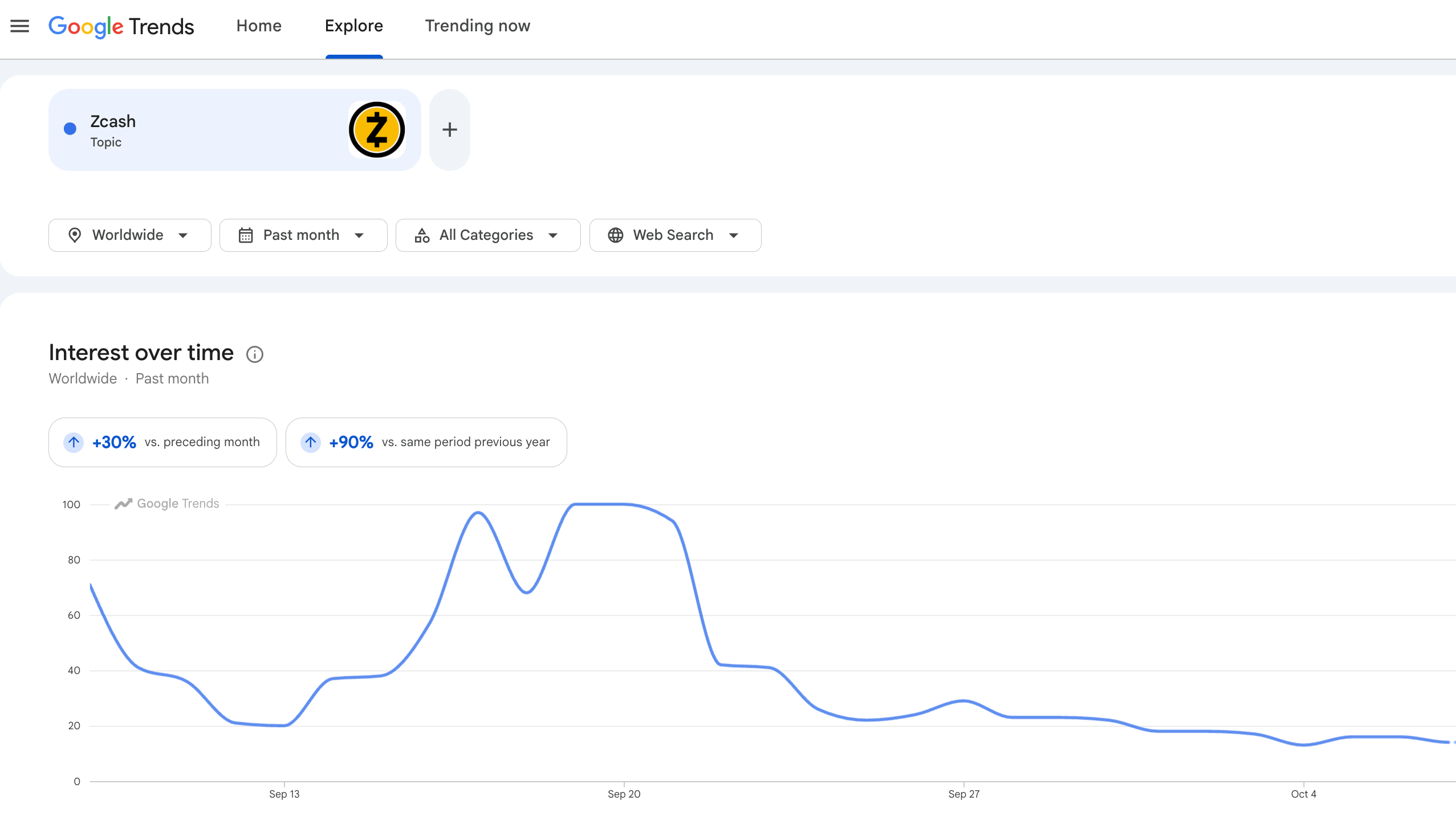
Source: Google Trends
Search data from Google Trends confirms the burst of outside interest. Worldwide searches jumped 30% month-over-month and 90% year-over-year.
Interest peaked at a score of 100 during the late-September price run before leveling off in early October. As usual with retail trends, search volume is following the price spike, not leading it.
"Encrypted Bitcoin" Euphoria on X
Whenever an older proof-of-work coin wakes up, crypto commentators inevitably rediscover its 21-million hard cap. This cycle, prominent venture figures have rebranded Zcash as the private twin Bitcoin never became.
Tyler Winklevoss delivered the most unabashed macro pitch, managing to fold nearly every high-tech narrative into a single post:
Zcash is the most exciting and undiscovered opportunity in crypto. It is encrypted bitcoin. It is pioneering privacy technology, quantum resistance, and AI-hardening. There is nothing out there even close to it and it's just beginning. Bookmark this tweet.
— Tyler Winklevoss (@tyler) August 18, 2026
It is a nice pitch for a multi-year Zcash price prediction, even if linking zero-knowledge proofs to "AI-hardening" requires some imaginative marketing on the timeline.
Once ZEC crossed $1,000, market sentiment shifted from calm accumulation to aggressive target-setting.
many are not pricing in how viral the “zcash is the next bitcoin” narrative is going to spread like wildfire once its cleanly trading > $1,000
— Ansem 🐂🀄️ (@blknoiz06) September 4, 2026
From there, timeline math escalated quickly. Quoting Arjun Khemani's observation that BTC and ZEC share identical emission schedules, Thor Torrens, founder of ONE OF ONES, dismissed five-figure milestones as overly cautious:
"Everyone is calling for $ZEC to 10k but that number is way too low. BTC went from 1k to 20k a decade ago. Times are way different now. The structural and macroeconomic climate in 2026 makes the historical retail run from $1k to $20k in 2017 look like child's play."
Comparing 2026 to 2017 makes for great engagement, though it casually skips over the fact that Bitcoin did not have to navigate a decade of privacy coin delistings to get there.
Instead of relying solely on exchanges, builders are trying to drive adoption directly to users. Nonprofits excel at open-source cryptography, but consumer software usually moves faster under a commercial setup.
That explains why former Electric Coin Company leads launched a dedicated startup to build a new wallet, drawing public backing from former Coinbase’s chief of tech, Balaji Srinivasan:
Zcash can scale. Zcash must scale. Zcash will scale.
— Balaji (@balajis) January 8, 2026
This signals a shift in priorities. If Zcash wants to reach users beyond privacy circles, the software has to look and feel like standard consumer tech. And packaging zero-knowledge cryptography into something everyday users will actually install remains the real test.
Reddit: The Pragmatic View
Switch to Reddit, and the enthusiasm cools down tangibly. Threads on r/CryptoCurrency and r/CryptoInvesting treat the price action with familiar skepticism, focusing on technical flaws and tokenomics rather than price targets.
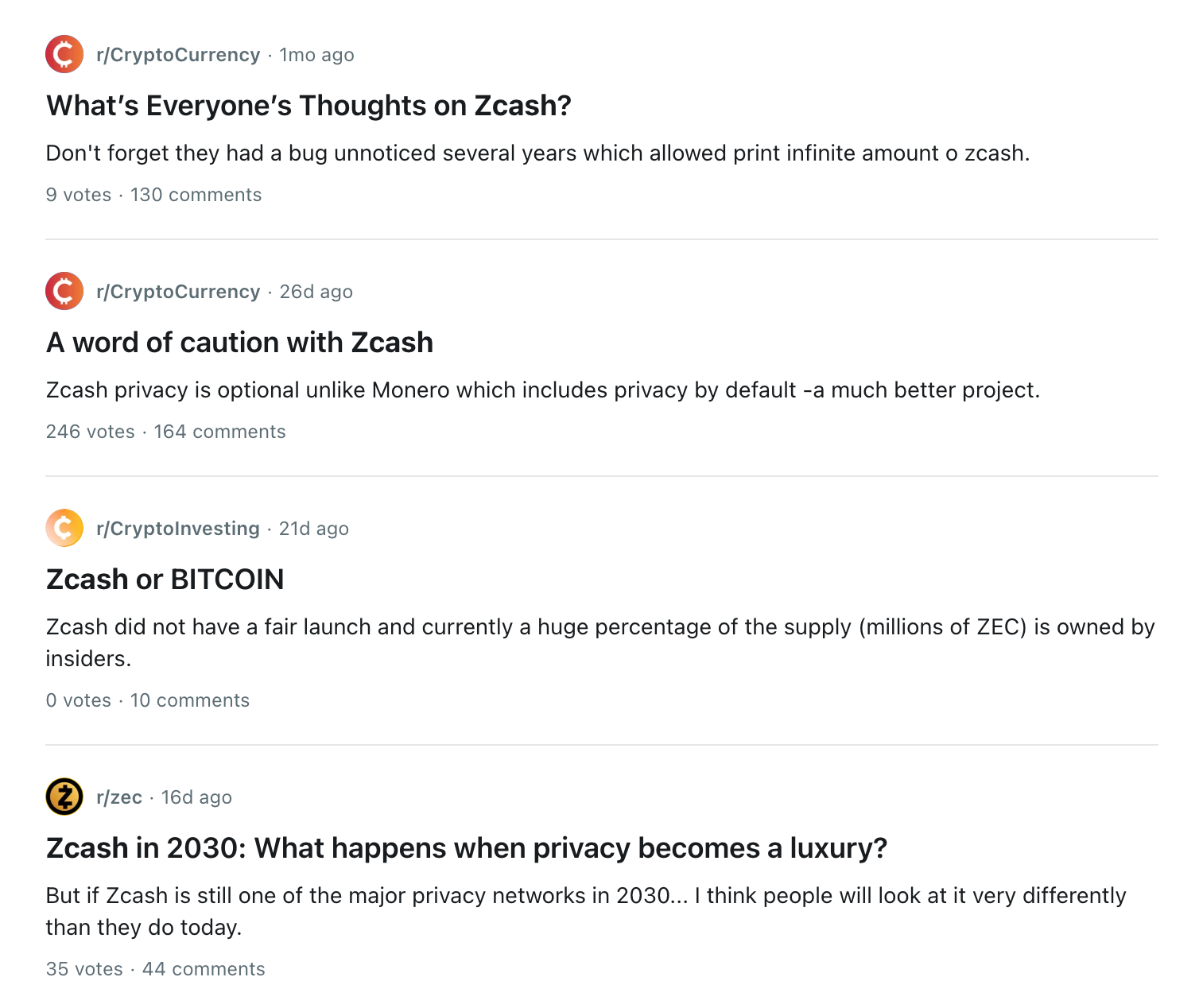 Source: Reddit
The main criticism orbits around three issues:
- The 2018 inflation bug: Retail memory runs long. Users regularly bring up the early flaw that could have allowed infinite minting. Developers patched it without evidence of exploitation, but skeptics still bring it up as a trust issue.
- Optional vs. default privacy: Monero remains the gold standard on Reddit. Many view Zcash's optional privacy as a flaw, saying that transparent transactions weaken anonymity for everyone else.
- Early supply distribution: Frustration over the initial launch hasn't disappeared, with users still critical of the coin supply allocated to founders and early insiders
Next read: Zcash vs Monero: Which Privacy Coin Is Better in 2026?
Even with the criticism, the core thesis doesn’t change in niche circles. ZEC holders on r/zec are sure that if global surveillance tightens by 2030, financial privacy will become an essential commodity, close to luxury even. Add quantum threat to that equation, and it will become clear why Zcash is trending on Google.
The quantum angle is widely discussed and not only on Reddit. In an exclusive interview with ChangeNOW at Token2049 Singapore, Tom Howard, CEO of Zcash Labs, said the team has been thinking about quantum risk for over 10 years, and explained what is already in place:
“In the next year or two, everything in Zcash is going to be upgraded to be fully post-quantum cryptography. But this Ironwood pool has a very unique feature: if a quantum computer were to come online tomorrow, that pool could be recovered to a post-quantum pool in a way that’s provable. So a quantum attacker can’t pretend that they own your coins.”
A roadmap is a promise, not shipped code. Still, it gives the r/zec crowd something sturdier than vibes.
Next read: Zcash Ironwood: Onchain Data Before & After the Upgrade
Zcash Price History: All-Time Highs and Market Cycles
Quick summary: The price history of Zcash has been a bumpy road: a supply-squeeze spike at launch in 2016, years of survival near $20 under regulatory pressure, and a sharp comeback above $1,600 in 2026.
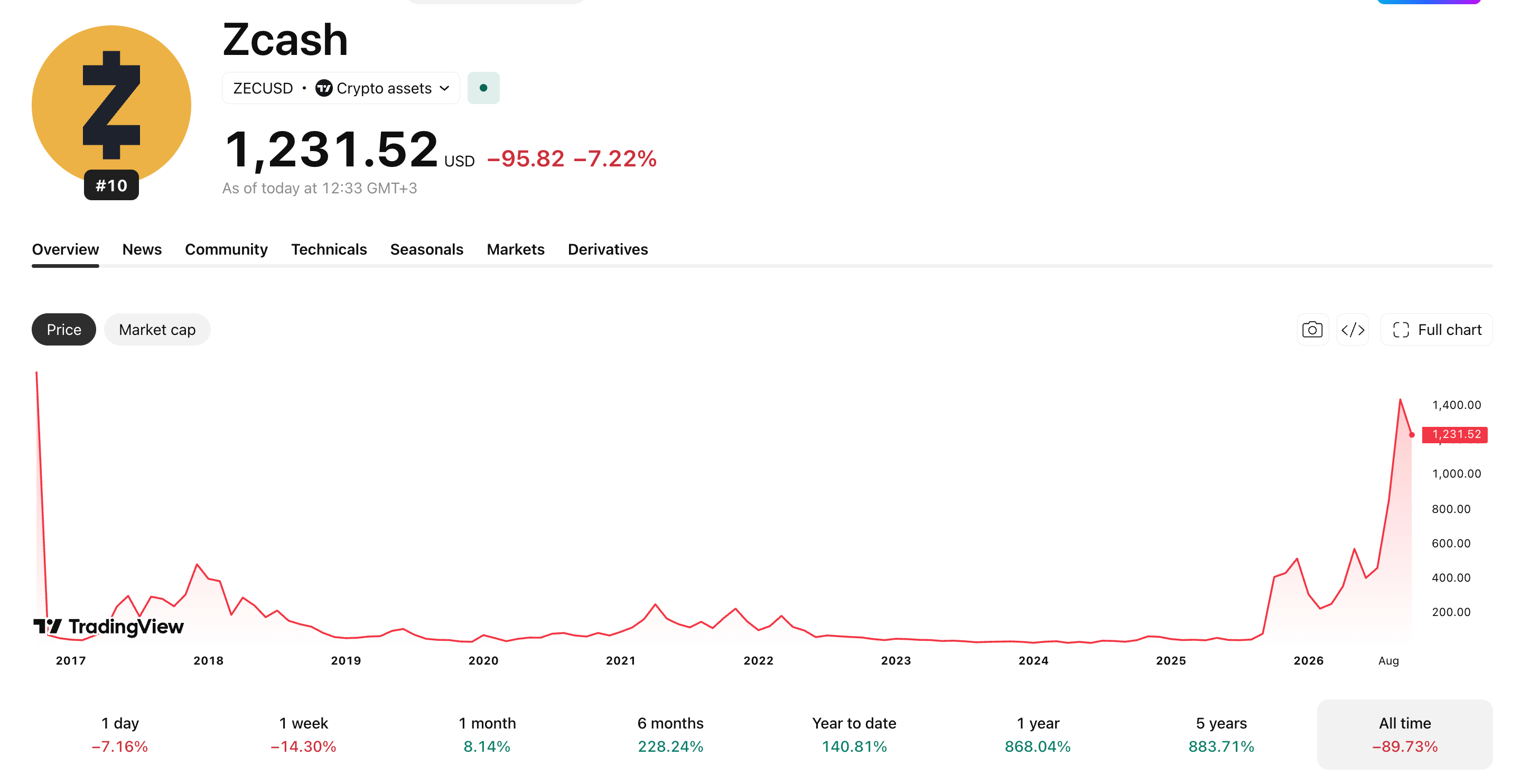
Source: TradingView
When Zcash launched in October 2016, the network used a slow-start mining schedule, meaning barely any coins existed during the first few days. That triggered temporary trades in the thousands of dollars before order books filled out.
Once normal liquidity was established, the chart started following regular crypto cycles:
- January 2018 peak: ZEC traded near $880 during the broader retail market run.
- March 2020 low: Delistings and the wider market drop pushed the price down to roughly $19.
- May 2021 rebound: The price recovered to $320 before losing momentum to newer smart contract chains.
- 2022–2024 range: Exchange bans across Europe and Asia kept ZEC trading flat between $20 and $35.
- September 2026 move: Institutional loan access and testnet speed upgrades pushed the price over $1,600, leading into the current consolidation near $1,200.
Zcash Chart Analysis: Price Range, RSI, and Open Interest
TL;DR: After topping out near $1,660 in late September, ZEC is taking a breather around $1,200. Momentum has cooled off, and traders are closing out leveraged bets.
Price Trend and Range
ZEC had a clean run from $400 to roughly $1,660 over the late summer. That move was huge and the market is digesting it right now. The price has pulled back toward ~ $1,200.
Trading volume has thinned out compared to the September breakout. Looks like the buyers and the market are testing whether the $1,200 level can hold.
RSI: Cooling Off from Overbought Levels
The daily Relative Strength Index (RSI) gives a clear picture of how fast things moved.
- Late September: RSI spiked above 80, showing that the rally was running hot and overdue for a pause.
- Current reading: RSI has dropped to roughly 44, sitting just below its yellow moving average at 54.
The indicator has completely reset. That puts the reading below the neutral 50 line, showing sellers currently set the pace without pushing the asset into oversold territory.
Open Interest: Leverage Is Leaving the Market
Open interest tracks the total dollar value of open futures contracts that haven't been settled yet. In other words, it shows how much borrowed money is floating around the trade.
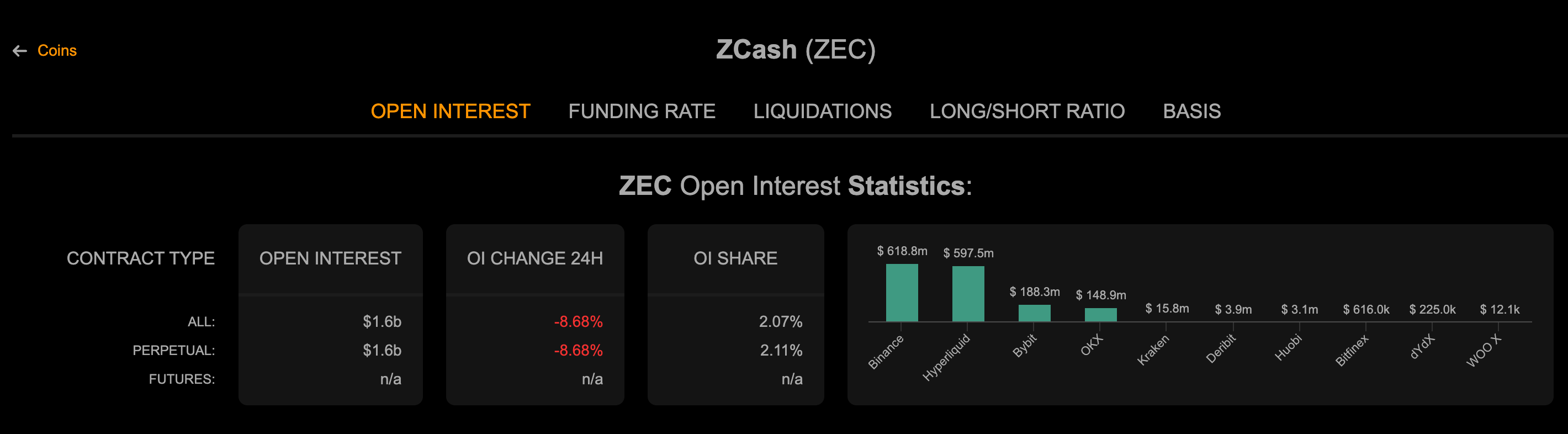
Source: Open Interest by Exchange, Coinalyze, October 2026
Total ZEC open interest currently is at $1.6 billion. Most of that volume is concentrated on Binance and Hyperliquid plus Bybit and OKX.
Note: When open interest drops alongside a falling price, it usually means traders are closing out positions and taking risk off the table. Instead of aggressive shorting, the market is simply de-leveraging while it waits for a clearer signal.
Zcash Price Prediction 2026–2030
Key takeaway: An objective Zcash price prediction relies on whether speed upgrades and consumer wallets can win against regulatory pressure. Short-term forecasts for 2026 eye the $1,800 range. By 2030, bullish predictions target up to $8,500 based on the "encrypted Bitcoin" narrative, while conservative models stall around $1,200–$1,400 and a delisting wave could drag ZEC back to $400–$600.
| Year | Scenario | Price Range |
|---|---|---|
| 2026 | Bullish momentum from the NU7 25-second block upgrade vs. post-rally sell pressure. | $950 – $1,800 |
| 2027–2029 | Mid-term scaling via Project Tachyon and new consumer wallets against regulatory friction. | $600 – $3,500 |
| 2030 | Financial privacy becomes a premium asset vs. strict global compliance restrictions. | $400 – $8,500 |
How to read these ranges:
- 2026 and 2030 highs come from third-party models: CoinCodex, Coinpedia
- 2027–2029 high is the successful-Tachyon case.
- 2026 low of $950 is Binance’s NU7-delay scenario.
- 2027–2029 and 2030 lows are our stress levels for the regulatory-isolation scenario: about half of today’s price ($600) and a full round trip to the roughly $400 base ZEC started the summer from.
Zcash Price Prediction 2026
The short-term Zcash price prediction hinges on the November 5 mainnet rollout of Network Upgrade 7 or NU7. This upgrade cuts target block times from 75 to 25 sec. If the network successfully transitions and transactions start confirming noticeably faster, the price could easily reclaim its recent highs.
CoinCodex projects a bullish price prediction of roughly $1,800 by the end of 2026. This assumes the current rally holds and retail traders buy into the faster network speed.
The bearish case looks at historical post-rally behavior. Retail users on Reddit remain cautious about past tokenomics and early supply distribution.
If the NU7 upgrade faces technical delays, Binance models suggest the price could drop toward the $950 range as leveraged traders close their open interest. That floor sits about 43% below the $1,660 peak and about a fifth below today’s price.
Zcash Price Prediction 2027–2029
Mid-term forecasts for the Zcash price prediction depend entirely on execution.
The core team is pushing Project Tachyon to scale the network to 50,000 TPS. Meanwhile, big investors like Balaji Srinivasan are backing new consumer wallets to onboard everyday users and boost adoption.
Scale is the part of this forecast that can be checked. Tom Howard put numbers on it in the same interview:
“Right now, [Zcash is] about the same as Bitcoin, which is about 2.9 transactions per second. And if you look at the Visa network, they are doing 40,000 transactions per second. […] This year, we should achieve somewhere between 20 to 100 transactions per second by the end of the year. And there’s a roadmap for scaling the proof-of-work blockchain to reach 50,000 TPS. So this combination of privacy and scalability should unlock these final properties to have it be useful as daily cash.”
Going from 2.9 TPS to 50,000 is a long road. The 20–100 TPS milestone is due this year, which makes it the first checkpoint for everything below.
If scaling goes well, Zcash could dominate the digital cash sector. Institutional products, like borrowing against ZEC on Coinbase, already provide deep liquidity. A successful Tachyon rollout could push the Zcash price toward the $3,500 mark by 2029.
However, exchange delistings remain the biggest risk factor for any mid-term price prediction.
Kraken's conservative annual-growth models place the target much lower, around $1,200 to $1,400. If Monero's default privacy continues to dominate and regular exchanges shun optional-privacy coins, the price could stagnate in this lower range.
And stagnation is the polite version. If delistings actually spread, the stress case is about half of today’s price, near $600, which would put ZEC’s market cap around $10 billion versus $20.5 billion now.
Zcash Price Prediction 2030
Any long-term ZEC price prediction for 2030 is a bet on the macroeconomic value of privacy.
The bullish thesis, heavily pushed by influencers on X, frames ZEC as "encrypted Bitcoin." Both assets share the exact same 21-million hard cap and emission curve.
The people building Zcash pitch a less meme-friendly version of the same idea. Howard’s argument is that Bitcoin left the job half-done:
“I think crypto lost its way along the way. We have a lot of, say, gambling-type use cases that have become predominant in the industry. And I think people lost sight of the vision, which is having your own self-sovereign money. […] Bitcoin, I feel like it never finished that mission. […] It basically succeeded at one of the properties of money, which is store of value. But it has not succeeded as, I would say, medium of exchange.”
Strip away the memes and “encrypted Bitcoin” is a usability claim: Bitcoin became the vault, Zcash wants to be the wallet.
If global financial privacy transitions into a premium luxury asset, scarcity will drive the valuation. CoinCodex and Coinpedia model potential 2030 targets between $7,000 and $8,500. Achieving this price requires the "Pretty Good Policy for Zcash" lobbying group to successfully secure favorable terms under the CLARITY Act.
When looking at a 2030 price prediction, the bearish counter-narrative assumes that strict regulatory frameworks simply shut privacy networks out of TradFi.
If compliance restrictions stop new money from entering the market, the long-term price prediction flattens out. Under those conditions, baseline models suggest the Zcash price might struggle to hold above $1,400.
What Each Target Implies for Market Cap
Reminder: Price targets mean little without the market cap behind them.
Here is every level from this article converted at the current circulating supply of about 16.9 million ZEC.
| Level | Price | Implied market cap | vs. today |
|---|---|---|---|
| 2030 stress low (regulatory isolation) | $400 | $6.8B | −67% |
| 2027–2029 stress low | $600 | $10.1B | −51% |
| 2026 low (Binance, NU7 delay) | $950 | $16.1B | −22% |
| Today | ~$1,200 | $20.5B | — |
| Conservative models (Kraken) | $1,400 | $23.7B | +15% |
| 2026 high (CoinCodex) | $1,800 | $30.4B | +48% |
| 2029 high (successful Tachyon) | $3,500 | $59.2B | ×2.9 |
| 2030 high (CoinCodex, Coinpedia) | $8,500 | $143.7B | ×7.0 |
Implied market cap = price × 16.9 million circulating ZEC; “vs. today” compares with the current $20.5 billion. At the full 21 million cap, the $8,500 case would equal about $178.5 billion.
What Would Actually Need to Happen: Bullish vs. Bearish Drivers
TL;DR: For the ZEC price to move upward, the network must successfully launch its speed upgrades and secure regulatory protection. If major exchanges continue delisting the asset, the trend will reverse downward.
We don’t pull price targets out of thin air. Upside targets come from third-party models, the downside stress levels are explained under the forecast table, and every scenario comes with a trigger you can check against hard data.
Below are the two primary paths for Zcash and the triggers that could completely invalidate them.
Bullish Scenario: Scaling and Adoption
This scenario assumes Zcash becomes a practical, everyday tool for exchanging assets rather than just a niche privacy project.
- Primary driver: A flawless mainnet launch of the NU7 upgrade. If transaction confirmations genuinely drop to 25 seconds, it could attract a new user base. In parallel, lobbyists from "Pretty Good Policy for Zcash" must successfully secure network protections within the CLARITY Act.
- Invalidation trigger: Any critical bugs during the transition to faster speeds or an official refusal by regulators to compromise will instantly break this trend.
The institutional part of this scenario is already in progress. Howard says Zcash Labs is getting inbound interest from TradFi:
“Wall Street and more traditional firms are actually accustomed to privacy, because the traditional system provides them quite a lot of privacy. […] As Zcash Labs, we feel a lot of incoming from various firms and institutions that want to know more about this and how it’s going to fit into the future regulatory landscape.”
Then there is the product wrapper. At the same Token2049 Singapore, Cameron Winklevoss said the Winklevoss twins filed for a Zcash ETF and drew a parallel with their Bitcoin ETF filing 13 years ago:
“13 years ago we did the same thing for a Bitcoin ETF. The price of Bitcoin in 2013 was $100. 13 years later, this is the sequel, and we filed for the Winklevoss Zcash ETF. […] Just to give people access to this asset class who may want to buy Zcash in a brokerage account because they can’t hold Zcash, the asset, and they want exposure to privacy, which is an asset. […] It’s a very precious asset.”
A filing is not an inflow, of course. Inflows are the exact metric the bearish scenario below depends on.
Bearish Scenario: Regulatory Isolation
The main risk for ZEC lies in losing liquidity due to exchange fears over compliance checks.
- Primary driver: A new wave of compliance demands. If top trading platforms remove ZEC from their pairs en masse, the coin loses capital access, and retail users will fully migrate to networks with default privacy. History shows what that looks like: in March 2020, delistings and a market-wide sell-off pushed ZEC to roughly $19.
- Invalidation trigger: If regulators officially classify Zcash as safe for institutional platforms, and the outflows from Grayscale’s Zcash ETF (ZCSH) turn into steady inflows, this bearish scenario becomes invalid.
Verdict
Treating Zcash as a guaranteed moonshot ignores the regulatory reality that has suppressed privacy coins for years. At the same time, treating it as dead ignores the massive rebound in volume, institutional interest, and the speed upgrades.
For anyone tracking a Zcash price prediction, the smart approach is to watch hard verification points:
- Watch testnet and mainnet metrics: Does the NU7 activation on November 5 go through without technical delays or bugs?
- Watch liquidity signals: Does open interest stabilize, do ZCSH ETF flows turn positive, or do exchange delistings accelerate across major platforms?
- Watch Washington policy: Does the CLARITY Act carve out protection for zero-knowledge tech, or does compliance tighten further?
The upside potential is real if privacy becomes a scarce, institutional asset by 2030. But until the network proves it can scale smoothly and keep global fiat ramps open, caution is just as valid as conviction.