


TL;DR: Layer 2 networks reduce gas costs using a mechanic called off-chain batching, and users start using L2 more actively. ChangeNOW data confirms this market shift - Base swap count grew by 14.39% while more costly L1 transactions dropped by nearly 11%.
Why Do We Need L2 When We Have Solana, Tron, and Cheaper Ethereum?
After network demand dropped and the Dencun upgrade rolled out, Ethereum swap fees fell significantly: from around $15-20 down to under $1. Add to this strict security guarantees and wide adoption.
We also have Solana, famous for being ultra-fast. And there's Tron - on platforms like ChangeNOW, you don't even have to pay gas when transferring USDT.
So, why should you even care if L2s are reducing costs? Well, because Layer 2 networks also deliver high speed and low fees while relying on Ethereum's well-protected base layer for final validation. Solana is known for network outages. Tron operates with a heavily centralized node structure.
High-value DeFi protocols require strict cryptographic protection. They deploy on L2s rather than risk assets on networks with weaker security models.
For the average user, this means you get the best of both worlds. You can swap tokens, or play Web3 games for a few cents per click and no centralized node failure can freeze your funds.
Why Cut Costs Further?
Paying $1-2 for a swap now feels like a Christmas sale compared to previous market peaks. Yet still, a dollar per transaction feels different for certain product categories. It feels so joyless, that stops those products from even working.
It’s unthinkable for apps like on-chain games to charge $1 every time a player moves an item or equips gear. The same thing is true for DeFi social platforms - they can’t expect people to pay 50 cents just to upvote a post or follow someone.
Micro-investing and automated trading tools hit the same wall. If you swap ten dollars or rebalance a small liquidity pool, a flat one-dollar fee ruins your returns immediately.
Sub-cent gas fees turn blockchains into truly usable software. When network fees drop to cat tears, developers can finally build apps where users interact without even thinking about gas. Real adoption starts right there.
How Layer 2 Networks Reduce Gas Costs
The answer hides in the mechanics of a transaction - L2 transactions go the same route as L1 on Ethereum mainnet but how they do it - that’s where it gets interesting.
L2 runs a 4-step assembly line and every stage trims a specific cost off your final receipt.
Off-Chain Execution
Smart contract computations cost a premium on Ethereum mainnet. L2 networks process the math on their own dedicated servers - they don’t need thousands of global nodes to calculate your swap. Crunching numbers off-chain costs almost nothing. And at this stage, Ethereum doesn't even know you’re making a transaction.
Batching
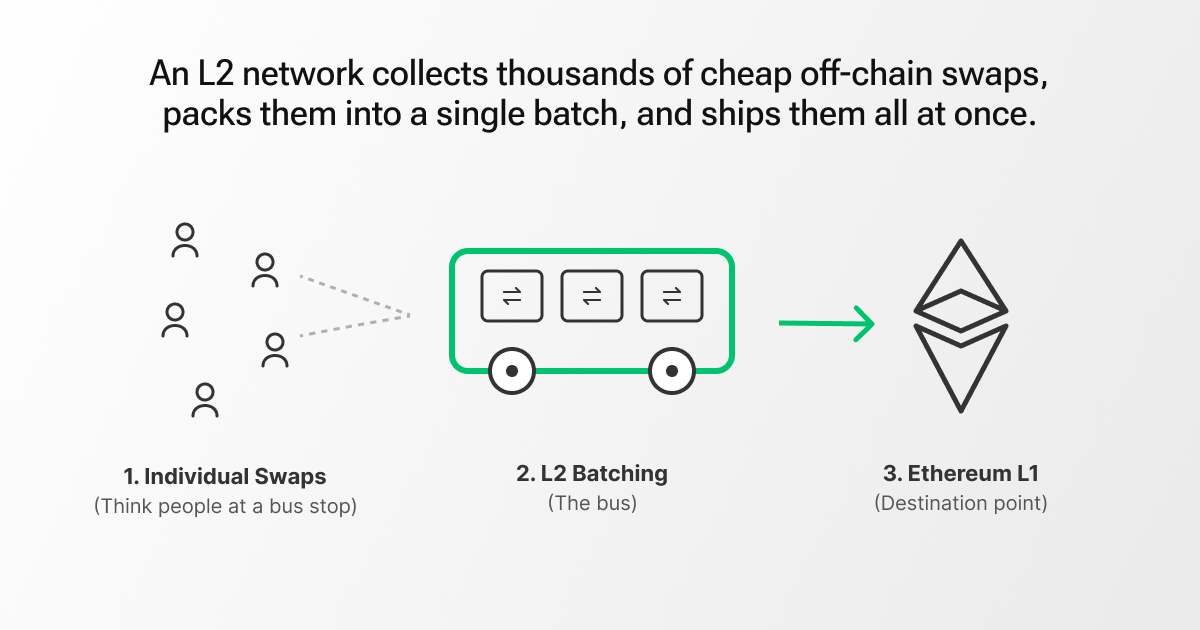
An L2 network collects thousands of cheap off-chain swaps, bundles them into a single package, and ships them all at once. The base gas fee required to interact with Ethereum gets split across all users in the batch. You pay a tiny fraction instead of absorbing the full cost alone.
Data Compression
On-chain storage is still highly expensive. Before shipping a batch, the L2 protocol gets rid of redundant zeros, replaces 42-character wallet addresses with short internal numbers, and merges multiple cryptographic signatures. A lighter package burns far less gas to store on the mainnet.
Publication and Proofs on L1
Networks prove their calculations to Ethereum in two different ways.
- Optimistic rollups (like Arbitrum or Base) assume all bundled transactions are valid by default. They publish the data and leave a seven-day window for validators to spot a mistake. That specific waiting period is the exact reason official bridges take a full week to let you withdraw funds back to the mainnet.
- ZK rollups (like zkSync or Scroll) skip the waiting game all together. They pin a heavy cryptographic proof directly to the batch. The Ethereum network verifies the math instantly and finalizes the transactions on the spot.
Regardless of the method, Ethereum acts as the final ledger. As a result, you get mainnet-level security without paying mainnet prices. Profit.
Blobs, Gas Price Drops & Dencun Upgrade
Before the Dencun upgrade on Ethereum mainnet, L2 networks had a structural problem. Yes, they batched thousands of transactions, and yet had to save that batch directly on the Ethereum mainnet. And that meant paying premium. Which kind of negated the whole point. If Ethereum got crowded, L2 fees spiked right along with it. Not cool.
Dencun fixed the problem by introducing "blobs."
A blob as a cheap cargo trailer attached to a regular Ethereum block. Rollups no longer have to buy pricey seats in the main passenger cabin. They can just toss their transaction batches into the trailer.
But! Ethereum can’t guard this cargo forever. The network automatically deletes blob data after ~18 days. Temporary storage is way cheaper than permanent on-chain memory.
And so, because L2s stopped fighting with regular users for mainnet space, their costs collapsed. Swap fees on networks like Arbitrum and Base dropped to fractions of a cent.
The main Ethereum network also got some breathing room since rollups moved their heavy files out of the main traffic lanes. Clean win-win, right? Right? Well, read on.
Risks and Transfer Security
Inside a Layer 2 network, your funds are secure - Ethereum's base layer validates everything. And cryptographic proofs guarantee that no one can fake a transaction or alter your balance within the rollup.
Dangers come with transit. Cross-chain bridges remain the weakest link in crypto infrastructure.
To move assets from Ethereum to Arbitrum, a bridge typically locks your mainnet tokens in a smart contract. It then mints a mirrored copy of those tokens on the L2. And hackers actively target these smart contract lockboxes. If an attacker finds a bug and drains the locked mainnet assets, the L2 tokens become worthless because they lose their backing.
Pro tip: Don’t use unverified third-party bridges.
Stick to official network bridges or use an established non-custodial platform like ChangeNOW. We skip vulnerable cross-chain smart contracts entirely. Instead, our internal system safely routes your swap through a massive network of liquidity providers, keeping your assets far away from bridge hackers.
Pros and Cons of L2 Reducing Gas Costs
The pros are pretty obvious - smaller gas fees. But are there actually any downsides to paying less?
Pros
- Extremely low fees: swap, mint, or vote all while paying less.
- Lightning speed: fastest responses in the Wild West.
- New use cases: welcome on-chain games and DeFi social media.
- Mainnet relief: Ethereum L1 stays uncongested.
Cons
- Fragmented liquidity: scattered capital leads to worse swap rates.
- Complex UX: jumping around networks and bridges to find your USDT
- Centralization risks: one crashed server pauses the whole network.
Market Changes and ChangeNOW Swap Insights
Recent ChangeNOW data shows Ethereum transaction count dropped by 10.89% this quarter. The network's overall share of platform swaps fell from 21.06% to 19.5% since July 2026. Looks like users are leaving the Ethereum mainnet for direct swaps.
Cheaper alternatives - L1 premiums: 1:0.
Our data hints at capital leaning more into Layer 2 networks. Base recently entered the top 10 most used networks on ChangeNOW, recording a 14.39% spike in transaction count.
Alternative L1 networks show mixed results. Solana experienced an 18.11% drop in swap count. Tron maintained its utility status for stablecoin transfers, growing its transaction count by 9.91%.
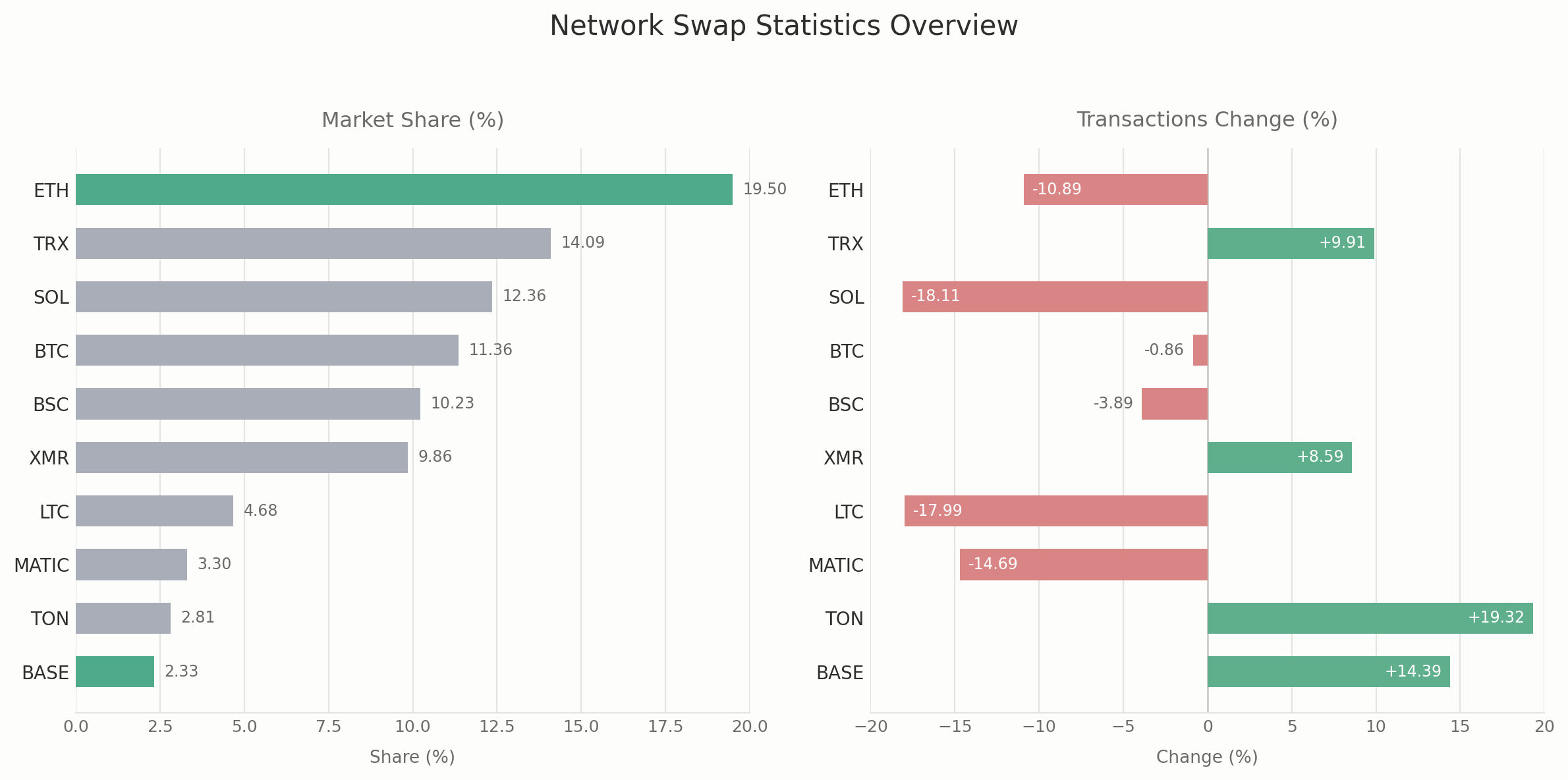 Source: ChangeNOW internal swap stats, Q3 2026
Fewer people are lining up to overpay for standard swaps. Users figured out the appeal of L2 and are actively moving their volume there.
Wrapping Up
The key takeaway here: processing transactions off-chain and batching them together is a sustainable way to scale. Once the mechanism behind how Layer 2 networks reduce gas costs, the logic checks out.
Chain abstraction comes next. Soon users will stop even bothering to track what network their tokens are on: are they on Arbitrum, Base, or Optimism? Smart routers and exchange platforms will manage cross-chain routing natively. You click swap, pay a fraction of a cent, and the backend handles the delivery. That’s the fastest route to mass adoption: low fees, simple rules, no headache.
Next read: Cheapest Networks for USDT Swaps in 2026


