The Toccata hard fork brings programmable UTXOs to Kaspa Layer 1 through new opcodes that let UTXOs inspect transactions and enforce rules over assets and application state. Argent gives developers a higher-level toolchain for building covenant-based applications without requiring them to work directly with every low-level protocol primitive. Together, these capabilities open a broader design space for programmable wallets, digital assets and other applications built on Kaspa’s Proof-of-Work BlockDAG.
As part of the long-term partnership, the ChangeNOW ecosystem supports Kaspa through KAS swaps, crypto payments with NOWPayments, asset storage in NOW Wallet and NOWNodes infrastructure for developers.
After Toccata launched, we spoke with Kaspa community members through ChangeNOW’s business development channel. We asked what changed with the hard fork, what developers can build with Kaspa’s now-live programmable UTXO layer and why Toccata marks a new stage in the network’s development.
Key Takeaways
Toccata introduces new transaction introspection opcodes and native covenants, making Kaspa UTXOs programmable and enabling stateful Layer 1 applications.
Built-in ZK verification supports Groth16 and RISC0-Succinct proofs, allowing applications to execute complex computation outside the base layer while Kaspa verifies the resulting proofs.
Kaspa’s programmability is verification-oriented: covenants enforce UTXO state transitions, while ZK precompiles separate application execution from Layer 1 verification and settlement.
Argent gives builders a higher-level way to create stateful applications across multiple contracts. It compiles the logic into auditable Silverscript contracts and lets separate covenants communicate with one another.
Kaspa Toccata Explained And Why The Upgrade Matters
Kaspa Toccata activates covenant-based programmability and native ZK verification on Layer 1. New introspection opcodes allow scripts to inspect and constrain spending transactions, making stateful transitions possible within Kaspa’s UTXO model.
Covenant IDs give applications a stable, consensus-tracked identity as their state moves across successive UTXOs. This makes application lineage easier to verify and index while preventing forged covenant-bound outputs from being created.
Before Toccata launched, Kaspa had processed more than 2.35 billion onchain transactions and reached a peak of 5,584 TPS. The network continues to operate at 10 blocks per second.
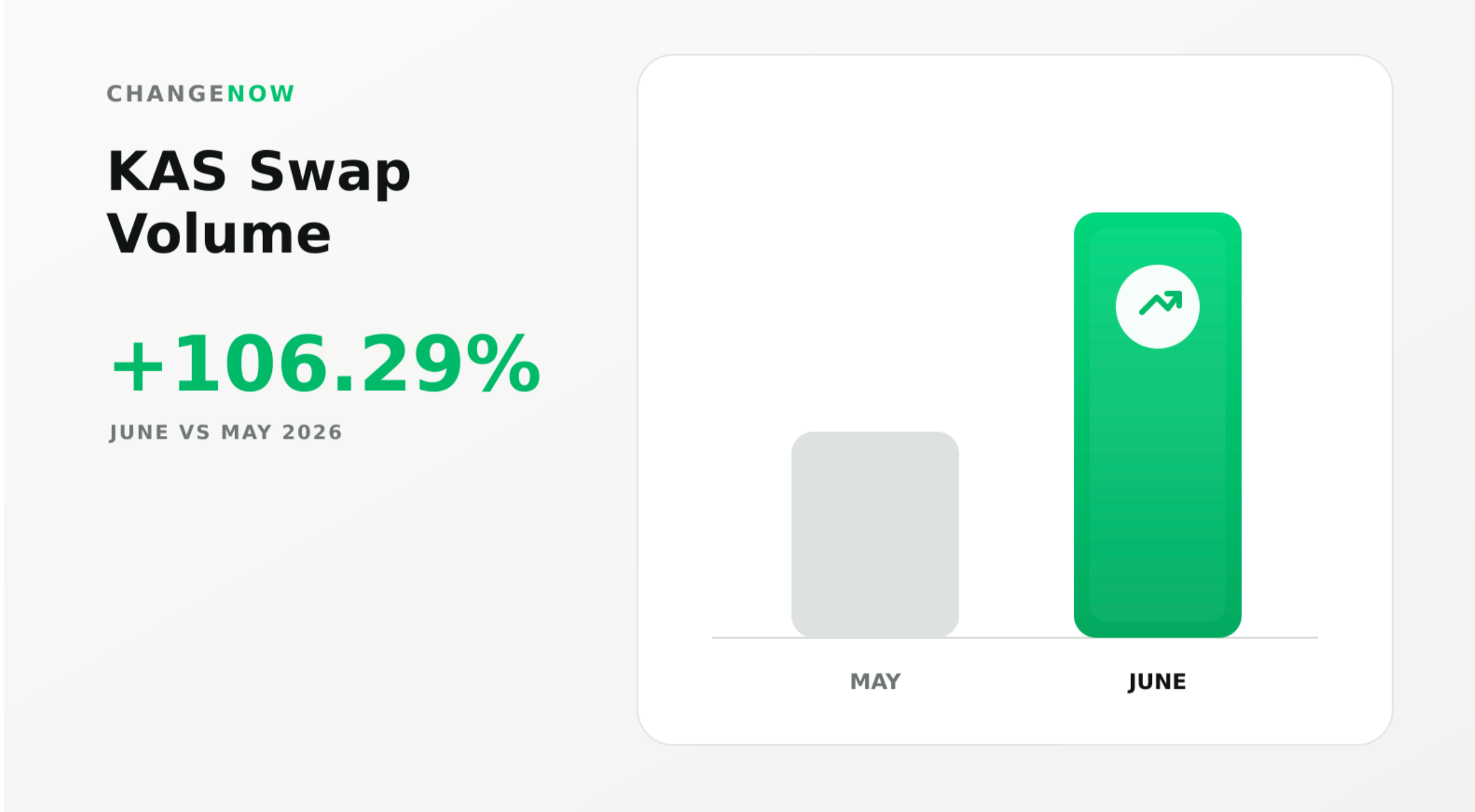
KAS swap volume on ChangeNOW rose by 106.29% in June compared with May, during the period surrounding the Toccata launch.
Toccata went live on a network with an established user base and working infrastructure. Regular transfers changed little, while developers gained a programmable UTXO layer for new wallets, assets and applications.
How the Kaspa Toccata Upgrade Changes KAS Transactions and Network Infrastructure
For most users, the Kaspa Toccata upgrade has changed little about everyday use of KAS. Transactions continue to work as before. Most changes affect wallets, RPC providers, block explorers, indexers and other services that interact directly with the protocol.
Toccata raised the fee floor from 1 to 100 sompi per gram. The change operates at the standardness layer as an anti-spam measure. It does not introduce a new consensus rule or a broader redesign of Kaspa’s fee market. Ordinary KAS transfers remain unchanged.
Most post-fork work has fallen to infrastructure providers. Wallets, block explorers, RPC providers, indexers, pools and application developers must correctly handle transaction v1, compute budgets, covenant bindings, covenant IDs, storage mass, user lanes, gas and updated RPC/protobuf fields.
Exchanges and other services across the Kaspa ecosystem are also updating their SDKs, transaction processing systems and internal infrastructure to support Toccata.
For ChangeNOW, Toccata required an update to an existing Kaspa integration. ChangeNOW services have supported the network since 2023, so the work focused on adapting the current infrastructure to the new transaction format and protocol requirements.
Users can still swap KAS through ChangeNOW, accept payments with NOWPayments and store their assets in NOW Wallet. Developers can access the network through NOWNodes infrastructure.
Why Kaspa Uses Programmable UTXOs Instead of an Account-Based Model
Kaspa uses programmable UTXOs to add application logic without replacing its Proof-of-Work, BlockDAG and UTXO model with a shared account-based state.
Covenants let developers set spending rules, carry state between transactions and control how assets move. Native ZK verification keeps heavier computation outside Layer 1 while Kaspa verifies the proof and settles the result.
Heavy execution can stay outside Layer 1, while the network checks proofs, transaction conditions and approved state changes. Programmability remains anchored to Kaspa’s Proof-of-Work BlockDAG.
What Developers Can Build With Kaspa Toccata, Covenants and ZK Verification
Programmable UTXOs are now live on Kaspa Layer 1. Developers can combine covenants, controlled state transitions and native ZK verification to build programmable wallets, asset systems, payment flows and other applications.
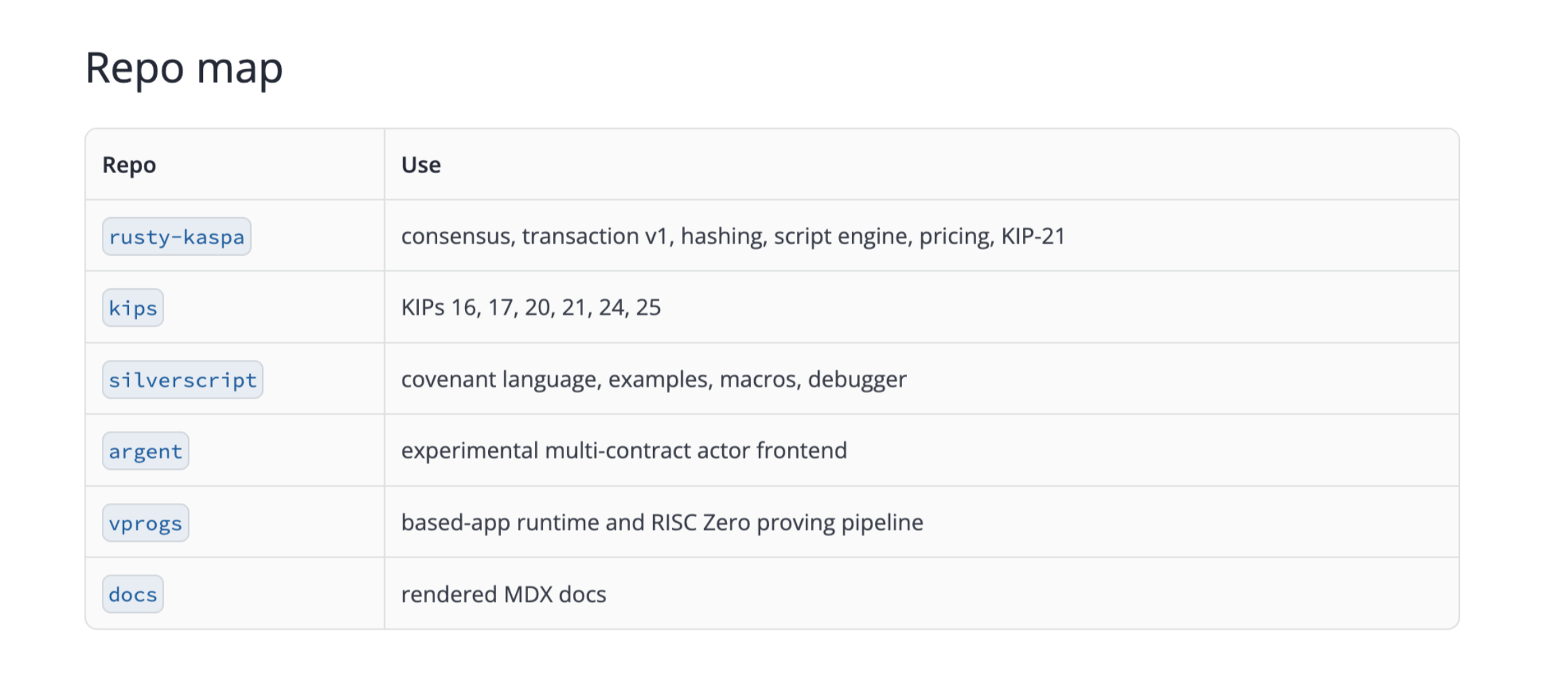
Silverscript handles covenant logic closer to the protocol level. Argent sits above it, giving builders a simpler way to describe stateful systems made up of multiple contracts and applications before compiling them into auditable Silverscript code.
Argent also allows independently compiled covenants to communicate with one another. Such interaction is essential for applications that need to share data, assets or state instead of operating as isolated contracts. The toolchain is still under active development and is not yet ready for broad production use.
Source: Kaspa developer repositories after Toccata
The first applications are likely to focus on custody vaults, programmable wallets, native asset experiments, payment infrastructure and improved wallet and indexer support. Based ZK applications will take longer because they require additional proving infrastructure, developer tooling and integrations.
For users who currently hold or swap KAS, regular transactions change little. The difference will appear through the wallets, assets and applications built around Kaspa’s programmable UTXO layer.
Toccata is already live. Its significance now depends on what developers manage to ship with it.
Why Infrastructure Matters for Kaspa
Toccata becomes accessible to users and developers only after connected services support its transaction model. ChangeNOW updated its existing Kaspa integration, while NOWNodes provides RPC access to the upgraded network.
KAS remains available through ChangeNOW swaps, NOWPayments, NOW Wallet and NOWNodes infrastructure.
ChangeNOW Exchange Crypto Calculator
Kaspa is available through ChangeNOW services, including KAS swaps, crypto payments, a wallet and infrastructure for developers.
Yes. The Toccata hard fork has already been activated on the Kaspa mainnet, and ecosystem services are gradually completing infrastructure updates to support the new protocol.
No. If you only hold, send or receive KAS, you do not need to take any action. Most of the changes introduced by Toccata affect wallets, exchanges, node operators and developers.
No. Toccata introduces native Layer 1 programmability through covenants rather than Ethereum-style smart contracts. Kaspa continues to use its UTXO-based Proof-of-Work architecture.
Yes. Toccata’s programmable UTXO primitives and built-in ZK verification are live on Kaspa Layer 1. Developers can begin building covenant applications, programmable wallets and native asset designs, although higher-level tooling such as Argent is still maturing.
Exchanges paused deposits and withdrawals while updating node software, transaction handling and infrastructure for the new transaction format introduced by the Toccata hard fork.
Yes. Kaspa remains supported across the ChangeNOW ecosystem, including instant KAS swaps, NOWPayments, NOW Wallet and developer infrastructure through NOWNodes.
Dogwifhat (WIF): Inside the Community Behind the Meme Coin
What keeps a meme coin alive after the first viral moment? WIF contributors explain how creators, culture, participation, and a dog in a pink hat built a brand without a traditional crypto company.
Kaspa Toccata Upgrade: Covenants and Programmable UTXOs | ChangeNOW Blog




 KAS swap volume on ChangeNOW rose by 106.29% in June compared with May, during the period surrounding the Toccata launch.
 Source: Kaspa developer repositories after Toccata

