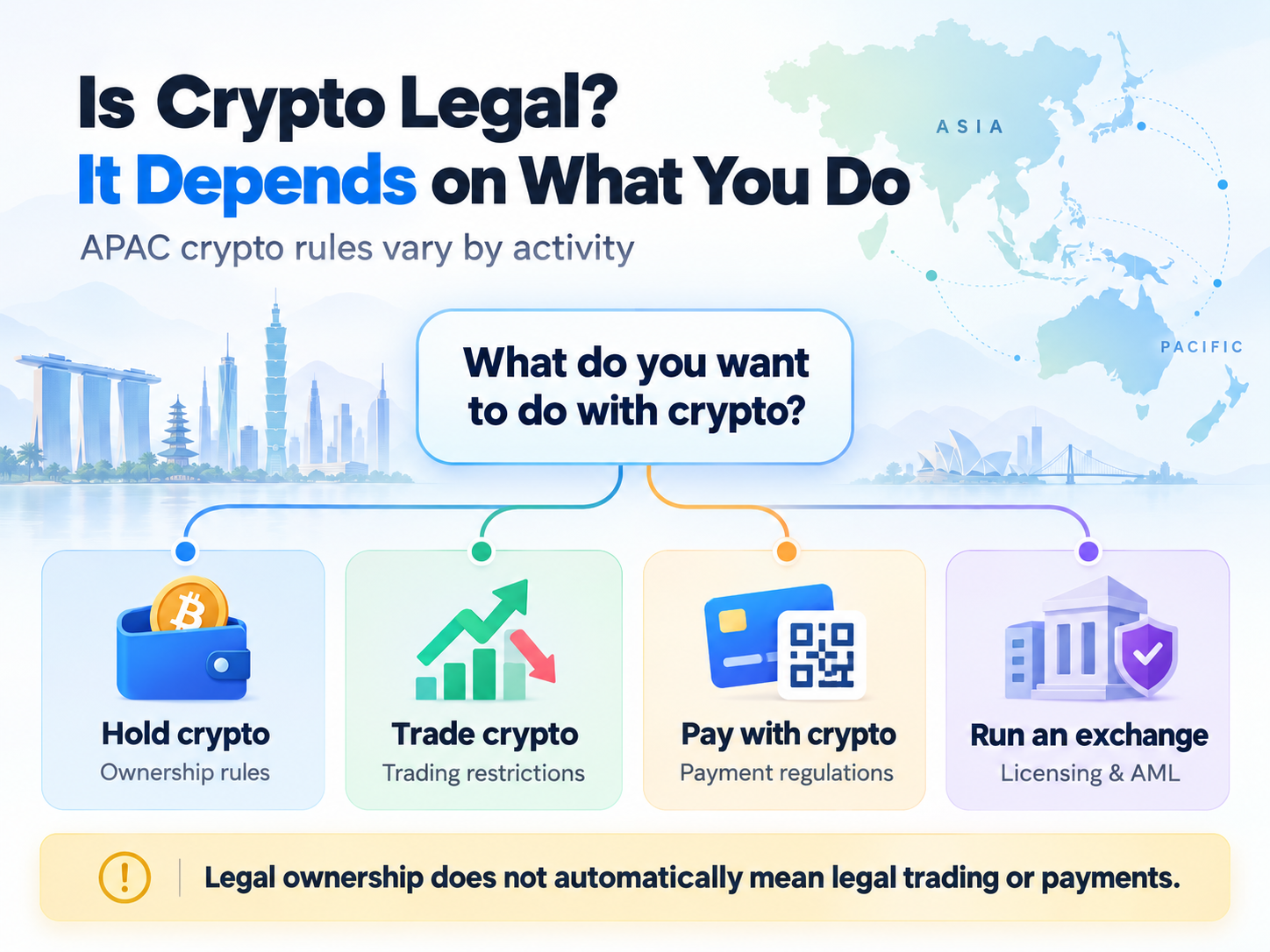
Crypto regulation in APAC is becoming more structured, but there is no single set of rules across the Asia-Pacific region. Hong Kong and Singapore operate licensing regimes for crypto businesses, Japan is moving toward securities-style oversight, and China continues to restrict cryptocurrency trading. Other markets are introducing new requirements for exchanges, stablecoins, and investor protection.
As of October 2026, the biggest difference between countries is which crypto activities are permitted, who can provide them, and what obligations apply to users.
Crypto Regulation in APAC: Quick Comparison
Country / Market
Crypto Status
Main Regulators
Exchange Requirements
Individual Tax Treatment
Hong Kong
Legal, regulated
SFC, HKMA
SFC licensing for covered trading platforms
No general capital gains tax; circumstances matter
Singapore
Legal, regulated
MAS
Licensing for regulated digital payment token services
Generally no capital gains tax; trading income may be taxable
Japan
Legal, regulated
FSA
Registration and supervision; transition toward FIEA
Progressive taxation under existing rules; reform enacted
South Korea
Legal, regulated
FSC, FIU, FSS
Reporting and AML requirements
Dedicated crypto gains tax scheduled for 2027
Australia
Legal, regulated
ASIC, AUSTRAC, ATO
AUSTRAC registration where required; platform licensing from 8 Apr 2027
Capital gains tax generally applies to investment disposals
China (mainland)
Trading services prohibited
PBOC and other authorities
Domestic crypto exchange services prohibited
No ordinary regulated retail trading framework
India
Legal to hold and trade, subject to restrictions
FIU-IND, tax authorities
AML registration and reporting requirements
Generally 30% tax on taxable VDA transfer income, plus applicable TDS
Thailand
Legal through regulated providers
SEC, Ministry of Finance
Licensing for covered digital asset businesses
FAQ
Hong Kong, Singapore, Japan, South Korea, Thailand, Malaysia, Indonesia, and several other Asian markets regulate cryptocurrency activities. Their frameworks differ in licensing, investor protection, AML requirements, and taxation. China follows a substantially more restrictive approach.
Mainland China prohibits virtual currency-related trading services and cryptocurrency mining. Other jurisdictions, including Bangladesh, maintain restrictive policies toward cryptocurrency transactions. However, restrictions on trading, payments, mining, and ownership should not be treated as interchangeable.
Hong Kong and Singapore are often considered major regulated crypto hubs because they offer established frameworks for authorised businesses. Japan also has a mature regulated market. The most suitable jurisdiction depends on whether the priority is retail access, exchange licensing, taxation, or stablecoin issuance.
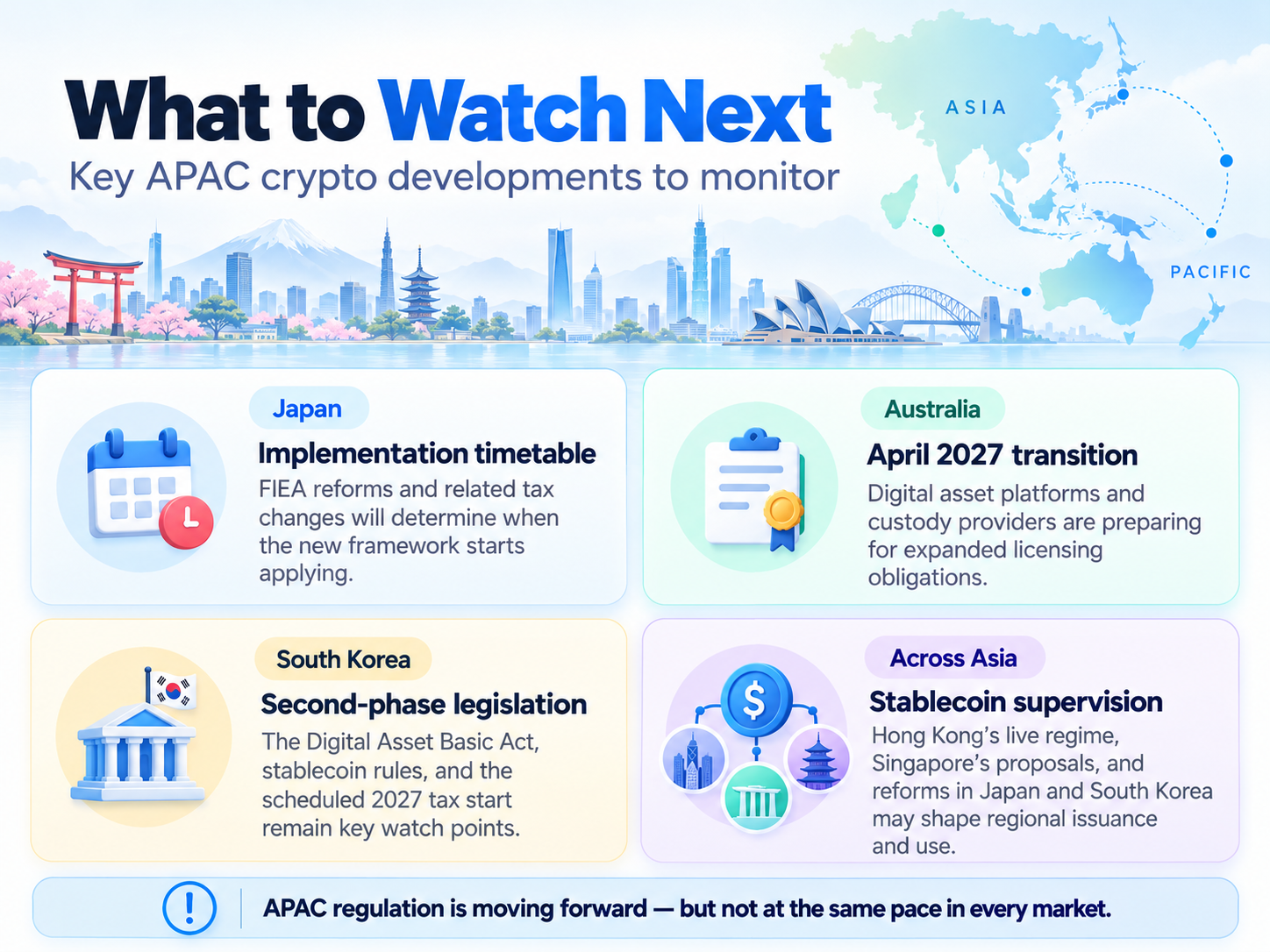
Major 2026 developments include Japan's enacted FIEA and tax reforms, Australia's new digital asset platform legislation, Singapore's stablecoin implementation proposals, and ongoing second-phase regulatory discussions in South Korea. The effective dates vary.
Yes. Cryptocurrency ownership and trading are legal in South Korea through permitted channels. Crypto service providers must comply with applicable reporting, anti-money laundering, and investor protection requirements.
Under legislation in place as of October 2026, a dedicated tax on certain individual cryptocurrency gains is scheduled to take effect on January 1, 2027. The framework includes an exemption threshold for qualifying gains, but the implementation date should be checked for further legislative changes.
No. Mainland China has prohibited cryptocurrency mining activities as part of its broader restrictions on virtual currencies. The country's position differs from Hong Kong's separately administered virtual asset regulatory regime.
Foreign nationality does not automatically exempt someone from mainland China's cryptocurrency restrictions. Crypto-related activities and services remain subject to applicable Chinese laws regardless of the user's citizenship.
Yes. Australians can legally buy, hold, and trade cryptocurrency. Crypto service providers must comply with applicable regulatory requirements, and taxable disposals generally fall under capital gains or income-tax rules.
Qualifying trading gains exempt (2025–2029) through licensed operators
Malaysia
Legal, regulated
Securities Commission, BNM
Registration or approval for regulated activities
Depends on whether gains are revenue or capital in nature
Indonesia
Legal as a regulated investment asset
OJK and other authorities
Regulated trading platforms and service providers
Final seller tax: 0.21% via qualifying domestic platforms; 1% otherwise
Philippines
Legal, regulated activities
BSP, SEC
BSP VASP framework and SEC CASP rules; BSP new-licence moratorium
General tax rules apply depending on the transaction
Vietnam
Emerging regulated framework
Government, Ministry of Finance, SSC
Pilot licensing framework
0.1% of gross transfer value for individuals under pilot rules
Taiwan
Legal, regulated activities
FSC
AML registration pending commencement of 2026 licensing law
Depends on transaction and taxpayer
New Zealand
Legal
FMA, DIA, IRD
Activity-based financial services and AML requirements
Taxable crypto income under ordinary income-tax rules
The table is a high-level overview, not a substitute for local legal or tax advice. Regulatory permissions may depend on the asset, provider, customer location, and type of transaction.
What Are the Crypto Rules in the Asia-Pacific Region?
Speaking about crypto markets worldwide, Petr Sergeev, CEO of Guardarian, explained in an interview with Cryptopolitan at TOKEN2049:
“You cannot take the same business model that works in one jurisdiction and assume it would immediately apply everywhere else.”
This is particularly relevant to APAC, where crypto businesses face different licensing, compliance, and operational requirements across markets such as Japan, Singapore, and Hong Kong.
Several trends define the current landscape.
Licensing is becoming more important. Hong Kong, Singapore, Japan, and other jurisdictions require certain crypto exchanges or service providers to obtain regulatory approval or registration.
Stablecoins are receiving separate attention. Regulators increasingly distinguish fiat-backed stablecoins from cryptocurrencies such as Bitcoin, introducing requirements for issuers, reserves, redemption, and disclosures.
Consumer protection is expanding. Custody standards, segregation of customer assets, market-abuse controls, and disclosure requirements are becoming central to crypto legislation.
AML and KYC obligations are tightening. Regulated businesses must identify customers, monitor suspicious activity, and comply with applicable transfer-information requirements.
Tax rules remain fragmented. A transaction that creates a taxable gain in one country may receive different treatment in another.
These differences matter for both businesses and individual investors. A crypto exchange operating legally in one APAC market does not automatically have permission to serve customers in another.
Likewise, the legality of holding cryptocurrency does not mean that every trading platform or payment method is permitted.
What New Crypto Laws Take Effect in Asia in 2026?
In 2026 some jurisdictions have enacted major reforms, while others are preparing new legislation or implementing frameworks introduced earlier.
The distinction between a law being passed and becoming enforceable is particularly important.
Market
Development
Status as of October 2026
Japan
Amendments bringing crypto trading under the Financial Instruments and Exchange Act
Passed 15 July 2026; main provisions awaiting commencement
Japan
Separate tax treatment for qualifying crypto gains
Enacted in March 2026; implementation linked to FIEA reform
Australia
Digital Assets Framework legislation
Assented to 8 April 2026; main provisions start 8 April 2027
Australia
Expanded AML/CTF obligations for virtual asset services
31 March 2026 for existing entities; 1 July for newly covered services
Hong Kong
Stablecoin issuer licensing
In effect since August 2025; first licences granted 10 April 2026
Singapore
Proposed amendments to implement its stablecoin framework
Consultation published 1 September 2026; closed 16 October
South Korea
Digital Asset Basic Act and stablecoin rules
Further legislation under discussion
South Korea
Individual crypto gains taxation
Scheduled to begin January 2027 under current legislation
New Zealand
Crypto-Asset Reporting Framework data collection
Began 1 April 2026 for covered service providers
Taiwan
Virtual Asset Service Act
Passed June and promulgated July 2026; commencement pending
Vietnam
Cryptoasset pilot tax regulations
Circular 32/2026 effective 27 March 2026
Pakistan
Virtual Assets Act and VASP licensing regulations
VASP regulations effective 21 August 2026
Malaysia
Revised digital asset exchange guidelines
Effective 20 May 2026
Japan Moves Toward Securities-Style Crypto Oversight
Japan passed amendments on July 15, 2026, to move major crypto trading activities toward oversight under the Financial Instruments and Exchange Act (FIEA).
The reform strengthens the regulatory treatment of crypto assets, including disclosure and market-abuse protections. However, its main provisions do not become effective immediately upon enactment.
Japan also enacted tax amendments in March 2026 introducing separate taxation for qualifying crypto transactions. The statutory national and local rates total 20%, or approximately 20.315% including the applicable reconstruction surtax. The new treatment is tied to the commencement of the FIEA reforms and is not yet generally effective.
Australia Prepares for a New Licensing Framework
Australia enacted the Corporations Amendment (Digital Assets Framework) Act on April 8, 2026.
The legislation brings covered digital asset platforms and tokenised custody platforms into the Australian financial services licensing system. Its principal new licensing requirements are scheduled to commence on April 8, 2027.
Meanwhile, Australia's updated AML/CTF requirements began applying to existing regulated entities on March 31, 2026. Newly covered virtual asset services generally became subject to the expanded requirements on July 1, 2026, subject to transitional arrangements.
Hong Kong and Singapore Develop Stablecoin Rules
Hong Kong's Stablecoins Ordinance took effect in August 2025, establishing licensing requirements for covered fiat-referenced stablecoin issuers.
On April 10, 2026, the Hong Kong Monetary Authority granted its first stablecoin issuer licences to Anchorpoint Financial Limited and HSBC.
Singapore is taking a different route. On September 1, 2026, the Monetary Authority of Singapore published proposed amendments to implement its stablecoin regulatory framework, including issuer requirements and consumer safeguards. The consultation closed on October 16, 2026; the proposals should not be treated as rules already in force.
These developments illustrate the growing regulatory distinction between trading cryptocurrencies and issuing digital tokens designed to maintain a stable value.
Country-by-Country Breakdown: Key Markets
The following jurisdictions represent some of the region's largest or most influential crypto markets. Their approaches also illustrate how differently regulators can treat the same technology.
Hong Kong: SFC Oversight and the Stablecoin Regime
Hong Kong crypto regulation permits cryptocurrency trading through regulated channels, with a strong focus on exchange licensing and investor protection.
Category
Hong Kong
Crypto legal?
Yes
Main regulators
Securities and Futures Commission (SFC); Hong Kong Monetary Authority (HKMA)
Key legislation
AMLO, SFO, Stablecoins Ordinance
Exchange licensing
SFC licensing for covered virtual asset trading platforms
Individual crypto taxes
No general capital gains tax; profits tax may apply depending on circumstances
Stablecoins
Licensing regime for covered fiat-referenced stablecoin issuers
The Securities and Futures Commission supervises centralised virtual asset trading platforms operating in Hong Kong or actively marketing covered services to local investors.
Licensed platforms must comply with requirements covering customer due diligence, custody, asset segregation, and investor protection. Retail investors can access permitted cryptocurrencies through licensed platforms, subject to applicable restrictions.
A crypto license in Hong Kong is therefore relevant not only to businesses but also to customers deciding which exchanges to trust. The SFC maintains a public register of licensed virtual asset trading platforms (VATPs), allowing users to distinguish authorised operators from applicants and unlicensed services.
Hong Kong also introduced a dedicated stablecoin regime. Under the Stablecoins Ordinance, covered fiat-referenced stablecoin issuers must obtain authorisation from the HKMA. The first licences were granted on April 10, 2026.
This distinction is important: an SFC-licensed trading platform and an HKMA-licensed stablecoin issuer operate under different regulatory permissions.
Singapore: How MAS Licenses Crypto Service Providers
Singapore crypto regulation allows digital asset services under a licensing framework supervised by the Monetary Authority of Singapore (MAS).
Category
Singapore
Crypto legal?
Yes
Main regulator
MAS
Key legislation
Payment Services Act, Financial Services and Markets Act
Exchange licensing
Applicable DPT service licensing and other activity-specific requirements
Individual crypto taxes
Capital gains generally not taxed; taxable trading income is possible
Stablecoins
MAS framework with further implementation measures under consultation
Under the Payment Services Act, providers conducting regulated digital payment token (DPT) services generally need the appropriate payment services licence.
A crypto license in Singapore may involve Standard Payment Institution or Major Payment Institution authorisation, depending on the business model and applicable thresholds. MAS crypto license requirements also include AML/CFT controls, customer due diligence, and ongoing compliance.
Singapore additionally regulates certain Digital Token Service Providers (DTSPs) serving customers exclusively outside the country. Since June 30, 2025, covered providers must obtain authorisation, and MAS has stated that it generally will not issue such licences because of the associated risks and supervisory limitations.
For individuals, crypto tax in Singapore depends on the nature of the activity. Capital gains are generally not taxed, but profits from business-like cryptocurrency trading can be treated as taxable income.
Singapore is also developing its stablecoin framework. Its September 2026 consultation, which closed on October 16, addressed issuer eligibility, cross-border issuance, reserve-related safeguards, and other consumer protection requirements. The implementing amendments remain proposals as of October 2026.
Japan: Crypto as a Financial Product and the Tax Overhaul
Japan crypto regulation combines an established exchange registration system with major legislative changes enacted in 2026.
Category
Japan
Crypto legal?
Yes
Main regulator
Financial Services Agency (FSA)
Key legislation
Payment Services Act; FIEA amendments
Exchange licensing
Registration and supervision of crypto asset exchange service providers
Individual crypto taxes
Existing progressive rules; qualifying separate taxation enacted but not yet applicable
Stablecoins
Regulated under the Payment Services Act framework
Japan has long required crypto asset exchange service providers to register with the Financial Services Agency. Registered businesses face obligations concerning customer assets, operational security, and compliance.
The 2026 reform is especially significant because it moves the regulation of crypto trading toward the Financial Instruments and Exchange Act. The legislation introduces stronger market oversight, including rules concerning disclosures and insider trading.
The Japan crypto exchange license framework is therefore entering a transition period, rather than changing overnight.
Japan crypto tax is another major area of reform. Under the existing system, many individual cryptocurrency gains are generally classified as miscellaneous income and may face combined progressive rates reaching approximately 55%.
The newly enacted legislation introduces separate taxation of approximately 20.315% for qualifying transactions, together with provisions for carrying forward eligible losses. However, the new regime is not yet generally applicable as of October 2026.
Japan stablecoin regulation already distinguishes eligible stablecoin arrangements from ordinary cryptocurrencies, with specific rules governing issuance and intermediary activities.
For investors, the main takeaway is to follow the effective dates of the new legislation rather than assume that all announced reforms already apply.
South Korea: The User Protection Act and Exchange Rules
South Korea crypto regulation in 2026 focuses on user protection, exchange oversight, and proposed second-phase legislation.
Category
South Korea
Crypto legal?
Yes
Main regulators
FSC, FIU, FSS
Key legislation
Virtual Asset User Protection Act; Specific Financial Information Act
Exchange requirements
Reporting, AML compliance, and related requirements
Individual crypto taxes
Dedicated gains taxation scheduled for January 2027
Stablecoins
Dedicated framework under legislative discussion
South Korea's Virtual Asset User Protection Act, which took effect in 2024, introduced safeguards for customer deposits and virtual assets, alongside restrictions on unfair trading practices.
Crypto exchanges must also comply with applicable financial intelligence and anti-money laundering requirements. Registration rules for virtual asset service providers were tightened from August 20, 2026; additional Travel Rule and customer due diligence amendments are scheduled to follow after a transition period.
Further reforms are being considered under the proposed Digital Asset Basic Act. These discussions cover broader digital asset regulation, including issuance, exchange activities, and stablecoins.
South Korea has also been considering phased access for corporate and institutional participants.
Taxation remains a major question for individual investors. Under the legislation in place as of October 2026, taxation of certain individual virtual asset gains is scheduled to begin on January 1, 2027, following previous postponements.
The legislated framework includes a KRW 2.5 million annual exemption threshold for qualifying gains, but proposals to postpone the January 2027 start date further have not, as of October 23, 2026, replaced the currently scheduled date.
Australia: ASIC, AUSTRAC and Platform Licensing
Australia crypto regulation permits cryptocurrency ownership and trading while placing increasing requirements on digital asset businesses.
Applicable AUSTRAC registration and financial services obligations; additional AFSL rules from 8 Apr 2027
Individual crypto taxes
Capital gains tax generally applies to investment disposals
Stablecoins
Subject to applicable financial product and virtual asset rules
Australia has three particularly important authorities for cryptocurrency.
The Australian Securities and Investments Commission (ASIC) oversees financial services and financial products. AUSTRAC supervises anti-money laundering and counter-terrorism financing obligations, while the Australian Taxation Office (ATO) administers crypto taxation.
On April 8, 2026, Australia enacted legislation establishing a new licensing framework for digital asset platforms and tokenised custody platforms. Covered operators will generally need appropriate Australian Financial Services Licence (AFSL) authorisation when the new rules commence on April 8, 2027, subject to transitional arrangements and applicable exemptions.
Separately, Australia's AML/CTF reforms took effect for existing reporting entities on March 31, 2026. Obligations for newly regulated virtual asset services, including certain crypto-to-crypto exchange, transfer, and custody activities, generally began on July 1, 2026, with specific transitional relief.
Australia crypto tax rules are also important for ordinary investors. Cryptocurrency held as an investment is generally treated as a capital gains tax asset. Selling, swapping, or spending it can trigger a taxable event, while staking rewards may be assessable as ordinary income.
This means a transaction can be perfectly legal while still creating tax-reporting obligations.
Is Crypto Legal in China?
Cryptocurrency trading services are prohibited in mainland China, where authorities have maintained extensive restrictions on virtual currency activities.
Category
Mainland China
Crypto legal?
Trading-related services are prohibited; ownership requires a more nuanced legal assessment
Main regulator
People's Bank of China and other authorities
Key framework
Official restrictions on virtual currency trading and speculation
Exchange licensing
No ordinary domestic licensing route for prohibited crypto trading services
Individual crypto taxes
No conventional regulated retail trading framework
Stablecoins
Private virtual currency activities face restrictions; e-CNY is separate
The China crypto ban is one of the strictest regulatory approaches in the Asia-Pacific region.
In 2021, Chinese authorities declared virtual currency-related business activities illegal financial activities, reinforcing restrictions on cryptocurrency exchanges and services offered by overseas platforms to mainland residents.
Authorities have also prohibited cryptocurrency mining operations.
However, it is important to distinguish prohibited trading services from the legal treatment of merely possessing a digital asset. The status of ownership and related property claims is more complicated than a blanket statement that every form of cryptocurrency possession is a criminal offence.
China's digital yuan, or e-CNY, is not a privately issued cryptocurrency. It is a central bank digital currency and should not be confused with Bitcoin, Ethereum, or privately issued stablecoins.
Hong Kong's licensing regime also does not override restrictions applicable in mainland China.
India: High Taxes, Unfinished Rules
India allows cryptocurrency ownership and trading, but its approach combines substantial tax obligations with anti-money laundering requirements and an evolving regulatory framework.
Under India's virtual digital asset (VDA) tax provisions, taxable income from covered crypto transfers is generally subject to a 30% tax rate, with applicable surcharge and cess. A 1% tax deducted at source may also apply to qualifying transfers, subject to statutory thresholds and conditions.
Crypto service providers carrying out covered activities must comply with applicable FIU-IND registration and AML obligations.
However, these requirements do not amount to a single comprehensive licensing framework for all crypto activities.
Southeast Asia and Other Markets in the Region
Beyond the largest APAC markets, regulation varies considerably across Southeast Asia, South Asia, and the Pacific.
Some governments have established regulated exchange markets, while others are introducing pilot programmes, strengthening AML controls, or restricting particular cryptocurrency activities.
Thailand, Malaysia and Indonesia
Thailand permits cryptocurrency trading through regulated digital asset businesses supervised by the Securities and Exchange Commission. Exchanges and other covered operators require appropriate authorisation, and investor protection remains a central regulatory priority.
Thailand exempts qualifying individual gains from transfers of cryptocurrencies and digital tokens through licensed exchanges, brokers, or dealers from personal income tax for income received from January 1, 2025, through December 31, 2029. Other activities and income may remain taxable.
Malaysia regulates digital asset activities through the Securities Commission Malaysia, including recognised market operators and digital asset exchanges. The country's regulatory approach focuses on approved market infrastructure, investor protection, and compliance.
Malaysia crypto regulation does not make every cryptocurrency activity automatically permissible. Users should distinguish registered platforms from unauthorised operators. Revised Securities Commission guidelines for digital asset exchanges took effect on May 20, 2026, strengthening custody and governance requirements while streamlining token-listing decisions. Tax treatment depends on whether gains are revenue or capital in nature.
Indonesia allows cryptocurrency trading as a regulated investment activity but does not generally treat cryptocurrencies as lawful payment instruments.
Oversight of crypto asset trading transferred to the Financial Services Authority (OJK) in 2025. The framework covers regulated market participants, custody arrangements, and investor protection.
Under Ministry of Finance Regulation PMK 50/2025, effective August 1, 2025, Indonesia generally applies a 0.21% final income tax on the gross value of crypto sales through qualifying domestic digital asset traders and 1% through other electronic trading platforms, including overseas platforms. The transfer of cryptoassets itself is no longer subject to VAT, although VAT may apply to related services.
Vietnam, the Philippines and Taiwan
Vietnam has introduced a pilot framework for regulated cryptoasset trading and taxation. Ministry of Finance Circular 32/2026/TT-BTC, effective March 27, 2026, establishes a personal income tax of 0.1% of the value of each covered cryptoasset transfer under the pilot framework, rather than a tax on net trading profits.
The distinction between authorised pilot activity and unrestricted public access remains important: the existence of tax rules does not itself mean that every exchange is licensed to serve Vietnamese users.
The Philippines regulates cryptocurrency-related services through a combination of central bank and securities regulation. The SEC introduced Crypto-Asset Service Provider (CASP) rules in 2025, while the BSP continued its moratorium on issuing new VASP licences from September 1, 2025, subject to reassessment.
The Bangko Sentral ng Pilipinas (BSP) oversees relevant virtual asset service providers within its remit, while the Securities and Exchange Commission (SEC) addresses securities-related activities and applicable crypto asset service requirements.
Taiwan passed its Virtual Asset Service Act on June 30, 2026, and promulgated it on July 22, establishing future FSC licensing requirements for virtual asset service providers and stablecoin issuers.
The Act has been enacted but is not yet in force: its commencement date will be set by the Executive Yuan. Existing AML registration and financial crime controls continue to apply during the transition.
South Asia and New Zealand
Pakistan enacted the Virtual Assets Act 2026, establishing the Pakistan Virtual Assets Regulatory Authority (PVARA). VASP licensing and activity-specific regulations took effect on August 21, 2026. Providers must follow the applicable authorisation process, and the creation of the framework does not grant automatic approval to every platform.
Bangladesh maintains a restrictive stance toward cryptocurrency transactions. Users face legal and financial risks when engaging in activities that conflict with foreign exchange, payment, or anti-money laundering requirements.
Cambodia regulates selected crypto-related activities while restricting unauthorised operators. Its framework distinguishes permitted activities from services that require approval or fall outside authorised channels.
New Zealand permits cryptocurrency ownership and trading, with regulatory obligations depending on the services a business provides.
A New Zealand crypto exchange license is not necessarily one universal authorisation. Financial service provider registration, AML/CFT obligations, and financial market licensing requirements depend on the business model.
New Zealand crypto tax rules treat cryptoassets as property for tax purposes, and income from selling, trading, or exchanging them is generally taxable when the relevant income-tax rules apply.
From April 2026, covered New Zealand crypto asset service providers also began collecting information under the Crypto-Asset Reporting Framework (CARF), increasing the visibility of transactions to tax authorities.
How Are Stablecoins Regulated in Asia?
Stablecoin regulation is becoming one of the most important differences between crypto markets in Asia.
The growing attention to stablecoins also reflects their potential role in cross-border payments. As Kevin Lee, CSO at BingX, observed when discussing industry conversations in Asia:
“Payments and stablecoins are discussed the most, given the significantly larger market for payments compared with trading, and the fact that these discussions directly address real-world hurdles in cross-border payments in Asia.”
Unlike Bitcoin or Ethereum, fiat-referenced stablecoins aim to maintain a stable value relative to a currency such as the US dollar. Regulators are therefore paying particular attention to reserve assets, redemption rights, issuer solvency, and financial stability.
Market
Regulatory Approach
Issuer Requirements
Status in 2026
Hong Kong
Dedicated fiat-referenced stablecoin regime
HKMA licence for covered issuance
In force; licensed issuers exist
Singapore
MAS single-currency stablecoin framework
Proposed implementing requirements and licensing arrangements
Proposed amendments; September consultation closed
Japan
Stablecoin rules under the Payment Services Act
Eligible issuer categories and intermediary requirements
Existing regulatory framework
South Korea
Proposed dedicated stablecoin framework
Requirements under legislative discussion
Not yet a fully implemented standalone regime
Legal Status of Crypto in Hong Kong: A Dedicated Licensing Regime
Hong Kong's stablecoin framework requires covered issuers of fiat-referenced stablecoins to obtain a licence from the HKMA.
The regime includes regulatory requirements designed to address reserve management, redemption, governance, and anti-money laundering risks.
A Hong Kong stablecoin license is separate from the authorisation required to operate a regulated cryptocurrency exchange.
Singapore: Issuer Standards and Consumer Safeguards
Singapore has developed a framework for qualifying single-currency stablecoins, with an emphasis on reserve backing, redemption, and issuer supervision.
On September 1, 2026, MAS opened a consultation on legislative amendments intended to implement the framework and introduce further safeguards. The consultation closed on October 16; the proposed provisions are not yet an operative issuer-licensing regime.
These proposals also address certain cross-border stablecoin arrangements, reflecting the increasing use of stablecoins in international payments and tokenised financial markets.
Japan and South Korea: Different Stages of Development
Japan already regulates eligible stablecoin arrangements through its Payment Services Act framework, including rules governing permitted issuers and intermediaries.
South Korea, by contrast, is still developing broader stablecoin legislation. Proposed measures form part of the country's wider debate over digital asset regulation and financial oversight.
For users, the key distinction is that a stablecoin being available on a crypto platform does not automatically mean its issuer is licensed in that jurisdiction.
What This Means for Buying, Swapping and Holding Crypto
Regulation affects more than crypto exchanges and institutional investors. It can also determine which services individuals can access, what identification they may need to provide, and when a transaction creates a tax obligation.
1. Check Whether the Activity Is Permitted
The first question is not simply whether cryptocurrency is legal in your country.
Buying Bitcoin, swapping tokens, using a custodial exchange, holding assets in a self-custody wallet, and paying for goods with cryptocurrency can be treated differently under local law.
A country may permit crypto investment while restricting cryptocurrency payments or particular service providers.
2. Understand KYC and AML Requirements
Discussing the challenges of operating across different jurisdictions, Petr Sergeev told Cryptopolitan:
“Being licensed in one main operating market doesn't necessarily mean that you meet the cross-border expectations of another region.”
This principle also applies to APAC, where regulatory approval in one country does not automatically authorise a crypto business to operate in another. Companies expanding across the region must account for local licensing, AML requirements, and restrictions on providing services to residents.
Depending on the service, jurisdiction, and risk assessment, these requirements can involve customer identification, transaction monitoring, sanctions screening, and requests for information about the source of funds.
Account-free does not automatically mean KYC-free.
For example, a non-custodial crypto swap may not require creating a conventional exchange account, but applicable AML procedures can still lead to additional verification.
3. Consider the Crypto Travel Rule
The Travel Rule is based on international standards developed by the Financial Action Task Force (FATF).
It requires covered virtual asset service providers to obtain, retain, and transmit specified information about the originator and beneficiary of certain transfers, subject to local implementation.
APAC jurisdictions have adopted different approaches and timelines. For example, Japan updated the scope of its cross-border Travel Rule requirements in August 2026, and Australia began applying new transfer-information obligations to additional virtual asset services in July 2026. South Korea approved further Travel Rule amendments in August 2026, with implementation staged.
For users, this can mean providing additional recipient details or completing verification when transferring crypto between regulated platforms.
The precise requirements depend on local law, the provider, and the transaction.
4. Keep Records of Crypto Swaps and Transfers
A crypto swap can be a taxable disposal even when no fiat currency is involved.
For example, exchanging BTC for ETH may trigger capital gains tax in Australia. Similarly, taxable crypto income in New Zealand can arise from trading or exchanging assets.
Users should retain transaction dates, asset quantities, acquisition costs, transaction values, and applicable fees.
Moving assets between wallets you own may be treated differently from selling or swapping them, but recordkeeping still matters.
5. Understand the Difference Between Custodial and Non-Custodial Services
Custodial platforms hold or control customer assets on their behalf. Non-custodial services are designed to let users retain control of their own wallets and private keys.
The regulatory obligations associated with each model depend on the activities performed and the applicable jurisdiction. Non-custodial technology does not automatically exempt a business from regulation.
ChangeNOW Crypto Super App offers different ways to interact with cryptocurrency, including non-custodial exchanges and account-based services through ChangeNOW Pro.
Before making a transaction, users should confirm local availability, supported networks, applicable verification requirements, and the legal treatment of their chosen activity.
What to Watch Next
The direction of crypto regulation (APAC) is becoming clearer, even though individual countries continue to follow different paths.
Greater regulatory cooperation could also shape the future of crypto in APAC. Kevin Lee, CSO at BingX, sees cross-border licensing as a potential turning point for the region:
“Cross-border license passporting will open up the Asia-Pacific market and establish it as the industry's undisputed powerhouse region.”
While APAC does not currently have a unified crypto licensing passport, Lee's prediction highlights how mutual recognition of regulatory approvals could make it easier for crypto businesses to expand across regional markets.
The broader trend is toward more formal oversight, but that does not mean APAC countries are adopting identical rules.
Regulatory information reflects the position as of October 23, 2026. Laws, implementing rules, and regulatory interpretations can change. This article is for general information and does not constitute legal or tax advice.
The Crypto Travel Rule requires covered virtual asset service providers to collect and share specified sender and recipient information for certain transfers. Its implementation varies across APAC jurisdictions, so verification and transfer requirements depend on the applicable local rules.