Blockchain is a shared record of transactions that every participant can see and no one can quietly alter after the fact. What businesses are really buying is a single honest copy of that record, held in common.
The interest is practical. A shared ledger removes intermediaries and the duplicated reconciliation work they generate, which cuts cost directly. It also lets parties who have no reason to take each other's word rely on the same record instead, and once that record is trusted, it can trigger the next step in a process rather than waiting on manual sign-off.
Those pressures explain most of the adoption happening today in finance, supply chain, and identity. The sections ahead cover how blockchain for businesses works, where it pays off, how to judge whether your business needs it, what implementation involves, and what it costs in 2026.
Welcome to the ChangeNOW Blog. Here we focus on research, real use cases, and practical insights — not hype. While we double-check our facts, nothing here should be taken as financial advice; crypto is a high-risk space, and your own research always matters.
How A Blockchain Works
A blockchain is built from blocks, and each block carries the transaction data itself, a timestamp, and a cryptographic hash of the block before it. That hash is what turns a pile of records into a chain. Alter an old record and its hash changes, which breaks the link to every block that followed, so tampering shows up immediately. Copies of the chain live on nodes across the network, each holding the full ledger, which means there's one shared source of truth and no central party keeping the master copy. The record updates only after participants validate a transaction and agree it's legitimate, a process decentralized networks handle through consensus protocols like proof-of-work or proof-of-stake. Once a block clears that step, it's replicated to everyone and can be added to but never removed. No single participant can go back and quietly rewrite what's already there.
Types of blockchain a business can choose
The types line up along a single axis: how widely control is spread, from a fully open network down to one owned by a single company. Each trade-off follows from where a type sits on that axis.
Type
How it's built
Where it fits
Public (permissionless)
Anyone can join, read, transact, and take part in validation; fully decentralized, but that openness makes verification more computationally expensive.
Open ecosystems where no party controls access.
Permissioned
FAQ
Blockchain for small business works where three conditions align: you handle cross-border payments, partner with entities you need to verify, or maintain provenance records that customers should trust. Under these conditions, blockchain integration offers concrete gains.
Payments: Non-custodial APIs let you move value across networks without correspondent-bank delays—the settlement still takes time to build and integrate, but the mechanism reduces middleware.
Verification: A shared ledger gives you one source of truth for partner activity instead of chasing confirmation across separate systems.
Proof of origin: An immutable record shows where goods came from or what claims are backed by. These apply to specific problems, not to administrative burden broadly. A small logistics firm moving goods across borders sees immediate value. A local services company does not.
Integration complexity is the primary barrier. Most enterprises run on systems built to work with centralized databases—ERPs, payment rails, compliance reporting. A blockchain strategy requires connecting these systems through middleware that usually doesn't exist off-the-shelf. The cost compounds: you're paying for development of the integration layer itself, not just the blockchain component. Add hiring and retention of developers with the right experience, and most deployments exceed initial budget estimates by 30 to 50%. Regulatory uncertainty and smart contract vulnerabilities matter, but they're secondary—companies typically stop at integration, not because of security fears, but because the engineering scope exceeds what the business case can justify.
Validation is limited to pre-selected nodes, which gives an operator more control and can run faster.
Controlled B2B networks with known participants.
Private
A single organization runs the whole ledger for internal use; Hyperledger is a common example. Concentrated control weakens security relative to wider setups, since there's no broad network of independent validators behind it.
Internal record-keeping inside one company.
Consortium
A group of organizations shares governance rather than one, balancing decentralization against access control.
Multi-company networks, common in supply chains.
Sidechain
A separate chain pegged two-way to a main one, so it can carry load without touching the primary ledger.
Scaling and experimentation alongside an existing chain.
How businesses put it to work
Whatever the type, the core blockchain uses in business fall into three connected categories. Transaction recording is the base case: the immutable shared ledger becomes the system of record every party reads from. Smart contracts go further, running a transaction automatically the moment predefined conditions are met, so an insurance claim pays out on validation, a just-in-time manufacturing order fires when stock drops, inventory levels adjust as goods move. Process automation is where those contracts chain together and a full workflow runs end to end, without anyone stopping to reconcile the books by hand.
Benefits of Blockchain Integration
Transparency and auditability
If you ask what are the benefits of blockchain for business, the payoff starts with a record everyone can see. When every party reads from the same ledger, the duplicated effort of each side keeping its own books disappears, and so do the reconciliation errors that come from comparing versions that never quite match. That same shared record doubles as an audit trail: because entries can't be quietly altered, an auditor or regulator can trace a transaction's full history directly, which is where the compliance savings show up.
Reduced intermediaries and cost
The bigger number is intermediaries. Most business dealings route through a chain of them—banks, brokers, legal advisors, payment processors—and each one adds a fee and a delay to preparing, executing, and monitoring an agreement. A blockchain-enabled business lets counterparties transact against the shared record instead, which strips out those layers and the administrative, legal, and service costs they carry. The saving isn't a discount on any single transaction; it's the removal of a whole category of overhead that used to be the price of doing business with someone you couldn't fully verify.
Security
Tamper-resistance is what makes the shared record worth trusting. It is append-only and cryptographically linked, so altering an entry breaks the link and exposes itself, which leaves fraud very little room to hide. Data that can't be changed after the fact is a different risk profile than a database an administrator can edit.
Automation via smart contracts
Here the cost case compounds. Smart contracts run the moment their conditions are met, which collapses processes that traditionally took days or weeks of manual sign-off into something that settles on its own. The reconciliation happens automatically, and steps that once waited on a person to check and approve now clear without the pause.
Trust between parties
Everything above converges here. Parties who don't fully trust each other, and who would normally hire a third party to stand between them, can transact directly when neither one can rewrite the shared record to their own advantage. The ledger holds one version of the truth that no single participant controls, and that is what makes the other four benefits worth having.
Applications of Blockchain Technology In Business
Finance
Finance is where the benefits land most directly, and the reason is settlement. The intermediary cost described earlier peaks in a cross-border transfer, which crawls through correspondent banks over several days. A shared settlement layer collapses that: parties settle near real time, directly, without a third party holding the transaction mid-flight. The same mechanism reaches past simple payments into trade finance and capital-market settlement, and it is what remittance corridors use to cut days of transit to minutes. It is also the core problem non-custodial exchange infrastructure is built to solve, moving value across many assets and networks at fixed or floating rates without a correspondent bank sitting in the middle.
Supply chain
Supply chain shows the same property applied to documentation instead of money. When shippers, ports, customs, logistics providers, banks, and insurers each keep their own records, reconciliation is the bottleneck. A shared ledger gives all of them the same data at the same time. In a Walmart pilot with IBM, tracing a package of mangoes back to its source farm dropped from nearly seven days to 2.2 seconds, and Walmart went on to require its leafy-greens suppliers to trace produce through the IBM Food Trust network.
Healthcare, retail, and identity
The remaining verticals apply the same shared-record property to narrower problems. Each trades on a different property of the ledger: privacy-preserving access in healthcare, proof of origin in retail, reusable verification in identity.
Vertical
What the ledger provides
Example
Healthcare
A patient carries medical history, imaging, and lab results across hospitals and labs, controlling access without surrendering privacy. Mostly in pilots and active development rather than routine production.
Patientory, Medicalchain, and the MedRec research model, running on permissioned frameworks like Hyperledger Fabric.
Retail (luxury)
An immutable certificate of origin travels with a product across borders, exposing counterfeits on the primary and resale markets.
The Aura Blockchain Consortium (LVMH, Prada, Cartier), with 60M+ products registered and Hublot's photo-verified digital e-warranty.
Digital identity / KYC
Decentralized identifiers and verifiable credentials let a person prove who they are while keeping the underlying data private, turning e-KYC from a repeated manual check into a reusable proof.
The W3C DID standard and the EU's eIDAS 2.0 mandate, which requires every member state to offer an identity wallet by the end of 2026.
The pattern holds across all three: the ledger removes a trusted middleman from a verification that used to require one.
Evaluate If Your Business Need Blockchain Solution: Checklist
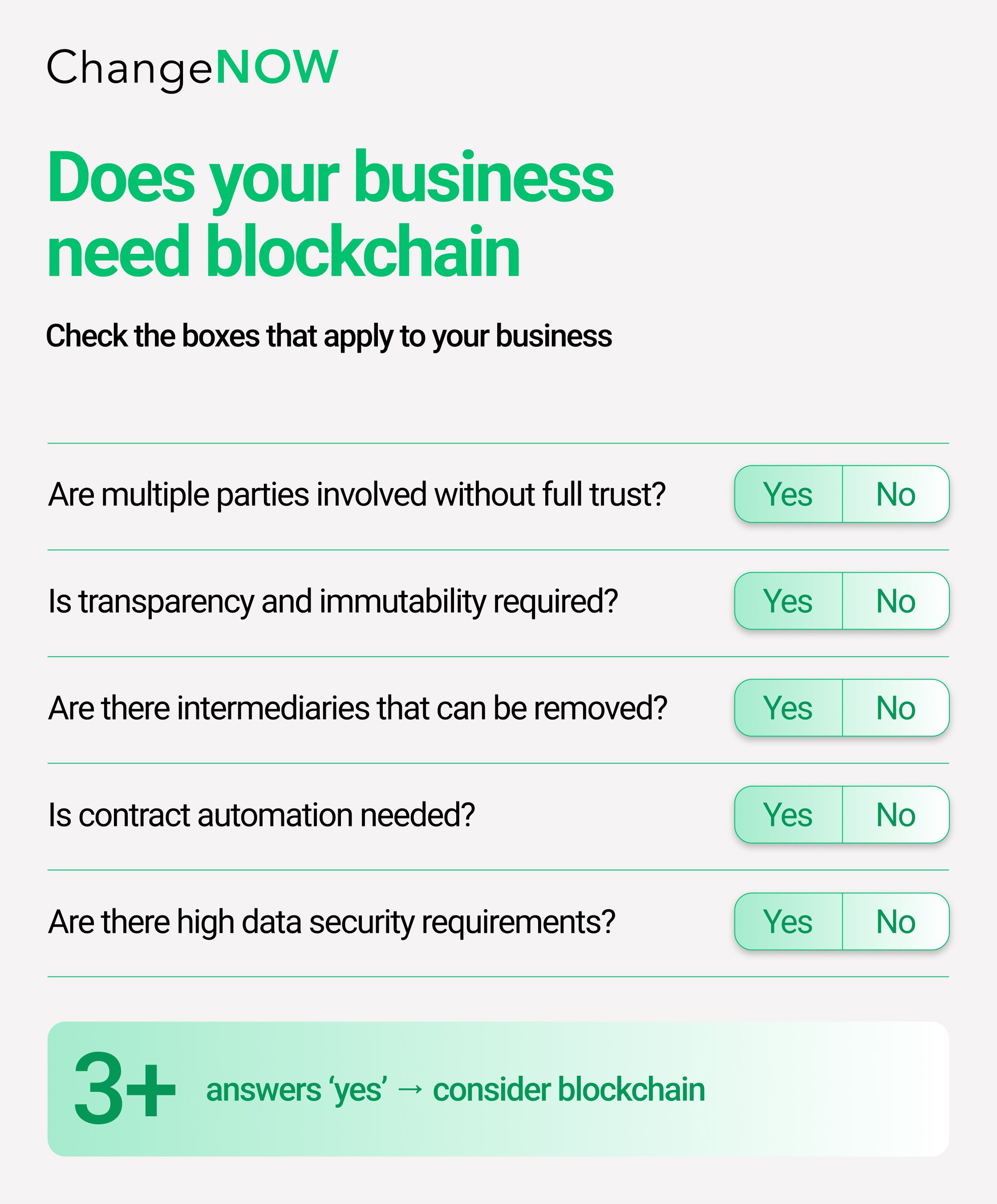
Not every business challenge requires a distributed ledger. To determine if implementing blockchain makes operational and financial sense for your organization, use this quick diagnostic checklist:
If your evaluation points toward a secure blockchain for business, you don't have to build the underlying architecture from scratch. You can streamline your blockchain integration and access ready-made infrastructure by exploring partnership options at ChangeNOW.
How to Implement Blockchain In Your Business
Implementation is a sequence of decisions, and the order matters more than any single technical choice inside it. Start by asking: What is blockchain business for your situation? Get the trust model right early and the platform, the build, and the integration work start to fall into place.
1. Evaluate the need
Map the end-to-end value chain and look for the specific places where latency, opacity, or a single point of failure is costing you something. Blockchain attributes only pay off where those pain points actually live. If the value chain doesn't surface a real one, the earlier checklist already told you to stop, and this is where you stop.
2. Choose a business model
When building a business using blockchain, decide how the initiative creates and captures value. A standard SaaS or transaction-fee model doesn't always translate cleanly to a distributed system, so the business model needs its own thinking. Token-based models (utility, security, or NFT) are one path, but they're optional. A payments or infrastructure use case may need no token at all, and forcing one in adds regulatory surface for no return.
3. Choose the blockchain type
The trust model becomes a concrete choice here: permissioned for a tightly controlled B2B network, decentralized for an open ecosystem. That decision, made now, drives the platform selection rather than the other way around.
4. Select a platform
Tie the platform to the trust model, not to a feature checklist. Where you land on the permissioned-versus-open axis narrows the field before any feature comparison starts:
Platform
Trust model
What you get
What you pay
Fits
Ethereum
Public, permissionless
Deepest tooling and ecosystem
Scalability ceiling, fee pressure
Transparent dApps, tokenization, public settlement
Polygon
Layer-2 on Ethereum
Sub-cent fees, full Ethereum compatibility
Inherits Ethereum's trust assumptions
Payments, loyalty, supply chain
Hyperledger Fabric
Permissioned (Linux Foundation)
Channel-based access control, privacy
More setup work, no native currency
Finance and healthcare consortia
No option wins universally, which is why mature deployments frequently run more than one at once, Fabric internally for private records and Ethereum externally for settlement.
5. Development
Build the smart contracts and backend, and define the data architecture, consensus rules, and governance for compliance, upgrades, and dispute resolution.
6. Testing
Refine the UX on a testnet, pressure-test scalability under realistic load, and debug before anything touches production. A security audit ahead of launch is not optional, because a smart contract flaw is expensive in a way that ordinary bugs are not.
7. Integration
This is where most of the real work sits, and where learning how to implement a blockchain usually means connecting existing infrastructure through APIs rather than building a chain from scratch. Instead of standing up settlement rails yourself, you can plug in a non-custodial exchange and settlement API that already spans many assets and networks, and let it handle the part you'd otherwise spend months on. Scalability, UX, and integration aren't a closing step to check off; they're the constraints that decide whether every choice above holds. A platform that can't scale, an integration that breaks a working system, or a UX that confuses the end user will sink a technically sound build.
8. Launch and maintenance
Launch is the beginning of the organizational problem, not the end of the technical one. Stand up a center of excellence, invest in a skilled blockchain developer you can keep, and plan for internal resistance, because adoption stalls on people at least as often as on code.
How Much Does Blockchain Development Cost In 2026?
Blockchain development costs in 2026 span everything from a single smart contract to multi-chain enterprise platforms, so published budgets should be treated as ballpark estimates rather than quotes. Development studios price projects differently depending on their delivery model, regional rates, and the type of work they specialize in. The ranges below provide a useful starting point, but audit scope, platform choice, and team location usually have a greater effect on the final budget than the pricing tier itself.
Project type
Typical budget
Typical timeline
Basic smart contract / MVP
$5,000–50,000
4–8 weeks
Mid-level dApp / business platform
$40,000–150,000
10–16 weeks
Enterprise blockchain solution
$150,000–200,000+, with complex multi-chain and regulated platforms reaching $500,000–2M+
20–30+ weeks
A standard token contract sits near the bottom of the first range, while an MVP with a web interface, wallet connectivity, and a production ready deployment sits near the top. Mid-level applications add backend indexing, monitoring, account management, testing across multiple environments, and a polished interface. Enterprise projects reach higher budgets because they include multi-chain architecture, legacy integrations, formal security reviews, and compliance work.
What actually changes the price?
Security audits create the biggest budget swing. Auditing a simple token contract may cost around $5,000, while a DeFi protocol that holds customer assets can require reviews costing $50,000 to $500,000 or more. Projects that manage user funds need an audit as part of the release process, and every material contract update requires another review.
Platform choice affects the budget as well. As discussed in the platform selection section, Ethereum projects often cost about 20 to 30% more because of development complexity and deployment costs. Many new applications launch on Layer 2 networks such as Polygon, Base, or Arbitrum to reduce those expenses.
Development rates vary just as much. Teams in parts of Southeast Asia may charge around $25 per hour, while rates in the US reach $150 per hour for senior blockchain specialists, and Western Europe sits slightly lower at $70–$110 per hour. Nearshore and offshore development can reduce labor costs by 30 to 50%.
Ongoing maintenance
Launching the product is only the beginning of the budget. Most teams should reserve roughly 15 to 20% of the initial development cost each year for maintenance, monitoring, infrastructure updates, and feature improvements. Every material smart contract change should be followed by another security audit.
Blockchain Implementation Risks Businesses Should Evaluate
Every advantage of blockchain comes with a trade-off. The same immutability that protects transaction records can also make deployment mistakes difficult to correct, while decentralization removes the central authority that could reverse costly errors. These limitations create several risks that businesses should examine before moving forward with an implementation.
Risk
Business impact
Regulatory uncertainty
Changing requirements can influence architecture decisions and compliance processes
Integration complexity
Custom middleware, data layers, and unclear ROI can increase project costs
Smart contract vulnerabilities
Code failures can result in irreversible financial losses
Cryptocurrency volatility
Settlement and treasury exposure varies depending on asset design
Regulation remains a major factor in blockchain projects, as legal frameworks continue to develop at different speeds across jurisdictions. A company operating internationally may face different requirements from agencies such as the SEC and CFTC in the US, along with separate compliance obligations in other markets. These requirements should influence architecture decisions from the earliest stages of development. Adding reporting systems, identity controls, or transaction monitoring after launch often increases costs and creates additional operational complexity.
Integration is one of the most common obstacles for blockchain initiatives. Many ERP systems, core banking platforms, and CRM solutions were not built to exchange data with distributed ledgers. Connecting these systems often requires custom middleware, API gateways, and data transformation layers — expenses and engineering challenges that may not appear in early vendor estimates.
Integration choices can also create compliance concerns when blockchain transparency conflicts with privacy requirements such as GDPR. In addition, traditional financial models often struggle to measure the value of distributed trust, making projected returns more difficult to justify during budget discussions.
Smart contract vulnerabilities can create irreversible losses
Smart contracts involve a trade-off between certainty and flexibility. Once deployed, vulnerable code may remain exposed if developers cannot modify it quickly or recover affected funds. Reentrancy attacks, access control failures, flash loan exploits, and oracle manipulation have caused significant losses across the industry.
Security firms and crypto researchers estimated smart contract exploit losses at approximately $3.3–$3.4 billion in 2025, with access control issues representing the largest category of incidents. Audits can identify many vulnerabilities before deployment, but they cannot guarantee complete protection. Secure development practices and continuous monitoring remain necessary throughout the project lifecycle.
Cryptocurrency volatility varies by system design
Cryptocurrency volatility receives considerable attention, although its impact depends largely on how a blockchain system is structured. Businesses that use native tokens for settlement or treasury operations are exposed to fluctuations in asset value. Many enterprise deployments avoid this risk by using permissioned networks without native cryptocurrencies or by relying on stablecoins and fiat-based settlement mechanisms.
The level of financial exposure comes from the chosen architecture and asset model rather than from blockchain technology alone. Companies evaluating blockchain solutions should therefore assess the specific economic design of the system instead of treating volatility as an unavoidable consequence of adoption.
Conclusion
Blockchain removes middlemen and kills manual reconciliation. But the real barrier for most enterprises isn't the technology itself. It is the massive cost of building a decentralized network from scratch.
In 2026, the standard approach is integration over reconstruction. Building custom networks takes months and drains engineering budgets. You can skip that by connecting existing infrastructure through APIs. This is where specialized providers like ChangeNOW come in. Our non-custodial APIs drop crypto exchange and settlement directly into your existing IT stack. You get the trust and speed of a distributed ledger, but you don't have to tear down your current systems or spend millions on custom development.
The article breaks down every way a crypto exchange earns money, from trading fees and the spread to listings, staking and custody, and shows how the business model decides which streams a platform can bill for.
This guide explores top crypto exchange with API solutions, from free cryptocurrency options to advanced services. Learn how crypto for business can scale with altcoin APIs, integrate with Web3 platforms, and unlock blockchain business opportunities.
Crypto affiliate programs are a practical monetization model for creators, publishers, and community owners in Web3. Using crypto referral program mechanics, affiliates earn revenue by sharing referral links and receiving a share of user activity, without selling ads or building products.
Blockchain for business: Implementation and Benefits | ChangeNOW Blog