


Banks and blockchain are increasingly appearing in the same headlines as traditional financial institutions move from cautious observation to deeper integration. They are building their own platforms for cross-border payments, issuing digital currencies and tokenized deposits, and expanding their work with digital financial assets.
The news about Toss Bank fits this trend well. One of South Korea's largest digital banks has signed an agreement with the Solana Foundation to test stablecoin-based cross-border transfers. At this stage, the project is a proof of concept (PoC), not a customer-facing product.
The bank has chosen to examine one of the oldest challenges in finance. Despite years of progress in fintech, sending money across borders is still often slower, more expensive and less transparent than making a domestic bank transfer.
So what exactly is Toss Bank trying to test, and why did it choose blockchain for this experiment?
Why Cross-Border Payments Still Need Blockchain Infrastructure
Cross-border transfers still have plenty of points where users lose visibility and control. Fees, intermediary banks, currency conversion, long processing times and payment statuses often leave people with little idea of where their money is or when it will arrive.
The main challenges usually come down to:
- settlement speed;
- the total cost of the transfer;
- visibility into where the money is;
- the role of intermediary banks;
- foreign exchange (FX) conversion;
- dependence on banking and payment system operating hours.
This is where banks begin looking at new payment rails. If even part of the intermediary layer can be removed, settlements become faster and payment tracking becomes clearer, cross-border transfers start looking less like an old financial system with a modern interface.
What Toss Bank And Solana Are Testing For Stablecoin Remittances
Toss Bank and the Solana Foundation have signed an MOU to develop blockchain infrastructure for cross-border settlement. The first stage will focus on testing stablecoin-based cross-border transfers.
An MOU may sound like a major commitment, but in practice it marks the start of research. It does not mean Toss Bank is already building a finished product or has committed to launching one on a fixed timeline.
The bank plans to test more than speed and transaction costs. The project also includes partner integrations, KYC and AML procedures, and the possible involvement of overseas participants in the payment network.
For Toss Bank, the test looks like an attempt to understand whether blockchain can work as part of banking infrastructure for cross-border settlement, rather than as a standalone crypto product. According to The Korea Herald data, Toss Bank’s international transfer service covers around 30 countries, while the bank’s user base exceeds 15 million.
The Payment Tools Solana Already Had
Solana’s role in this story looks fairly logical. By the time the MOU was signed, the network already had tools related to payments and payment acceptance.
According to materials about the deal, Toss Bank specifically pointed to Solana’s transaction finality speed and low transaction costs as reasons to test the network for cross-border payment PoC. The MOU does not specify which stablecoin will be used. That question remains part of the PoC.
Toss Bank also had technical reasons for choosing Solana specifically.
Solana Pay documentation describes payment requests, payment links and QR codes that can be used to build a wallet-based payment flow. The user receives a payment request, confirms the transaction in a wallet and can check the result on-chain.
Merchant tools have also developed around Solana Pay. The product has already been used in e-commerce scenarios, including Shopify and USDC checkout. For businesses, this matters because the topic is not limited to transfers between wallets. It also touches a full payment process.
Payment verification is another important detail.
In cross-border settlement, it matters not only that money has been sent, but also that the transaction has actually gone through. Solana Pay describes an on-chain confirmation mechanism that allows the result to be checked using network data.
Toss Bank’s interest is therefore not tied only to Solana as a network. By the time the tests started, Solana already had a set of payment tools that could be applied to real settlement scenarios.
Toss Bank is not the only Asian financial player looking at Solana through payments. Singapore Gulf Bank had already demonstrated stablecoin issuance on Solana during Breakpoint 2025, while DBS Bank noted institutional client interest in the network.
The trend goes beyond any single chain. In Japan, for example, Ripple and SBI Group have already launched a JFSA-approved USD stablecoin available to both retail and institutional users.
How Mobile Payments In Asia Made QR Payments Normal
QR payments have already become part of daily life in many Asian countries.
PromptPay, VietQR, SGQR and DuitNow QR have made QR payments a familiar action across the region.
Against that background, the more interesting question is no longer the payment gesture itself, but the rails that move the money behind it.
For more on how mobile wallets and QR flows are becoming part of new payment models, read our article about WalletConnect. We also covered cross-border payments and their limits in a separate article.
Why Stablecoin Payments Are Moving Into Global Settlement
Stablecoins are appearing more often in discussions about global settlement. Projects that want to move money across borders faster are testing them as a practical settlement asset.
The reason is pragmatic. A bank cannot easily build a payment system around an asset that may change price while a transfer or transaction check is still in progress. Settlement needs predictability.
This is why a digital dollar often appears in tests like this. It is easier to use for contractor payouts, B2B settlement, remittances and other scenarios where participants need a clear unit of account instead of tracking market movement.
Where ChangeNOW Fits Before Stablecoin Payments
A cross-border transfer rarely starts with a stablecoin.
A user may hold BTC, ETH, SOL or other assets, while a specific payment flow may require USDC, USDT or a particular network. Before the transfer itself, one more step appears.
This is where ChangeNOW becomes part of the payment infrastructure. The service handles conversion before the funds enter the payment route.
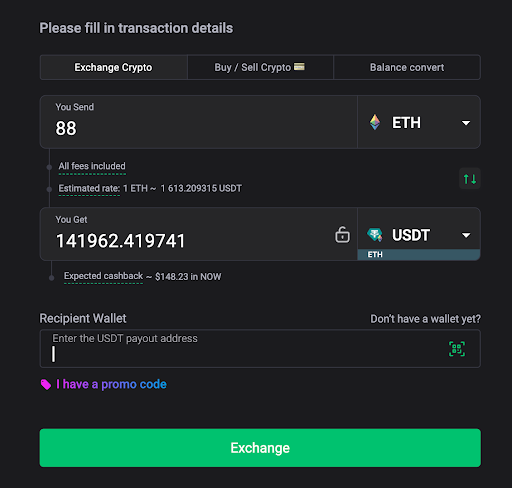
Without this layer, the service would lose one of its key advantages: accepting various cryptocurrencies and automatically converting them into the asset the merchant wants to receive.
What Can Still Block Blockchain Payments
In cross-border transfers, the technical part is often the easiest one. The real weight sits in compliance, licenses, counterparties and the rules of each jurisdiction.
“After the test, it may turn out that the metrics do not improve. If the system adds an on-ramp into Solana and an off-ramp out of Solana, new questions appear: where conversion happens, who provides liquidity, who carries FX and operational risks. In practice, this route may even become more expensive. So this news is more about the start of research than a future product launching tomorrow,” – Xena Kash, Editorial Advisor, former CEO of NOWPayments and NOWNodes noted.
Here it’s important to understand:
- who runs AML and KYC checks for the sender, recipient and partners;
- what stablecoin rules apply in each country;
- what licenses the bank and payment providers need;
- who handles refunds, disputes and support;
- how local banks and foreign partners connect to the system.
If these questions remain open, network speed alone does not turn a test into a banking product. This matters especially in South Korea, where fintech companies and banks operate in a dense regulatory environment.
Asia Might Be The First Place To Find Out
The Toss Bank case shows how blockchain discussions are moving closer to banking infrastructure.
A few years ago, news like this mostly stayed inside crypto pilots. Now blockchain is being tested around services that already have millions of users, active payment products and real cross-border transfers.
Mass adoption is still far away. But projects like this show which ideas can move beyond the crypto market and enter existing financial systems.
If more tests like this follow, the next step may look less like a new crypto app and more like a familiar banking service, with part of the settlement running on blockchain infrastructure.


