






Changelly and ChangeNOW sell wallets and exchanges the same core product: an exchange API, an embeddable widget and a commission on every swap the partner routes. The differences show up in pricing mechanics, settlement time, integration effort and fiat support.
This comparison of Changelly API and ChangeNOW API is written for CTOs and product leads choosing an exchange provider for a wallet or a crypto exchange in 2026. All figures below come from the public documentation and B2B pages of both companies, checked in October 2026.
How we compared: selection criteria
- Asset and network coverage. Does the API support the tokens and chains that your users already hold?
- End user pricing. How do the provider fee and your partner fee get to the rate the end user sees?
- Partner revenue model. What's the standard commission, how far can it be tweaked and what's the payout structure?
- Integration options. What can you actually ship in addition to a raw API? Widgets? White label products?
- Developer experience and reliability. Auth, rate limits, testing, monitoring and published uptime.
- Swap speed and transaction handling. Settlement time, AML holds, refunds and who deals with each one.
- Fiat on/off ramp. Can users move between fiat and crypto within your product?
- Partner support and scale. Account management, post integration maintenance and the size of the partner base.
Changelly API vs ChangeNOW API at a glance
| Criterion | Changelly API | ChangeNOW API |
|---|---|---|
| Assets | 1,000+ | 1,300+ |
| Blockchains | 185+ | 110+ |
| Trading pairs | 500,000+ | 2,250,000+ |
| Rate types | Fixed and floating | Fixed and floating |
| End-user pricing | 0.25% Changelly fee + partner extra fee + network fee, itemized in API responses | One final rate with every fee included |
| Default partner revenue | Extra fee set by the partner (from 0.2%); 50% revenue share, up to 0.125% of turnover, for widgets and links | From 0.4%, customizable by asset, pair, swap size, flow and user segment |
| Partner payouts | BTC or ETH; minimum 0.004 BTC or 0.06 ETH | 11 cryptocurrencies or fiat, at any time |
| Authentication | RSA-SHA256 signature on every request | API key in the request header |
| Rate limit | 10 requests per second | 30 requests per second, custom limits on request |
| Average swap time | 10 to 40 minutes | About 1 minute |
| Published reliability | 99.9% uptime (Fiat API) | 99.99% availability, 350 ms response time |
| Fiat on/off-ramp | Dedicated API: 100+ fiat currencies, 20+ payment methods | On request: 70+ fiat currencies through third-party providers |
| Security and compliance | AML/KYC risk scoring | SOC 2 and ISO 27001 certified, AML monitoring |
| Partner base | 840+ partners, 11 years on the market | 5,000+ partners, 9 years on the market |
1. Asset and network coverage
Changelly. Changelly API covers 1,000+ crypto assets across 185+ blockchains, with over 500,000 trading pairs. That network count is the higher of the two and is the one that really matters for products where the end user is going to be holding assets on a smaller or newer chain.
ChangeNOW. The API supports 1,300+ assets across 110+ networks and over 2,250,000 exchange pairs. Liquidity is sourced from both centralized and decentralized exchanges and every asset on the list can be swapped for any other. A cross chain swap is executed via a single API call and the catalog includes a large number of rare pairs.
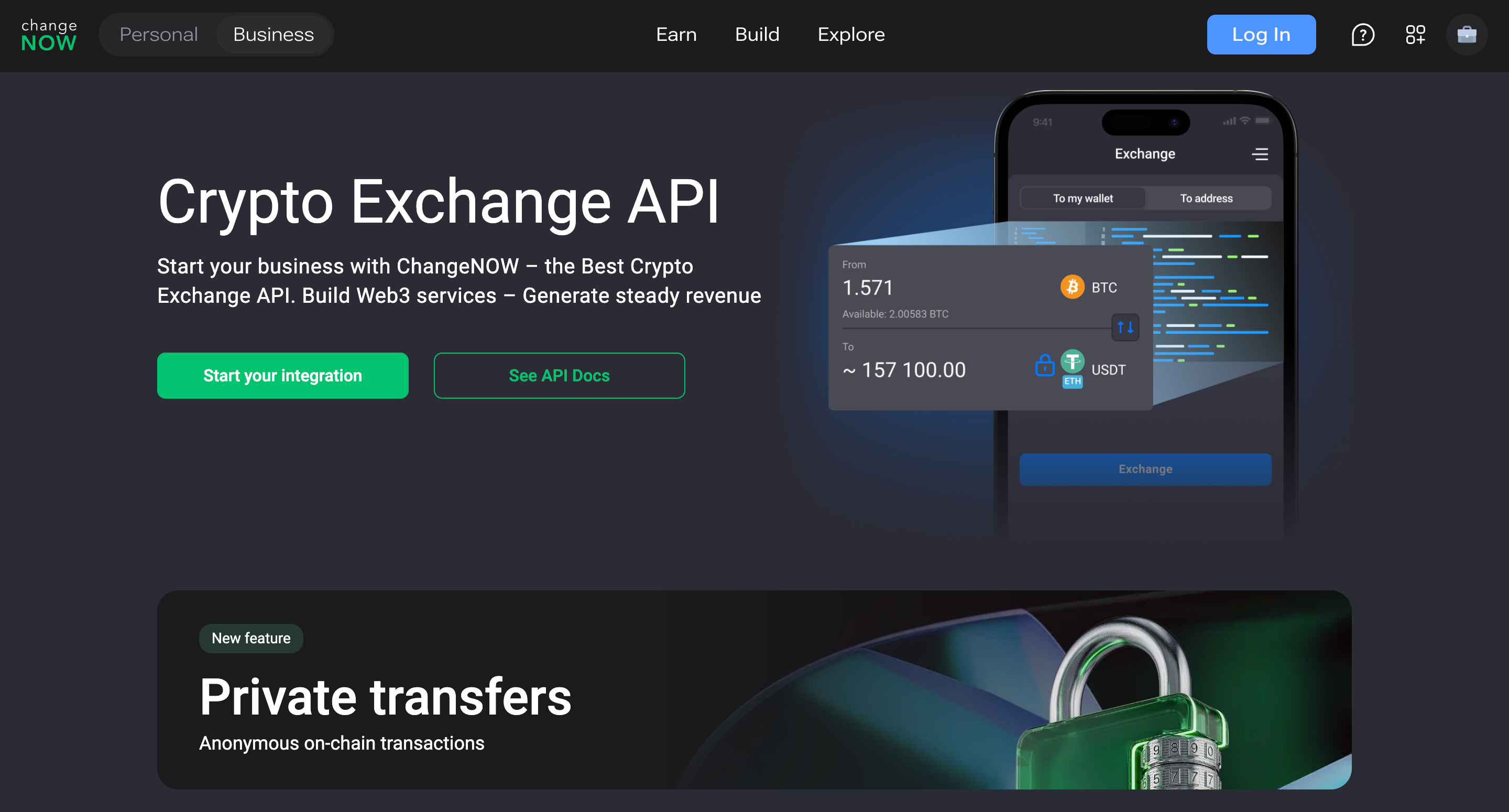
Verdict: ChangeNOW covers more assets and builds every pair between them whereas Changelly reaches more networks. Both APIs return their full list of currencies and you can simply compare that list against your users' top assets to determine which product is the right one for them.
2. Exchange rates and end-user pricing
Both APIs support fixed and floating rates. The providers differ in how the final price is assembled and shown to the user.
Changelly. The user pays Changelly's 0.25% exchange fee, the partner fee (which Changelly refers to as an 'extra fee') and the network fee. The API responses will return each of those components in their own field. A product team can therefore show the full breakdown prior to the user confirming.
ChangeNOW. The partner commission is embedded in the exchange rate. The user sees one figure (the amount that will end up in their wallet) with all the costs already factored in, leaving less scope for argument over some hidden cost being deducted.
Verdict: The pricing model is what determines how the fees appear in your interface and the partner fee you set determines which provider is the cheaper one for a given pair. The reliable comparison is the amount you actually receive for the same input, pair and network when you request it from both APIs at the same time.
3. Partner revenue model
Changelly. Changelly API partners are paid via an additional fee on top of Changelly's 0.25%. There is no cap on the additional fee. Changelly recommends 0.2% as the level that converts best and suggests starting at 0 and then increasing it at a later stage.
Different fees on different API keys under one account are possible only on special conditions and by request. Widgets and referral links follow a separate model: 50% of Changelly's fee by default, which caps partner income at 0.125% of crypto-to-crypto turnover, and 30% on fiat-to-crypto purchases.
Payouts arrive in BTC or ETH. Earnings must first be converted into one of them, and the minimum withdrawal is 0.004 BTC or 0.06 ETH. Other payout currencies go through the account manager.
ChangeNOW. Partner commission starts at 0.4% per swap and can be set individually for various assets, trading pairs, swap sizes and for the standard and fixed rate flows. A wallet can apply one rate to retail users and another to a premium tier or a specific region without opening extra accounts. Partners with higher monthly volume get access to exclusive tools and volume discounts.
At ChangeNOW’s default 0.4% rate, a wallet routing $5 million in monthly swap volume earns $20,000. The same volume at Changelly’s recommended 0.2% extra fee brings just under $10,000, because Changelly calculates the fee on the amount the user receives. Both figures can be raised, and on both platforms a higher partner fee also raises the rate the user pays.
Verdict: ChangeNOW pays more at default settings and gives finer control over where its commission applies, with payouts in 11 currencies. Changelly leaves the extra fee entirely to the partner, with no upper limit, and pays out in BTC or ETH.
4. Integration options
Changelly. The B2B line covers the Exchange API, a separate Fiat on/off-ramp API, a DeFi API for decentralized swaps through DEX aggregation, an exchange widget, Changelly Pay for merchant checkouts and invoicing, and token listing.
ChangeNOW. Beyond the Exchange API, partners can choose:
- an embeddable widget with an Exchange module and a Top-Up module that accepts deposits into a partner wallet in any supported asset;
- white-label products: a non-custodial wallet, a no-code exchange and a Telegram exchange bot, with infrastructure, nodes and updates run by ChangeNOW;
- Private Transfers through the API, which route on-chain transfers through a ChangeNOW node so the sender's wallet does not appear in the recipient's history (75+ networks, about 2 minutes on average).
The API has no setup fee or monthly charge, and a basic integration takes a few hours with the public documentation.
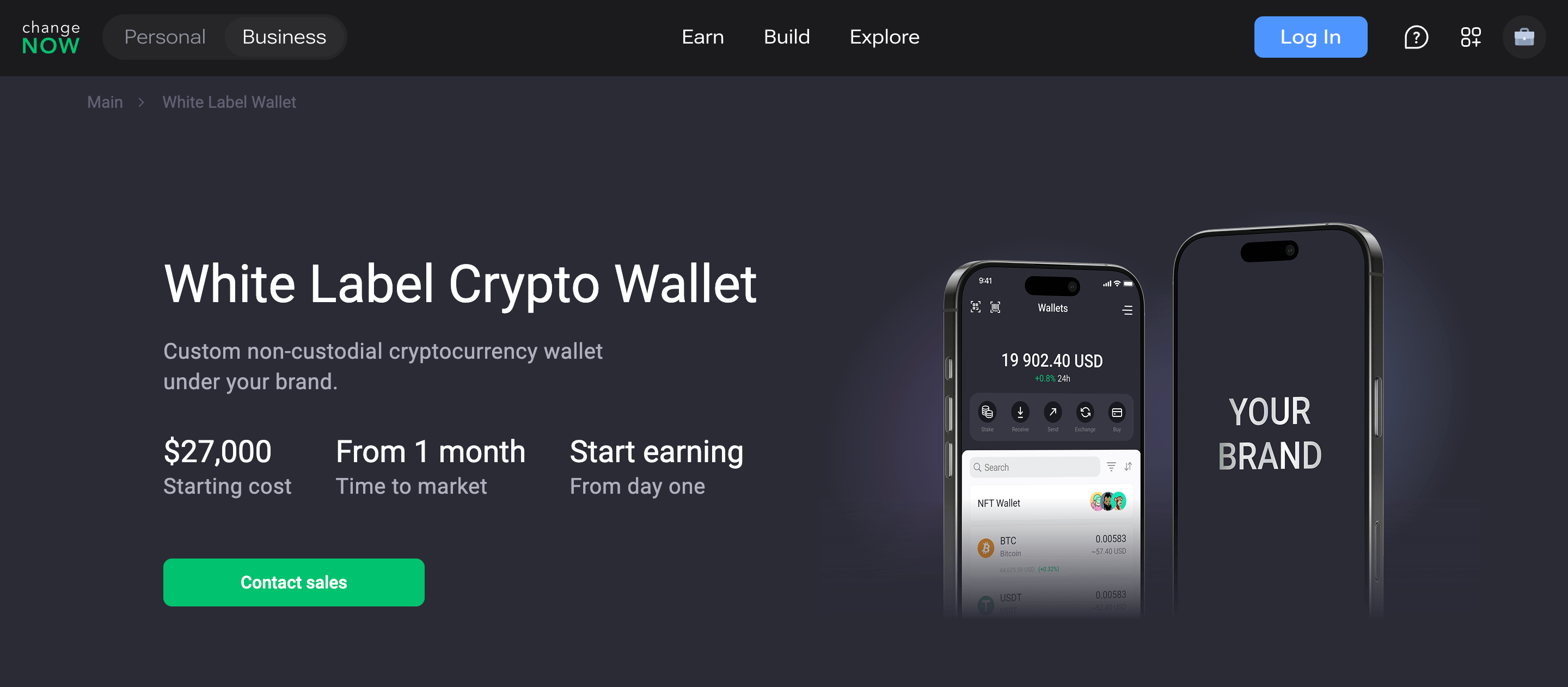
Verdict: ChangeNOW gives partners more products to launch under their own brand with little or no engineering. DeFi routing and merchant checkout are better covered by Changelly.
5. Developer experience and reliability
Changelly. Changelly API v2 is based on JSON-RPC. The request body is signed with the partner's RSA private key (SHA256). The integration must live on the backend to keep keys private. The default limit is 10 requests per second, raised on request. There is no sandbox: teams test with a Postman collection against production. The API has no field for the partner's own customer ID, and transactions cannot be looked up by blockchain hash. Changelly runs a public status page, and the 99.9% uptime figure on its B2B page refers to the Fiat API.
ChangeNOW. Requests authenticate with an API key, with no per-request signing, and a private key is required only for the v2/exchanges endpoint; ChangeNOW generates it from the partner's GPG key. The limit is 1,800 requests per minute (30 per second) per key, and custom limits are available. Instead of a sandbox, ChangeNOW recommends the XRP-XLM pair for low-cost live tests.
The metrics are 99.99% availability, 350ms response time and incident alerts within 10 minutes and there's a status page which allows partners to subscribe to specific events. ChangeNOW is SOC2 and ISO27001 certified.
Verdict: Both APIs report transaction progress via status polling and are both tested on mainnet with small amounts. ChangeNOW takes less engineering to authenticate, allows three times more requests per second, links swaps to partner data and publishes concrete SLA metrics. Changelly's signed requests add integrity checks at the cost of extra backend work.
6. Swap speed and transaction handling
Changelly. A typical swap takes 10 to 40 minutes, longer when the network is congested. Swaps can be placed on hold under Changelly's AML/KYC procedures. In that case the user or the partner's own team emails Changelly's security team to complete verification. Refunds normally take 1 to 10 business days and can run longer when a user sends funds through the wrong chain or deposits an unsupported asset.
ChangeNOW. The average swap completes in about 1 minute. In March 2026, ChangeNOW moved deposits on Monero, Polygon, Cardano, Litecoin and Zcash to dynamic confirmation thresholds. Standard deposits are now credited after the minimum number of blocks: 5 confirmations instead of 25 for Monero, 7 instead of 200 for Polygon.
Only high-value or high-risk deposits require more. ChangeNOW also screens swaps for AML risk and may request verification when one is flagged. Support cases such as wrong-network deposits or missing memos go straight to ChangeNOW’s 24/7 support team and the partner’s personal manager.
Verdict: ChangeNOW settles swaps faster and takes more of the exception handling off the partner's team. With Changelly, settlement windows are longer and the partner's team takes part in resolving holds.
7. Fiat on/off-ramp
Changelly. Fiat is a standalone Changelly product with its own API. It supports 200+ crypto assets, 100+ fiat currencies and 20+ payment methods and routes each purchase through the various providers. Changelly states 99.9% uptime for the API and each of the fiat providers behind it will have their own KYC rules.
ChangeNOW. Fiat on- and off-ramp is available to API and widget partners on request. It covers 70+ fiat currencies through third-party providers, with card and bank transfer payments, and partners can also withdraw their own earnings in fiat.
Verdict: Changelly is the stronger option when users arrive with cards and bank accounts and fiat entry is the main conversion path. ChangeNOW's fiat coverage is narrower and is set up per partner rather than sold as a separate product.
8. Partner support and scale
Changelly. Changelly reports 840+ partners, 11 years on the market and 12 million+ registered users. Its partner list includes Zengo, SecuX, Klever Wallet and Coinomi, and it publishes case studies with metrics from CoolWallet, ELLIPAL and NGRAVE. Each API partner works with a dedicated account manager. Changelly has also run a co-marketing package for new API partners, valued at $10,000 and combining blog banners, CRM campaigns and social media posts. On its B2B pages, Changelly displays the Outstanding Blockchain Technology Provider award from the FinanceFeeds Awards 2024.
ChangeNOW. ChangeNOW counts 5,000+ partners after 9 years on the market. Each partner gets a personal manager and a 24/7 support team. Its partners include Trezor, Cake Wallet, MoonPay and CoinStats, along with swap services such as Houdini Swap and RocketX. In June 2026, ChangeNOW was named Best Digital Assets Fintech at the BeInCrypto x Proof of Talk Institutional 100 Awards, where winners went through data-based screening and independent judge scoring. ChangeNOW does not serve users or partners in the United Kingdom.
Verdict: ChangeNOW's partner base is around six times bigger, and its team remains involved in day-to-day operations after launch. Changelly is stronger on co-marketing.
Which API fits your product
- Non-custodial software wallet. Commission control matters most here. ChangeNOW lets one account charge premium and standard users different rates, and the 1,300+ asset catalog covers what users already hold.
- Hardware wallet companion app. Users approve each transaction on the device and then wait for the result while it's still connected. ChangeNOW's one minute average settlement is ideal for that type of flow.
- Cross-chain aggregator. An aggregator already runs its own interface and routing logic; what it takes from an exchange API is liquidity and throughput. ChangeNOW adds 2,250,000+ pairs as a liquidity source, with a limit of 30 requests per second per key that can be raised on request.
- Portfolio tracker adding swaps. For apps like CoinStats, a widget is the fastest route to in-app swaps. ChangeNOW's Exchange module pays 0.4% of its volume, against Changelly's widget revenue share of up to 0.125%.
- Fiat-first onboarding app. When most users start with a card or a bank account, Changelly's dedicated fiat API with 100+ currencies does more for conversion than crypto-to-crypto speed.
- Team without engineers. ChangeNOW's white-label exchange, Telegram bot and WordPress plugin launch a branded swap service without backend development.
Conclusion
For a wallet or an exchange whose revenue comes from crypto-to-crypto swaps, ChangeNOW's settlement time and commission controls carry the most weight. Products whose users arrive with cards and bank accounts get more from Changelly's fiat API.
Two questions stay open in any public comparison: the final amount each API returns on your most-used pairs, and how each provider resolves a held swap for your users. Both can be answered with live API keys before the contract is signed.
Register to get ChangeNOW API key
Methodology and sources
We took figures and product terms from the official documentation and B2B pages of both companies and verified them in October 2026. Swap times are the averages each company publishes; actual times depend on the network and the assets involved.
Sources
- Changelly for Business
- Changelly Crypto Exchange API
- Changelly Fiat on/off-ramp API
- Changelly partners
- Changelly Exchange API v2 documentation
- Changelly Exchange API FAQ
- Changelly authentication guide
- Changelly Fiat API: authentication
- Changelly affiliate program terms
- Changelly co-marketing offer for API partners
- Changelly at the FinanceFeeds Awards 2024


