


The Bitcoin Lightning Network offers another way to move BTC. Instead of recording every payment directly on the blockchain, it enables users to send Bitcoin through a network of off-chain payment channels. Transactions can settle in seconds, often with significantly lower fees.
But how does the Lightning Network work, and is it actually better than regular Bitcoin transactions?
This guide explains the technology behind Lightning, how to send and receive BTC, what fees to expect, and the limitations worth understanding before using it.
Key Takeaways
- The Lightning Network is a Bitcoin Layer 2 protocol that enables fast, low-cost BTC payments through off-chain payment channels.
- Unlike regular Bitcoin transactions, Lightning payments typically settle within seconds, although routing and liquidity limitations can affect reliability.
- Lightning can be used for everyday payments and BTC exchanges. Platforms such as Swapzone help users compare providers offering BTC Lightning swaps.
What Is the Bitcoin Lightning Network?
The Lightning Network is a Layer 2 payment protocol built on top of Bitcoin. Its main function is to make Bitcoin payments more practical for frequent or small transactions.
Bitcoin's base layer processes transactions in blocks, which are produced approximately every ten minutes. During periods of high demand, users may need to pay higher transaction fees to receive timely confirmation.
With Lightning, rather than requiring miners to confirm every individual payment, users can exchange Bitcoin through payment channels that operate outside the main blockchain. Only certain channel operations, such as opening and closing a conventional channel, need to be recorded on-chain.
This allows many payments to take place without competing for limited Bitcoin block space.
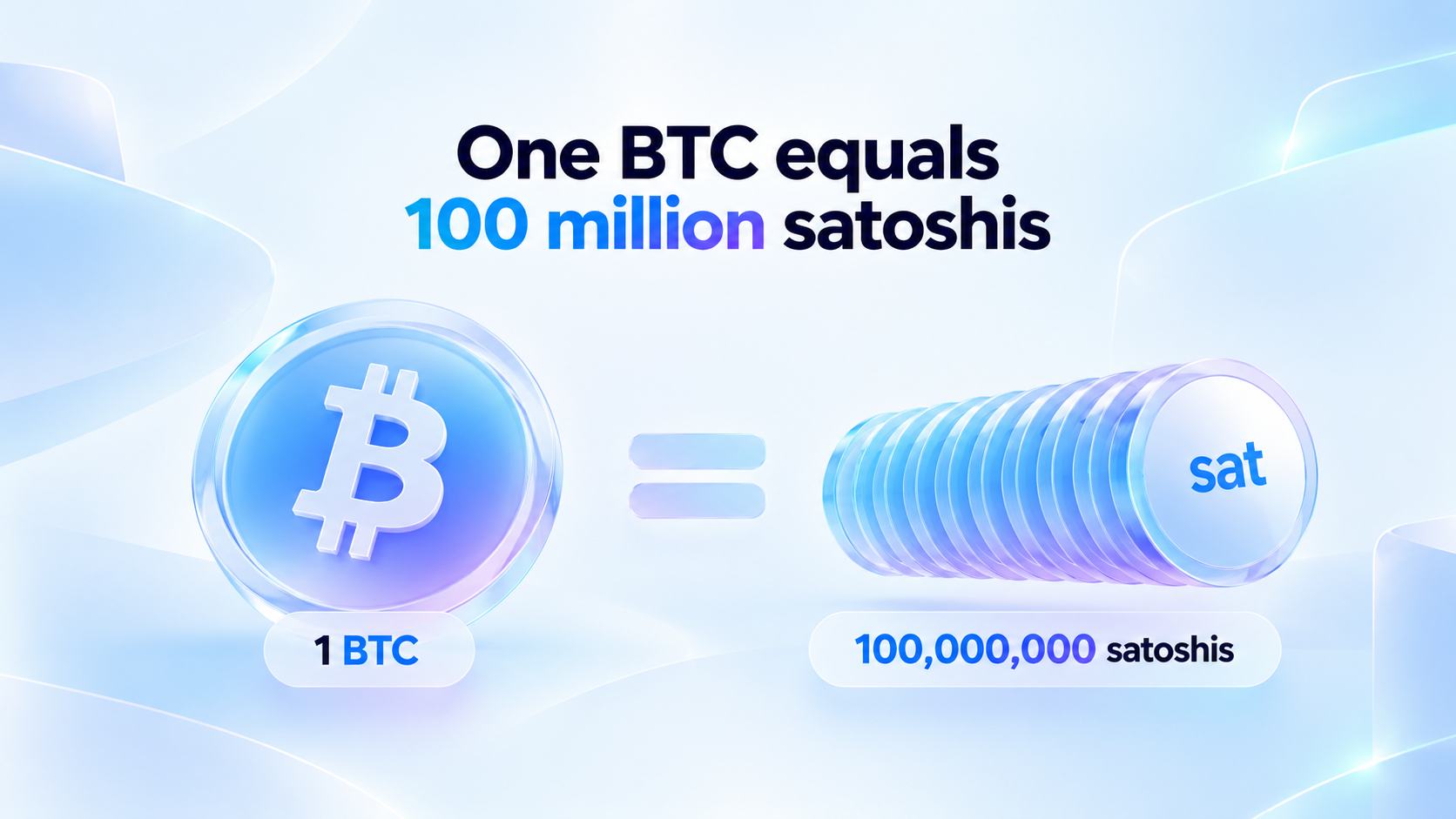
Lightning is not a separate cryptocurrency or an alternative blockchain. It uses BTC, with balances commonly expressed in satoshis (sats), the smallest unit of Bitcoin.
The Lightning Network was proposed by Joseph Poon and Thaddeus Dryja in 2016 as a way to address Bitcoin's scalability limitations without fundamentally changing its base-layer consensus rules.
Today, the technology supports use cases ranging from small purchases and online tipping to merchant payments and cryptocurrency transfers.
How Does the Lightning Network Work?
The Lightning Network lets users send Bitcoin without recording every payment on the blockchain. It uses payment channels, where Bitcoin can move between participants while the total amount locked in the channel stays the same.
There are three main parts:
- opening a payment channel
- updating balances off-chain
- routing payments through other channels when needed.
Payment Channels and Off-Chain Transactions
Lightning doesn't create new Bitcoin or move it to another blockchain. It simply lets users send BTC back and forth within a payment channel, without recording every payment on the Bitcoin blockchain.
Here's how it works:
- Open a channel. One user locks 100,000 sats (0.001 BTC) into a payment channel. This requires a transaction on the Bitcoin blockchain. Initially, the full balance belongs to the user who funded it.
- Send Bitcoin. The user sends 20,000 sats to the other participant. Their balances are now 80,000 and 20,000 sats. No new blockchain transaction is needed.
- Send Bitcoin back. The second participant returns 5,000 sats. The balances change to 85,000 and 15,000 sats, again without an on-chain transaction.
- Close the channel. When the participants finish using the channel, they can close it. The final balances are settled on the Bitcoin blockchain.
Only opening and closing the channel require on-chain transactions in this example. Payments made while the channel is open simply update how the locked Bitcoin is divided between the participants.
The funds are secured through a two-party multisignature arrangement, meaning neither participant can take the other's share.
Lightning also uses cryptographic safeguards to prevent participants from successfully claiming outdated balances.
This approach reduces blockchain congestion and makes repeated Bitcoin payments faster and generally cheaper.
Routing and Settlement
What happens if you want to send Bitcoin to someone you don't share a payment channel with?
You don't need to open a new channel for every recipient. The Lightning Network can route payments through existing channels.
For example, imagine you want to send 10,000 sats to an online store. Your wallet doesn't have a direct channel with the store, but it can find a route through two other Lightning nodes.
A Lightning payment can pass through one or several routing nodes, depending on available channels, network congestion, and how liquidity is distributed across the network.
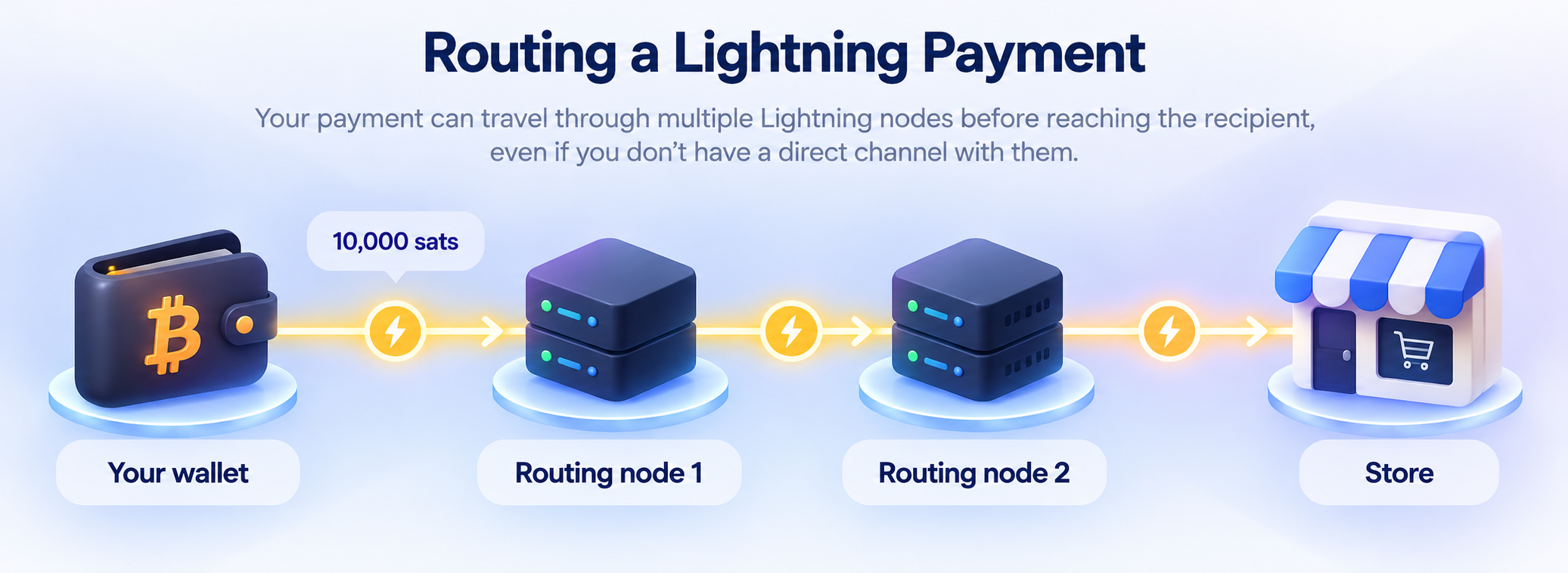
Each node forwards the payment through its connected channels. The nodes may charge small routing fees, but they cannot simply take the payment for themselves.
The network uses Hashed Timelock Contracts (HTLCs) to coordinate this process. These cryptographic contracts make Lightning payments secure. They ensure that funds are transferred only when the required conditions are met. Otherwise, the payment expires and the funds can be returned to the sender.
For the payment to succeed, every channel along the selected route must have enough available liquidity.
Why Liquidity Matters
Lightning channels have limited capacity.
For example, a channel holding 100,000 sats cannot forward an unlimited amount of Bitcoin.
Two concepts are particularly important:
- Outbound liquidity: Bitcoin available on your side of a channel that can be sent.
- Inbound liquidity: Capacity available for receiving Bitcoin through a channel.
If a payment route lacks sufficient liquidity, the transaction may fail even when both sender and recipient are online.
Modern Lightning wallets and service providers can handle much of this complexity automatically. Still, liquidity remains one of the network's fundamental limitations.
How to Use the Bitcoin Lightning Network
A compatible wallet handles most of the technical work. Here's how to get started:
Step 1: Choose a Lightning Wallet
Choose a wallet that supports Lightning payments, such as Phoenix, Breez, or Wallet of Satoshi. Features, custody models, and regional availability vary.
Some wallets give you direct control over your BTC, while others manage funds on your behalf. Learn more:
Custodial vs. non-custodial wallets guide
Step 2: Add Bitcoin
Fund your wallet with BTC. Depending on the app, you can deposit Bitcoin on-chain or receive it through Lightning. Some wallets charge additional fees for channel setup or transfers between on-chain and Lightning balances.
Make sure you select the correct network: a regular Bitcoin address and a Lightning one are not interchangeable.
Step 3: Send or Receive Bitcoin
To send BTC, select Send, scan the recipient's Lightning QR code or paste their invoice, review the amount and fees, and confirm.
To receive BTC, select Receive, enter an amount if required, and share the generated invoice or QR code.
A Lightning invoice contains the payment details and may have an expiration time. Successful payments typically settle within seconds, although delays or routing failures can occur.
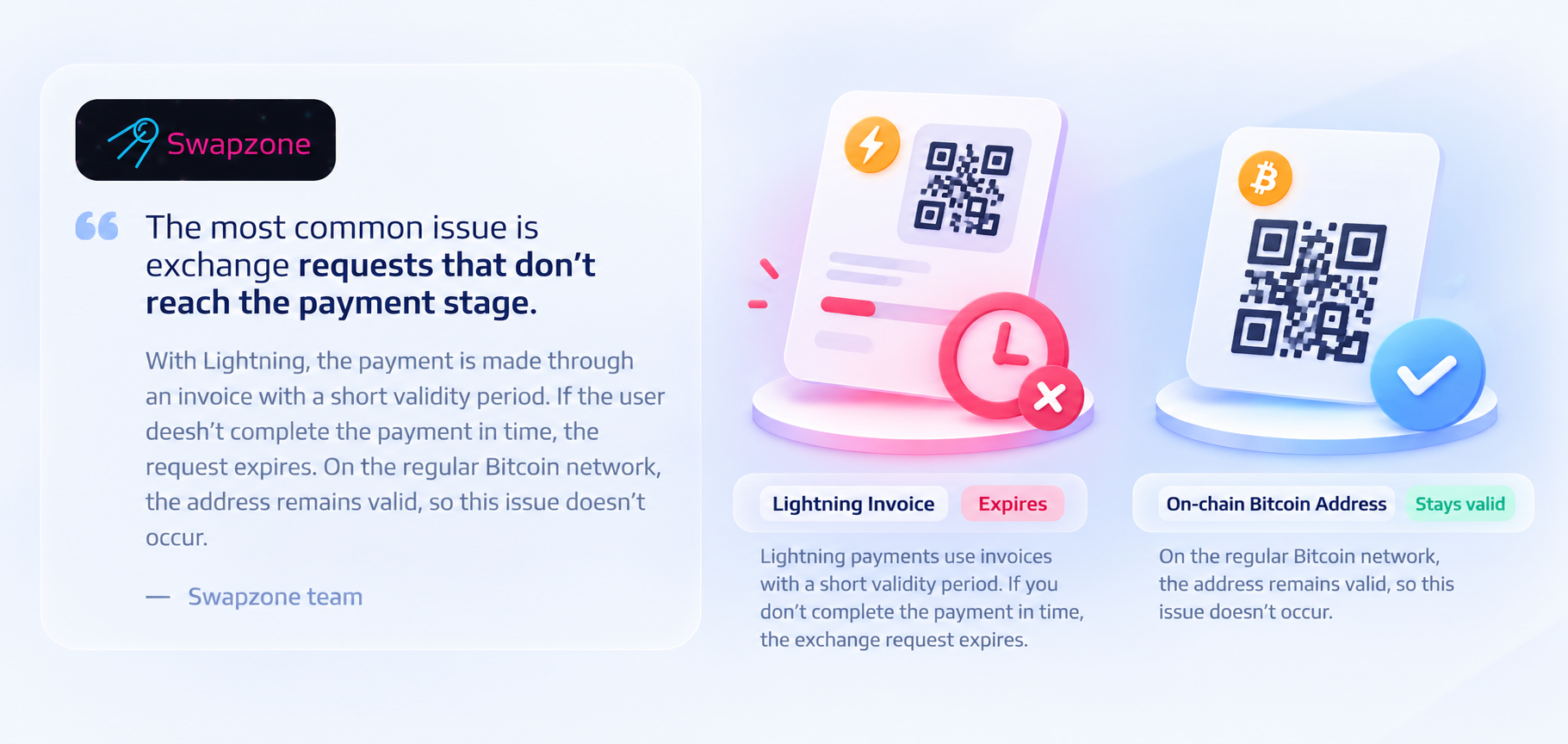
Watch the invoice expiration time. Lightning invoices typically have a limited validity period. According to the Swapzone team, exchange requests that expire before payment are among the most common issues users encounter. If an invoice expires, request a new one rather than attempting to pay the outdated invoice.
How to Swap BTC Using the Lightning Network
A BTC Lightning swap allows users to exchange Bitcoin between the regular Bitcoin network and the Lightning Network through a compatible exchange provider.
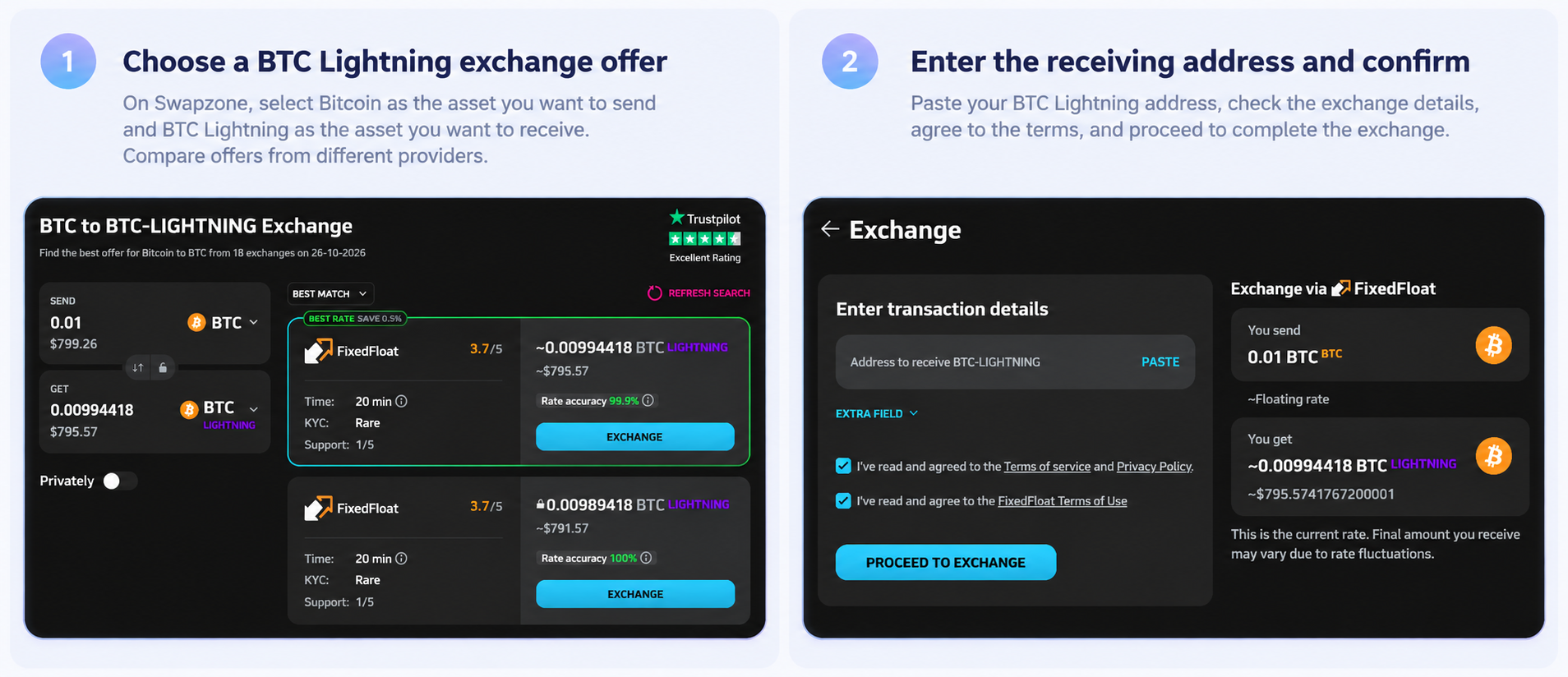
For example, Swapzone aggregates offers from multiple providers. Here’s how it works.
- Visit Swapzone and select BTC as the sending currency and BTC Lightning as the receiving currency.
- Enter the amount you want to exchange and compare available offers from different providers.
- Choose an offer and click Exchange.
- Enter your BTC Lightning receiving details, review the exchange information, and agree to both Swapzone's and the selected provider's terms.
- Click Proceed to Exchange and follow the provider's payment instructions to complete the swap.
Lightning Network Fees, Speed, and Limitations
The main benefits of Bitcoin Lightning Network payments are lower transaction costs and faster settlement.
Lightning Network Transaction Fees
Bitcoin Lightning Network fees generally consist of routing charges and, where applicable, wallet or service fees.
Routing nodes can apply two types of charges:
- Base fee: A fixed amount for forwarding a payment.
- Fee rate: A variable charge calculated relative to the payment amount, commonly expressed in parts per million (ppm).
For example, suppose a routing node charges a base fee of 1 sat and a fee rate of 100 ppm. For a payment of 100,000 sats, the routing charge at that hop would be approximately 11 sats.
Lightning routing fees are not necessarily the same as the total cost of a cryptocurrency exchange. Exchange providers may incorporate their own fees or spreads into the quoted rate.
The Swapzone team notes that its platform does not charge an additional exchange fee, while pricing is determined by the selected provider. Unlike on-chain Bitcoin transaction fees, which depend heavily on network demand, Lightning-based exchange costs may include routing charges and provider spreads.
For this reason, users should compare the final amount they will receive rather than looking only at the Lightning routing fee.
Lightning Network Transaction Speed
Lightning payments typically settle within seconds when a suitable route is available. Its effective throughput depends on the network's topology, channel capacity, liquidity, node performance, and other operational conditions.
While individual Lightning payments can settle within seconds, a complete cryptocurrency exchange may take longer because of additional processing and settlement steps.
Swapzone's internal data from a five-week sample illustrates this difference:
"Completed Lightning exchanges had a median processing time of 3 minutes, with the middle 50% taking between 2 and 5 minutes. Regular Bitcoin exchanges had a median of 6 minutes, with the middle 50% ranging from 2 to 13 minutes," the Swapzone team explains.
The longest completed Lightning exchange in the sample took 50 minutes, while some regular BTC exchanges exceeded 24 hours.
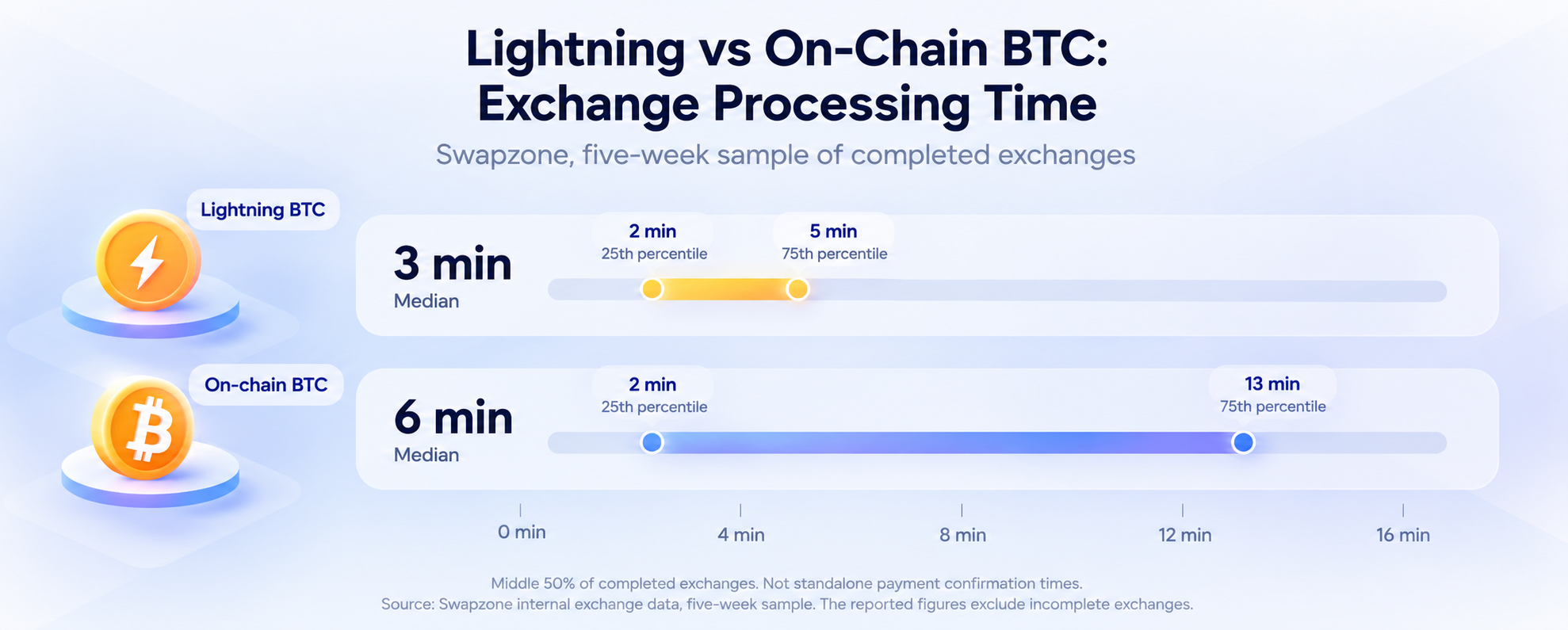
These figures describe completed exchanges in Swapzone's sample, not standalone Bitcoin or Lightning payment confirmation times. They should not be interpreted as guaranteed processing times.
Benefits and Limitations of BTC Lightning Network
| Benefits | Limitations |
|---|---|
| Payments can settle in seconds | Payments may fail when liquidity is insufficient |
| Routing fees are often low | Opening and closing payment channels require on-chain fees. |
| Useful for micropayments | Large payments may be harder to route |
| Reduces demand for Bitcoin block space | Wallets and services introduce different operational risks |
| Enables payments without a direct channel | Requires compatible infrastructure and receiving methods |
When Should You Use Lightning Instead of Regular Bitcoin?
Lightning is generally better suited to smaller, time-sensitive payments, while on-chain Bitcoin transfers may be more practical for larger amounts or when Lightning support is unavailable.
The Swapzone team reports that typical Lightning exchange amounts in its observed flow start at around 0.001 BTC. However, this is an observation about exchange activity, not a universal minimum for Lightning transactions.
"If the amount exceeds the provider's limit or the wallet doesn't support Lightning, choose on-chain Bitcoin. If speed matters for a smaller amount, Lightning is a good option," the Swapzone team advises.
Before choosing a network, check the exchange provider's limits, wallet compatibility, available liquidity, and expected costs.
Bitcoin vs Lightning Network: Key Differences
The Lightning Network is not a competitor to Bitcoin. It is a payment layer that depends on Bitcoin's underlying blockchain.
The distinction is between Bitcoin Layer 1 transactions and Lightning Layer 2 payments.
| Feature | Bitcoin Network (Layer 1) | Lightning Network (Layer 2) |
|---|---|---|
| Settlement | Recorded directly on Bitcoin blockchain | Payments settled off-chain through payment channels |
| Speed | Block confirmations typically take minutes | Successful payments typically settle in seconds |
| Fees | Depend on blockchain demand and transaction size | Usually low routing fees, plus possible service charges |
| Best suited for | Larger transfers, savings, direct on-chain settlement | Frequent payments and micropayments |
| Liquidity requirements | Available on-chain BTC | Sufficient channel liquidity and routing capacity |
| Infrastructure | Standard Bitcoin wallet | Lightning-compatible wallet or service |
| Security model | Direct Bitcoin blockchain validation | Bitcoin-anchored channels with additional protocol and operational risks |
The Future of the Lightning Network
Lightning Network development increasingly focuses on improving payment reliability, liquidity management, wallet usability, and broader Bitcoin adoption.
Better liquidity management. Lightning Service Providers help wallets obtain channel capacity and manage payments without requiring every user to understand routing infrastructure.
Improved payment reliability. Technologies such as Multi-Part Payments split a payment across multiple routes. This is especially useful for larger transfers that might not fit through a single route.
Simpler wallet experiences. Wallet developers continue working to make Lightning payments feel more like conventional digital payments, with fewer manual channel-management steps.
Taproot Assets enable stablecoins and other assets to be issued on Bitcoin and transferred through Lightning channels. In June 2026, Lightning Labs released Taproot Assets v0.8 and its first public SDK, making it easier for developers to build multi-asset applications. However, adoption still depends on wallet compatibility, liquidity, and support from payment providers.
Challenges to Wider Lightning Adoption
Despite improvements in payment infrastructure, exchange provider adoption remains a challenge.
According to Swapzone, fewer than a quarter of the more than 20 exchange providers featured in its comparison results support Lightning. The team also reports that Lightning accounts for a consistent share of exchange requests, although it has not provided an exact percentage.
"We see significant potential and demand for Lightning, especially among businesses that need to process cryptocurrency payments quickly," the Swapzone team says.
Broader adoption will depend on improved channel liquidity, easier integration, wider wallet compatibility, and support from more exchange providers.
Lightning doesn't need to replace regular Bitcoin transactions. Its value lies in making BTC practical for smaller, everyday payments, while new tools may expand what the network can be used for.