A coin delisting means a particular platform has stopped or will stop supporting the asset, but it does not automatically mean your funds have disappeared. If you still hold the coin, check the platform's withdrawal deadline. If you have already sent it for an exchange, check the transaction status first and contact support rather than sending another transaction.
Key Takeaways
A delisted coin does not automatically become worthless or disappear from its blockchain.
Trading, deposits, and withdrawals can stop at different times, so check exactly what the platform has disabled.
If you already sent the coin for an exchange, the transaction hash and on-chain status are more important than the delisting announcement alone.
A confirmed deposit may require manual processing if the asset becomes unsupported before the swap is completed.
Never send the same transaction again simply because the original exchange has not completed.
What Does It Mean When a Coin Gets Delisted?
When a coin gets delisted, an exchange or another crypto service stops supporting some or all operations involving that asset. The blockchain itself may continue operating normally. What changes is the platform's ability to trade, receive, send, or otherwise process the coin.
Delisting is not always one single event.
Status
What it means
What you should check
Trading pair removed
The coin can no longer be traded in that pair
Whether another pair or withdrawal is still available
Deposits disabled
New incoming transactions are no longer credited normally
Whether you have already sent funds
Withdrawals disabled
Funds can no longer be sent out through the platform
Whether a deadline or alternative procedure exists
Full asset delisting
The platform ends support for the asset
Withdrawal, conversion, or recovery instructions
Token migration
An old contract or chain is being replaced
Whether you need to migrate to the new version
Exchanges usually announce deadlines for affected services separately. For example, trading may stop before withdrawals do.
That distinction matters much more than the word "delisted" by itself.
Why Do Crypto Exchanges Delist Coins?
FAQ
Delisting alone does not erase a blockchain asset. However, you can lose practical access through a particular platform if you miss its deadlines or send funds after support ends.
Often yes, for a limited period. The exact withdrawal deadline depends on the platform and specific delisting notice.
Check the TXID first. If the transfer is confirmed but the exchange has not progressed, contact official support with the transaction hash and exchange ID.
Platforms can remove assets for commercial, technical, security, or compliance reasons.
Common reasons include:
insufficient liquidity or trading activity;
discontinued project development;
blockchain or wallet maintenance problems;
security incidents;
token or network migrations;
legal or regulatory changes;
compliance or risk concerns;
failure to meet a platform's listing requirements.
At ChangeNOW, the decision is based on whether the asset can still be reliably supported.
“At ChangeNOW, the decision to delist an asset depends primarily on whether we can keep it operational. The most common reasons are the loss of supported markets or drying liquidity on DEX pools. Other cases include rug pulls, token migrations, rebrandings, contract changes, and moves to a different network.” — Blockchain Integration Team at ChangeNOW
A delisting on one service does not necessarily mean every other exchange or wallet has stopped supporting the coin.
Before moving funds, check the specific asset and network supported by the destination.
What Should I Do If I Still Hold a Delisted Coin?
If the coin is still in your wallet or exchange account, first determine whether withdrawals remain available. Do not transfer it simply because you saw a delisting notification.
If the notification arrived by email, verify it through the platform's official website or app , social networks, ask the support team in dedicated chats before following any links. See our guide on how to avoid crypto phishing emails for additional security checks.
Check the official announcement for:
the trading cutoff;
the deposit cutoff;
the withdrawal deadline;
supported networks;
token migration instructions, if applicable;
any conversion or recovery policy after the deadline.
If withdrawals remain available, you may be able to move the coin to a compatible self-custody wallet or another service that still supports the exact asset and blockchain.
Verify support on the receiving side before sending.
A blockchain transaction cannot ask the receiving platform whether it still supports your token. It can be successfully confirmed on-chain while the destination service is unable to credit it automatically.
What If I Already Sent a Delisted Coin for an Exchange?
If you already created an exchange and sent the coin, first check whether the transaction was actually broadcast and confirmed. A delisting that happens while an exchange is in progress does not by itself tell you whether the funds were received or whether the swap can still be completed.
There are several possible situations.
The Transaction Has Not Been Confirmed
If the transaction is still pending on the blockchain, the receiving service may not have received spendable funds yet.
Check:
the transaction hash;
blockchain confirmation status;
destination address;
network;
amount.
Do not create another exchange or resend the funds to "fix" the delay.
The Transaction Was Confirmed Before Support Ended
If the blockchain shows that the funds reached the specified deposit address while the asset was still supported, the exchange may still be processable.
However, completion can depend on whether the service can still access liquidity and send the requested output asset.
If processing has stopped, don't worry. Contact support with the exchange ID and transaction hash.
The Deposit Was Confirmed After the Coin Became Unsupported
This case may require manual investigation.
A transaction can be valid on-chain even when the receiving platform no longer supports that asset. Crypto networks do not automatically reject transfers because one platform has changed its asset list.
Possible outcomes depend on the platform and the technical status of the asset. They may include:
completing the original exchange;
returning the deposited asset;
recovering it manually to another compatible address;
waiting for wallet or network functionality to resume;
being unable to recover the asset technically.
Recovery is possible, as our support team always aims to resolve every case.
The Asset Was Delisted While the Exchange Was Already Processing
Delisting in the middle of an exchange is different from sending an unsupported token without creating a valid exchange first.
The platform may already have detected the deposit and begun processing it.
At that point, the important questions are:
Was the deposit recognized?
Is the original asset still transferable?
Is liquidity still available?
Can the requested payout still be completed?
If not, can the original asset be returned?
At ChangeNOW, funds from existing deposits are routed to the relevant node as part of the delisting process. When there is enough time before external market support ends, the team also contacts affected users or partners about unfinished exchanges.
“When there is enough time before a delisting deadline, we try to notify affected users and partners about unfinished exchanges so they can take action in advance.” — Blockchain Integration Team at ChangeNOW
If the deadline is too close for advance communication, the remaining balances are secured as part of the delisting process. Users who contact support afterward may be eligible for compensation in an equivalent asset, depending on the circumstances of the case.
What Information Should I Send to Support?
If a delisted or unsupported coin has already been sent, give support enough information to locate the transfer without several rounds of messages.
Prepare:
exchange ID;
transaction hash or TXID;
coin ticker and full asset name;
blockchain network;
amount;
sending address;
deposit address;
approximate transaction time;
screenshot of any relevant error, if available.
Never send your seed phrase or private key.
What If the Coin Was Delisted Because of a Token Migration?
A token migration requires extra care because there may now be two technically different versions of what appears to be the same asset.
A project might:
deploy a new smart contract;
move to another blockchain;
replace an old token with a new token;
set a deadline for migration.
Do not assume an old token can be sent to a deposit address intended for the new version.
Check the project's official migration instructions and the receiving platform's announcement before moving the asset.
Migration announcements can also be impersonated by scammers, so verify any request before following links or moving funds.
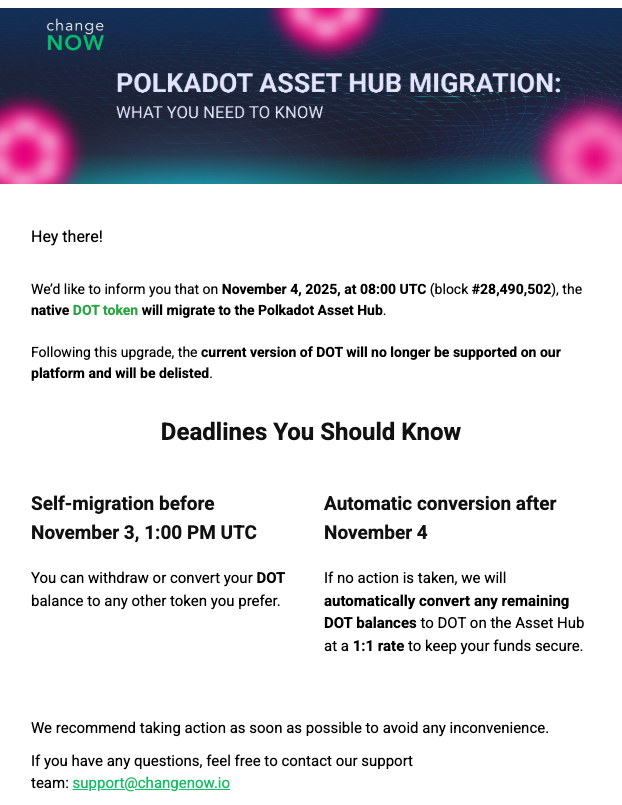
Ahead of Polkadot’s November 2025 Asset Hub migration, DOT holders at ChangeNOW Pro were notified that the existing version of DOT would become unsupported.
Users could withdraw or convert their balance before the deadline, while remaining balances were automatically migrated 1:1 to DOT on the Asset Hub. The example shows why a delisting caused by migration should be treated differently from a permanent asset removal.
“When circumstances allow, we try to give users and partners around a week to take action before a migration or delisting deadline.” — Blockchain Integration Team at ChangeNOW
Can a Delisted Coin Be Recovered or Refunded?
A delisted coin may be recoverable if the receiving service still controls the destination address and has the technical ability to access and transfer the asset.
That does not guarantee recovery.
The result can depend on:
blockchain availability;
wallet infrastructure;
supported token contract;
access to private-key infrastructure;
minimum transferable amount;
network fees;
whether the old asset can still be transferred;
whether a token migration has already closed.
There is also an important distinction between returning the original asset and compensating its value. If ChangeNOW has already completed the delisting process and the remaining assets have been sold, returning the original coin is no longer technically possible.
In such cases, a refund of the original asset should not be expected. Depending on the circumstances, compensation may instead be considered in another asset.
“Once an asset has been fully delisted and the remaining holdings have been sold, returning the original asset is no longer technically possible. Any subsequent resolution would therefore have to be handled as compensation rather than a return of the original coin.” — Blockchain Integration Team at ChangeNOW.
Recovery or refund may involve additional costs if the original deposit was made incorrectly, for example, using an unsupported network, sending the wrong asset, providing a missing or incorrect memo, or depositing an unsupported coin or token. In such cases, ChangeNOW may apply an additional $50 transaction fee for manual recovery, along with applicable network fees. For small deposits, these costs may be comparable to or even exceed the amount being recovered, which is why it is important to verify both the asset and the network before sending funds.
This fee does not apply simply because an asset was delisted after a valid deposit was made. A valid deposit affected by a subsequent delisting is handled according to the circumstances of the exchange and the technical status of the asset.
Final Checklist: Coin Delisted, What Should I Do?
If the asset is still in your wallet:
read the official delisting announcement;
check the withdrawal deadline;
verify another compatible wallet or service before transferring it.
If you already sent the asset:
check the TXID;
verify the asset, contract, network, and destination;
save the exchange ID;
do not send another transaction;
contact official support if processing has stopped.
The exact next step depends on where the funds are now and whether the asset can still be technically processed.