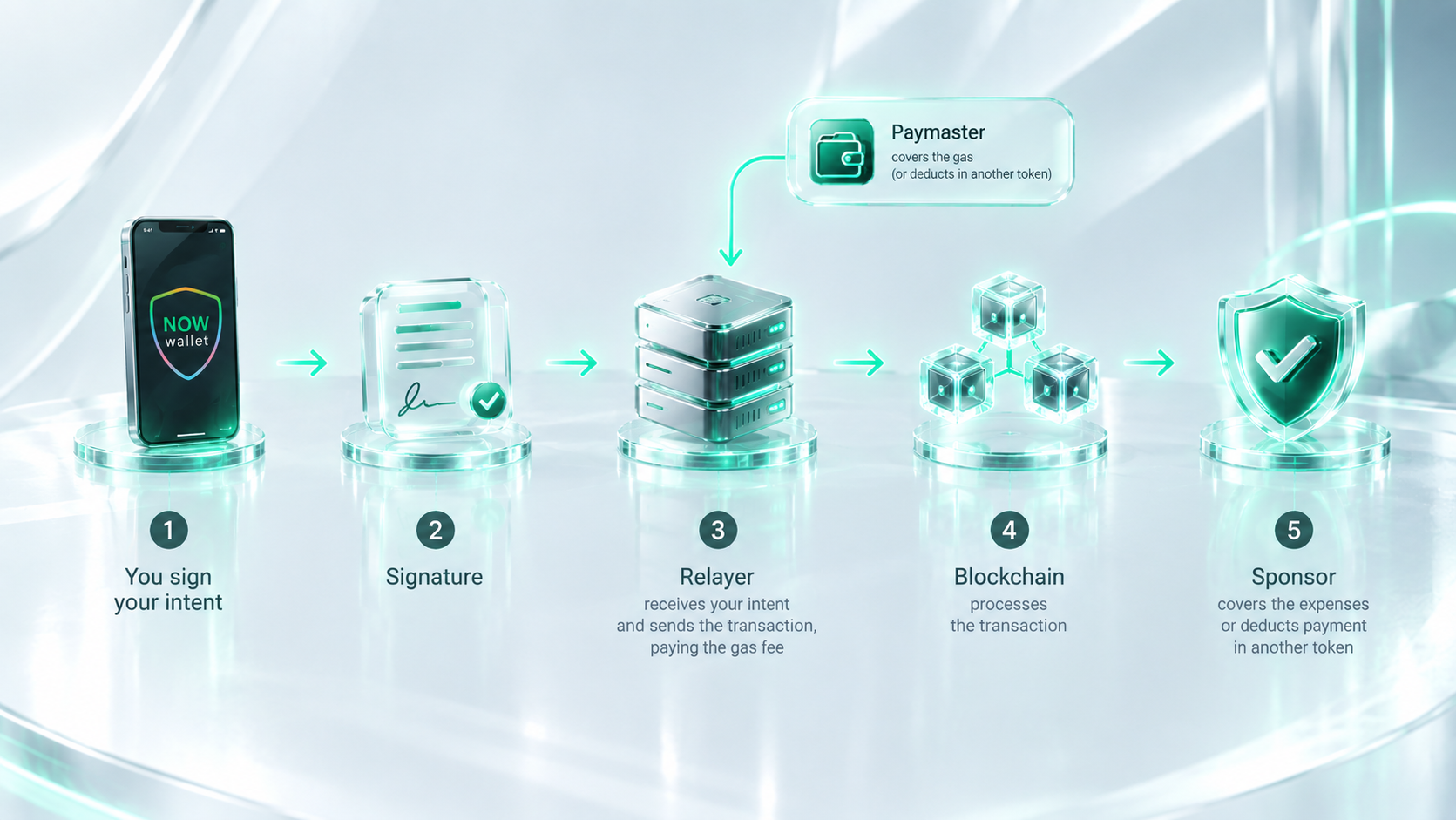
Gasless transactions work by separating two things that normally happen together: approving a transaction and paying for it. You sign the action you want to take, but you don't pay the network fee yourself. A helper – usually called a relayer or a paymaster – picks up your signed request, submits it to the blockchain, and covers the fee. That helper either absorbs the cost itself, often an app trying to attract new users, or gets paid back in a token you already hold, like a stablecoin. The fee never disappears. Someone still pays it. Gasless just changes who, and in what currency.
Key Takeaways
"Gasless" doesn't mean free. The network fee always gets paid by someone – gasless just changes who covers it and in what token.
You sign your intent; a third party (a relayer, bundler, or paymaster) submits the transaction and pays the gas.
There are three main approaches: meta-transactions through relayers, account abstraction with a paymaster, and mechanisms built directly into specific blockchains.
Sponsors cover fees for a reason – user acquisition, promotions, ecosystem grants – or they simply charge you back in a different token.
Gasless and gas abstraction run on the same infrastructure. The difference is who ends up paying: a sponsor, or you in a token of your choice.
Your signature still controls the transaction. A relayer can't change the amount or the recipient, but it can delay a transaction, refuse to send it, or see what's inside it.
The main risks are bot abuse funded by someone else's budget, relayer censorship or centralization, and unclear rules around who's liable for a sponsored transaction gone wrong.
What Are Gasless Transactions?
A gasless transaction is one where you don't pay the network fee directly from your own balance. Someone else – an app, a relayer, or a smart contract called a paymaster – covers it for you, or lets you pay in a token other than the network's native coin.
You'll see the same idea under a few different names: meta-transactions, sponsored transactions, gas-free transactions. They all describe the same underlying pattern, just from slightly different angles depending on who's implementing it.
The reason this matters comes down to a specific onboarding problem. A new user can hold various assets, unable to move any of it, because they don't hold the one coin the network actually charges fees in. Gasless transactions exist specifically to remove that wall.
What Is Gas and Why Do Blockchain Transactions Cost Fees?
Gas is the fee you pay for a blockchain to do work on your behalf: verify your transaction and include it in a block. It exists mainly to stop the network from being flooded with spam, since every action has to cost something real.
FAQ
A relayer is a service that submits your signed transaction to the network and fronts the gas cost, typically used in the meta-transaction model. A paymaster is a smart contract specifically built into the ERC-4337 account abstraction standard that decides, on-chain, whether and how to cover a given transaction's fee. Relayers are the older, more general-purpose pattern; paymasters are a specific, standardized piece of newer wallet infrastructure.
No. A handful of networks are designed so that transactions genuinely cost nothing at the protocol level. Gasless transactions are different: the fee still exists and still gets paid, just not directly out of your pocket at that moment.
Your wallet interface should show it clearly, usually a $0 fee or an explicit "sponsored" or "gas-free" label right before you confirm. If a fee is silently being deducted in a different token than you'd expect, that's gas abstraction rather than a fully gasless transaction, and worth reading closely before you approve it.
Yes. Block explorers show the actual fee payer address for a transaction, which in a sponsored transaction will be the relayer, paymaster, or bundler rather than your own wallet address. It's a straightforward way to verify a transaction was genuinely sponsored rather than paid from your balance.
It depends on where it failed. If the relayer or paymaster rejects the request before submission, for example because a sponsorship budget ran out, nothing reaches the blockchain and no gas is spent by anyone. If the transaction gets submitted and then fails on-chain, the sponsor typically still pays the gas for that failed attempt, since gas is charged for computation attempted, not just computation that succeeds.
Gas compensates the validators who run the computers processing and confirming transactions. It also funds the security of the network itself – without a cost attached to using block space, anyone could spam the chain with junk transactions for free.
How Is a Gas Fee Calculated?
The logic is simple even though the exact numbers vary by network and by action: the fee reflects how much computational work a transaction requires, multiplied by how much the network is currently charging for that work. Think of it like an electricity bill – usage times rate. A basic transfer requires very little work and costs correspondingly little; a complex contract call, like a swap or a mint, requires more and costs more. The rate itself moves with demand, rising when a lot of people are trying to transact at the same time and falling when the network is quiet.
Why Do Gas Fees Change So Much?
Fees spike whenever demand for block space spikes – everyone rushing to react to the same event at once. They also vary a lot between networks: the same type of transaction on Ethereum mainnet and on a layer-2 rollup can cost very different amounts, since L2s process transactions in batches and pass only a fraction of the cost back to each user.
Why Is Paying Gas Fees a Problem for Users?
Gas fees create a specific kind of friction that has nothing to do with whether someone wants to use crypto. It's estimated that around 40% of new crypto users abandon the process specifically at the point of needing to acquire a gas token. The pattern shows up everywhere:
You need the network's native coin before you can do anything, even if you already hold other assets on that chain.
Balances get scattered across networks, and each one demands its own gas token, so holding USDC on three different chains can mean needing three different coins just to move it.
Transactions fail with cryptic errors when you're a few cents short on gas, which is a confusing way to lose time as a newcomer.
Fees swing unpredictably during network congestion, turning a transaction that cost pennies yesterday into one that costs several dollars today.
"I think that one alone kind of stands out as, yeah, that actually makes adoption easier – because trying to explain to someone, hey, you've got to have coin A and coin B, it's a thing, maybe it becomes just a whole other layer to the onion."
Gasless transactions exist directly because of that layer.
How Do Gasless Transactions Work, Step by Step?
The mechanism is the same across almost every implementation, even though the technical details vary by chain:
You sign the action you actually want, but you don't sign or pay for the fee.
A relayer or paymaster receives that signed request.
It submits the transaction to the network and pays the gas out of its own balance.
The sponsor either absorbs that cost outright, or debits you for it separately in a token you already hold.
The network processes the transaction like any other. The fee gets paid – just not by you, and not necessarily in the native coin.
The core idea worth holding onto: signing and paying are two separate steps, and gasless transactions are what happens when you decouple them.
What Are the Main Types of Gasless Transactions?
What Are Meta-Transactions and Relayers?
A meta-transaction is a transaction you sign off-chain, which a relayer then wraps and submits on-chain on your behalf. A forwarder contract checks that your signature is valid before letting the action through, so the relayer can't tamper with what you actually authorized. The relayer recovers its cost from the app operator, a subsidy pool, or a fee built into the transaction itself. This was the original approach to gasless UX, pioneered by projects like the Gas Station Network – GSNv1 is now considered outdated technology, largely superseded by account abstraction.
What Is Account Abstraction (ERC-4337)?
Account abstraction turns a wallet from a simple keypair into a programmable smart contract. Instead of a regular transaction, you submit something called a UserOperation, which describes your intended action. A network of bundlers packages these together and sends them to a central EntryPoint contract, which can pull in a paymaster to cover the gas if one is configured. The practical result: your wallet can pay gas in a stablecoin, sponsor its own transactions, or bundle several actions into one signature.
What Is a Paymaster?
A paymaster is the smart contract inside this system that actually decides whether to cover a user's gas fee, and how. Three types are common:
Type
How It Decides
Typical Use Case
Verifying paymaster
An off-chain service signs off on sponsorship, based on its own rules
App-controlled promotions, specific user cohorts
Token paymaster
Accepts an ERC-20 token, like USDC, in place of the native coin
Letting users pay gas in whatever they already hold
Deposit paymaster
Draws from a pre-funded balance the operator tops up in advance
Enterprise or institutional sponsorship at scale
Whichever type is running, the operator usually sets rules around it: which actions qualify, which users are eligible, and how much budget can be spent before sponsorship stops.
Can Regular Wallets Use Gasless Transactions? (EIP-7702)
Yes, without switching wallets entirely. EIP-7702, activated on Ethereum in May 2025 as part of the Pectra upgrade, lets a normal wallet temporarily borrow smart contract behavior – including paymaster support – while keeping the same address, balance, and history it always had, with nothing extra to migrate or deploy.
How Do Gasless Transactions Work on Different Blockchains?
The concept is universal. The implementation isn't. TON and Solana make good examples of just how differently two major non-EVM chains solve the same problem, though they're far from the only ones with their own fee-delegation designs.
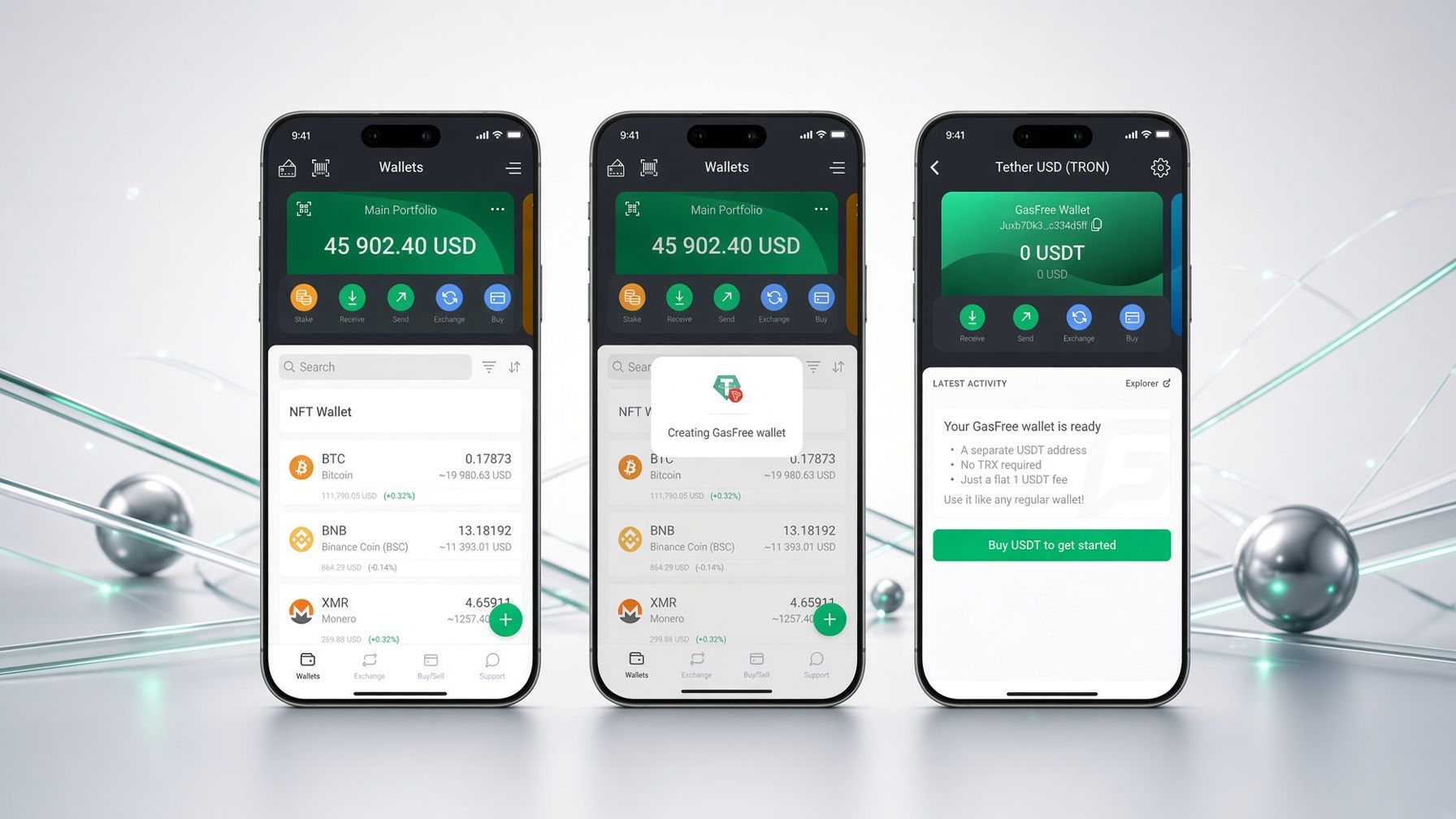
TRON solves the problem for one specific, very popular use case: sending USDT. Normally, a USDT transfer on TRON burns network resources (Bandwidth and Energy), so the sender needs TRX. With GasFree, you instead sign a permit transfer off-chain, and a service provider submits the transaction and covers the network resources. The provider is repaid with a flat fee of about 1–1.5 USDT, deducted from your GasFree wallet balance, plus a one-time activation fee charged with your first transfer.
TON handles it at the message level. A wallet contract that receives an external message (sent directly by the user) pays its own gas. But if it receives an internal message from another contract, that message can carry its own attached TON to cover the fee – so a relayer service sends an internal message with gas attached, and the user's wallet executes the action without touching its own balance.
Solana builds the option directly into transaction structure. Every transaction has a fee_payer field that can be set to any account, separate from whoever actually signed the action. Some relayer services use exactly this: the user signs their intended action, the relayer signs as fee_payer and covers the SOL fee, and the whole thing lands as one atomic transaction, often letting the user pay the relayer back in USDC or another SPL token instead.
Approach
How It Works
Where It's Used
Meta-transactions / relayers
Off-chain signature, forwarder contract verifies and relays
Early EVM dApps, still common for simple sponsored actions
Offline signature (TIP-712); service provider pays TRX resources, user pays a USDT fee
USDT transfers on TRON, supported by several wallets
TON internal messages
Relayer's contract attaches gas to an internal message
TON wallets and TON Connect apps
Solana fee payer
Separate signer covers the fee field in the same transaction
Solana wallets and relayer services
What Is the Difference Between Gasless Transactions and Gas Abstraction?
A gasless transaction means a sponsor pays 100% of the fee. Gas abstraction means you still pay, but in a token of your choosing rather than the network's native coin. Both run on identical infrastructure – the only difference is where the bill ultimately lands.
Gasless
Gas Abstraction
Who pays
A sponsor (app, relayer, grant)
You, in a non-native token
Typical use case
Onboarding, promotions, first-time actions
Ongoing use once you're active on the app
Cost to you
None, directly
Yes, just not in the native coin
Who Pays for Gasless Transactions, and How Do They Make Money Back?
Sponsors are usually app developers, payment providers, ecosystem foundations running grant programs, etc. They cover gas because it functions as a customer acquisition cost – the same logic behind a free trial or a welcome bonus, just paid in network fees instead of cash.
Sponsors recoup that spend in a few common ways: a markup or spread built into whatever token you're actually paying with, transaction or card fees layered on top elsewhere in the product, a subscription that bundles gas costs into a flat monthly price, or simply prepaid credits an operator budgets for and tracks like any other line item in a marketing budget.
What Are the Benefits of Gasless Transactions?
For users: the win is obvious, no separate token to hunt down before you can do the thing you actually opened the app to do.
For app developers: sponsored gas measurably improves signup and activation rates, because it removes the exact step where most first-time users otherwise give up.
For the wider ecosystem: apps built around stablecoin payments, in-game purchases, or recurring subscriptions can finally offer one clean, predictable price instead of "amount plus an unpredictable extra fee nobody can estimate in advance."
Common real-world scenarios where this shows up:
P2P payments between friends
paying a merchant directly in a stablecoin
recurring subscription charges
in-game purchases where asking a player to first go buy a gas token would kill the moment entirely.
Are Gasless Transactions Safe?
The parts of self-custody that matter most don't change. Your signature is still required for anything to happen. Your funds still sit in your own wallet the whole time. Replay protection still stops anyone from reusing an old signed action to push through a second, unauthorized transaction.
What a relayer genuinely cannot do: alter the amount, change the recipient, forge your signature, or reuse it for something you didn't approve.
What it can do: refuse to submit your transaction, sit on it longer than you'd like, or see the details of what you're sending, since it has to read the transaction to relay it.
"Gas abstraction removes the friction most users never understood in the first place. That's huge, but it doesn't solve the backup problem or the phishing problem."
A sponsored transaction can still carry a malicious approval hiding inside it – removing the gas fee doesn't remove the need to actually read what you're signing.
What Are the Risks and Limitations of Gasless Transactions?
Sponsored gas is, functionally, free money to whoever's using it, which invites the obvious abuse: bots farming airdrops or draining a sponsor's budget on worthless spam transactions. Operators fight back with rate limits, per-user caps, and sometimes identity checks before sponsorship kicks in.
Beyond abuse, there's a structural concentration risk: a small number of relayer services or bundler networks processing most sponsored traffic on a given chain creates a single point of failure, and in theory, a point of censorship. Availability is also genuinely inconsistent – what's gasless in one wallet, on one chain, for one specific token, might not be gasless anywhere else. On the operator side, sponsoring fees at scale also raises open compliance questions that are still being worked out case by case rather than through settled regulation.
Which Blockchains and Wallets Support Gasless Transactions?
On EVM chains, ERC-4337 support has spread across Ethereum mainnet, most major L2s, BNB Chain, and Avalanche, among others, through paymaster infrastructure providers. Outside the EVM world, chains like TON and Solana ship their own native mechanisms, as covered above. Whether your specific wallet can actually use any of this depends heavily on the wallet's own architecture: smart contract wallets support it by design, while traditional key-based wallets need either EIP-7702 or a relayer integration bolted on top. The honest caveat here: always check what a specific app actually supports, since "the chain supports it" and "this particular wallet, in this particular app, right now" are frequently two different answers.
On the ChangeNOW side, this same underlying idea already ships as GasFree USDT in NOW Wallet – sending TRC20 USDT without first buying or holding TRX for gas, which is the same sponsored-fee principle described throughout this guide, just applied to one of the most commonly held stablecoins on one of the most gas-sensitive networks for it.
Gasless UX is quickly becoming the baseline expectation for consumer-facing crypto apps, especially anything built around stablecoin payments rather than speculative trading. Wallets and chains are actively competing on how invisible they can make the fee-paying process, since it's one of the clearest, most measurable levers for improving activation. What's still unsettled is less the technology itself and more the framework around it, starting with who's liable when a sponsored transaction goes wrong.