For the user, fixed vs floating exchange rate choice is mostly about a guarantee. For the exchange, it's more about timing.
This guide covers what each flow is, what you gain and lose by picking one over the other, and potential scenarios in which fixed may be better than floating, and vice versa.
Note:
If you're looking up "fixed vs floating exchange rate" in the TradFi sense, it’s not it. When we talk about crypto swaps, these terms mean something completely different. More about it below.
TL;DR
A fixed rate locks your final crypto amount before you send funds, shielding you from market volatility but usually costing a slight extra (known as a spread).
A floating rate executes at the live market price when your deposit arrives, which is usually cheaper but exposes you to price swings (known as slippage).
Choose fixed for volatile assets and exact payouts; choose floating for stablecoins and lower fees.
Fixed and floating in TradFi vs crypto
In traditional finance and Forex trading, "fixed vs floating" refers to macroeconomic monetary policy. For example, whether a government pegs its national currency to another asset or lets the open market dictate its value.
In the territory of crypto swaps, these terms define the execution mechanics of an exchange: whether the platform or the user absorbs the risk of market volatility during the transaction window.
Now to the difference between the two swap flows.
Fixed vs floating exchange rate: the main difference
A fixed and a floating exchange rate are two ways a crypto exchange can quote you a trade. The difference basically comes down to two things:
Timing: When the final number gets locked.
Risk: Who carries the risk if the market moves before the trade completes.
What is a fixed exchange rate
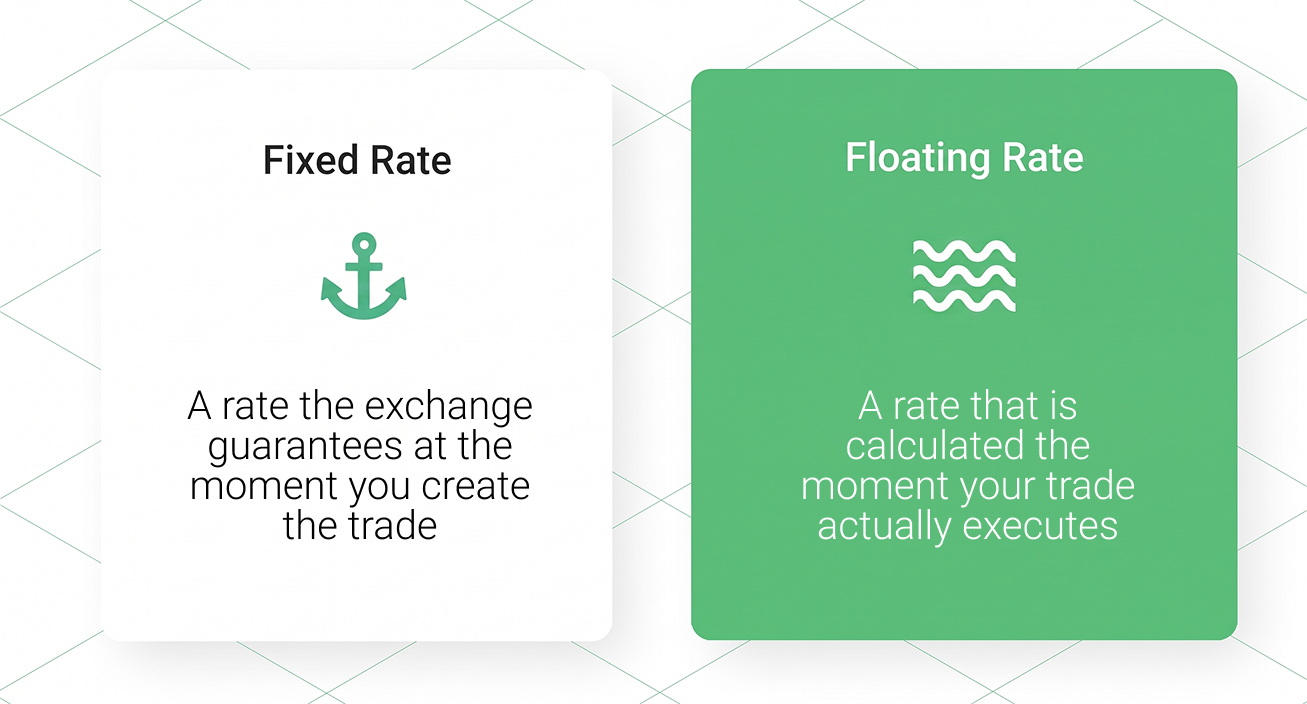
The definition: A swap model that locks your exact payout upfront, where the exchange absorbs the risk of market volatility in return for a small built-in buffer.
With a fixed exchange rate, the user is guaranteed the exact amount shown at the moment the trade is created. That amount doesn't change even if the price moves.
The main perk here is certainty: you know in advance exactly how much you’re going to get.
The downside here is a small hedging cost that is usually built into the rate. The exchange usually takes more risks during this swap flow, so it has to compensate for it.
That cost depends mainly on the coin you're receiving, confirmation speed most of all, though volatility plays a role too. A fast coin like Ethereum carries less risk: the deposit usually arrives before the price has much room to move. A slower coin like Bitcoin carries more, since a longer confirmation window gives the market more time to shift before the trade locks in.
The size of that buffer initially is set by hand by a listing team - coin by coin, when a coin is added to a fixed rate. From there it moves on its own, not so much with network congestion as with how many fixed rate trades are open on that pair right now. Each new one nudges the buffer up a little.
What is a floating exchange rate
The Definition: A market-driven swap model where the upfront quote is an estimate, and the final payout executes at real-time market prices once your deposit arrives.
A floating exchange rate is calculated the moment your trade actually executes.
The number you see when you initiate a swap is called an estimate. If the market moves before your funds arrive, the final amount shifts too: sometimes higher, sometimes lower.
That distinction matters when comparing providers. Some exchange providers make their estimates look more attractive than what users are actually likely to receive, especially when competing for the top spot inside large wallets and aggregators. Ranking providers purely by the quoted rate used to be common practice, and that created an obvious incentive to optimize the estimate for ranking and traffic instead of accuracy.
More sophisticated services now look past the initial quote and track actual payout data too, how much users end up getting compared to what was shown at the start.
On ChangeNOW, about a half of floating rate trades either match the estimate or land above it.
Behind that estimate, the system pulls together order books from multiple liquidity providers and picks the best rate available at that moment, then applies the exchange fee on top.
The comparison also looks past the raw order book price, factoring in things like a provider's own trading terms. A higher account tier like a VIP with a provider such as Binance, for example, can mean lower costs on their side, which turns into a better rate for you.
Many simpler exchangers skip that step and lock a single liquidity provider to each pair instead.
How fixed rate works (ChangeNOW example)
Let's look at how the mechanics work using ChangeNOW as an example.
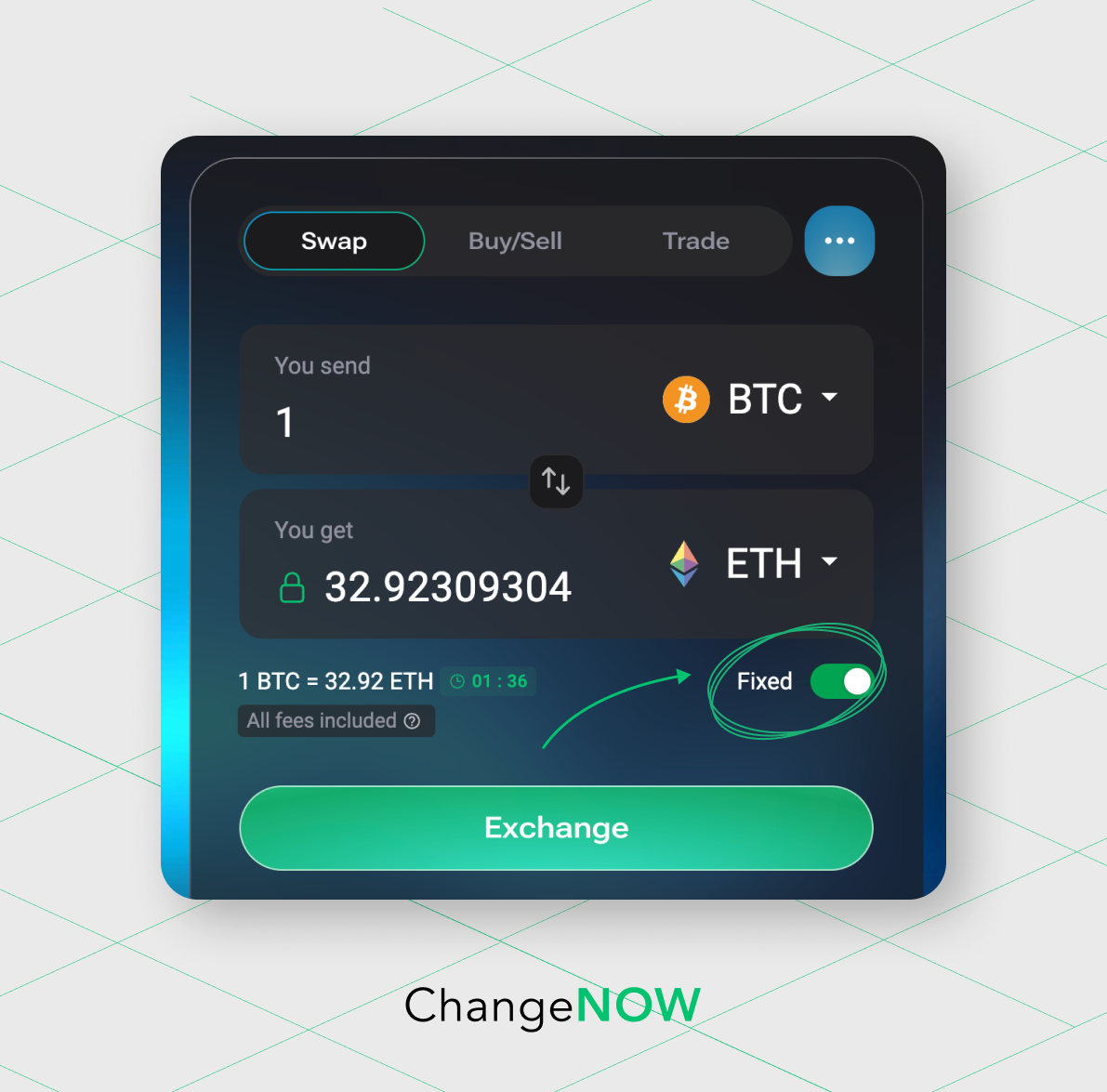
When you tap that toggle and choose a fixed rate exchange flow, the amount shown when you create the trade is the exact amount you get. However, a few industry-standard conditions must be met:
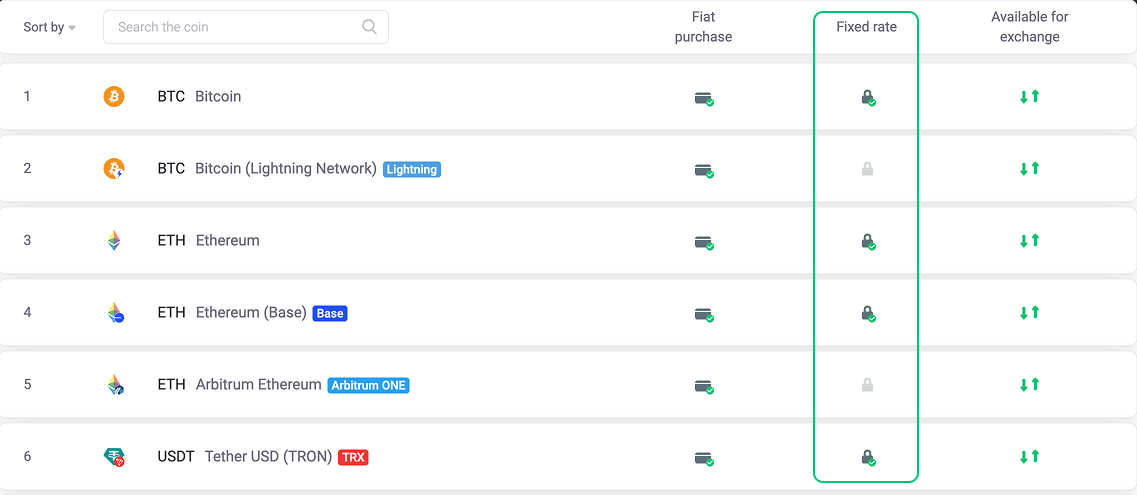
Supported pairs: The pair has to support fixed rate. There are a number of currencies and network combinations for which a fixed exchange rate is not available (due to extreme volatility or low liquidity). Check the currencies page and look for the “checked lock” icon.
10 min rule: The deposit has to arrive within 10 minutes after you create a trade.
Perfect match: The currency, the network, and the amount you deposit must match the ones you agreed on when initiating a swap.
Amount limit: For each currency and direction there's a maximum amount. If the amount you want to swap exceeds the limit, the system will try and make it fall into that limit by retrying the swap automatically at 75% of your original amount.
If one of these conditions isn't met - for example, the deposit is late, or it arrives on the wrong network, the trade switches to the standard rate. Or if that's not possible, you get a refund.
That’s basically it. If all the conditions are met, your swap goes through and you get precisely the amount you expected.
How floating rate works (ChangeNOW example)
Our internal stats show that users use floating rate about 80% of the time. With this flow, the final amount is set once your deposit actually goes through, at whatever rate is live in the market at that moment.
We already mentioned the estimate earlier - the number you see at the start of the swap.
Between initiating a swap and your deposit’s arrival, the price has time to move, and the final amount can land above or below that estimate.
Fixed vs floating exchange rate: Advantages & disadvantages
Fixed and floating trade one thing for the other. Fixed rate mode swaps a slightly higher cost for certainty. Floating mode swaps that certainty for a lower overall cost.
Here are some factors you might want to consider:
Advantages
Disadvantages
Fixed rate
- Amount is locked before you send anything. - No exposure to rate swings (slippage) once confirmed. - Predictable outcome, good for large or time-sensitive trades.
- Usually costs slightly more due to the built-in risk premium. - Comes with strict conditions: exact currency, network, amount, and a 10-minute window. - Capped by a maximum amount per pair.
Floating rate
- Cost is usually lower - Final amount is estimated, not guaranteed
- Final amount is confirmed only when the deposit converts. - Exposed to the market volatility the whole time the trade is in progress. - Harder to plan an exact outcome on volatile pairs or large trades.
Fixed or floating: pick the right flow for your swap
Fixed rate fits when:
The market is moving fast, and you don't want the rate working against you mid-swap
You're sending a large amount, where even a small shift would cost you
You'd rather know the exact amount now than pay less and save a little
Network congestion is expected, BTC during a hectic period, for example. The longer it takes to confirm, the more time the price has to move against you.
You're running recurring or business trades, where knowing the cost upfront makes accounting easier.
Floating rate fits when:
The market's calm, so there's little room for the rate to move
The amount is small enough that a slight difference either way doesn't matter
You'd rather pay less most of the time than pay the fixed rate’s risk premium every time
You're swapping stablecoin to stablecoin, where volatility is too low for the fixed rate margin to be worth it
Common Mistakes When Choosing a Swap Rate
Even experienced traders sometimes choose the wrong flow.
Here are the most common errors to keep in mind and watch out for:
Choosing a fixed rate on stablecoins. If you are swapping USDC for USDT, the market volatility is practically zero. Choosing a fixed rate means you are paying a premium for a non-existent risk.
Sending funds from a slow exchange. To get a fixed rate, your deposit must usually arrive within a strict time window (e.g., 10 minutes). If you send funds from a centralized exchange (like Binance or Coinbase) that delays withdrawals for security checks, you might miss the window. The trade will automatically revert to a floating rate, defeating the purpose.
Ignoring network fees during high congestion. In floating rate mode, extreme network congestion can delay your transaction. By the time it confirms on the blockchain, the asset's price might have dropped significantly (slippage). If the network is struggling, paying the fixed rate premium is often cheaper than suffering the slippage.
Sending the wrong amount. Fixed rates are locked to the exact amount you entered. If you type in 1 ETH but send 0.99 ETH (because your wallet deducted the network fee from your principal), the strict conditions of the fixed rate are broken, and the swap will switch to floating.
The bottom line
Fixed rate locks your amount for a small risk premium or a hedging cost. Floating rate skips that margin and gives you the market rate instead, whatever it is once your deposit converts.
Pick based on the trade in front of you. A calm market and a small amount, floating works fine. A fast-moving market, a large amount, or you just want the number locked before you send anything, fixed earns its cost.
You can switch between the two on ChangeNOW before you send anything, so there's no need to commit to one for every trade.
Fixed rate locks your final amount before you send anything. Floating rate sets it only once your deposit converts, based on the market rate at that moment.
10 minutes from creating the trade. The deposit has to arrive within that window, in the exact currency, network, and amount.
That's floating rate working as intended. The final amount is set at conversion, not at the estimate, so the market can move either way in between.
No. The cost is built into the rate itself, there's no separate charge on top.
No. Availability depends on the pair, check the currencies page to see which ones qualify.
The trade switches to floating rate, or gets refunded if that's not possible.
Floating usually costs less since there's no built-in risk premium. But its outcome isn't locked, so on any single trade it can end up costing more than fixed would have.