You can borrow crypto without providing your own collateral, but the options are limited. Most retail crypto loans still require collateral, while no-collateral borrowing usually relies on flash loans, credit delegation, borrower assessment, or institutional credit.
This guide explains which no-collateral crypto loans actually exist in 2026, who can use them, and how to recognize offers that are simply too good to be true. We also spoke with CoinRabbit, a crypto lending platform, about why collateral remains so important and what lenders have to rely on when it is removed.
Glossary
Collateral – assets you lock up to secure a loan.
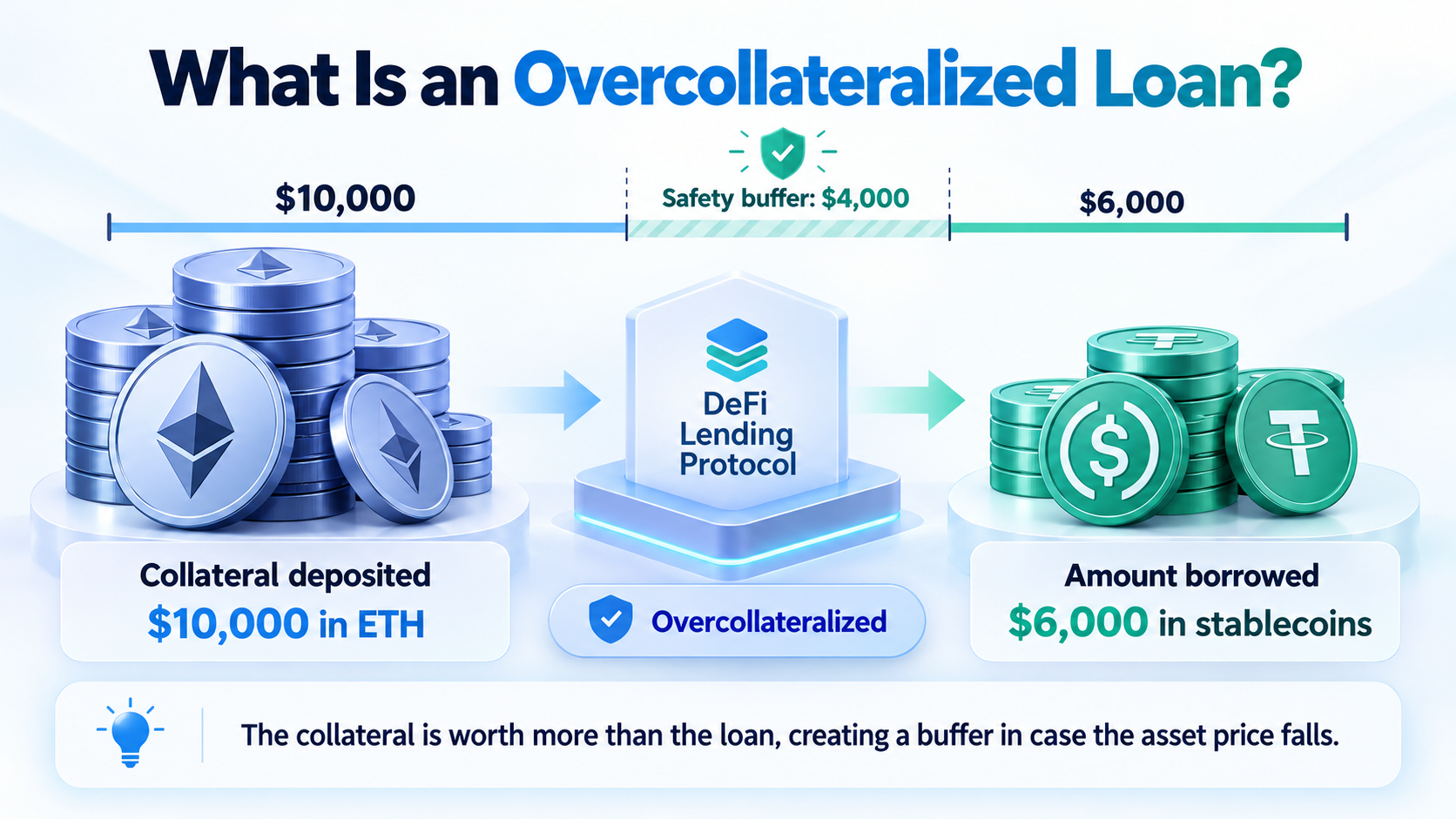
Overcollateralized loan – a loan where the collateral is worth more than the amount borrowed.
Undercollateralized loan – a loan where the collateral is worth less than the amount borrowed.
Unsecured loan — a loan issued without collateral, usually based on creditworthiness, identity, income, or another form of borrower assessment.
Flash loan – an uncollateralized DeFi loan that is normally borrowed and repaid within the same blockchain transaction.
Credit delegation – a model where one user allows another user to borrow against their collateral.
Can You Borrow Crypto Without Collateral?
Yes, but there is no universal no-collateral crypto loan available to everyone.
Here’s how the main crypto borrowing models compare:
Borrowing method
Your own collateral required?
Available to retail users?
Can you keep the borrowed funds?
Traditional DeFi loan
Yes
Yes
Yes
Flash loan
No
Technically yes
No
Credit delegation
No
Limited
Yes
Credit or reputation-based loan
No or limited
Limited
Yes
Institutional crypto credit
Sometimes no
Usually no
Yes
If a lender does not have collateral, it needs another way to make sure the loan gets repaid.
FAQ
Potentially. Some credit-based or delegated lending arrangements can provide stablecoin liquidity without requiring the borrower to supply their own collateral. Access is limited, however, and requirements differ considerably between platforms.
Flash loans can also provide uncollateralized stablecoin liquidity, but the assets must normally be repaid within the same transaction.
If you mean borrowing crypto today and repaying it weeks or months later, the options are much narrower. Flash loans do not qualify, credit delegation requires someone else's backing, and credit-based loans are available only to eligible borrowers. For most retail users, long-term no-collateral crypto credit remains limited.
Unsecured BTC loans for ordinary retail users are uncommon. Most crypto lending services require collateral, while some unsecured lending products focus instead on fiat or stablecoins.
It depends entirely on the lender and borrowing mechanism.
The absence of collateral does not prove that a loan is either legitimate or fraudulent. Check how the lender manages default risk, what fees apply, who operates the service, and what happens if you cannot repay.
Be particularly cautious about offers combining no collateral, no KYC, no credit checks, guaranteed approval, and an upfront payment.
Collateralized DeFi lending often does not require a traditional credit check because the collateral protects lenders.
Flash loans also do not depend on a credit score because repayment happens atomically.
For genuine longer-term unsecured borrowing, however, lenders generally need some way to assess borrower risk.
With collateralized DeFi loans, some or all of your collateral may be liquidated. With an unsecured loan, missed payments may trigger penalties, collection procedures, restrictions on future borrowing, or other consequences defined in the agreement.
With a standard flash loan, failure to repay simply causes the entire blockchain transaction to revert.
No.
This is why calling flash loans an alternative to a personal loan can be misleading.
You cannot take a flash loan on Monday, use the money for several weeks, and repay it next month. The borrowed assets have to be returned as part of the same transaction. Flash loans are genuine uncollateralized borrowing, but they are not consumer credit.
That might mean verifying your identity, checking your income or credit history, assessing your on-chain reputation, signing a legal agreement, or relying on another party's collateral.
In a standard flash loan, the protocol solves the problem differently: the borrowed funds must be returned within the same transaction or the transaction reverts.
Why Do Most Crypto Loans Require Collateral?
Traditional lenders can assess identity, income, credit history, and legal obligations. A blockchain address gives them far less information.
If an anonymous wallet can borrow 10,000 USDC with no collateral or credit check, what forces it to repay? In most DeFi lending, collateral solves that problem.
This is also why many DeFi loans are overcollateralized.
CoinRabbit says this trade-off is one of the reasons it relies on overcollateralized lending rather than extensive borrower profiling.
“For us, overcollateralization is what makes privacy-focused lending possible. If a lender does not rely on collateral, it has to compensate with something else. Usually more information about the borrower, such as income, credit history, identity, or reputation. We prefer not to collect data we don’t need.”
Why Borrow If You Already Have More Crypto Than You Need?
At first, overcollateralized loans can sound slightly absurd. If you already own $10,000 in ETH, why lock it up to borrow $5,000?
Because borrowing and selling solve different problems.
A crypto holder may want liquidity without selling an asset they expect to appreciate. Borrowing can allow them to retain exposure to ETH or BTC while temporarily accessing stablecoins or other assets.
Depending on the jurisdiction, borrowing may also have different tax consequences from selling an asset.
From the lender’s side, collateral can also replace much of the traditional credit assessment process.
What Does “No-Collateral Crypto Loan” Actually Mean?
Four different things can be described as a crypto loan “without collateral,” even though they are not equivalent.
Unsecured
A genuinely unsecured loan is issued without the borrower pledging an asset that the lender can seize if the borrower defaults.
Instead, the lender usually relies on creditworthiness, income, identity, contractual obligations, or other forms of underwriting.
Undercollateralized
An undercollateralized loan still has collateral, but the collateral is worth less than the amount borrowed.
For example, a borrower might provide $70,000 in collateral for a $100,000 loan.
The lender therefore still takes credit risk.
No On-Chain Collateral
Some crypto lending arrangements require no tokens to be deposited into a smart contract but are backed by assets elsewhere.
Goldfinch is a useful example. Its documentation says borrowers do not deposit on-chain collateral, while real-world assets can be pledged as collateral instead.
So: No crypto collateral does not necessarily mean no collateral at all.
Collateral Provided by Someone Else
The borrower may not provide collateral personally, but another participant can take that risk instead.
In that case, the loan may look uncollateralized from the borrower’s side, even though the lending system still has protection behind it.
1. Flash Loans
Flash loans are probably the purest example of borrowing crypto with zero collateral. Protocols such as Aave allow assets to be borrowed without depositing collateral first.
There is one fairly substantial condition: the loan must be repaid within the same blockchain transaction.
Suppose a smart contract borrows 1 million USDC. It can use that liquidity to perform a series of operations, such as arbitrage between decentralized exchanges. Before the transaction ends, however, the borrowed funds and the required fee must be returned.
If repayment does not happen, the entire transaction reverts. It is effectively as though the loan never happened.
Aave also supports a more advanced flashLoan() flow where, under certain conditions, the borrowed amount can become a regular debt position backed by existing collateral or credit delegation.
Common applications include:
arbitrage;
liquidations;
collateral swaps;
refinancing DeFi positions;
other complex smart contract strategies.
2. Credit Delegation
Credit delegation lets you borrow without using your own collateral.
On Aave, one user deposits collateral and gives another user permission to borrow against it. The borrower receives the funds, while the original depositor takes on the risk.
So the loan is uncollateralized for the borrower, but not for the protocol: someone else's collateral is still backing it.
This usually works best when the two parties already trust each other or have an agreement in place.
3. Credit and Reputation-Based Crypto Loans
Another approach is replacing collateral with underwriting.
If a lender cannot fall back on deposited crypto, it can evaluate the borrower instead.
That assessment may include:
verified identity;
income;
conventional credit history;
repayment history;
wallet activity;
on-chain reputation;
previous loans.
This starts to resemble conventional unsecured lending.
Teller, for example, currently offers access to no-collateral borrowing options. Its 2026 materials distinguish between traditional unsecured loans provided by partner lenders and a smaller protocol-native USDC loan based on a user's Teller Score.
For the latter, borrowers need verified identity and sufficient score-based borrowing capacity. Teller also connects users with traditional lenders offering unsecured loans, but those loans are approved by third-party lenders and paid into a bank account rather than issued as crypto.
That is a useful illustration of a wider principle: no collateral does not mean no requirements.
The less collateral a lender has, the more important borrower assessment becomes.
Availability can also depend heavily on jurisdiction, identity, lender criteria, loan size, and credit history.
That additional data can solve the lender’s risk problem, but it creates another trade-off for the borrower: privacy. As CoinRabbit puts it:
“For high-net-worth users, sharing more financial and identity data can become a security risk. The more information exists about a person’s wealth, the more attractive they may become to scammers and other attackers.”
4. Institutional and Business Crypto Credit
Professional borrowers can sometimes borrow without depositing crypto worth the entire value of the loan. Instead, lenders may assess:
financial statements;
assets and liabilities;
trading history;
revenue;
legal entity structure;
business model;
existing debt;
counterparty risk;
previous repayment history.
Contracts and legal recourse can also exist outside the blockchain.
In our recent conversation with Cap Founder and CEO Benjamin Sarquis Peillard, he noted that many of crypto’s largest lending markets were built around borrowing against assets such as Bitcoin.
Cap uses a different model. Institutional borrowers are assessed by independent underwriters, who put their own capital behind the loan and earn a premium for taking that risk. If the borrower defaults, the underwriter’s collateral can be liquidated.
Borrowers also undergo KYB and remain legally obligated to repay the loan.
As Benjamin Sarquis Peillard puts it:
“Permissionless infrastructure does not mean permissionless underwriting.”
Moving credit on-chain does not eliminate credit assessment. It changes who evaluates the borrower, who provides the protection behind the loan, and how that protection is enforced.
Can You Borrow Crypto Without Collateral and Without KYC?
Technically, yes, in very specific situations.
A flash loan does not work like a traditional identity-based loan because repayment is guaranteed by the transaction itself.
Credit delegation can also happen between blockchain addresses, depending on how the parties structure their agreement.
But a much more suspicious proposition is:
Borrow 10,000 USDT for six months.
No collateral.
No KYC.
No credit check.
Instant approval.
At that point, ask a basic question: how is the lender protecting itself?
If there is no collateral, no underwriting, no verified borrower, no enforceable contract, and no atomic repayment mechanism, the economic model does not make much sense.
That is one reason supposedly effortless crypto loans are frequently used as bait for scams.
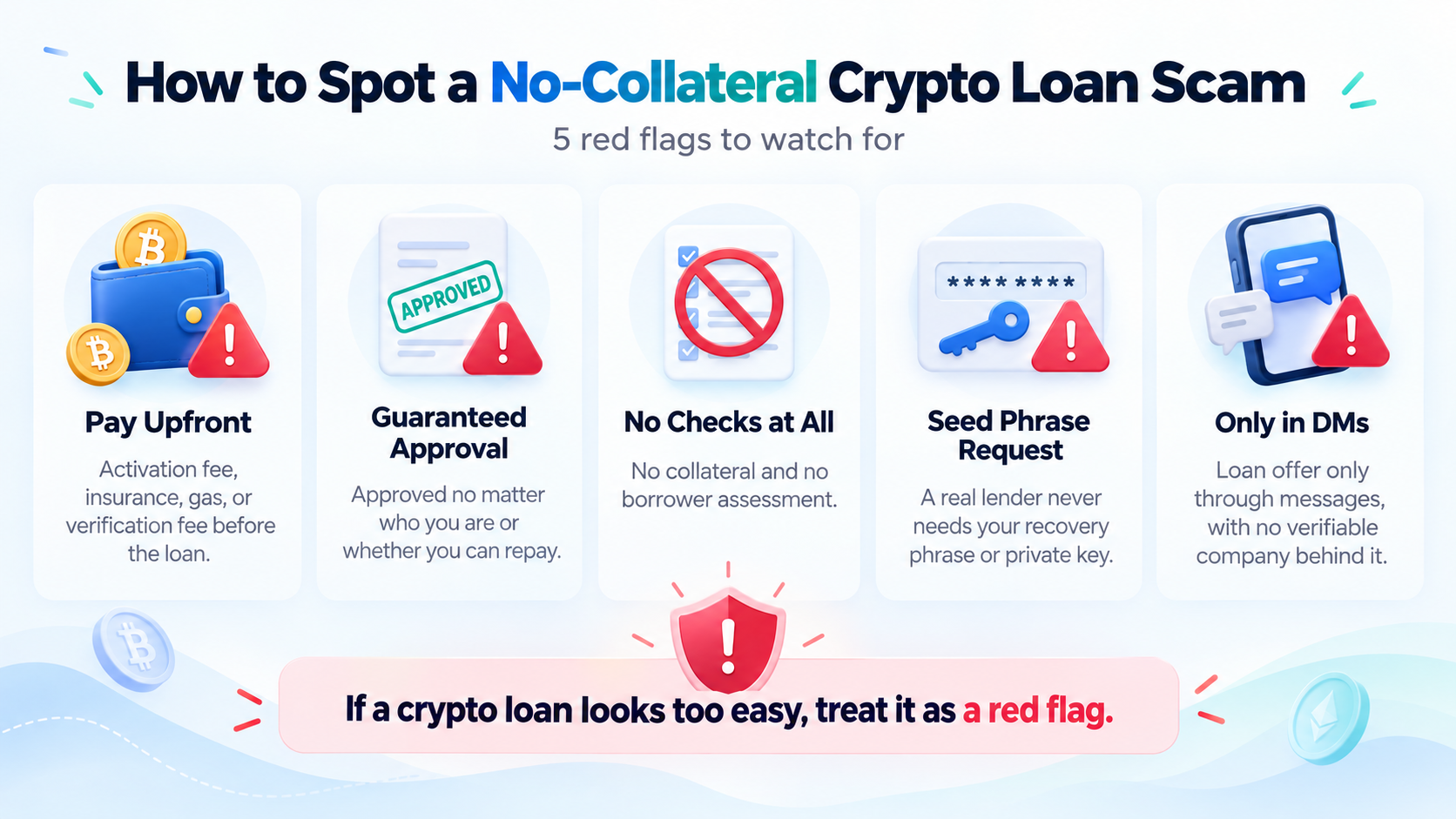
How to Spot a No-Collateral Crypto Loan Scam
The promise of easy money makes lending a convenient target for scammers.
Be particularly cautious when a lender promises a large unsecured loan while asking almost nothing about you.
1. You Have to Pay Before Receiving the Loan
A scammer may claim that your loan has already been approved but require you to send crypto for:
an activation fee;
insurance;
wallet verification;
a processing fee;
tax;
gas;
collateral “verification.”
After the payment is sent, another fee often appears.
2. Guaranteed Approval
Legitimate unsecured lending requires some mechanism for evaluating or controlling risk.
“Guaranteed approval” regardless of identity, income, creditworthiness, or repayment ability should immediately raise questions.
3. No Collateral and No Underwriting
One of these can disappear.
Both disappearing at once is considerably harder to explain.
If a lender offers a term loan with no collateral and asks for absolutely no information about the borrower, find out exactly what makes repayment enforceable.
4. Requests for Your Seed Phrase or Private Key
No legitimate lender needs your seed phrase.
Anyone with it can control your wallet.
Never share:
a seed phrase;
private keys;
wallet backup files;
recovery codes.
5. The “Lender” Only Exists in DMs
Be wary of loan offers arriving through Telegram, WhatsApp, Discord, X, or another social network, particularly when there is no independently verifiable company behind them.
A website alone does not prove that a lender is legitimate either. Check who operates it, how long it has existed, what terms govern the loan, and whether the business is authorized to provide the financial services it advertises where applicable.
No-Collateral vs Collateralized Crypto Loans
Both models simply move risk around differently.
No-collateral loan
Collateralized crypto loan
Crypto deposit required
No
Usually yes
Credit/identity checks
Depends on the model; common for term loans
Often not required in DeFi
Liquidation risk
Depends on the lending model
Yes, if collateral value falls too far
Availability
Limited
Widely available in DeFi
Borrowing limits
May depend on creditworthiness
Usually depend on collateral
Interest rate
May be higher because the lender takes more risk
May be lower due to collateral
Default consequences
Depend on agreement/lender
Collateral can be lost
Best suited for
Qualified borrowers
Existing crypto holders
Collateralized borrowing can provide faster access to liquidity because the protocol does not need to establish whether an anonymous borrower is trustworthy.
Unsecured lending removes liquidation risk to deposited assets but generally requires the lender to know considerably more about the borrower.
What If You Have No Crypto to Use as Collateral?
If you do not have crypto to use as collateral, your realistic options are credit-based borrowing, credit delegation, and traditional unsecured credit. Businesses may also qualify for institutional lending.
If you only need liquidity rather than crypto specifically, a conventional loan may be simpler than searching for a specialized no-collateral crypto product.
Collateralized Borrowing Can Still Be Simple
No-collateral loans often come with more checks and more data collection.
ChangeNOW’s Borrow feature, powered by CoinRabbit, takes the opposite approach: users secure the loan with assets they already hold and can access liquidity without selling them.
As CoinRabbit puts it:
“Collateral gives us the proof we need to issue a loan without knowing everything about the borrower.”
The trade-off is liquidation risk, but in return the process can stay more private and accessible.
A “no-collateral” loan is not automatically cheaper or safer. In fact, unsecured lenders may charge more because they accept greater default risk.
If you receive a borrowed asset but need another cryptocurrency, swapping adds another layer of fees and price exposure.
So, Is Borrowing Crypto Without Collateral Real?
Yes. But “no collateral” describes several very different products.
What remains extremely difficult to justify is a long-term retail loan offering a large amount of crypto with no collateral, no identity verification, no credit assessment, and no enforceable repayment mechanism.
For most retail users, long-term borrowing with no collateral and no repayment safeguards remains rare.
Fixed vs Floating Exchange Rate in Crypto: Which to Choose?
A fixed rate locks your final crypto amount against volatility, while a floating rate executes at live market prices. Learn the difference, risks, and when to use each.
Borrow Crypto Without Collateral | Options in 2026 | ChangeNOW Blog