


Quick answer:
- United States: commodity.
- Canada: commodity.
- EU: other crypto-asset.
- UK: exchange token.
- Singapore: digital payment token.
- Japan: financial asset.
The classification depends on the jurisdiction rather than on Bitcoin itself.

Quick answer:
The classification depends on the jurisdiction rather than on Bitcoin itself.
This guide explains the actual criteria regulators use and shows how different jurisdictions apply them.
Disclaimer: This article is for informational purposes only and does not constitute legal or financial advice. Cryptocurrency regulations vary by jurisdiction and are subject to change.
Regulators classify assets by three narrow legal tests, and most assets primarily fit one category. Understanding those tests explains almost every classification decision that follows.
A commodity is a fungible asset that has no central issuer and whose price is set by open market supply and demand. Classic examples are oil, wheat, and gold. Legal definition does not require the asset to be physical.
A security represents a claim on the future performance of someone else's effort. For example, a share of a company or an investment contract. The tests trace back to the U.S. Supreme Court's Howey test.
A currency is a state-sanctioned medium of exchange and unit of account, expected to hold its value to price goods. Legal tender status is a government decision. It means an asset can be widely used for payments and still not qualify as a currency in the legal sense.
In short: Bitcoin becomes a commodity mostly because it fails the other two tests.
| Criterion | Commodity | Security | Currency | Bitcoin status |
|---|---|---|---|---|
| Fungibility | Required | Not always | Required | One BTC is interchangeable with another |
| Central issuer or promoter | None | Usually yes | Yes (a central bank) | No issuer, no founding company |
| Expectation of profit from someone else's effort | Not a factor | Defining test | Not a factor | No managing team to rely on |
| Used as a payment instrument | Secondary function | No | Primary function | Usable for payments |
| Price stability | Varies by commodity | Varies | Required by definition | High volatility |
| Physical or industrial use | Usually yes | No | No | The clearest mismatch with classic commodities |
| Fully decentralized network, no controlling party | Not a formal factor | Weighs against security status | Not a formal factor | Matches |
Bitcoin doesn't cleanly resemble any of the three categories on every point. It ends up classified as a commodity mostly by process of elimination.
Bitcoin isn't a currency in the legal sense, even in places where it's widely traded. It lacks a central issuer that can manage its supply, and its price swings far more than any government would tolerate.
The comparison people reach for most often is gold. Both BTC and gold are scarce and lack a central issuer. And they both get held as a store of value. It is the strongest argument for treating Bitcoin as a commodity rather than a currency.
A recurring counterpoint among long-term Bitcoin holders is that frequency of use as payment shouldn't be the deciding factor at all. Plenty of currencies throughout history circulated as stores of value first and mediums of exchange second.
But the legal test stays tied to state sanction and price stability, and Bitcoin fails both.
Bitcoin is not treated as a security. The reasoning comes down to the Howey test.
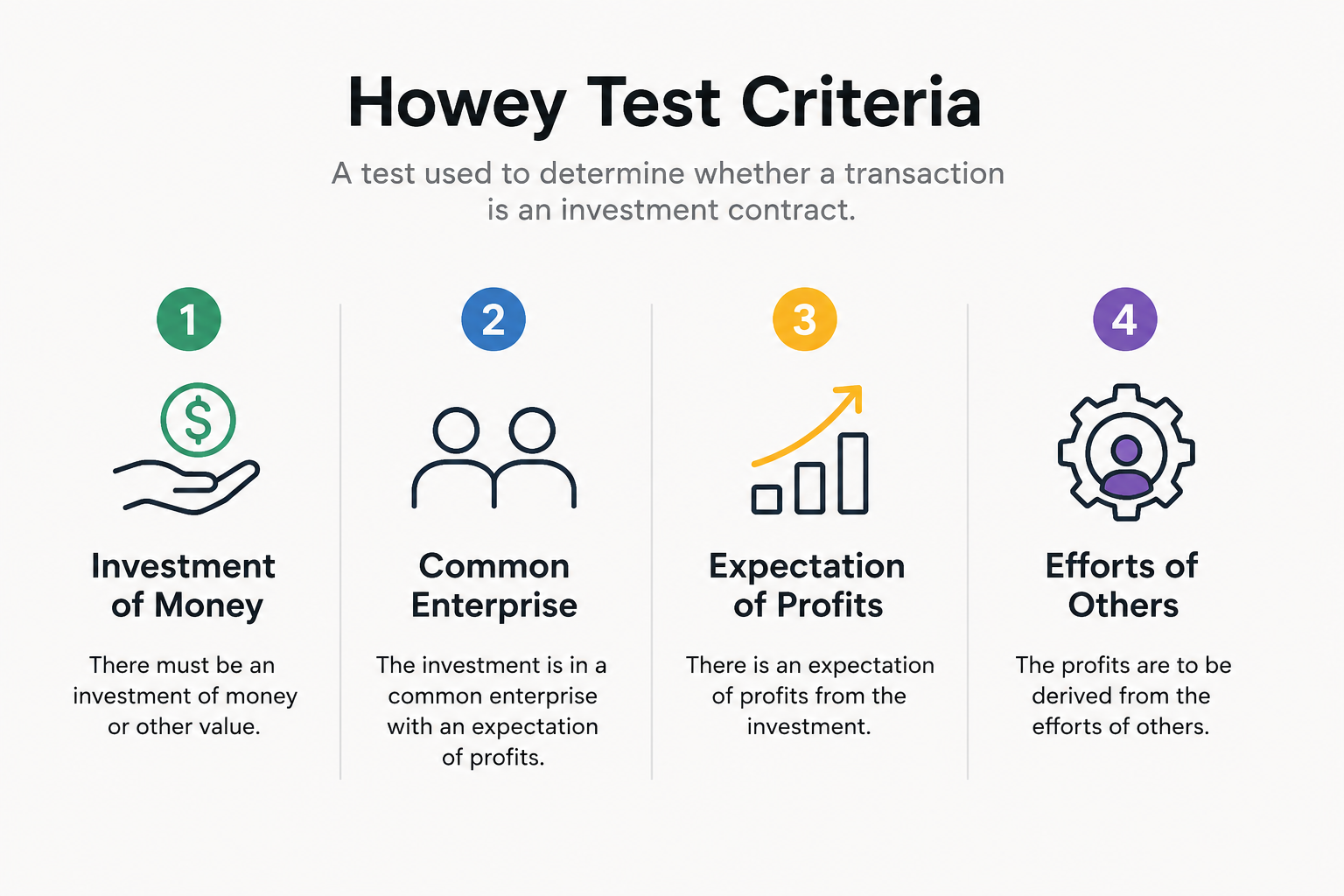
Bitcoin doesn't meet the "efforts of others" prong of the Howey Test. BTC never raised public funds to develop its technology. And there's no central entity whose efforts investors are relying on for profit (meaning failing of "expectation of profits” criteria). Former SEC Chair Jay Clayton confirmed this in 2018:
“Cryptocurrencies are replacements for sovereign currencies…That type of currency is not a security.”
That's why Bitcoin is generally treated as a commodity rather than a security.
Several factors line up in Bitcoin's favor when regulators reach for a “commodity” label:
Not everyone accepts that Bitcoin can be classified as a commodity.
The U.S. approach turns out to be the exception in how explicitly it uses the word "commodity." Most other major economies place Bitcoin in a bespoke category instead.
Wrap-up: The US and Canada classify Bitcoin as a commodity. Some other major jurisdictions instead created bespoke categories. The EU (MiCA's "other crypto-assets"), UK ("exchange token"), Switzerland ("payment-type token"), Singapore ("digital payment token"), and South Korea ("virtual asset"). Japan is shifting toward a financial-asset category with securities-style rules, while El Salvador grants Bitcoin legal tender status.
| Country / bloc | Bitcoin's status | Regulator / basis |
|---|---|---|
| United States | Commodity under the CFTC; reinforced by a March 2026 joint SEC-CFTC classification of digital commodities. | CFTC / SEC |
| European Union | Neither a commodity nor a security. It falls into MiCA's "other crypto-assets" category, distinct from asset-referenced tokens and e-money tokens. | MiCA |
| United Kingdom | An "exchange token". It's an unregulated token category, separate from security tokens and e-money tokens, defined by its use as a medium of exchange. A new FCA authorization regime opens in September 2026. | FCA |
| Canada | A commodity, specifically treated as property/a commodity by the Canada Revenue Agency (CRA) for tax purposes. | CRA |
| Japan | Moving away from a payment-instrument classification. As of July 2026, Bitcoin and over 100 other crypto assets shift to a financial-asset category under the FIEA, with securities-style disclosure and insider-trading rules. | FSA |
| Switzerland | Treated as a **payment-type token **rather than a "financial instrument," per the Federal Council's position. | FINMA |
| Singapore | A "digital payment token" regulated under the Payment Services Act. Its own category, not commodity or security. | MAS |
| South Korea | Classified as a non-security "virtual asset" under a binary security/non-security system that echoes Howey-style reasoning. Not legal tender. | FSC |
| El Salvador | Bitcoin holds legal tender status, though a 2025 IMF agreement removed the requirement for merchants to accept it. | Bitcoin Law |
Most regulators do not treat Bitcoin as a security because it has no central issuer or investment-contract structure. Instead, they place it into either the commodity category or a dedicated crypto-specific legal framework.
Bitcoin's legal status depends on where you are. In the United States and Canada, regulators generally classify it as a commodity. Other major jurisdictions, including the EU, the UK, Singapore, Switzerland, and South Korea, have introduced dedicated legal categories designed specifically for crypto assets rather than forcing Bitcoin into traditional definitions.
Despite these differences, regulators reach a similar conclusion: Bitcoin is neither a security nor a conventional currency.

ChangeNOW at TOKEN2049 Singapore: Where to Find us During This Week
ChangeNOW's guide to its TOKEN2049 Week in Singapore: where to find the booth, when its team speaks, and how to get into its own and partner side events.

How Layer 2 Networks Cut Gas Costs & Win Users
Layer 2 networks use off-chain batching to crush gas fees and capture daily swap volume. Here's how.

Cheapest Networks for USDT Swaps in 2026
Real on-chain data reveals which USDT network saves you the most on every swap.


