Cross-border payments get expensive before the provider charges a transfer fee. Money may sit in destination markets waiting for payouts, FX can pass through several counterparties and failed transfers add reconciliation and support costs.
Providers are trying different ways to cut those costs, from connected domestic payment systems and card-based settlement to CBDC pilots and stablecoin rails. Each approach solves a different part of the route, while local liquidity, compliance and payout infrastructure still matter.
Velo is developing digital settlement and liquidity infrastructure around these problems, with Lightnet and other licensed partners covering supported fiat routes.
We asked Adrian Wang, Head of Web3 Products at Velo, where cross-border costs actually come from, why prefunding remains expensive and what tends to break when several providers handle the same payment.
Key Takeaways
The quoted transfer fee can be only a small part of the real cost of a cross-border payment.
Capital tied up for future payouts can matter more to operators than the fee charged on a single transaction.
The final receive amount is more useful to compare than the advertised fee alone.
Velo is working on the liquidity and settlement side of cross-border payments, while licensed partners remain responsible for local fiat delivery.
Payments become harder to trace when transaction, pricing and compliance information does not follow the money across providers.
What Velo Is Working On
Velo is developing infrastructure around cross-border liquidity and digital settlement. Local collection and payout still depend on available payment rails, licensed providers and the requirements of each corridor. Lightnet provides payment infrastructure across supported markets.
ChangeNOW supports VELO exchange routes through its ecosystem partnership with Velo. A standard ChangeNOW exchange ends when crypto is delivered to the wallet address provided by the user; fiat payout is not part of that exchange.
The Cost Starts Before the Transfer
Research from the Bank for International Settlements shows how many steps can sit behind an international payment, from payment instructions and account updates to settlement and monitoring. Transfer fees cover only one part of that route.
We asked Adrian Wang which expense providers are most likely to underestimate when entering a new corridor.
“The thing that surprised me most when I started looking at actual corridor economics is how little the wire fee matters. Everyone anchors on SWIFT fees because they're visible, but for an operator moving real volume they're close to noise. What actually costs money is pre-funding. If you want to pay out in a market, you need money sitting in an account in that market before the payment arrives, and that money does nothing else.” – Adrian Wang, Head of Web3 Products
Adding payout markets can tie up more capital. Providers need liquidity available before customers ask for it, even if part of that balance sits unused between transfers.
Low transfer fees can still come with wider FX spreads. Failed payouts add reconciliation, support work and delays.
CBDC pilots, card-network payment systems and stablecoin settlement address different parts of the payment route. Velo is working on cross-border liquidity and settlement within that wider set of approaches.
One Balance, Several Payout Rails
A payment provider can use one partner balance instead of keeping separate balances in every destination market. The routing layer checks the currency, available liquidity and local payout methods. A licensed provider then completes delivery through a bank account, e-wallet or another supported rail.
Shared funding does not make every corridor available. Each route still needs sufficient liquidity, a supported payout method and regulated local coverage.
What Users Should Compare
Fees tell only part of the story. For the sender, the more useful number is how much local currency reaches the recipient after the exchange rate and other charges are applied.
“I'd want them to care about the number that lands, not the fee they were quoted. Almost all the cost in cross-border sits inside the exchange rate rather than the fee line, so a service showing you a low fee without showing you its rate is telling you the less useful half. If someone only ever checks one thing, check the amount the recipient receives against what they'd get elsewhere.” – Adrian Wang, Head of Web3 Products
Price is easier to check than reliability. Users may see a quote before sending funds, but information about failed payouts, delays and recovery can be much harder to compare between providers.
“Cost is easy to compare and reliability isn't, which is exactly why the industry advertises on cost. Internally the metric we actually watch is delivery rate, and I think users would be better served if more of the industry published it.” – Adrian Wang, Head of Web3 Products
For routes that end in a bank account or another local payment method, users should also check who handles the final payout, what verification is required and what happens if the transfer cannot be completed.
Orbit Plus shows the FX rate before confirmation and supports USDT and USDC conversion to local currency through available Lightnet payment rails. Bank payout availability depends on the corridor, and KYC is required.
Why Different Corridors Need Different Approaches
Large transfers between heavily traded currencies already benefit from deep FX liquidity, established banking relationships and mature payment infrastructure. Traditional providers can move significant volume efficiently in those corridors.
Thinner routes are harder to serve. Providers may need more counterparties, local currency balances and regulated partners before funds can reach the recipient.
Local collection and payout also depend on licences, payment access and requirements that vary by jurisdiction. Changing the settlement method does not remove those constraints.
Banks, card networks, CBDC projects and stablecoin-based settlement solve different parts of the payment route. Velo is working on the liquidity and settlement side of that market.
Tokenized assets and on-chain credit are separate from the payment routes discussed here. ChangeNOW covers supported projects on its real-world assets page.
What Breaks Between Payment Providers
Tracking Stops Between Providers
Cross-border payments often pass through several companies. Once the payment moves from one provider to another, tracking can become difficult because each company may use its own transaction ID and status system.
“The individual hops mostly work. The problem is the joins between them. The biggest one is that nobody can answer ‘where is my money right now.’ Each participant knows their own leg and has no visibility into the others, so when something stalls, the user is passed between support desks that each correctly say it isn't them.” – Adrian Wang, Head of Web3 Products
Quotes Can Change Before Payout
The FX rate may be shown at the start of the payment, while the final payout is calculated later. If the rate changes in between, the recipient may get a different amount than expected.
Compliance Data Can Stop at the Handoff
A user may complete verification with one provider, but the next provider may still need additional information. That can delay the payment or lead to another document request near the end of the route.
Velo is working on liquidity and settlement around these parts of the cross-border payment process.
VELO Token Utility and Network Support
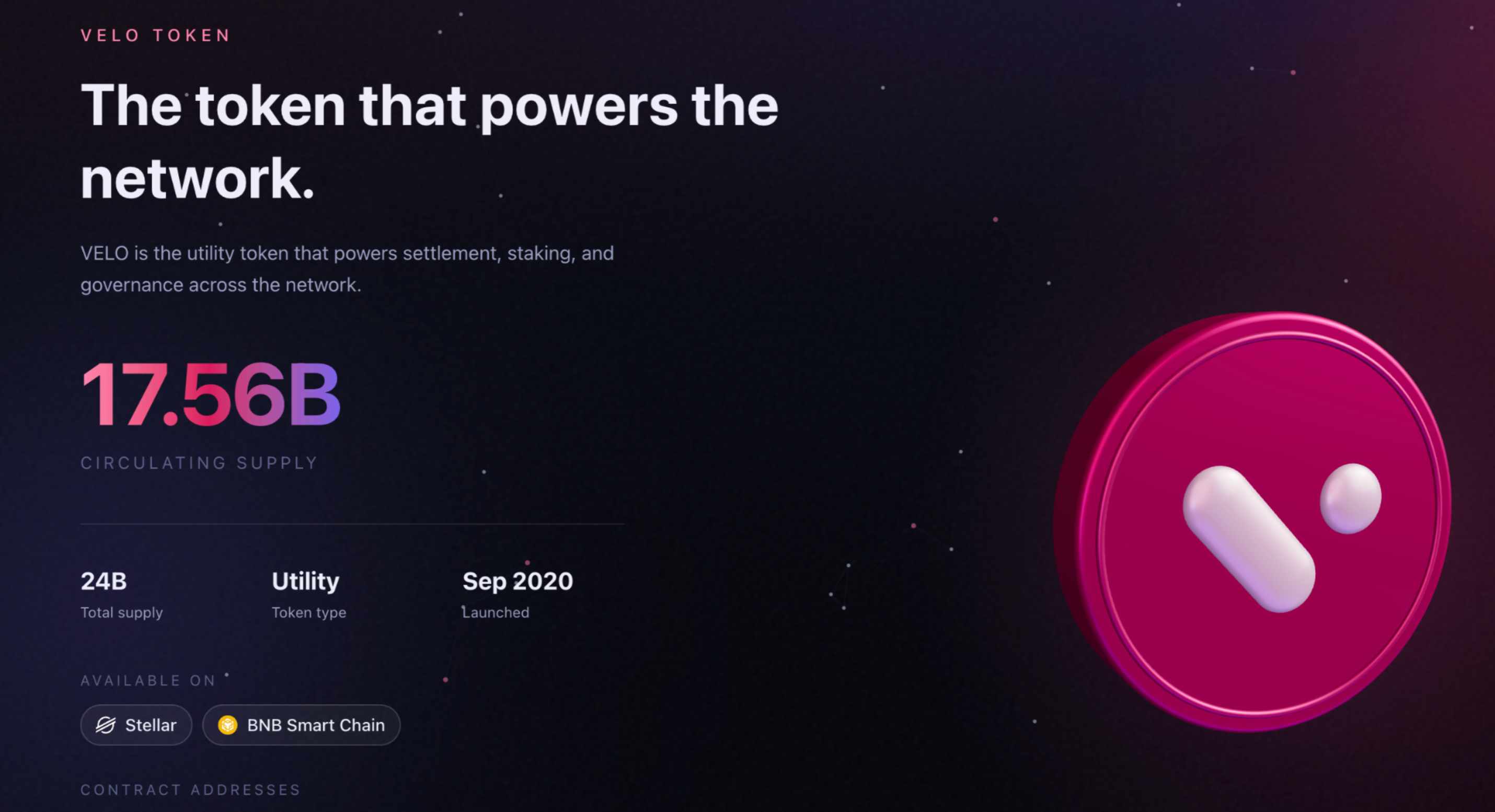
VELO is used for settlement, staking and governance within the Velo ecosystem. For users, the more immediate consideration is network support.
The official VELO token page lists VELO on Stellar and BNB Smart Chain. Before making an exchange, the selected network needs to match the receiving address.
VELO token data and network availability. Circulating supply is a dated snapshot and may change. Source: Velo, checked August 27, 2026.
Make sure the VELO network matches the receiving address. Sending VELO through the wrong network may result in lost funds.
How to Exchange VELO on ChangeNOW
ChangeNOW supports VELO exchanges on BNB Smart Chain.
Choose VELO on BNB Smart Chain as the receiving asset.
Enter a compatible wallet address and review the estimated receive amount.
Example BTC to VELO exchange route on BNB Smart Chain. The rate shown is an interface snapshot, not a current quote. Source: ChangeNOW, checked August 27, 2026.
Disclaimer: Crypto exchanges involve exchange-rate, network, smart contract, liquidity and regulatory risks. Check the receive amount, selected network, destination address and regional availability before confirming a transaction. Information in this article is educational and does not constitute financial advice.
FAQ
Cross-border settlement is the process of completing a payment between parties in different countries, including the movement of funds between financial institutions or payment providers.
Incorrect recipient details, unsupported payout methods, compliance requirements, liquidity constraints or restrictions in the destination market can prevent a payment from being completed.
Timing depends on the corridor, currencies, providers and payout method. Additional intermediaries or verification checks can extend the payment time.
Check the final receive amount, exchange rate, payout method, expected delivery time, verification requirements and the provider responsible for the final payout.
No. Stablecoins can be used for settlement, but conversion into local currency and delivery through local payment rails may still require regulated providers or banking infrastructure.
ChangeNOW supports VELO exchanges on BNB Smart Chain. The receiving wallet must support the same network selected for the exchange.


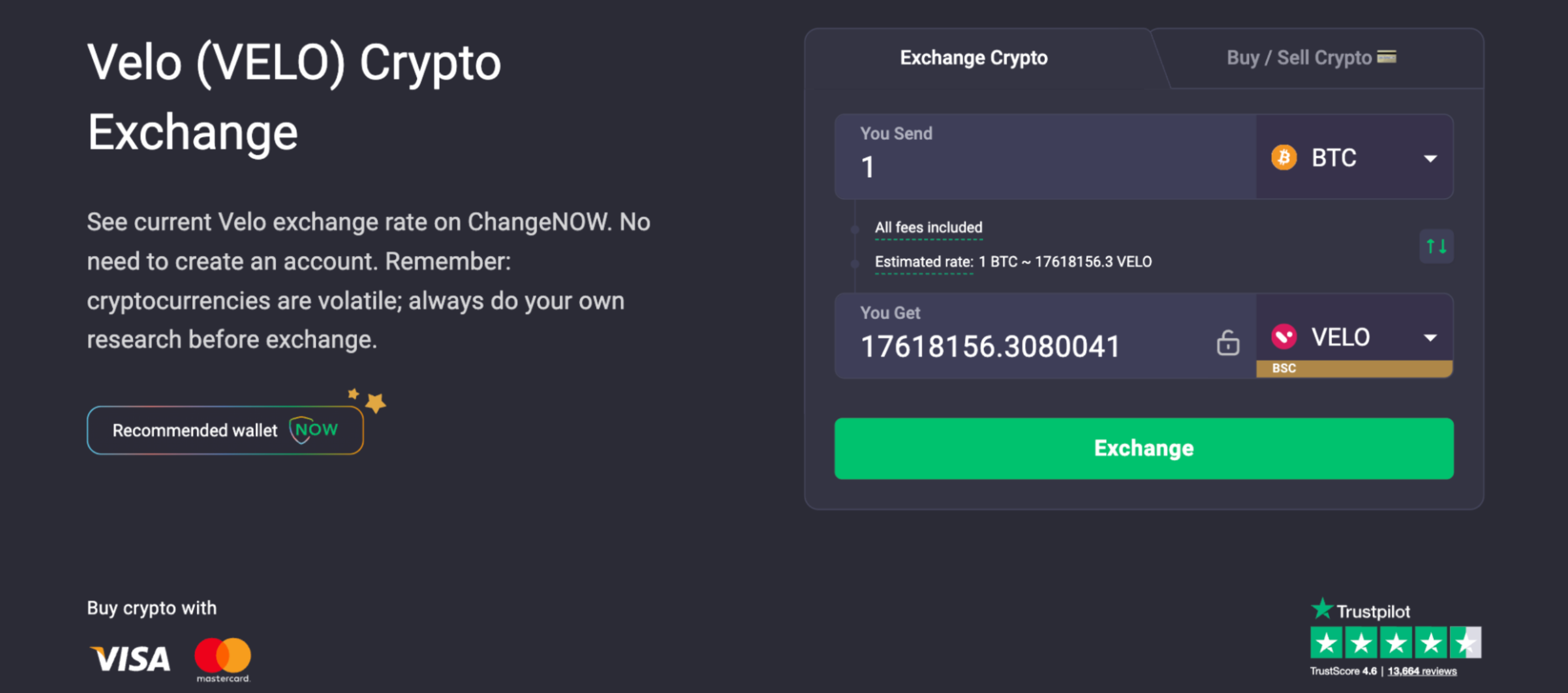 Example BTC to VELO exchange route on BNB Smart Chain. The rate shown is an interface snapshot, not a current quote. Source: ChangeNOW, checked August 27, 2026.