Imagine buying a share of a New York apartment building with $100, or earning yield from US government bonds without opening a bank account.
This is what real world assets (RWAs) look like in 2026. The segment is becoming one of the fastest-growing in crypto, as more traditional financial instruments move on-chain.
Real world assets (RWAs) are blockchain-based tokens that represent ownership or exposure to real-world assets such as bonds, real estate, or commodities. Instead of relying on banks or brokers, users interact directly with tokens that track value, ownership, or cash flow.
Two things change for the user. Access becomes simpler. Settlement becomes faster.
But the risk model changes too. You are no longer dealing only with price volatility. You are dealing with issuers, custody, legal structure, and verification.
If you understand this shift, RWAs open access to markets that were previously closed. If you don’t, you are taking risks you cannot see.
Before You Go Further
RWAs give on-chain access to assets like government bonds, credit, and real estate. This is one of the fastest-growing segments in crypto, but it is often misunderstood.
Key points to understand before you continue:
RWA tokenization moves ownership on-chain, but the asset and its risks remain off-chain
Most capital flows into predictable yield, not speculation
A token can be liquid while the underlying asset is not
Yield does not come from the token – it comes from the underlying asset
If you cannot explain who controls the asset, you are not managing risk
RWAs are not just another crypto narrative. They are a shift in how capital moves.
Understanding the structure behind the token matters more than the token itself.
What Are RWAs and Why They Matter
Real world assets (RWAs) are blockchain-based tokens that represent ownership rights or financial exposure to physical assets and traditional financial instruments.
In simple terms, real world assets in crypto connect traditional finance with blockchain infrastructure.
According to Chainlink, RWAs include currencies, commodities, equities, bonds, and other forms of value that exist outside blockchain but can be represented digitally on-chain.
These assets can include:
FAQ
Real world assets are tokens that represent physical or financial assets such as bonds, real estate, or commodities. They allow these assets to be used within blockchain systems.
Tokenization converts ownership rights into digital tokens issued through smart contracts. These tokens represent exposure to the underlying asset.
RWA tokens carry risks including custody, regulation, liquidity, and smart contract vulnerabilities. Each asset must be evaluated individually.
Yes. Users can gain exposure through tokenized assets or DeFi protocols, but ownership structures vary by platform.
RWAs connect traditional finance with blockchain, improving access, liquidity, and efficiency.
[frame color="grey" radius="5"]Verdict: RWAs bring real yield on-chain, but they also introduce real-world dependencies. You are not only dealing with smart contracts, but with legal structures, custodians, and counterparties. Understanding this difference is what separates investment from blind exposure.[/frame]
You do not buy the asset directly. You hold a token that represents rights to value, income, or exposure. If the underlying asset generates income, that value flows through the structure behind the token.
This is how RWAs bring traditional finance on-chain.
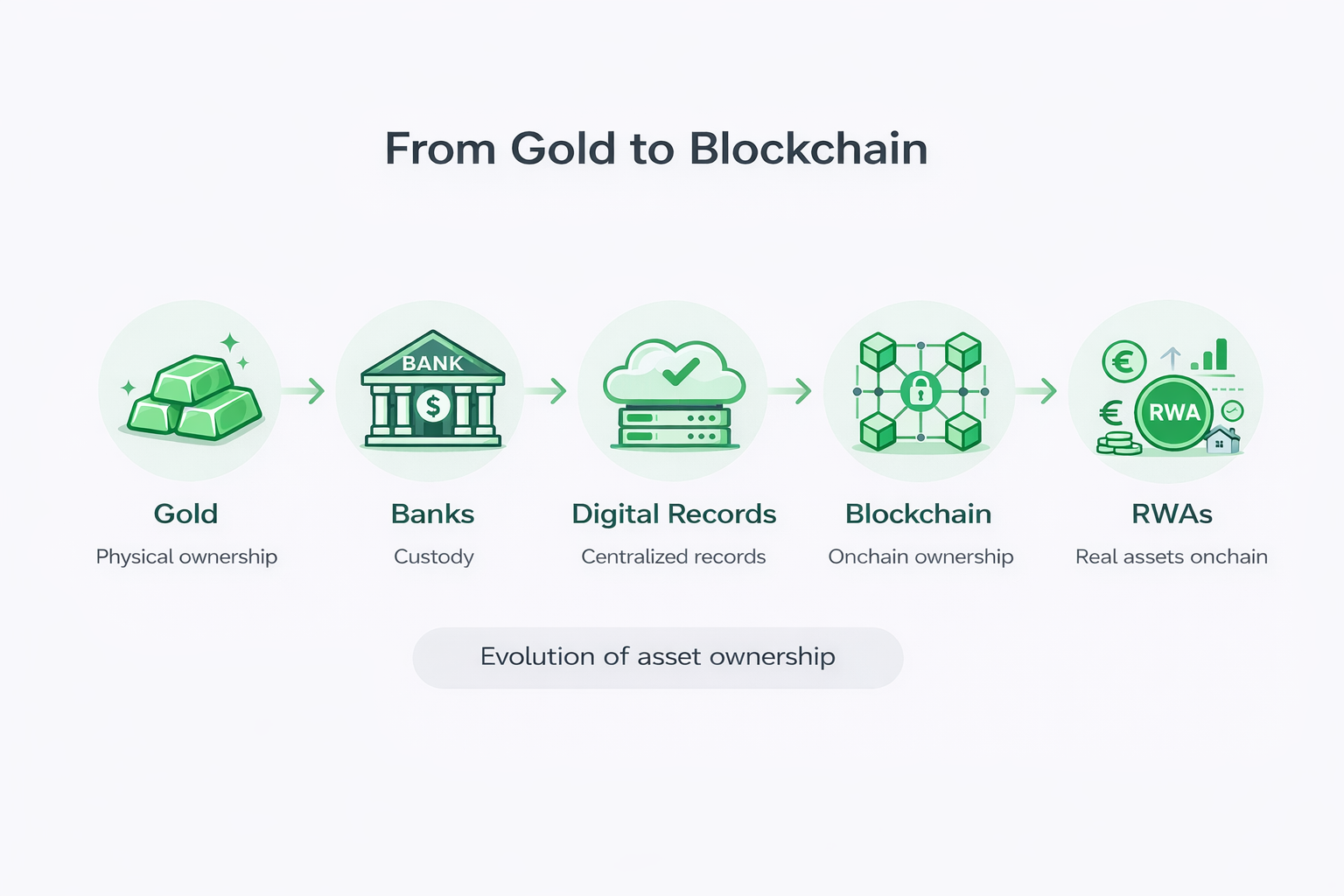
From Gold to Blockchain How Assets Evolved
Financial systems have always relied on trust, but the source of that trust has changed over time.
At first, value was tied to physical assets like gold. Ownership was straightforward. If you held the asset, you owned the value.
Later, banks took on that role. People stopped holding assets directly and instead relied on institutions to store and manage them. Money became a claim on reserves rather than the asset itself.
Today, most assets exist as digital records inside centralized systems. Ownership is not something you physically control. It is something that is recorded and confirmed by institutions.
Blockchain changes this model.
Ownership can be verified on-chain and transferred directly between users. There is no need for multiple intermediaries to confirm a transaction.
Tokenization builds on this. It links real-world assets to on-chain records so value can move faster and with fewer dependencies.
Evolution of asset ownership from physical assets to blockchain and tokenized real-world assets.
The diagram shows how financial systems moved from physical ownership to bank custody, then to digital records, and finally to on-chain ownership and tokenized assets.
Your bank account, your brokerage balance, your property records – all of them exist as entries in centralized systems. If the system changes, freezes, or fails, your access can be restricted.
Blockchain changes how ownership is recorded. Instead of relying on one institution, ownership can be verified on-chain and transferred directly between users.
Tokenization builds on this by linking real-world assets to on-chain records, so value can move without multiple intermediaries.
How Real Assets Become Tokens on Blockchain
RWA tokenization is the process of converting ownership rights of real-world assets into blockchain-based tokens.
This is not just a technical process. It combines legal structure and blockchain infrastructure.
A typical flow looks like this:
Step
What happens
Why it matters
Asset selection
Choose asset (bonds, real estate, credit)
Defines value
Legal structuring
Define rights and compliance
Protects ownership
Token creation
Issue tokens via smart contracts
Enables access
Custody
Store real asset
Maintains backing
Verification
Audit or oracle data
Ensures trust
Investax explains that tokenization connects legal ownership with digital infrastructure, allowing assets to be managed and transferred more efficiently.
Once tokenized, the asset can be traded, transferred, or used in DeFi.
Types of Real World Assets in Crypto
When evaluating real world assets, the structure behind the token matters more than the narrative. RWA is not a single category. It is a mix of different markets that have started moving on-chain.
The source of returns is different.
If you treat all RWAs the same, you misprice risk.
Financial assets
This is the most developed segment.
It includes:
government bonds
tokenized treasuries
corporate debt
private credit
These are familiar instruments. The difference is the wrapper, not the logic.
Returns usually come from interest, not price appreciation. You are not betting on market hype. You are earning from underlying cash flows.
That is why this segment attracts institutions. It is easier to model, easier to understand, and less dependent on crypto cycles.
Physical assets
This is where things get more complex.
It includes:
real estate
commodities like gold or oil
infrastructure
These assets do not live on-chain. That creates an extra layer of risk. The value depends on how the underlying asset is managed, stored, and verified.
Liquidity is also different. You can sell a token instantly. You cannot sell a building instantly. So the token may look liquid, while the asset behind it is not.
Alternative assets
This is the least standardized part of the market.
It includes:
art
royalties
intellectual property
Here, pricing is less predictable. Value depends more on demand than on measurable fundamentals.
Some assets generate income, like royalties. Others rely purely on market interest.
This creates higher uncertainty. It can also create higher upside, but only if you understand what you are buying.
Each category has different liquidity, risk, and regulatory exposure.
What actually matters when choosing an RWA
The category defines the risk profile.
Before allocating capital, focus on:
where the yield comes from
who controls the underlying asset
how the asset is verified
whether there is real liquidity
Two assets labeled as “RWA” can behave in completely different ways.
RWA is often presented as a single narrative.
Some assets behave like bonds. Some behave like real estate. Some behave like speculative bets.
If you do not understand what sits behind the token, you are not investing. You are guessing.
Real World Assets in DeFi
DeFi initially focused on crypto-native assets, but most capital exists outside blockchain.
Real world assets in DeFi allow protocols to generate yield from real economic activity instead of relying only on crypto-native speculation.
Examples include:
lending backed by real-world credit
stablecoins backed by bonds
tokenized funds
RWAs expand DeFi by integrating traditional financial instruments into blockchain ecosystems.
Data from DeFiLlama shows that RWAs have become one of the fastest-growing segments in DeFi, with billions of dollars locked in tokenized assets.
This signals a shift that DeFi is starting to connect with real economic activity.
Video Explainer
This video shows how real-world assets are brought on-chain and how they are represented as tokens. It explains how assets like bonds, credit, and real estate can be used within blockchain systems.
What are Real World Assets (RWA) and how tokenization works on-chain.
RWAs are already used in lending, funds, and tokenized treasuries.
Real Examples of RWA in 2026
RWA tokenization is already being used in real financial products, not just in experimental crypto projects.
RWAs are already used in products that generate real yield and attract institutional capital. The shift to on-chain finance is no longer theoretical. It is visible in how capital is being allocated.
Tokenized US Treasuries Are Driving the RWA Market
A few years ago, earning yield from US government bonds required a broker, paperwork, and access to traditional finance.
Now the same exposure is available on-chain.
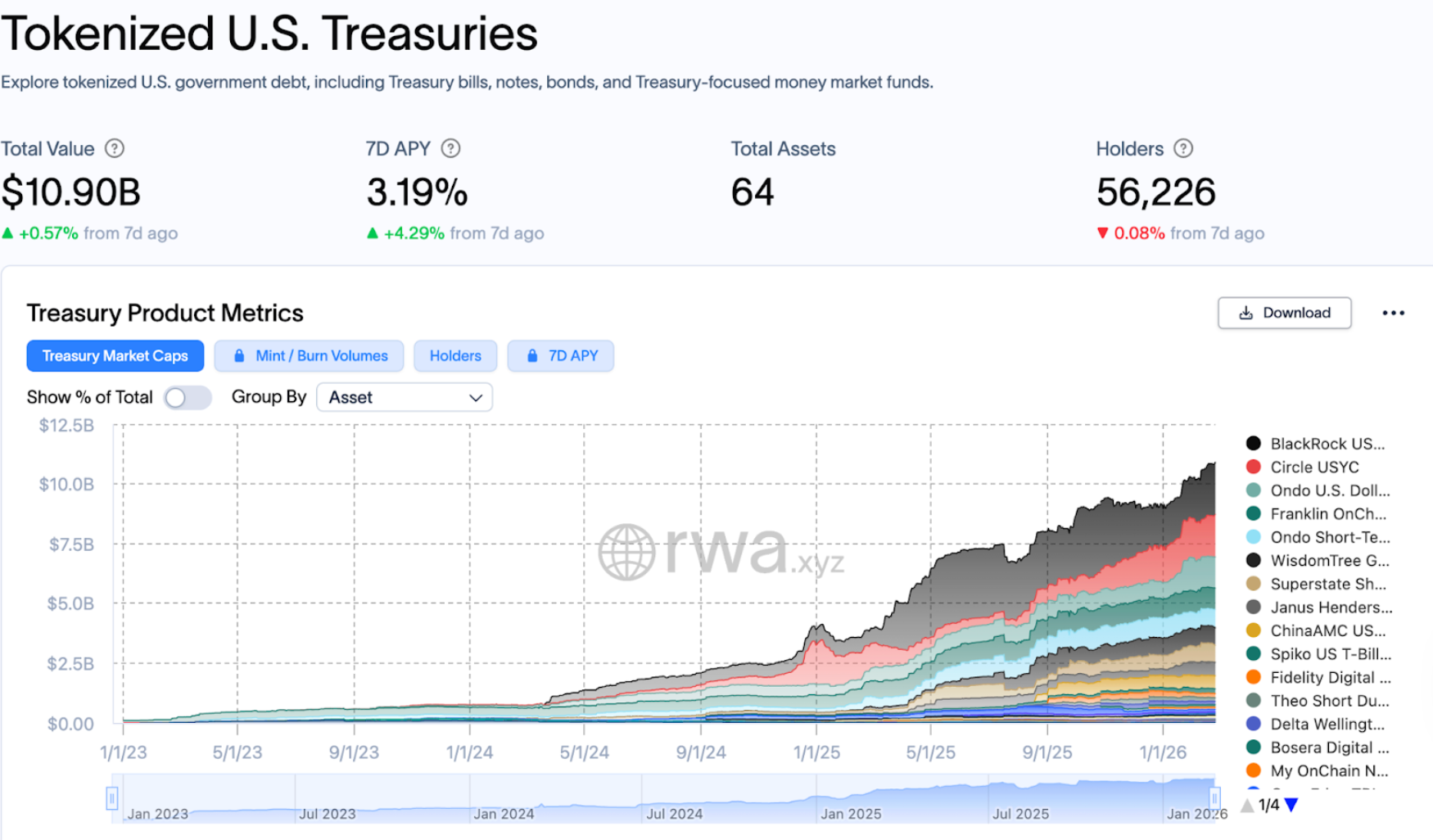
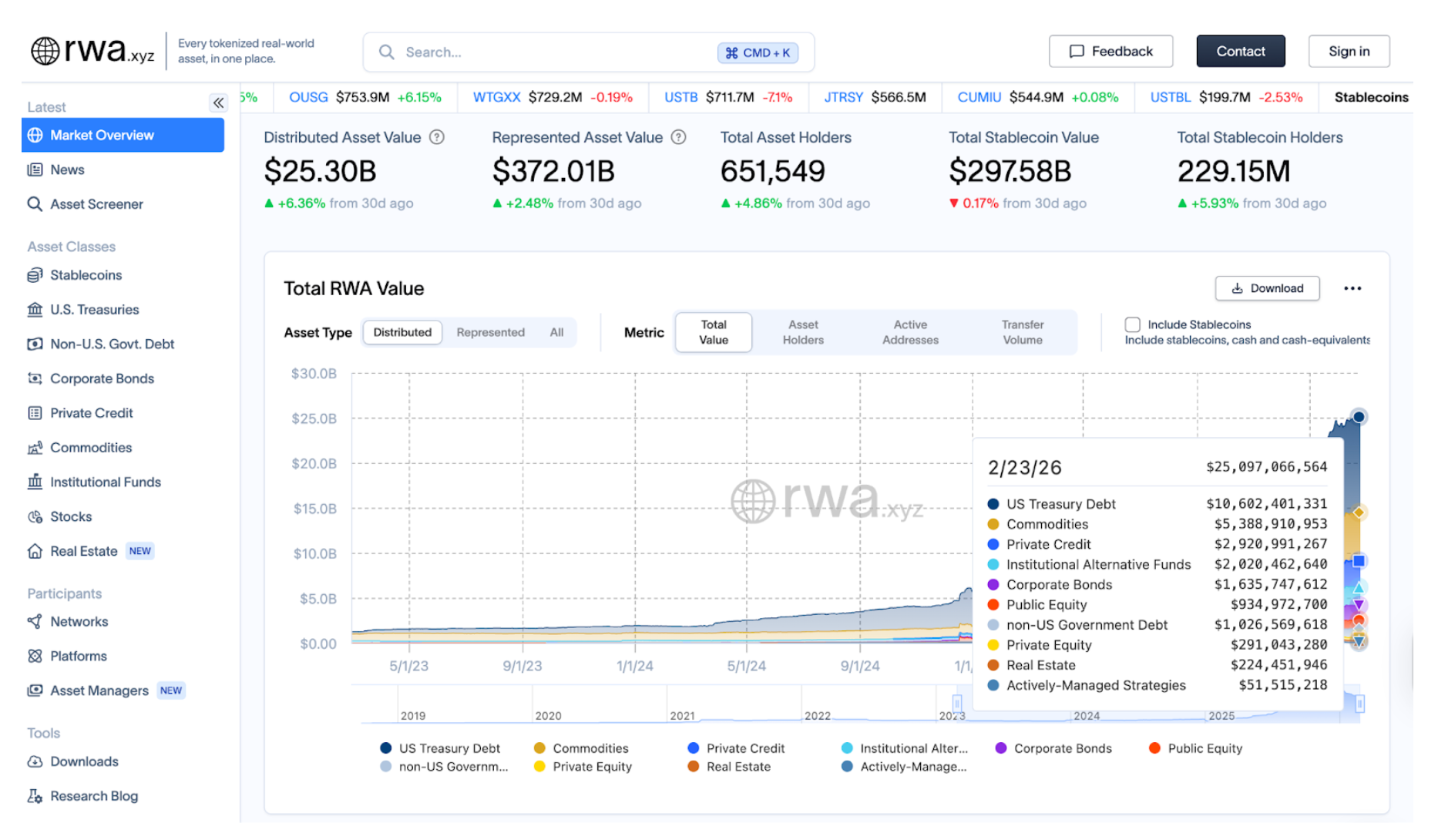
Tokenized US Treasuries already exceed $10.9 billion. Investors receive yield linked to real interest rates, currently around 3–5%.
Tokenized US Treasuries surpass $10.9B as institutional products drive market growth (source: RWA.xyz).
Most of the growth happened after 2024, when institutional products entered the market. BlackRock, Franklin Templeton, and other asset managers introduced tokenized treasury funds, increasing capital inflows.
This shift reflects institutional participation rather than retail demand.
What This Means in Practice
RWAs are not only about tokenizing assets. The more important shift is how financial infrastructure is changing. Settlement is one of the clearest examples.
Today, moving money between institutions is slow and depends on multiple intermediaries. Final settlement can take hours or days.
Blockchain changes this process. Transactions can settle almost instantly, without centralized clearing. Banks and asset managers are already testing on-chain settlement using tokenized assets and digital cash.
If this scales, the change is structural. Value moves faster, dependencies decrease, and counterparty risk is reduced.
Government bonds are issued on-chain, providing yield linked to real-world interest rates.
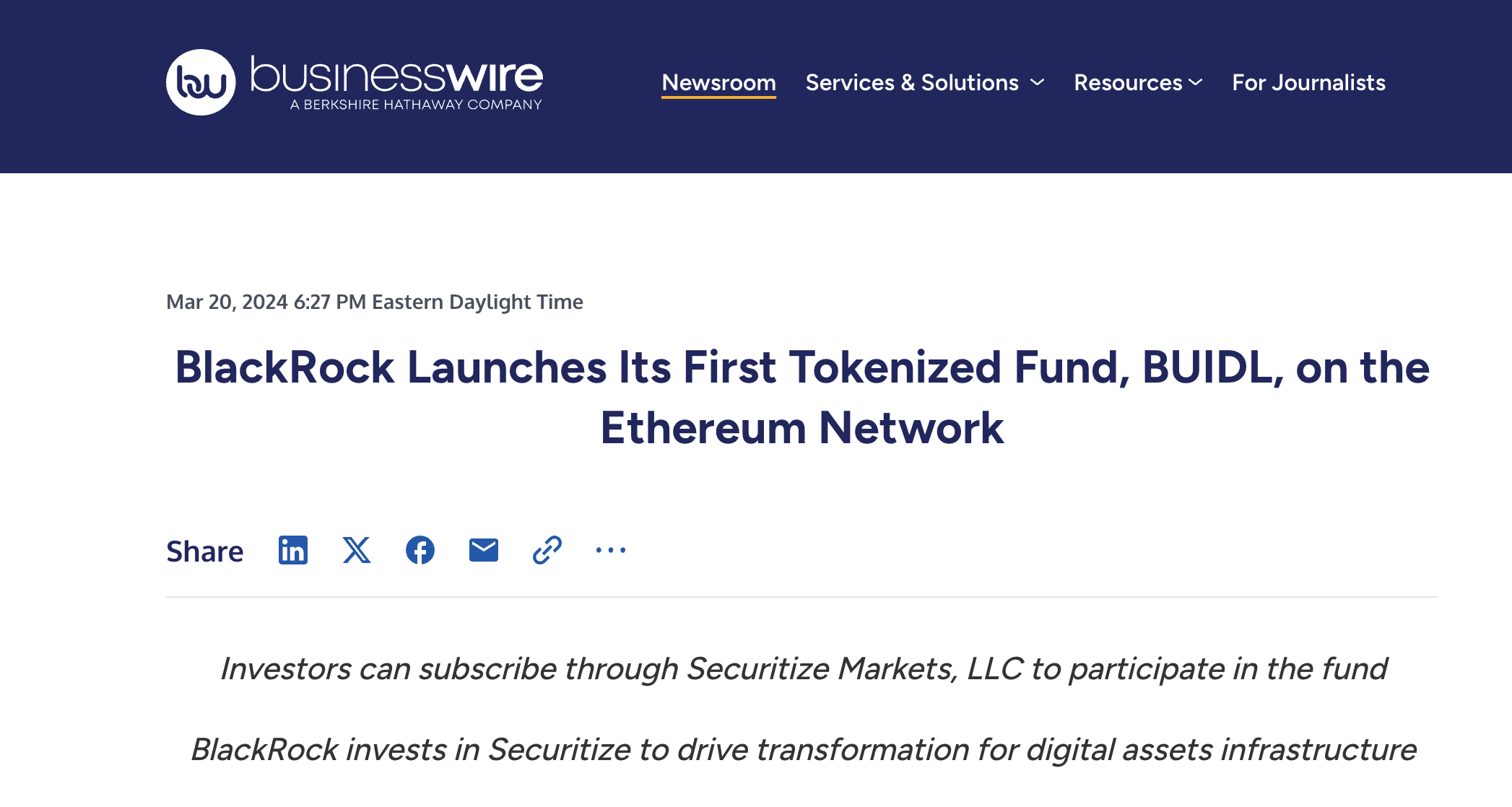
Business Wire reports that BlackRock launched a tokenized fund backed by US Treasuries, bringing traditional yield instruments on-chain and opening access to blockchain-native capital. Franklin Templeton and other asset managers are also exploring tokenized funds, showing that this is not limited to crypto-native companies.
Private credit
Private credit is one of the fastest-growing RWA segments. Returns often range from 8% to 12%, depending on the borrower and structure.
This capital is deployed into real-world lending. Businesses borrow funds, and token holders receive yield from those repayments.
Higher yield comes with higher risk. Defaults, weak reporting, and liquidity constraints can significantly impact returns.
Real estate
Tokenized real estate lowers the entry barrier. Instead of buying a full property, investors can access fractional ownership.
However, the underlying asset remains illiquid. A token can be traded quickly, but selling the property still takes time.
Real Assets You Can Access Today
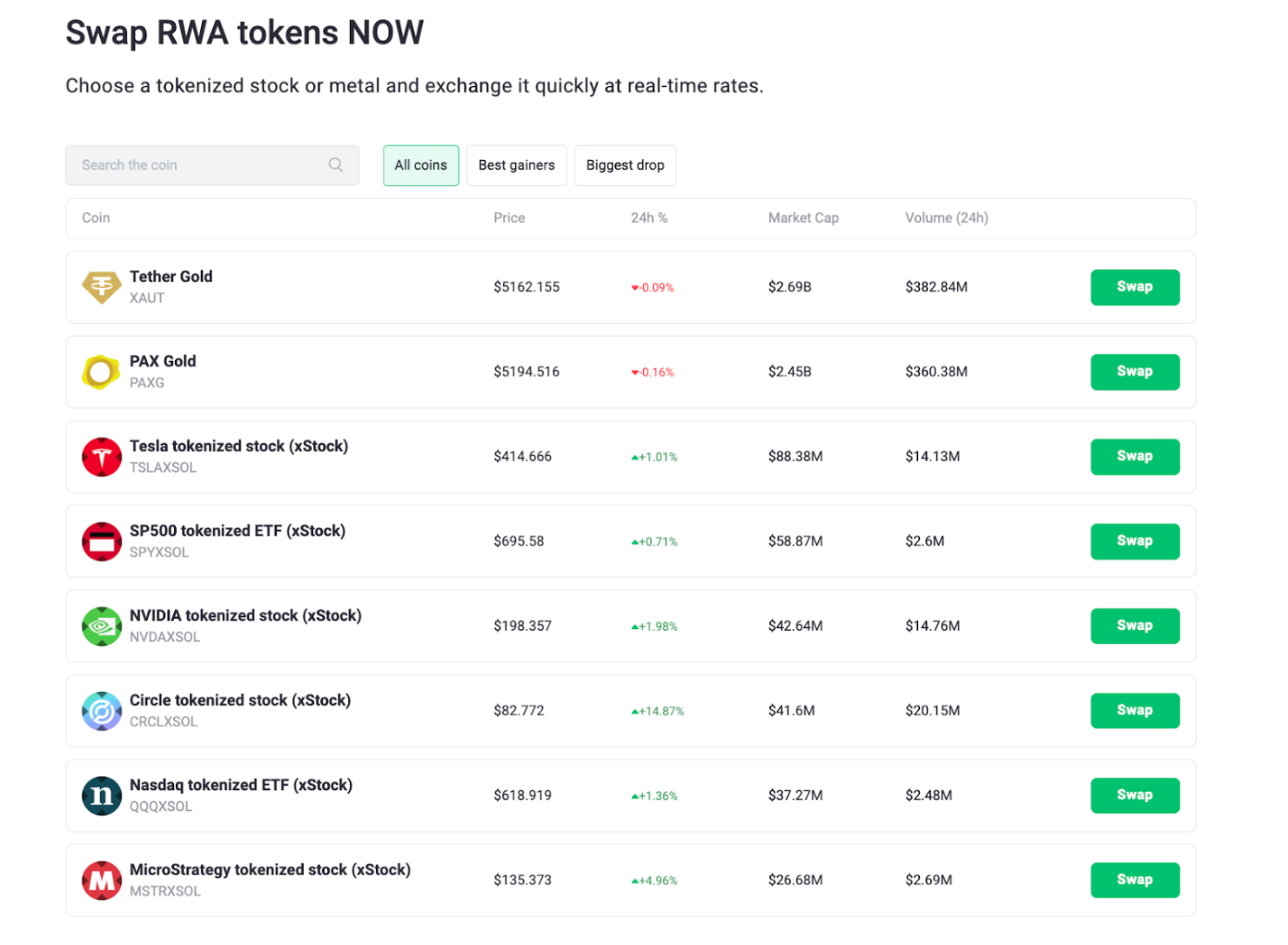
Real world assets are already available on-chain. You are not limited to funds or institutional products. You can access tokenized gold, stocks, and other assets directly.
Gold-backed tokens like Tether Gold (XAUT) and PAX Gold (PAXG) track the price of physical gold stored in custody.
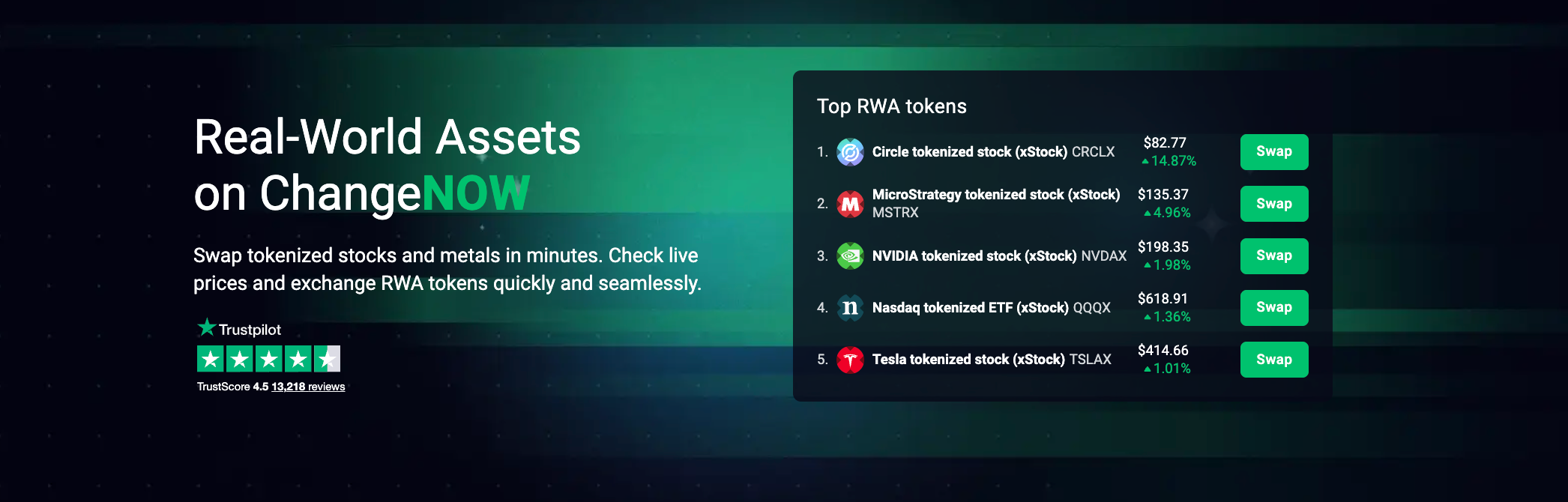
Tokenized equities provide exposure to companies like Tesla or Nvidia, allowing users to access stock-like assets through blockchain infrastructure.
Below is an example of how these assets are presented, including price, liquidity, and available markets.
RWAs are not limited to funds or institutional products. Some assets are already available as tokens and traded on-chain.
This is not just theory. These assets are already traded on-chain, with real liquidity and real pricing.
Gold
Gold-backed tokens track the price of physical gold held in custody. Each token represents a specific amount of gold stored by the issuer.
Examples include Pax Gold (PAXG) and Tether Gold (XAUT), where each token is backed by real reserves.
Before allocating capital, you need to understand how gold-backed tokens verify reserves and custody.
Some platforms provide tokenized exposure to equities such as Nvidia or other publicly traded companies.
These tokens track price movements, but ownership structure and rights depend on the issuer.
Stablecoins backed by real assets
Stablecoins are one of the largest RWA segments.
Some are backed by cash and short-term government bonds. Others are backed by private credit or structured products.
Circle’s USDC, for example, is backed by cash and short-term US Treasuries, linking on-chain liquidity with traditional financial instruments.
What matters is not the asset category, but the structure behind it.
Two tokens can look identical but carry completely different risks depending on custody, verification, and legal framework.
Benefits of Tokenized Assets
Tokenization changes how assets are accessed and transferred, but the impact depends on how the product is structured.
Access improves. Users can enter markets like government debt or private credit without traditional intermediaries.
Settlement becomes faster. Transactions can move without multiple layers of clearing and reconciliation.
Transparency can improve, but only if reporting and verification are properly implemented.
Efficiency increases, but it does not remove legal, custody, or counterparty dependencies.
Settlement becomes faster and cheaper.
According to Chainlink, tokenization reduces friction in traditional financial systems and improves capital efficiency.
Where RWA Investing Breaks
Investing in real world assets involves both on-chain and off-chain risks that do not exist in crypto-native assets.
Custody risk: The underlying asset must exist and be properly managed. A token does not guarantee that the asset is safe.
Regulatory risk: Many RWAs fall under securities laws. Access, transfers, and redemption can change depending on jurisdiction.
Liquidity risk: A token can be traded instantly. The underlying asset often cannot. This creates a gap between perceived and actual liquidity.
Smart contract risk: Bugs and vulnerabilities can affect how assets are issued, traded, or redeemed.
Off-chain dependency: Verification and enforcement happen outside the blockchain. If that link breaks, the token loses its meaning.
In some cases, the token may trade actively while the underlying asset remains illiquid. This creates a mismatch between perceived liquidity and actual exit conditions. Before interacting with any asset, it is worth checking risk factors and transaction details.
Track liquidity, backing, and any changes from the issuer.
If you stop checking, you stop managing risk.
Before allocating capital, understand how the asset is structured, how yield is generated, and how redemption works.
Start small. Scale only after you understand the risks.
RWA vs. Crypto Native Assets
RWAs and crypto-native assets can look similar, but they behave differently.
Feature
RWA tokens
Crypto native assets
Backing
Real-world assets
Market demand
Regulation
Higher
Lower
Transparency
Mixed
Fully on-chain
Liquidity
Variable
Usually higher
Risk
Off-chain + on-chain
Mostly on-chain
What this means: RWAs can generate yield from real cash flow, not just price movement. But you take on off-chain risk – custody, legal structure, verification.
Crypto-native assets are easier to verify on-chain. But returns depend more on market cycles.
Understanding this difference helps avoid mistakes.
Who Is Building the RWA Infrastructure
RWA growth is not driven only by traditional institutions. Crypto-native projects are building the infrastructure that connects real assets to blockchain.
Some focus on compliance and identity. Others focus on trading, settlement, or cross-chain infrastructure.
IOTA
IOTA focuses on infrastructure for digital identity, asset tracking, and tokenization.
Its approach is based on integrating real-world data and compliance into blockchain systems, which is critical for RWA adoption.
Other ecosystems are also entering the space, focusing on tokenization frameworks, compliance layers, and liquidity infrastructure.
What matters is not the narrative, but execution. RWA requires more than tokens. It requires legal structure, data verification, custody, and liquidity.
Projects that can combine these layers will capture the majority of capital.
RWA Market Size and Future Outlook
The RWA sector is growing. Most global assets are still offchain, which creates significant potential.
RWA.xyz, tokenized assets continue to expand as institutions explore on-chain finance.
The scale of RWA adoption becomes clear when you look at on-chain data.
Growth of tokenized real-world assets based on on-chain data
The data shows steady growth in tokenized assets, with acceleration in recent months as institutional products enter the market.
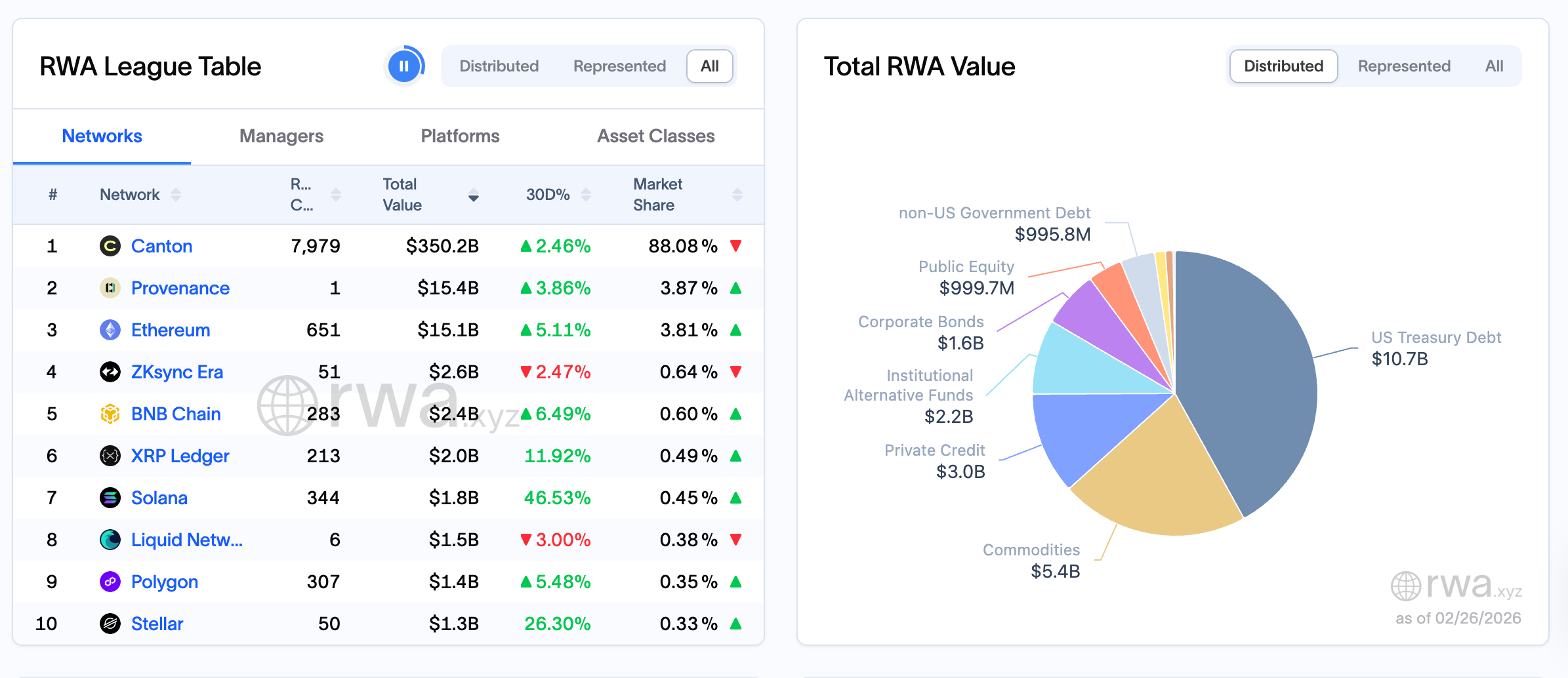
To understand where capital is actually flowing, you need to look at how it is distributed.
Looking beyond growth, the structure of the market shows where capital is actually concentrated. Most of the capital is concentrated in government debt and credit products.
Capital is moving into assets that generate cash flow rather than relying on price exposure.
At the same time, activity is concentrated across a limited number of blockchain networks. This suggests that infrastructure, liquidity, and compliance play a key role in attracting capital.
Not every chain will capture RWA growth. Capital flows where it can be deployed efficiently and with lower risk.
Despite the current size, the market is still in early stages. Estimates suggest that tokenized assets could reach trillions of dollars over time.
What is driving this growth:
institutional adoption
demand for yield
improved transparency
faster settlement
This shift is already visible in how capital is being deployed. RWA growth is not evenly distributed.
Capital does not move randomly across the market. It concentrates where risk is clearer, yield is predictable, and infrastructure can support large flows.
Binance Research by Moulik Nagesh, Joshua Wong, Michael JJ, and Asher Lin Jiayong highlights that tokenization is moving beyond early experiments and becoming part of real financial workflows.
Tokenized assets such as money market funds and government bonds are increasingly used on-chain, driven by faster settlement and more efficient capital use.
RWA-related total value locked (TVL) has already reached billions of dollars, reflecting growing institutional participation. RWAs are moving from experimentation to infrastructure.
As more capital moves on-chain, the focus is shifting from access to efficiency – how assets are issued, settled, and managed within blockchain systems.
The next phase depends on how efficiently this infrastructure can handle larger flows.
Final Thoughts
Real world assets are changing how capital moves by bringing real yield on-chain. They connect blockchain with traditional finance, making assets more accessible and settlement faster. At the same time, they introduce new risks that come from off-chain dependencies.
Understanding how real world assets work is essential before allocating capital.
For the first time, users can access real-world yield directly on-chain. Government bonds, credit, and real estate are no longer limited to traditional finance. But access does not remove complexity. It shifts responsibility to the user.
If you do not understand where the yield comes from, who controls the asset, and how it is verified, you are not investing. You are taking blind exposure.
The opportunity is real. So are the risks. Start small. Verify everything. Scale only after you understand what sits behind the token.