IOTA didn’t loudly appear overnight. What many people call a “new era” in 2025–2026 is really the next logical phase of a project that’s been building for over a decade now. From its beginnings in 2015 as an innovative ledger for the Internet of Things, IOTA has been steadily developing its underlying technology, partnerships, and ecosystem.
2025 became a turning point for IOTA, cementing big upgrades across protocols, strong partnerships, trade infrastructure, identity systems, and general growth. Below are the most significant shifts that explain the real change in the 2025-26 transition for IOTA.
TL;DR
Rebased Mainnet: IOTA has migrated to a completely decentralized, fast network of 50,000 transactions per second, with full support for smart contracts written in Move.
Multichain Integration: At present, IOTA already supports more than 150 blockchain integrations and is seamlessly enabled to transfer assets and develop apps across multiple networks, courtesy of LayerZero and Stargate.
Future-Proof Identity: This new Identity 1.7 Beta shields digital IDs from future quantum attacks, and it allows organizations to verify credentials in a secured and private manner.
ADAPT in Action: The IOTA is aimed to simplify trade across Africa. This is helpful for little companies, accelerating the handling of paperwork and payments, while making transactions more transparent.
Growing Web3 Talent: The MasterZ × IOTA Hackathon trains developers, students, and newcomers to build real Web3 projects and explore opportunities for grants and further collaboration.
Ready for the Real World: IOTA is a real-world, secure, and scalable network ready for enterprise adoption and long-term growth.
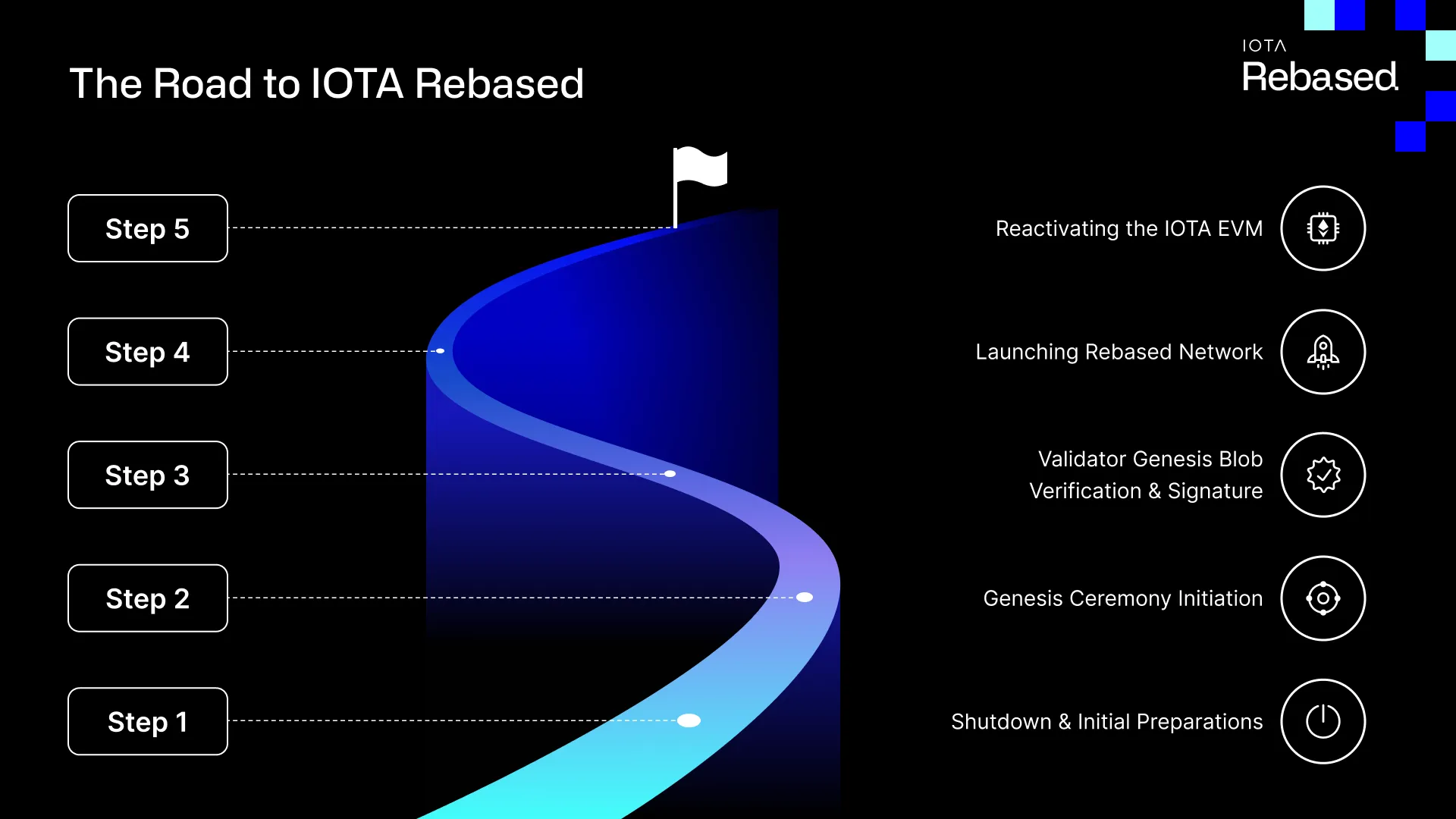
Even before 2025, the project has been in a gradual development process from the original Tangle concept and Chrysalis upgrades, to smart contract expansions and ecosystem building. What made 2025 stand out was the Rebased protocol upgrade. What is IOTA Rebased? Simply put, it is a full transformation of IOTA into a decentralized, performant Layer-1 network ready for real application usage [1].
Rebased is a new foundation for various applications, smart contracts, or ecosystems developed on IOTA to allow for quick, efficient, and scalable operations.
The launch reflects the collaborative spirit of IOTA’s global community. Through the tireless support, commitments, and participation of the token holders, developers, and enthusiasts, this has become possible. It keeps in view that IOTA grows by the people who believe in the decentralized future.
The Rebased mainnet represents the most ambitious upgrade in IOTA’s history. By laying this robust foundation, IOTA is ready to support complex dApps, real-world trade infrastructure, and next-generation identity solutions.
This upgrade removed centralized elements, introduced a Delegated Proof-of-Stake consensus, added Move smart contracts at the base layer, significantly boosted performance (over 50,000 transactions per second with sub-second finality [2]), and revamped tokenomics with staking and fee mechanisms. Because of this, IOTA can now support large-scale enterprise use cases like supply chain solutions and complex tokenization – things that were very hard or impossible before.
One of the biggest technical achievements of the latter half of 2025 was the connection of IOTA’s Mainnet to the larger blockchain universe via the LayerZero and Stargate technologies. This connects IOTA to over 150 different independent blockchain networks such as Ethereum, Solana, BNB Smart Chain, Base, and many others.
This integration means:
Cross-chain asset and data flow is now possible for IOTA users.
Stablecoins and tokenized real-world assets can move in and out of IOTA with ease.
Developers can build multichain dApps that bridge ecosystems without heavy custom bridges.
Liquidity is less fragmented, making more assets and use cases available to IOTA users.
That's a big deal for adoption and developers' interests as well. Being isolated within the ecosystem of the Web3 world becomes a "non-starter" for modern networks – interoperability is the new table stakes.
Identity 1.7 Beta: Future-Ready Digital Trust
IOTA isn’t stopping with financial infrastructure. One area where it’s pushing real utility is digital identity, and the Identity 1.7 Beta release is an important step. This update introduces post-quantum cryptography and hybrid signatures for Verifiable Credentials – meaning identities and credentials on IOTA can be secured against future threats like quantum computers.
Pro Tip: In simple terms, IOTA Identity 1.7 Beta is a system that ensures digital identity credentials are safe in the future, even in a quantum computer attack. It allows organizations to publish proof on the blockchain, which can be easily verified by anyone. In short, it is a system to ensure digital identity is safe, simple, and trustworthy.
This is important far beyond crypto. The digital identity is a rapidly expanding global market, projected to surpass $70-100 billion in the early 2030s. Governments and enterprises alike are looking for GDPR-compliant, interoperable, and verifiable identity solutions that can be used across borders and sectors. In this light, IOTA Identity does not compete with NFTs or basic wallets – it competes in the same space as government-issued IDs, enterprise credentialing solutions, and compliance infrastructure.
Through the support of hybrid signatures, IOTA allows for a smooth transition into post-quantum security without requiring organizations to suddenly walk away from their current cryptographic infrastructure. At the same time, on-chain verifiable credentials enable proofs to be publicly confirmed where transparency is required, with full respect for privacy regulations. The combination positions IOTA Identity as practical infrastructure for real-world adoption, where long-term security, regulatory alignment, and trust are more critical than short-term experimentation.
ADAPT: IOTA in the Real World of Global Trade
The ADAPT initiative (African Digital Access and Public infrastructure for Trade) is a prime example of IOTA’s participation in transforming real-world economics. This project plans to roll out IOTA technology across 55 countries in Africa, bringing a shared digital backbone for identity, cross-border documentation, payments, and data exchange. Analysts estimate this could help double intra-African trade by 2035, reduce customs processing times dramatically, and unlock tens of billions in economic activity. That’s macro-economic impact – not just crypto headlines.
Barrier
Explanation
How IOTA Addresses It
Inefficient border procedures
Delays in customs clearance can take several days, which increases trade costs substantially.
Digital documentation facilitates smooth cross-border transactions, making it easier to conduct trade.
High logistics costs due to poor infrastructure
Poor infrastructure, such as roads, ports, and rail, increases logistics costs, which can be as high as shipping outside the continent.
IOTA-powered digital tracking, smart contracts, and secure payment systems cut unnecessary corners in logistics.
Low intra-African trade
Only ~15–20% of Africa’s trade is internal, vs 50–70% in other regions, largely due to barriers like inefficient infrastructure and high regulatory costs.
ADAPT establishes a digital backbone for identity, payment systems, and documentation. This facilitates trade and opens the region to new trade and commerce.
Lack of transparency and trust
The paper-based and fragmented nature of the system creates opportunities for corruption and errors in the conduct of trade.
On-chain verifiable credentials, digital identity, and a public ledger ensure transparency. This helps prevent fraud and establish trust among trading partners.
Limited access for small and medium enterprises (SMEs)
SMEs lack access due to high participation costs and complex procedures.
Barriers to entry are reduced through digital workflows, identity verification, and cross-border payment solutions.
ADAPT represents a collaborative effort with key partners such as the African Continental Free Trade Area (AfCFTA), the Tony Blair Institute for Global Change, and the World Economic Forum. The result brings together technical expertise with deep networks and practical experience in African trade. The initiative has already shown success with real-world deployments in Kenya, Rwanda, and the UK, proving that IOTA technology can work at scale.
Hackathons: Building the Next Generation of IOTA Builders
The MasterZ × IOTA Hackathon is a new way to develop Web3 talent in Europe. It is a skill-focused, impact-oriented approach, not chase for hype. Unlike most hackathons that assume prior blockchain experience, this initiative begins with a structured online learning phase led by IOTA and MasterZ experts. This brings down the entry barrier and will permit developers from Web2, students, and newcomers to confidently enter into Web3 with hands-on experience of real production-grade tools and a programming language Move.
After the learning phase, participants enter a building phase where they create real-world Web3 applications on the IOTA platform. The emphasis is on applications that have the potential to scale after the hackathon, including supply chain tracking, digital identity, asset tokenization, and trustless document management. The participants are mentored and supported throughout the process to ensure that the applications are built with scalability, usability, and adoption in mind.
The event culminates in a Berlin Demo Day, where the best teams get to pitch their ideas directly to the IOTA Foundation, providing an opportunity for grants, incubation, and long-term collaboration in the IOTA ecosystem. Even beyond the final showcase, participants gain visibility through leaderboards, NFT certificates, and potential mentorship roles, making the hackathon not just a competition, but a structured pathway into Europe’s growing Web3 economy built around IOTA.
Adoption and Regulatory Considerations
Like any infrastructure-level blockchain project, IOTA faces several structural risks. Adoption remains the primary challenge: enterprise and government integrations require long sales cycles, regulatory alignment, and proof of long-term reliability, which slows visible traction compared to retail-driven crypto ecosystems. Regulatory uncertainty around digital identity, data sovereignty, and compliance frameworks can also affect the pace and geography of deployments.
IOTA’s approach to mitigating these risks is pragmatic rather than speculative. The project focuses on standards-based architecture, open-source governance, and direct collaboration with regulators, research institutions, and public-sector partners. By aligning its roadmap with compliance-friendly technologies such as verifiable credentials, privacy-preserving identity, and post-quantum cryptography, IOTA positions itself to adapt to evolving regulation rather than resist it. While this strategy sacrifices short-term hype, it increases the likelihood of durable, real-world adoption once institutional thresholds are met.
How to become part of IOTA?
Becoming part of the IOTA ecosystem doesn’t require deep technical knowledge or long onboarding processes. For most users, it starts with holding IOTA tokens, which are used for interacting with the network, experimenting with its tools, and participating in the broader ecosystem as it grows. One of the simplest ways to acquire IOTA is through non-custodial exchange services like ChangeNOW, where users can swap popular cryptocurrencies into IOTA or buy the token with fiat.
Holding IOTA tokens also opens the door to participating in network proposals and community governance, where token holders can vote on improvements, funding initiatives, and ecosystem development plans. This system ensures that the community has a real say in the project’s evolution, aligning incentives between users, developers, and institutional partners. This approach fits IOTA’s philosophy: low-friction, privacy-aware access, real-world usability, and active participation in shaping the network’s future.
Conclusion
In 2025-2026, IOTA will start a new phase, moving from the aspirational Internet of Things concept to a ready-for-use, secure, and technologically/scalable solution. This is confirmed by the progress achieved with Rebased Mainnet, work with Multichain, Identity 1.7, and other endeavors like ADAPT.
The platform is prepared to support complex decentralized applications, streamline cross-border trade, and foster long-term adoption across industries, marking a clear transition from development to tangible impact.