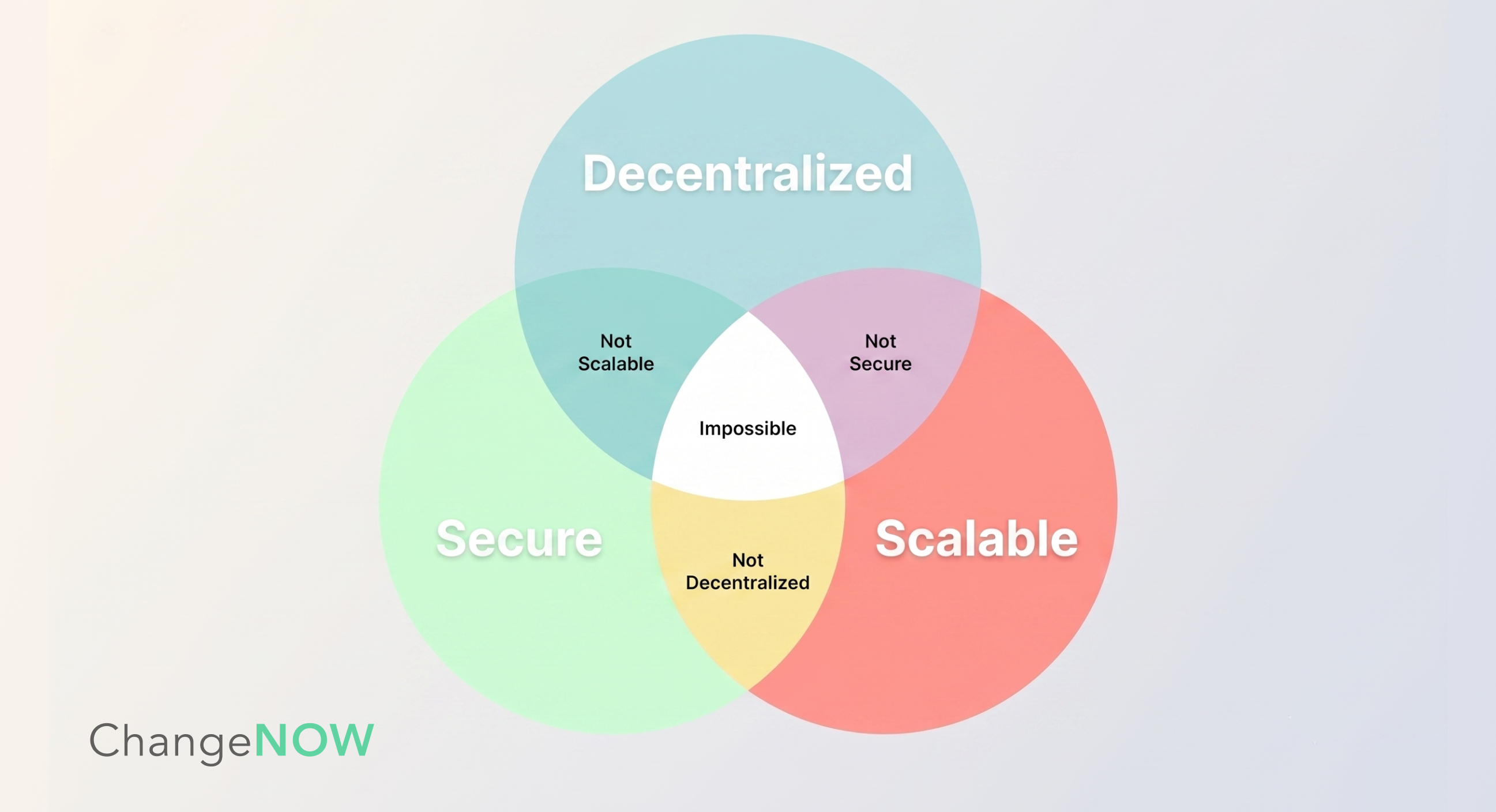
When we employ builders to build a house we are faced with a stark reality: we can only pick two options from the list - cheap, fast or high-quality. Paying for a hurried project usually means sacrificing quality, and seeking excellence often implies extensive delays.
Digital networks are facing the exact same challenge. Why do we send money on Ethereum and pay $15? Why does Solana occasionally freeze at busy hours or charge fractions of a penny, but depend on validators with extremely high hardware requirements?
The answer is the crypto trilemma. The notion accounts for why developers find it difficult to reconcile the three basic characteristics of a successful cryptocurrency.
Key Takeaways
The blockchain trilemma asserts that a network may successfully prioritize only two of three features: security, decentralization and scalability.
Often, speed improvements come at the expense of less decentralization, or more control concentrated in one place over the network.
The main techniques to overcome these technical restrictions in 2026 are Layer 2 networks and modular systems.
Users have to always be making trade-offs between low fees, speed of transaction, and the capacity to trust the system without a central authority.
Blockchain Trilemma Definition
The blockchain trilemma is the belief that a decentralized network cannot successfully attain three fundamental objectives at the same time: security, decentralization, and scalability.
It's basically an analogue of the famous "project management triangle" or so-called "iron triangle" which is built up from three components: quality, speed and price.
In crypto, developers have to continually compromise between security, decentralization, and scalability since when you improve one you usually weaken the other two.
1. Decentralization
Decentralization is the extent to which control is diffused across the network. In a highly decentralized system, no one entity, corporate, government or bank, can freeze accounts, reverse transactions or shut down the network.
This degree of security is maintained by thousands of independent computers (nodes) across the globe checking data. If one node goes down or goes bad, the remainder of the network still works as if nothing happened.
2. Security
Security is the network’s ability to secure the user’s funds and data from hackers and double-spending assaults. In blockchain, security is directly proportional to the number of participants authenticating the transactions.
The more independent computers that are involved in consensus, the more costly it is for an attacker to tamper with the ledger.
The great security of the network makes it very resistant to manipulation, but the stringent verification process inevitably slows down the speed of transactions.
3. Scalability: Speed and Price
It is the capacity of a network to handle a tremendous number of transactions per second without blocking the network or increasing transaction fees. That’s the single biggest pain issue for the regular user. Poor network scalability means “gas wars”, when the cost of a tiny amount of crypto to a user exceeds the value of the transaction, and confirmations take hours instead of minutes.
Blockchain Trilemma in Practice
In practice, most significant cryptocurrencies are designed to optimize two properties at the sacrifice of the third. Such trade-offs help explain the existence of diverse networks and their varying responses under duress.
Secure + Decentralized (Yet Slow)
Examples: Bitcoin, Classic Ethereum
These networks are all about preventing fraud and not having a central authority that owns the data. This makes the network very safe because each node has to validate every single transaction on the main layer.
But it also makes it hard for a network to process many transactions at once. They are as reliable as a Swiss bank, but the poor throughput and steep fees make them unworkable for buying a cup of coffee.
Fast + Safe (But Centralized)
Examples: Ripple (XRP), Binance Smart Chain (BNB)
If you want speed and inexpensive prices, you generally land on centralized networks. You can confirm transactions in seconds for a fraction of a cent.
But there’s a price to pay for this efficiency. These networks are frequently run by a limited group of validators or a core company. People need to trust these central authorities to keep the system going. They can’t just take their money and migrate to an entirely different network.
It is notoriously difficult to build a network that is lightning fast and highly decentralized without compromising security. In the past, any efforts aiming to incorporate all three have been either victims of network halts or bridge hacks. The security of the main chain cracks under the weight of the data when a decentralized network tries to execute transactions quicker than the hardware can verify.
How is Blockchain Trilemma Solved in 2026?
The industry has mostly abandoned the search for a single, “perfect” blockchain. Instead, engineers are layering new technologies on top of current networks to circumvent traditional constraints and increase efficiency.
Layer 2 Networks
Layer 2 networks address the scale problem by shifting transaction processing away from the main blockchain.
Instead of taking every single digital receipt to the main accountant (the Ethereum mainnet) and standing in line, users put a thousand receipts into one folder. They send only the overall payment to the primary accountant, the specific breakdown remaining in the user’s office.
This is how networks like Arbitrum, Optimism and Base work. Users get the speed and low fees of a centralized exchange, with the added security of the main blockchain.
Modular Blockchains
In the past, one blockchain had to handle everything: process transactions, store the data and secure the network. This “monolithic” method is too burdensome for modern needs.
The industry is going towards modularity today. Instead of one blockchain being a one man band trying to do all the work, the duties are distributed. Some networks do transactions, whereas some networks are used only for storing data or for consensus only. This enables each layer to scale separately without stalling the entire system.
How ChangeNOW Helps Solve the Blockchain Trilemma
The never ending war for security, speed and decentralization has divided the crypto sector into a state of fragmentation.
Because of the scalability trilemma, now we have thousands of competing Layer 1 networks, Layer 2 solutions and sidechains. Each has its own strengths and shortcomings, therefore moving assets between the two without dealing with intricate bridges or technical delays is challenging for a regular user.
ChangeNOW takes the technical hassle out of the user. It doesn’t matter if you’re switching on a crowded mainnet or a speedy Layer 2 chain. The platform takes care of all these distinct levels automatically for the routing. With just a few clicks, users can effortlessly convert a typical “heavy” Layer 1 asset into a fast “light” Layer 2 token, completely overcoming the speed and cost constraints of the underlying networks.
The concept of the scalability trilemma was popularized by Ethereum co-founder Vitalik Buterin around 2017, although he published the foundational Ethereum Whitepaper outlining the network's initial goals back in 2014. In his later blog posts and discussions, he detailed the complexity of balancing the three basic network properties and gave the framework developers still use today to analyze network architecture.
Not exactly. Layer 2 networks and modular blockchains have made great progress, but haven’t totally eradicated the trade-offs. But users are still faced with the trade-off between cost, speed, and the security models they need to trust when moving assets between chains.
Bitcoin is considered the safest blockchain. It has the most independent miners, the most total processing power and the longest continuous track record. This huge decentralization makes it almost hard to attack or influence the network.
Theoretically, sure, but in reality it’s really difficult. Most of the efforts that promise to solve all three problems suffer from network halts or security flaws. Currently, to have high security, decentralization and speed at the same time, you need to combine several networks.
Yes. If a network values security and decentralization more than scalability, transaction costs will go up when a lot of people want to transmit money at the same time. This is because the main chain has a limited number of slots and users have to pay greater fees for their transactions to be processed.
Layer 2 networks do not process every single transaction on the main blockchain, hence their fees are lower. They do this by grouping thousands of transactions together and sending one summary to the main chain. This greatly reduces the amount of computing effort that needs to be done for each individual payment.
High decentralization usually reduces the speed of the network. The consensus takes longer since the ledger state must be agreed upon by thousands of nodes in a separate time zone. Developers often minimize the number of nodes required to validate transactions to boost speed, which decreases decentralization.
Fixed vs Floating Exchange Rate in Crypto: Which to Choose?
A fixed rate locks your final crypto amount against volatility, while a floating rate executes at live market prices. Learn the difference, risks, and when to use each.
What Is the Blockchain Trilemma? Explained for Beginners in 2026 | ChangeNOW Blog