


Individual announcements rarely tell you much. When the same network consistently produces tokenized funds, institutional projects, and new Layer 1s, these announcements cease to be standalone news. Instead, they form a single, cohesive narrative.
Individual announcements rarely tell you much. When the same network consistently produces tokenized funds, institutional projects, and new Layer 1s, these announcements cease to be standalone news. Instead, they form a single, cohesive narrative.
Avalanche is in that position today. More tokenized real-world assets are coming to the network, new Layer 1s are launching, and more and more traditional financial products are starting to move onto the network.
As part of the long-term collaboration between ChangeNOW and Avalanche, we spoke with Joey Cuccaro, Business Development at Ava Labs, about why financial institutions choose Avalanche, what keeps developers building on the network, and how AVAX is being used as more financial activity moves on-chain.
A few years ago, most tokenization stories focused on pilot projects. Financial institutions wanted to know whether blockchain could support real-world assets and meet the requirements of regulated markets.
Now, the market has moved past this pilot phase. Avalanche has become an ecosystem where tokenized funds, credit products, regulated investment vehicles and many other tools are developing at the same time.
Joey Cuccaro believes this is a key reason that traditional financial institutions continue choosing Avalanche for new on-chain products.
"Avalanche has become the place traditional institutions go when they want to put assets on-chain. BlackRock's BUIDL fund is one of the single largest real-world assets on Avalanche, holding over $900 million and accounting for nearly half of the network's distributed RWA market, which helped push Avalanche's total tokenized-asset figure to a record of about $13.5 billion in July 2026. The AVAT Nasdaq listing is the next logical layer on top of that - a regulated, publicly traded vehicle that lets investors get exposure to the ecosystem without holding the token directly." — Joey Cuccaro
BlackRock's BUIDL shows how much the market has changed. Tokenization has become a normal accepted part of finance. The real competition now is over which networks financial products will be issued and managed on.
Avalanche's tokenized asset market is already measured in billions of dollars, while access to the network is expanding beyond crypto through familiar investment products.
Institutional activity on Avalanche extends well beyond these two examples. Over the past several months, the network has repeatedly appeared in headlines thanks to new enterprise initiatives.
These include Hyundai's pilot program for cross-border USDT settlements, Progmat's tokenized securities initiative in Japan, and other projects using Avalanche as the infrastructure behind financial services.
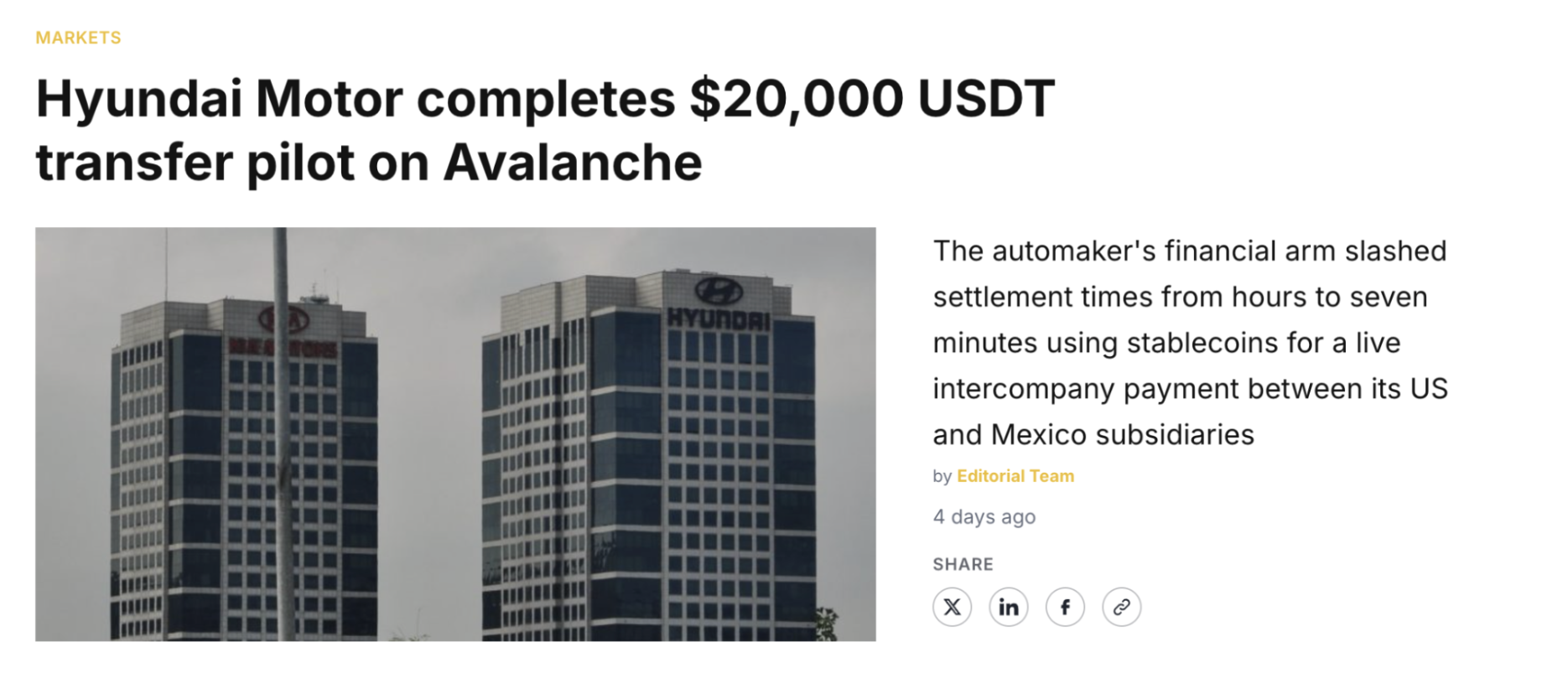
Source: Crypto Briefing
These projects also cover different segments of the financial market, from corporate payments to tokenized securities. The mix of use cases shows that Avalanche is now being used to support a broader range of financial services rather than serving a single use case.
"What that means for someone onboarding through ChangeNOW is less abstract than it sounds. The same institutional flows that bring BUIDL, JAAA, ACRED and others on-chain also deepen liquidity, harden the infrastructure, and make AVAX the settlement asset sitting underneath all of it. So when a user swaps into AVAX, they're not just buying a token, they're buying access to the rails institutions are now standardizing on. Over time, that convergence is what makes tokenized yield products and on-chain finance reachable for ordinary users, not just qualified purchasers." — Joey Cuccaro
As more institutions launch products on Avalanche, AVAX now serves as the settlement layer behind new financial products and services.
Want to get exposure to the Avalanche ecosystem? You can buy or swap AVAX on ChangeNOW in just a few clicks using crypto or supported fiat payment methods.
Behind every financial company, a team has to choose the right infrastructure. Companies want infrastructure that fits their product, keeps costs predictable, and gives them control over how their network operates.
Nearly 80 Layer 1s are already running on Avalanche, and Ava Labs expects that number to continue growing as more institutions move on-chain. According to Joey Cuccaro, teams are choosing it because of Avalanche's architecture and its ability to let teams launch dedicated Layer 1s built around a specific product or workload.
"The teams that keep building share one thing above all: they came to Avalanche for the technology and stayed because it delivers. They want sub-second time to finality, some of the most economic fees and blockspace costs in the industry, and an architecture that lets them launch a sovereign L1 tuned to their exact needs rather than competing for shared blockspace. With the L1 model, a team can configure its own execution environment, set its own fee market, and isolate its workload so congestion elsewhere never spikes its costs - all while staying connected to the wider ecosystem." — Joey Cuccaro
This level of control explains why teams with different technical and operational needs continue choosing Avalanche. Some need high throughput, while others prioritize their own network economics or an isolated execution environment. Dedicated Layer 1s allow them to meet those requirements without competing for resources with other applications.
Privacy matters just as much as transparency. It is often seen as a strength in public blockchain applications, but enterprise finance comes with different requirements.
Companies are rarely willing to expose treasury movements, internal settlements, or payroll transactions to competitors. Avalanche developed the eERC standard for these use cases.
"Privacy is increasingly part of that calculus as well. With Avalanche's eERC standard, teams can issue tokens where balances and transaction amounts stay completely confidential. That unlocks use cases that a fully transparent chain can't serve - enterprise payments, salaries, treasury moves, and internal token economies that simply can't be exposed to competitors. For institutions, that combination of confidentiality and auditability is often the deciding factor." — Joey Cuccaro
For enterprise applications, privacy is often a requirement rather than an option. The ability to keep sensitive data confidential while preserving auditability makes these use cases difficult to support on fully transparent blockchains, from internal settlements and corporate payments to tokenized financial instruments.
Cuccaro points out that projects across very different industries tend to prioritize the same infrastructure requirements.
"That performance, control, and privacy is the common thread, whether a team is building a high-frequency trading venue, a consumer loyalty program serving millions, or a tokenized securities platform. They're all optimizing for the same fundamentals: speed, cost, sovereignty, and confidentiality. Teams that prioritize those items tend to find there's no real substitute, and that's what keeps them building here." — Joey Cuccaro
Regardless of the industry, the priorities remain the same: speed, predictable fees, infrastructure control, and privacy. Cuccaro believes this combination is what keeps teams building on Avalanche.
The upgrade was a success – and the data confirms it.
AVAX swaps on ChangeNOW rose 82.1% month over month in May 2026. Although these figures are specific to ChangeNOW, they highlight how quickly demand for AVAX can grow as activity across the ecosystem increases.
According to Joey Cuccaro, this is exactly what happened after the Octane upgrade.
"The chain activity and volume response was dramatic. The C-Chain went from roughly 300K transactions per day in early 2025 to an average of 2.5M daily in 2026 - an approximate 10x increase." — Joey Cuccaro
Transaction growth alone does not explain where the activity came from. More important is that the increase in activity came from several parts of the ecosystem rather than a single popular sector.
"What is particularly interesting is that this surge did not stem from a single origin, but rather materialized from across the entire ecosystem. The influx was driven by institutional adoption, consumer applications, tokenized real-world assets, and stablecoin activity just to name a few. Additionally, new categories began contributing to ecosystem growth as well - over 1,600 AI agents launched on the C-Chain through ERC-8004 after it went live in February." — Joey Cuccaro
Growth across institutional products, stablecoins, RWAs, consumer applications, and AI makes that momentum more sustainable than a short-lived surge driven by a single trend.
Another change was easier to miss. After Octane, it wasn't just existing users who became more active. New teams also began building on Avalanche.
"Beyond that, a major influx of new participants spanning institutions, developers, protocols, and applications migrated to Avalanche to capitalize on its unique economic structure and capabilities." — Joey Cuccaro
These changes point to a new role for Avalanche. Rather than being just another Layer 1, it now supports new financial products and services.
Toward the end of the conversation, Joey Cuccaro offers a different view of blockchain adoption. Real success will come not when people talk more about blockchain, but when they stop noticing it altogether.
"The most underrated use case on Avalanche right now lies in 'invisible' adoption, applications and integrations where the people using them have no idea a blockchain is involved." — Joey Cuccaro
Joey points to several examples of this approach, including loyalty programs for the LSU Tigers and Detroit Pistons, as well as Balcony, which is helping tokenize roughly $240 billion in property records for a county in New Jersey.
For end users, the technology fades into the background, leaving the service in the spotlight while blockchain becomes the underlying infrastructure that keeps it running.
This also changes the role of AVAX within the ecosystem.
"For ChangeNOW's users specifically, the underrated angle is that AVAX is quietly shifting from 'a thing you trade' to the settlement underneath all of this activity. Most people swap in and out of AVAX as a position, while fewer have noticed it's becoming the plumbing for the industry." — Joey Cuccaro
As more products launch on Avalanche, AVAX is increasingly becoming part of the infrastructure behind new financial services.
Cloud services, banking APIs, and payment networks all became part of everyday life. Blockchain may be heading in the same direction, and Avalanche is building with that future in mind.
The interview with Joey Cuccaro suggests that the success of blockchain infrastructure is no longer defined by technical performance alone. Increasingly, it depends on whether a network can support real financial products. Avalanche is positioning itself around that goal.


SimpleSwap vs ChangeNOW 2026
A detailed head-to-head review of ChangeNOW and SimpleSwap — from transaction times and pricing to security and user experience.
(Updated: )
Crypto Mass Payouts: How Platforms Can Pay Thousands of Users
Paying one person in crypto is easy. Paying thousands is an infrastructure problem. Here’s how mass crypto payouts work with CSV, APIs, wallets, and email-based payments.

Token2049 Singapore Day 1 Recap: Big Stages, an OKX Office Tour and 128 Cups of Coffee
From Tom Lee's bull market talk to a plush poop: so lively, so different Token2049 Singapore Day 1, recapped.


