What can go wrong with a stablecoin that still holds $1? Plenty. The chart looks calm, but the route can still bite: a thin book, a bad spread, a rejected network, a stuck deposit, or a payment record that sends finance into detective mode.
USDT is where crypto trades first. Spot pairs, perps, collateral, OTC desks, P2P buyers, panic exits – liquidity gathers there before it spreads elsewhere.
Traders do not care which stablecoin has the better story in that moment. They ask whether the book can take the order right now.
USDC enters the conversation when the transfer has to be explained after it lands: invoices, treasury records, issuer disclosures, reserve reports, and counterparty checks.
In 2026, the choice starts in the transfer screen: the pair you need, the chain you choose, the wallet that receives it, the fee you pay, and the place where the money has to land.
Disclaimer:This content is for informational purposes only and does not constitute investment advice or a recommendation to invest in any crypto asset whatsoever.
Key Takeaways
A USDT transfer on Tron and a USDT transfer on Ethereum can behave like two different products once fees, wallet support, and deposit rules enter the picture.
USDT is built into active trading, fast exits, and altcoin routes where liquidity and spreads decide the result.
USDC works for payments, invoices, business records, and counterparties that care about reserve disclosures.
Before sending USDC or USDT, check the network, contract address, wallet support, withdrawal fee, minimum deposit, and destination rules.
Choosing USDC or USDT: Matters of Liquidity
Liquidity is not just a market metric. It decides how much money you actually receive after a trade, swap, or exit.
In stablecoin markets, liquidity means a few practical things:
how many trading pairs support the stablecoin;
how deep the order books are;
how tight the spread is between buy and sell prices;
how many buyers or sellers are available when the amount gets larger;
whether you can move through one direct route or need extra conversions.
This is where USDT still has the edge in most crypto-native markets.
USDT usually has broader exchange coverage, deeper trading pairs, and stronger liquidity across altcoin routes. That makes it especially useful when users need to enter or exit positions quickly, move through less popular pairs, or reduce slippage on larger swaps.
FAQ
Often, yes, but not by default. USDT usually has deeper order books, more exchange pairs, and stronger altcoin routes across many crypto-native venues. That can make it more efficient for trading, hedging, exchange transfers, or fast exits.
Still, the better route depends on the exact pair, exchange, chain, spread, and order size. Before placing a larger trade, check order book depth, recent volume, estimated slippage, and whether an extra conversion is needed.
USDC may be a better fit for business payments when documentation, reporting, counterparty review, or regulated payment flows matter. Its reserve disclosures and regulated positioning can make transactions easier to explain to finance teams, auditors, and payment partners.
That does not make USDC risk-free or automatically better for every payment. Businesses should still check the chain, wallet support, fees, contract address, settlement route, platform risk, and local compliance requirements before sending funds.
Fees depend on the chain and platform. Compare gas, withdrawal fee, minimum deposit, receiving network, and wallet support before sending.
Yes. Both can move below or above $1 during bank stress, redemption pressure, exchange issues, or market panic.
Hold USDT if the next move is likely a trade. Hold USDC if the next move needs audit-ready records, issuer disclosures, or regulated counterparty support. Many users keep both and decide at the transfer screen.
No. They are dollar-pegged crypto tokens, not bank dollars. They still carry issuer, blockchain, exchange, wallet, and regulatory risks.
The one with better route depth and destination support. Check spread, limits, network fee, receiving wallet rules, and support quality.
It depends on the pool, chain, protocol, and exit liquidity. Check token contract, pool depth, smart contract risk, oracle setup, and withdrawal path.
USDC, meanwhile, can be very strong in different contexts: regulated platforms, payment flows, institutional routes, and selected DeFi ecosystems. Its liquidity is not weak, but it is often more concentrated around specific platforms, chains, and use cases.
For a small transfer, the difference may be barely noticeable. A simple stablecoin swap or payment can work almost the same with either USDC or USDT.
The difference becomes more visible when the route is larger or less liquid. A bigger exit from a thin altcoin pair may have better execution through USDT because more buyers, sellers, and direct pairs are available. With USDC, the same route may require an extra conversion, wider spread, or lower available depth.
The stablecoin can still stay close to $1. The loss usually comes through execution: worse fill, extra swap, higher spread, or a less efficient route.
This does not make USDC weak. USDC can have strong liquidity on regulated platforms, selected exchanges, payment flows, and institution-facing routes. But in many crypto-native venues, more trading pairs, deeper books, and faster exits still sit around USDT.
Practical rule is simple:before choosing USDC or USDT, check where your actual route has better liquidity. The best stablecoin is not always the one with the cleanest reputation. Sometimes it is the one that gets you in or out with the least friction.
Why USDT Still Runs Crypto Trading Routes
USDT, also called Tether, is the largest dollar-pegged stablecoin by market cap. It launched in 2014 and became one of crypto’s main quote currencies across exchanges, OTC desks, spot markets, and derivatives venues.
Tether’s transparency page says issuer assets exceed liabilities and gives circulation and reserve reporting. Tether presents USDT as pegged to the U.S. dollar and backed by its reserves.
Traders keep using USDT because many markets already quote against it. During a sharp sell-off, the question gets simple: which book can absorb the order without turning the exit into a worse trade?
If the altcoin already trades against USDT and the market is dropping, the exit route is sitting in front of the user. Moving through USDC first can mean another conversion, another spread, and another chance to get a worse fill.
USDT’s liquidity does not help when the user cannot reach the market. Regulation, exchange policy, regional rules, and deposit-network support can turn a deep asset into a blocked route for one specific account.
Binance said it would delist trading pairs associated with non-MiCA compliant stablecoins for EEA users, including USDT-related pairs. Reuters reported that Coinbase planned to restrict services for certain stablecoins in the EEA under MiCA rules by December 30, 2024.
The problem is access, not only the peg. A trader may hold USDT and still lose the intended route if an exchange removes the pair, blocks deposits on the selected network, disables conversion, or changes collateral rules before the position closes.
USDT starts causing problems when:
the exchange removes USDT pairs in the user’s region;
the account falls under EEA or another strict compliance regime;
the platform trades USDT but rejects the deposit network the user picked;
a margin venue changes collateral or settlement rules before exit;
the user needs direct redemption, audited reporting, or regulated counterparty comfort;
the destination supports USDT on one chain but not the chain the user holds.
Example: a trader holds USDT on Tron because the fee is low. The next exchange accepts USDT only on Ethereum or has removed USDT pairs for that region. The global market is still deep, but the user now has a routing problem: convert, bridge, withdraw through another platform, or sell into a worse pair.
The “USDT has deeper liquidity” argument needs a second check here. A deep market does not help if the account, region, or network blocks access to it.
The video below gives Tether’s own view of how Tether tokens work.
For USDT, the working questions stay blunt: what backs it, where it can be redeemed, which exchanges support it, and how deep the route is when the market moves.
Why USDC Fits Payments Records And Treasury Work
USDC is a dollar-pegged stablecoin issued by Circle. It launched in 2018 and built its reputation around transparency, regulated access, institutional integrations, and payments.
USDC belongs in workflows where the payment trail matters more than the fastest exit. The point is documentation: who paid, which wallet received funds, which issuer backs the token, and how the record will look later.
Circle says USDC is 100% backed by highly liquid cash and cash-equivalent assets. Circle also says USDC is redeemable 1:1 for U.S. dollars and supported by independent attestations conducted by a Big Four accounting firm.
Circle states that USDC is natively issued on 33 blockchain networks, which gives it broad reach across wallets, payment apps, DeFi protocols, and on-chain settlement routes.
A finance manager doesn’t want to decode crypto Twitter FUD before approving a payment rail, but does want reserve clarity, redemption language, records, and a stablecoin that fits the paperwork.
USDC has its own scars. Reuters reported that USDC lost its dollar peg in March 2023 after Circle disclosed exposure to Silicon Valley Bank. The peg later recovered. The lesson was blunt: even a cleaner stablecoin still depends on banks, reserves, issuers, and market confidence.
USDC And CENTRE
USDC also carries the CENTRE backstory. Circle and Coinbase originally created CENTRE as a governance and interoperability framework for fiat-backed digital dollars, so USDC was not designed only as an exchange balance. The idea was closer to an open payment layer: digital dollars moving between wallets, apps, exchanges, and payment products.
The governance structure changed in 2023. Circle and Coinbase announced that CENTRE would no longer exist as a stand-alone entity and that Circle would bring USDC governance and operations in-house. The history still matters for this comparison: USDC grew from an interoperability-first idea, which helps explain why it often feels stronger in payments, fintech integrations, business records, and regulated counterparties.
When USD Coin Makes More Sense
USDC makes more sense when the transfer has to survive paperwork after it lands. A business, payment team, fund, or treasury desk needs a traceable payment record: issuer records, reserve reporting, invoices, counterparty checks, and accounting notes that do not turn into manual cleanup later.
USDC makes sense when:
you need clean records for invoices, reports, or internal accounting;
your counterparty asks for USDC instead of USDT;
you work with platforms that review issuer transparency and reserve reporting;
you plan to hold stablecoin exposure beyond one quick trade;
you use DeFi pools where USDC liquidity is deep enough for the amount;
reconciliation, reporting, and counterparty comfort matter more than the deepest trading pair.
Where USDC Routes Get Complicated
USDC is easier to document, but the route can still push back.. The weak spots tend to appear on DEXs, bridges, smaller chains, and altcoin markets where USDT has the deeper book.
A user may choose USDC for the record and still get a worse trade. The pool is thin. The route needs a bridge. The receiving app accepts bridged USDC, but not native USDC. Another chain has native USDC, but the exchange deposit page lists a different version.
Circle describes CCTP as a protocol for native 1:1 USDC transfers between supported blockchains. Circle’s developer docs describe the burn-and-mint model behind CCTP, which avoids traditional bridge liquidity pools and wrapped tokens on supported routes.
Native USDC and bridged USDC can lead to different deposit, accounting, and recovery outcomes.
the altcoin trades mainly against USDT;
the DEX pool has weak USDC depth;
the route needs bridged USDC instead of native USDC;
the wallet shows the same ticker, but the contract is different;
the destination accepts USDC on one chain and rejects another;
the chain loses direct issuer support or relies on exchange routing.
Reuters reported that Circle ended support for USDC on Tron in 2024. Chain support can change even when the ticker stays familiar.
Example: a user wants to send USDC from a wallet to an exchange. The wallet holds bridged USDC on a smaller chain. The exchange deposit page accepts native USDC on Ethereum, Base, or Solana, but not that bridged contract. The token looks correct in the wallet. The route is wrong.
“USDC is safer” is too broad for real routing. A stronger paper trail isn’t fixing a thin pool, a wrong contract, or a bridge route with weak exit liquidity.
Circle’s older Money Movement episode gives USDC a real payment-flow context: wallets, business payments, marketplace checkout, supplier payouts, and local currency conversion.
For businesses, Circle explains how USDC can move through payment and marketplace flows. The payment only works if the receiver can accept, record, and reconcile it without extra back-and-forth.
USDC vs USDT By Transaction Type
The right choice depends on what you are actually doing: trading, sending, holding, paying, or moving funds across chains.
Transaction Type
USDT Usually Fits Better When…
USDC Usually Fits Better When…
Trading or exiting a position
The asset has deeper USDT books, tighter spreads, and stronger exchange liquidity
The USDC pair has enough depth and gives a cleaner route
Altcoin swaps
The market mostly trades against USDT
The platform offers a direct and liquid USDC route
Moving funds between platforms
Both platforms support the same USDT network with low fees
Both platforms support the same USDC network and the fee route is better
Wallet-to-wallet transfers
The recipient already uses USDT on that chain
The recipient requests USDC or needs cleaner payment records
Business payments
Speed, market access, or local USDT demand matters more
Invoices, accounting, compliance, or payment documentation matter more
DeFi deposits
The protocol has deeper USDT pools and stronger exit liquidity
The protocol has stronger USDC pools, lending markets, or collateral support
Large transfers
The route can absorb size without spread damage
The receiving side values records, issuer clarity, or regulated rails
Regional access
Local platforms still support USDT without extra limits
The platform favors regulated or MiCA-aligned stablecoin issuers
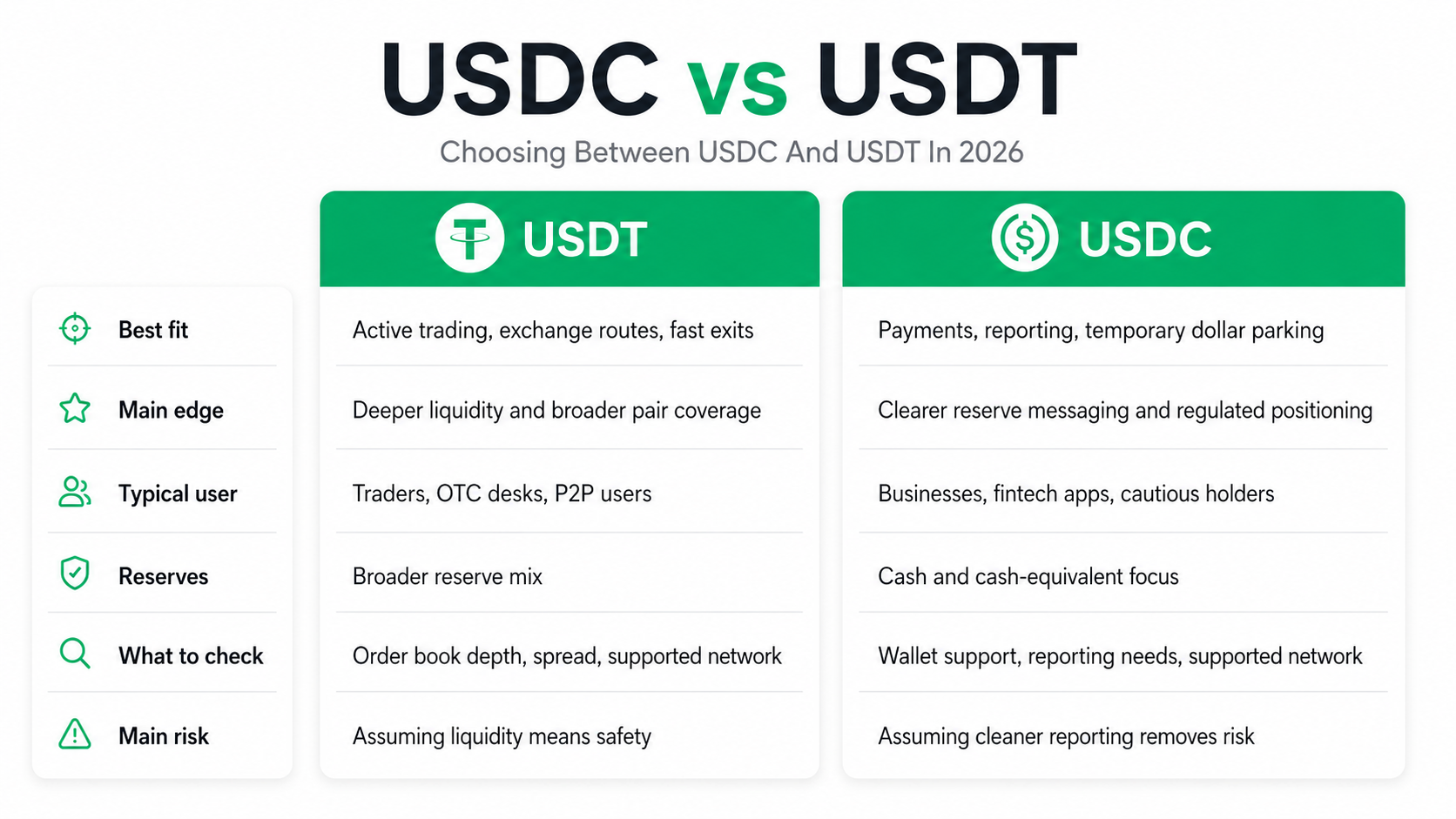
USDT may be better for liquidity. USDC may be better for records and regulated counterparties. The wrong chain, thin route, or unsupported token version can make either choice expensive.
Real Edge Cases Before You Send
A route can look clean until the deposit page says no.
Exchange transfer after a trade. You exit an altcoin into USDT because the book has real depth. The order fills. Good. Then the funds go to another exchange, and that exchange accepts USDT only on another network. Now the problem is no longer liquidity. It is a support ticket, a recovery form, and a “cheap” network that suddenly costs time.
Supplier payment in USDC. USDC may look like the adult choice: invoice, TXID, wallet address, amount, date, counterparty. Then the sender uses bridged USDC on a chain the accounting tool does not classify properly. The money arrives, but the file still needs manual cleanup.
DeFi exit liquidity. The lending market looks fine, the APY looks fine, the deposit goes through. Then the route back runs through a thin pool, and the price is worse than expected. Yield was visible. Exit liquidity was not.
Wallet transfer mistake. Right address, wrong token contract. Same ticker, wrong asset. The screen looks normal, but the destination does not support that version. Now the user is stuck waiting for manual recovery, probably over a transfer smaller than the headache.
Low-fee network trap. USDT on a cheap network looks attractive until the receiving platform credits USDT only on another chain. The withdrawal was cheap. Recovery became the real fee.
Compliance cleanup. USDC lands from a wallet or chain the company cannot map cleanly. The dollar value is there, but finance still needs a usable record, not a TXID floating somewhere in wallet history.
Difference Between USDT And USDC In Reserves
Reserve quality matters because a stablecoin is only as strong as the assets, redemption process, and trust structure behind it. A dollar peg is not a spell. It needs collateral, liquidity, market confidence, and functioning rails.
USDC has clearer public reserve language. Circle says USDC reserve holdings are disclosed weekly, with monthly third-party assurance from a Big Four accounting firm. The phrasing is short, direct, and easy to repeat in a finance meeting.
Tether’s reserve profile is larger and more mixed. Reuters reported that in Q1 2026 Tether’s USDT reserves included about $117 billion in U.S. Treasury bills, about $19.8 billion in gold, and about $7 billion in Bitcoin.
Neither answer should become copium. “Funds are safu” is a meme, not a risk model. A serious stablecoin check looks at reserve composition, issuer disclosures, redemption access, exchange support, legal structure, and market depth under stress.
Poor records create back-office work. Bad fills take money from the trade. One problem shows up in accounting. The other shows up in the executed price. Treating both as “stablecoin safety” makes the comparison too vague.
Frequent stablecoin users can outgrow one-off swaps once transfers become part of their weekly workflow. ChangeNOW Pro brings swaps, custody, cashback, and asset control into the same setup, so every transfer does not start from a blank route check.
USDC vs USDT fees do not come from the ticker alone. The chain often decides the cost.
Sending USDT on Ethereum can cost much more than sending USDT on Tron or another low-fee chain. Sending USDC on Ethereum can cost more than sending USDC on Base, Solana, Polygon, or another cheaper route. The stablecoin may aim to track $1. The transaction path can still be expensive.
A stablecoin transfer has four cost layers.
Cost Type
What It Means
Why It Matters
Network Fee
Gas paid to the blockchain
Changes by chain and congestion
Exchange Fee
Withdrawal, swap, or conversion fee
Depends on the platform
Spread
Difference between quoted and executable price
Grows when liquidity is thin
Recovery Cost
Time and support work after a wrong-chain transfer
Can cost more than the original fee
Chain choice also matters because not every platform supports the same USDC and USDT routes.
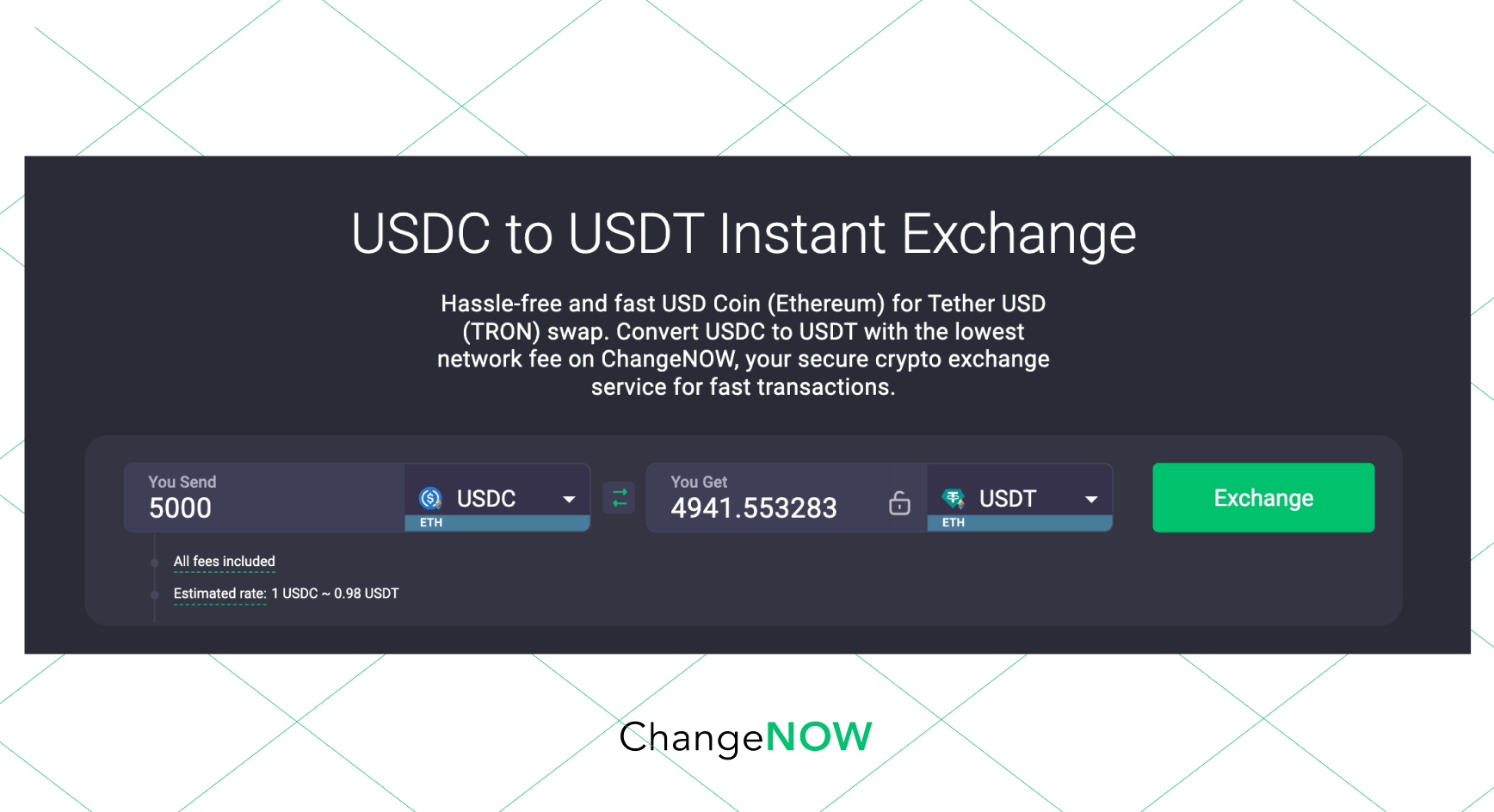
On ChangeNOW, users can exchange USDT across 17 networks, including KuCoin Community Chain, Avalanche, and NEAR. That gives users more room to choose a route based on wallet support, speed, fees, and destination requirements.
USDC is also available across multiple networks on ChangeNOW. Users can exchange USDC on 19 networks, including newer supported routes such as Mantle and SeiEVM. This is useful when users want to avoid high Ethereum fees or need a specific chain for payments, DeFi, or wallet compatibility.
Pro Tip:Before sending USDC or USDT, check the chain, contract address, withdrawal fee, destination wallet support, minimum deposit, and memo or tag requirements. Stable value does not protect against wrong-network mistakes.
Which One Is Safer In 2026
The safety debate breaks into two separate risks: execution risk and issuer risk.
USDT reduces execution risk on liquid routes when deeper books help limit slippage. If a trader needs to exit quickly, the main question is whether the order can clear without a bad fill.
USDC reduces reporting anxiety for users who care about reserve clarity, attestations, and regulated positioning. That matters more when the payment has to pass through finance, compliance, or counterparty review.
The U.S. side also matters in 2026. The White House said the GENIUS Act was signed into law on July 18, 2025 and provides for the regulation of payment stablecoins. This pushes the safety question away from slogans and toward checks that actually matter: issuer, reserves, redemption path, disclosures, platform support, and local rules.
A serious risk check is less emotional than the usual USDT vs USDC argument.
Risk Question
Stronger Answer
Why
Which has deeper trading liquidity?
USDT
Larger volume and wider trading pair adoption
Which has clearer reserve messaging?
USDC
More direct public backing language
Which is easier for business records?
USDC
Better fit for reporting and compliance review
Which works better in many exchange exits?
USDT
More crypto-native liquidity
Which is risk-free?
Neither
Both carry issuer, chain, market, and regulatory risk
Crypto Twitter turns this topic into a FUD arena fast. One side attacks Tether reserves, and the other brings up USDC’s 2023 depeg. Serious users need to name the risk before choosing a side: slippage, issuer exposure, redemption access, unsupported networks, frozen transfers, weak pools, or local exchange rules.
USDT vs USDC By Use Case
Active Trading
For active trading, USDT has the simpler path on many crypto-native venues: the pair is listed, the volume is there, and the exit may not need another conversion.
A trader watching order books cares about spreads, slippage, and execution speed. During a fast sell-off, the priority is getting filled before the next candle breaks lower.
USDC can still work for trading, especially on exchanges and chains where USDC pairs have strong depth. For many altcoin routes, USDT still feels like the main road.
Temporary Dollar Exposure
USDC works for users who care about reserve clarity, reporting, and regulated rails while holding dollar exposure between transactions.
A trader who sold today and plans to buy again tomorrow may stay in USDT because the next pair will probably use it. Someone parking funds for a supplier payment may choose USDC because the transfer will need a clearer record later.
Neither stablecoin should be treated as a bank deposit. Both are private digital tokens with issuer, market, chain, and platform risk.
Payments And Business Use
USDC makes more sense for business payments, invoices, and treasury workflows when the record matters after settlement. Its reserve messaging and regulated positioning give finance teams fewer loose ends to explain.
USDT can work well for payments in markets where it has massive user adoption. In some regions, USDT behaves like a crypto-native dollar rail because users already recognize it and wallets already support it.
A small merchant may accept USDT because customers already have it in their wallets. A larger company may push for USDC because the payment has to pass through invoices, treasury review, and counterparty checks before anyone can close the file.
DeFi And On-Chain Moves
In DeFi, the chain, protocol, pool depth, and bridge route matter more than the stablecoin logo.
USDC has strong usage across many DeFi apps, especially in institution-facing and payment-adjacent flows.
USDT remains heavily used in liquidity pools, exchange routes, and cross-border transfers.
Before depositing either stablecoin into DeFi, check the token contract, chain, pool liquidity, bridge path, smart contract risk, and withdrawal depth. A strong stablecoin cannot save a weak pool.
Fast Swaps
For simple swaps, the practical check is short: rate, network, fee, minimum amount, and receiving wallet support. ChangeNOW works well at this step because the user can check the route before sending funds.
The best stablecoin for a swap is the one the next wallet can actually receive.
Pre-Send Checklist Before Moving USDC Or USDT
A two-minute check can save a support ticket.
Check these points first:
Trading pair depth: which pair has the tighter spread and stronger order book?
Network support: does the receiving wallet support the exact chain you plan to use?
Withdrawal fee: does the exchange charge more for one network than another?
Token contract: are you sending the official token, not a fake copy?
Redemption path: can the issuer or platform support redemption if market stress hits?
Counterparty preference: does the exchange, business, or recipient prefer USDC or USDT?
Regional rules: are there local restrictions that affect one stablecoin more than the other?
Time pressure: are you calmly moving funds, or trying to exit before the market moves again?
USDC and USDT dominate the stablecoin conversation, but they are not the only options. For a wider market view, see ChangeNOW’s guide to the top stablecoins and how they differ.
Final Verdict on USDC vs USDT
USDT may fit better when the next move depends on market depth: trading, hedging, exchange transfers, altcoin routes, or a fast exit. It does not remove issuer, platform, or chain risk, but deeper liquidity can reduce the damage from weak order books, wider spreads, and extra conversion steps.
USDC may fit better when the next move needs a clearer payment trail: invoices, supplier payments, treasury notes, counterparty review, or regulated payment flows. It does not remove execution or platform risk, but it can make the transaction easier to document, explain, and reconcile after it lands.
There is no universally safer choice for every transaction. The better stablecoin depends on the route, chain, counterparty, platform support, fees, liquidity, and reporting needs.
Before sending either stablecoin, check the pair, chain, wallet, fee, spread, contract address, and exit path. For larger amounts, compare at least one backup route before moving funds.


 This does not make USDC weak. USDC can have strong liquidity on regulated platforms, selected exchanges, payment flows, and institution-facing routes. But in many crypto-native venues, more trading pairs, deeper books, and faster exits still sit around USDT.