Tether (USDT) is a stablecoin designed to track the value of the US dollar. Simply put, 1 USDT is meant to equal roughly $1 at all times.
That “roughly” part matters more than people like to admit, but we’ll get to that later.
Unlike decentralized cryptocurrencies, USDT is issued by a centralized company - Tether Limited. This means new tokens don’t just magically appear through mining or staking. Instead, they are created and removed through a controlled process:
Minting: new USDT is issued when demand increases
Burning: USDT is removed from circulation when it’s redeemed
This constant adjustment of supply is what helps keep the price stable around the $1 mark.
In practice, Tether acts less like a typical crypto asset and more like a digital version of cash inside the crypto ecosystem. It’s widely used for trading, storing value between volatile moves, and moving funds across exchanges without touching traditional banking systems.
And yes, that convenience is exactly why it became so dominant. The complications come right after.
How Does Tether Work?
The mechanics behind USDT are surprisingly straightforward, at least on paper.
When users (usually large institutions, not an average retail trader) deposit fiat currency with Tether Limited, new USDT is minted and sent into circulation. On the flip side, when USDT is redeemed for fiat, those tokens are burned, effectively removed from supply.
This constant in-and-out flow is what keeps the system balanced.
Behind all of this sits the idea of reserves. Tether claims that every USDT is backed by real-world assets, which typically include:
U.S. Treasury bills
Cash and cash equivalents
Other short-term financial instruments
The goal is simple: ensure that there’s enough backing to support redemptions and maintain the $1 peg. Whether that backing is always as clean and liquid as it sounds is… a longer conversation. We’ll get there.
Why Does USDT Exist?
Crypto markets are volatile to the point of being emotionally exhausting. Prices swing, narratives flip, and portfolios can look very different within hours.
USDT exists to solve exactly that problem.
First, it provides price stability in an ecosystem where most assets behave like caffeinated squirrels. Traders can move into USDT during uncertainty without exiting crypto entirely.
Second, it acts as a bridge between fiat and crypto. Instead of constantly moving money through banks, users can switch between cryptocurrencies and USDT as a proxy for dollars.
Finally, it enables fast, global transfers without relying on traditional banking systems. Bank transfers depend on intermediaries and can take days to clear. With crypto, you send USDT wallet to wallet, and it’s done.
That combination of stability, accessibility, and speed is what turned Tether from a niche tool into a core piece of crypto infrastructure. Not necessarily beloved, but definitely unavoidable.
Time to talk about the part everyone pretends not to care about until something breaks: the company behind the “stable” coin.
Tether Company & Background
Tether is a company with a story, a structure, and a network of relationships that shape how USDT operates in the crypto world.
History of Tether
Tether didn’t start as the giant it is today. Back in 2014, it launched under the name Realcoin, which honestly sounds like something a scam would call itself before rebranding into something more respectable.
Not long after, it became Tether, and its growth closely followed the expansion of the crypto market itself. As trading volumes exploded, so did the need for a stable, dollar-like asset inside the ecosystem.
A key detail that never really goes away: Tether has long been closely linked to the crypto exchange Bitfinex. The two share management and ownership ties, which has raised eyebrows more than once over the years.
It doesn’t automatically mean something shady is happening, but it does mean independence might be limited.
Tether’s Leadership & Structure
Tether is not decentralized. Not even a little.
It operates under a centralized structure, where the company has complete control over:
token issuance (minting new USDT)
token destruction (burning)
reserve management
This means there’s no DAO, no community governance, and no “code is law” philosophy. Decisions are made internally, and users have to trust that those decisions are sound.
That level of control is exactly what allows Tether to function efficiently. It’s also exactly what makes some people uncomfortable.
Business Model of Tether
Tether’s business model is almost offensively simple.
They issue digital dollars, hold real-world assets as backing, and earn yield on those reserves. A large portion of that comes from U.S. Treasury bills, which generate steady, low-risk returns.
And when you scale that across tens of billions of dollars in circulation, the result is… a lot of money. Like, billions in profit.
Tether operates very similarly to a private digital bank, just without the same level of transparency or regulatory structure you’d expect from traditional financial institutions.
Which is either impressively efficient or mildly terrifying, depending on how much trust you’re willing to extend.
USDT Across Blockchains (Full Tether Networks Breakdown)
Before diving into specific networks, there’s one thing people constantly misunderstand:
USDT is not tied to a single blockchain.
Instead, it’s issued across multiple networks. Each version (ERC-20, TRC-20, etc.) is technically a separate token on a different chain, but all of them are backed by the same underlying reserves managed by Tether.
In practice, that means:
1 USDT is still meant to equal $1, regardless of the network
but fees, speed, and usability vary a lot depending on where you’re using it
So choosing a network isn’t just a technical detail. It directly affects how painful or convenient your experience is.
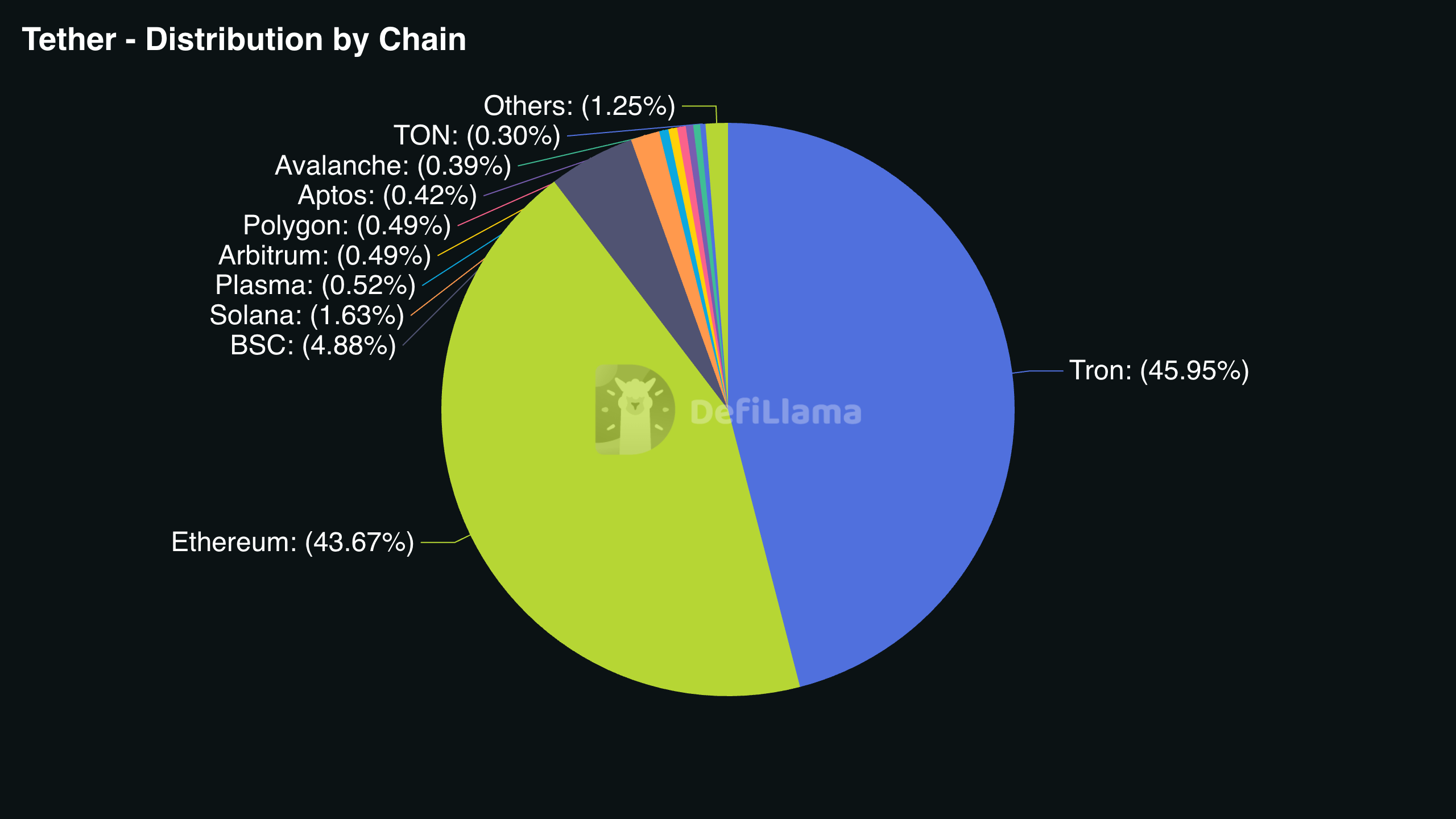
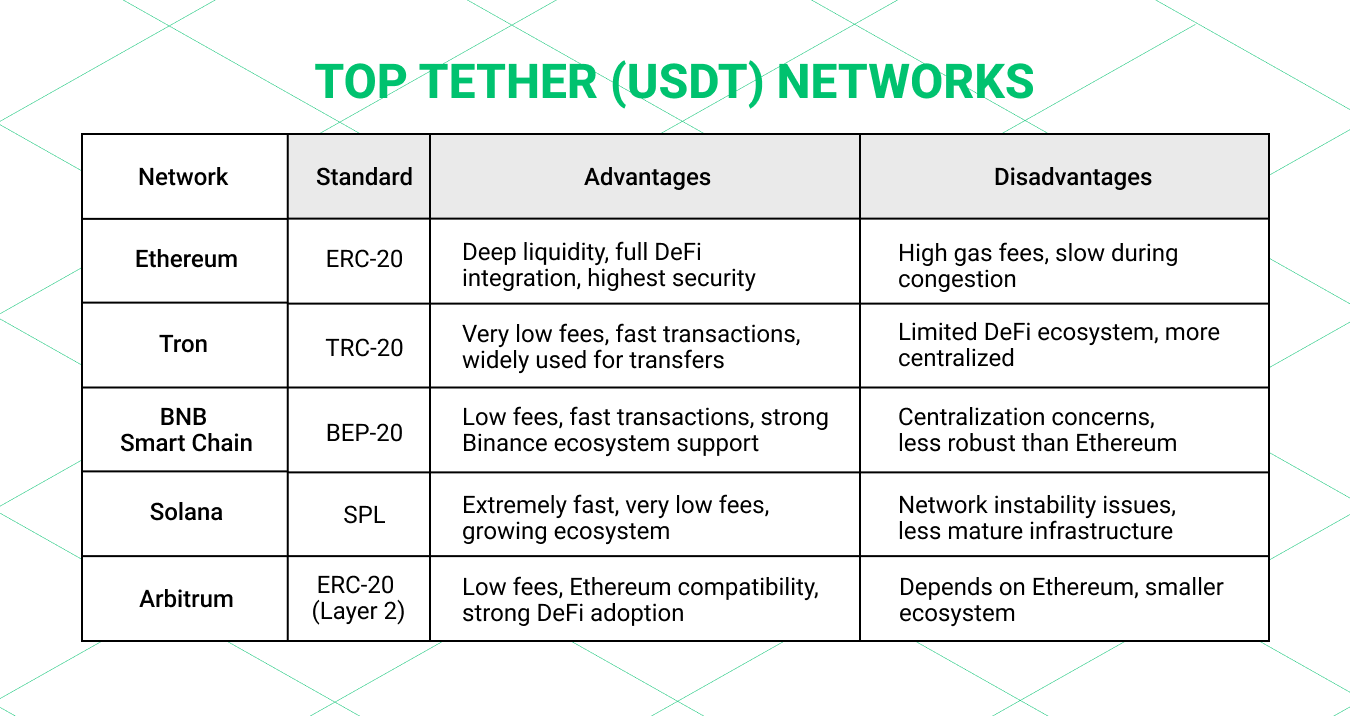
Top five networks include Ethereum, TRON, BNB Smart Chain, Solana, and Arbitrum, and they are the most popular ones that the users of USDT are currently utilizing.
In the sections below, we will take a closer look at each of the networks (including less popular ones), their pros and cons, and the best uses for them.
Tether on Ethereum (USDT ERC-20)
This is the “original power player” version of USDT.
USDT on Ethereum (ERC-20) is:
deeply integrated into DeFi
supported by almost every major protocol
backed by massive liquidity
If you’re interacting with lending platforms, DEXs, or anything remotely complex, this is usually the default.
The downside is exactly what you expect: gas fees.
Ethereum can get expensive fast, especially during network congestion. Moving USDT here can feel less like a transaction and more like a small financial decision.
Still, if you care about ecosystem depth and composability, ERC-20 is hard to beat.
This is where things get very practical, very fast.
USDT on TRON is:
fast
widely used for global transfers and arbitrage
cheaper than Ethereum in most cases. However, sometimes the Tron network behaves strangely and demands high fees, which Reddit users have noticed:
TRC-20 USDT dominates a huge portion of real-world transaction volume, especially in regions where people just want to move money without losing chunks of it to fees.
In fact, Tron and Ethereum are constantly competing for USDT trading volume, often passing each other in daily activity. If ERC-20 is the “financial infrastructure” version, TRC-20 is the “actually usable day-to-day” version.
In our previous article, we broke down Tron and stablecoins in more detail. Make sure to check it out.
Somewhere between Ethereum’s complexity and TRON’s simplicity sits BNB Smart Chain.
USDT on BSC (BEP-20) offers:
low fees and fast transactions
strong adoption among retail users
tight integration with the Binance ecosystem
It’s especially popular for users who are already inside Binance or using BSC-based apps. The environment is familiar, transactions are cheap, and the barrier to entry is low.
The trade-off is a more centralized ecosystem compared to Ethereum, which at this point, shouldn’t surprise anyone.
USDT on Solana is built for speed. And not in a marketing sense, but actually fast.
It offers:
high throughput (thousands of transactions per second)
very low fees
a rapidly growing DeFi ecosystem
Solana has positioned itself as a performance-focused chain, and USDT fits neatly into that narrative. Transfers are quick, cheap, and smooth when the network behaves.
The catch is reliability. Solana has had periods of instability in the past, which is not ideal when you’re moving what’s supposed to be “stable” money.
Still, for users who prioritize speed and cost, it’s an increasingly popular option.
Avalanche is built around one idea: speed with finality.
USDT on Avalanche offers:
fast transaction finality (2 sec)
solid presence in DeFi ecosystems
growing interest from institutional experiments and tokenized assets.
For instance, Avalanche saw the total value of tokenized real‑world assets surge to over $1.3 billion in 2025, driven by growing institutional activity like BlackRock’s $500 million fund launch. And RWA is quite a hyping topic right now.
It’s not the biggest USDT network, but it sits in that interesting middle ground where both retail and more serious players are actively building.
This one feels different, because it’s tied to something people actually use daily: Telegram.
USDT on TON benefits from:
deep integration with the Telegram ecosystem
growing use in peer-to-peer payments
a user experience that feels closer to messaging than traditional crypto
It’s still early compared to giants like Ethereum or TRON, but the distribution advantage is obvious. When your wallet can live inside a chat app, adoption doesn’t have to fight as hard.
Algorand leans heavily into efficiency and clean design.
USDT on Algorand provides:
fast and low-cost transactions
a network built with institutional use cases in mind
a reputation for technical reliability
However, Tether has suspended support for USDT on Algorand as part of its strategic review of legacy blockchains. Minting was stopped earlier, and the network is no longer actively supported, meaning users should avoid using this version of USDT for new transactions.
USDT Networks: Fees, TPS, Finality comparison
However, not all USDT networks are equal. Although the value of USDT remains constant, the underlying structure can significantly impact how fast and how much a transaction costs.
The table below highlights a comparison of the most commonly used networks, based on three main criteria: throughput (TPS), finality, and fees.
Network
Approx. TPS
Finality (Approx.)
Typical Network Fees
Ethereum (USDT ERC-20)
~12–15 TPS
~10–12 min
High — typically $2–$20+ depending on congestion
TRON (USDT TRC-20)
~50–100 TPS
~10-60 sec
Very low — ~$0.001–$0.02
BNB Smart Chain (USDT BEP-20)
~80–150 TPS
~2–8 sec
Low — ~$0.01–$0.30
Solana (USDT SPL)
~2000–4000 TPS
~0.3–13 sec
Extremely low — ~$0.0002–$0.001
Polygon (USDT)
~110-550 TPS
~2–5 sec
Very low — ~$0.01–$0.10
Arbitrum (USDT L2)
~20–50+ TPS
~2–5 sec
Low — ~$0.02–$0.50+
Optimism (USDT L2)
~10–30+ TPS
~2–5 sec
Low — ~$0.05–$0.70+
Avalanche (USDT)
~50–200 TPS
~1–2 sec
Low — ~$0.10–$0.30
TON (USDT)
Tens of thousands possible
~6 sec
Very low — ~$0.001–$0.02
Final Thoughts
TL;DR – which USDT network to use
Ethereum (ERC‑20) – DeFi, lending, big liquidity, higher fees.
TRON (TRC‑20) – Fast, cheap, everyday transfers.
BSC (BEP‑20) – Binance users, low-cost, simple.
Solana (SPL) – Ultra-fast, very low fees, occasional instability.
Dogwifhat (WIF): Inside the Community Behind the Meme Coin
What keeps a meme coin alive after the first viral moment? WIF contributors explain how creators, culture, participation, and a dog in a pink hat built a brand without a traditional crypto company.