Welcome to the ChangeNOW Blog. Here we focus on research, real use cases, and practical insights — not hype. While we double-check our facts, nothing here should be taken as financial advice; crypto is a high-risk space, and your own research always matters.
Swaps reach a wallet through a crypto swap API integration. Your team builds the flow and sets the pricing. ChangeNOW runs the exchange, the liquidity and the infrastructure under it. This guide covers the build side of that arrangement for a product team deciding whether to ship swaps.
How do you integrate crypto swaps into a wallet
Swaps go in through the API, into the app you already run. ChangeNOW processes the exchange on its side and the user stays inside your interface, which keeps the swap in your existing flow.
What do you build, and what does ChangeNOW handle
Your side
ChangeNOW's side
The business logic: where swaps sit in the wallet and how the flow behaves
The exchange itself: sourcing CEX and DEX liquidity and trading each swap
Which pairs you expose
Infrastructure, nodes, and updates
Your margin on every swap
Uptime and response time (claimed 99.99% / 350 ms)
How the swap is presented (White Label or aggregator) and how you route it
Support: a personal manager and a 24/7 desk
Which rate types you wire up (float, fixed)
Risk calls: halting tainted funds and the KYC behind a release
Your developer places the API calls to match. It is a REST crypto exchange API. The documentation describes every endpoint plus a standard flow that covers roughly 90% of partner projects. You wire up the calls your flow needs and skip the rest.
Setup takes two steps: registration in the partner dashboard, then the API key. The agreement is a Click-Wrap checkbox at registration. A separate signed contract is available on request at any stage, if your legal team wants one.
Nothing upfront with ChangeNOW. Registration, the API key and the documentation are free, and there is no platform fee after launch. Instead, you earn from 0,4% on every transaction your users make. As monthly turnover grows, partners qualify for volume-based terms, including commission discounts and features that are not open by default.
Licensing depends on your jurisdiction and belongs with your legal counsel. The integration itself does not add a compliance function on your side. The wallet stays non-custodial, screening happens at ChangeNOW, and a normal swap involves no KYC step for the user at all. KYC appears only on the refund branch described above, and KYB only if you take profit out in fiat.
ChangeNOW offers entry points of different depth. A referral link or button launches fastest and tests whether your audience wants swaps at all, though it sends the user out of your app. A widget is a ready-made exchange interface you place inside your product, with less build effort and less control over layout. The API keeps the swap in your native flow and hands you the pairs, the rate types, the commission and the error handling.
For a feature you want to test, a link is enough. For a revenue line you intend to manage, the API is entry point.
An aggregator collects quotes from several venues, asks the user to choose one, and routes the order out. ChangeNOW trades the exchange itself and returns a single rate, which is what makes a one-price White Label flow possible inside your interface.
Yes. Wallets commonly run ChangeNOW alongside other providers and route each request through their own algorithm. Under White Label the user still sees one rate and the routing stays invisible.
The routing logic is yours to build and maintain. It is the one piece of a multi-provider setup that no integration delivers for you.
It's that simple: an experienced team can go live in about two days. With testing in a dedicated test environment before production, a realistic timeline is closer to two weeks, including pre-launch checks.
Your product stays available throughout. The work happens in your test environment and switches to production when you are ready.
Business development stays with you from first contact through launch, including technical questions. What remains on your side is the part only you can decide: where the swap belongs in the wallet and how it behaves.
How does a crypto swap work inside a wallet
For the user it is instant crypto exchange: pick a pair, enter an amount, confirm. Under it, your wallet requests an estimate through the API, a crypto swap provider like ChangeNOW returns a rate and a deposit address, the user's funds leave the wallet for that address. Then ChangeNOW trades the pair on its own side and sends the output to the receiving address. Your interface follows the status from deposit to payout. What the user never sees is the depth that pair is traded against. ChangeNOW's liquidity covers more than 1,500 coins across 90+ networks. All of them are inter-exchangeable, which is what makes cross-chain swaps possible. On top of that sit more than 2,250,000 pairs, including rare ones that are hard to find elsewhere. At the point of the trade, all of it surfaces as a single rate.
Why does the user see only one rate?
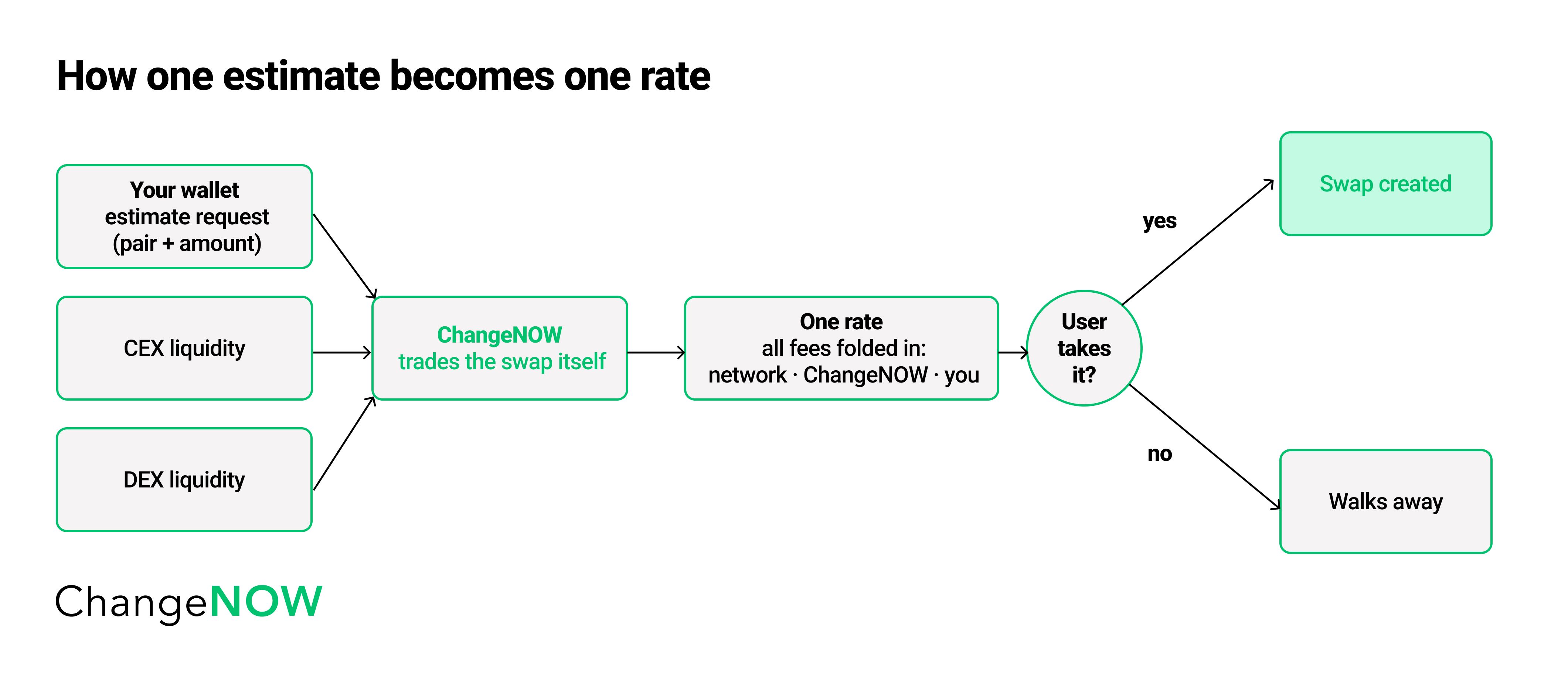
Because ChangeNOW quotes as the counterparty to the trade. Your wallet sends a pair and an amount, one internal rate comes back, and every fee is already inside it: the network's, ChangeNOW's, and yours. That number is the price the swap is created at, and the user's decision is to take it or leave it.
Liquidity comes from both CEXs and DEXs, and ChangeNOW trades the exchange itself, on its own side. When your wallet sends an estimate request with a pair and an amount, one internal ChangeNOW rate comes back, with every fee already included: the network's, ChangeNOW's, and yours. The user takes that rate or leaves it.
White label or aggregator: which model fits a wallet
The layer on top of that rate is yours to design.
Under White Label, the user never sees that a third-party provider processes the swap. They enter a pair and an amount inside your interface, one rate appears, and the handoff stays invisible. Most wallet partners choose this model.
The crypto swap aggregator model works in the other way: the user sees several providers with their rates and picks one. In a wallet, where the swap is one feature among many, a provider-selection screen adds a decision the user did not come for.
Either model can sit on top of several liquidity providers at once. ChangeNOW alongside others, with your own router choosing between them per request. The best rate is where most routers start to select. But the rate is just a quote. What the user judges the wallet on is the payout.
Teams that run swaps as a revenue line should see the whole picture:
how close payouts land to estimates across a real sample of swaps,
median completion time on the pairs,
how often a provider stops a transaction and what it takes to release it,
how the API holds up at your peak hours.
How accurate is the rate the user sees?
The estimate is the rate the swap is expected to process at. It already carries every fee plus the risk of what can move between the quote and the trade. Two things move it: a user who confirms the swap and funds it twenty minutes later, and a market that keeps trading in the meantime. ChangeNOW's own breakdown of why a received amount can differ from the estimate comes down to the same mechanics: a network fee deducted from the sending amount, or the rate shifting while the deposit is confirmed.
The distance between quote and payout has a name, payout-to-estimate accuracy, and it is a figure to ask a provider for. ChangeNOW's own number: roughly 95% of swaps pay out exactly the estimate or more than it.
Fixed vs floating rates for wallet swaps
The standard (float) rate carries an allowed deviation, currently capped at 3%. ChangeNOW's own statistics put actual deviations well below that ceiling.
The fixed rate removes the deviation by moving the risk onto the provider: ChangeNOW pays exactly the shown estimate even when the market moves against the trade. Every registered partner has fixed rate available by default.
In the API, float and fixed are separate endpoints. You integrate whichever you need and decide separately whether to expose the choice to the user.
Where the rate comes from rarely becomes a question for partners, as long as it stays close to the market. A minority audit it closely and ask why a quote differs from Binance or CoinMarketCap. ChangeNOW positions its rate as the best available across both standard and fixed flows, on the grounds that it trades to that rate from deep CEX and DEX liquidity while the user runs no comparison across exchanges.
How do crypto wallets earn from swaps
A wallet earns from swaps by setting its own commission on top of the exchange rate. It sits inside the quote the user sees, it accrues to your partner balance on every completed swap, and nothing is charged back to you for running it. Swap commission is one of several ways a crypto wallet can make money. But one of the most common and profitable after all.
How do you set your swap commission
Partner commission starts at 0.4% of every user's swap. You set the number before integration and can change it at any time, up or down or to zero, per individual asset, per pair, or by swap size. Both sides earn on exchange volume, which puts you and ChangeNOW behind the same goal of growing turnover. That's why we help young wallets grow together.
The Free Fast Track Program by ChangeNOW addresses early stage wallets, and intake is capped at three wallets a month. A selected wallet gets targeted placements across crypto media, with cumulative reach above 10M. It also gets exposure to ChangeNOW's combined social audience of 100,000-plus, and a place at tier-1 conferences in the 15,000-attendee range. The 0.4% crypto revenue share runs from the first day of integration.
There is no ceiling on the number. Whatever your model needs, 1%, 3% or 7%, the dashboard will take it. The limit comes from your own audience instead: commission rides on top of the rate, so every point you add shows up in the quote.
Per-pair control is where the pricing decision gets interesting. On a unique pair with no competing route, a higher commission still converts, since users have nowhere cheaper to go. On top-traffic pairs, a lower commission buys volume.
In any case, the ChangeNow team of experts will always advise you on the best commissions, based on our experience.
Payouts default to crypto, in any of 11 currencies you choose. A fiat route exists and works differently. It runs through a third-party provider with its own KYB, and ChangeNOW does not process it, which adds a compliance step and an outside dependency to what would otherwise be a single payout action.
Payouts in currencies outside the default set are open to discussion on request.
What happens after you launch swaps
Who maintains the swap infrastructure?
ChangeNOW takes the infrastructure, the nodes and the updates after launch, so that maintenance never lands on your team. Its published figures are 99.99% availability, 350 ms response time, and a 10-minute window for accident warnings.
A personal manager and 24/7 support come with the account from launch. The business development contact who handled the integration stays available afterwards.
What if a user sends the wrong amount or the wrong network?
Every swap runs through a deposit address, which leaves room for the wrong currency, the wrong network, the wrong address, a duplicated transaction, or a missing memo or tag. The most frequent case is a deposit that arrives a few dollars short of what the swap expects.
Push, refund and continue are dedicated endpoints for these situations. You trigger the fix from a button in your own interface, and the user avoids a support queue on either side.
Some cases resolve automatically and others by hand. The user keeps their funds in both, even though the error is formally theirs. The fix can carry a fee for them: paying around $50 to recover a wrong-network deposit compares well against losing $10,000.
What happens if a transaction is flagged?
The second class of problem is the funds themselves. ChangeNOW halts a transaction when they look tainted on its side. That is a judgment call and it can be wrong, so there are routes back. A false positive is released or refunded. Where there is no reason to hold the funds but a push cannot be completed, they are refunded once the user clears KYC. Serious cases hold the funds until police or a formal investigation take over.
These stops are rare, and the screening that produces them keeps gray funds off your rail.
Is a non-custodial wallet liable for the source of user funds?
A non-custodial wallet cannot vet where user funds came from, and under the partner terms it does not have to. Responsibility for the source of funds sits outside your account, which is the exposure a DEX arrangement would leave with you.
When ChangeNOW distrusts a transaction, the block lands on that transaction. Your account keeps running. A CEX used as a crypto liquidity provider works differently: one problematic user can freeze the whole account and the liquidity inside it.
What does the integration look like stage by stage
Stage
You and your team
ChangeNOW
Setup and agreement
Register in the partner dashboard and pull the API key the integration runs on. Accept the Click-Wrap agreement, or request a signed contract if your legal team wants one.
Issues the dashboard and key. Partner terms are ready at registration.
Scope and decisions
Decide where swaps sit in the wallet and how the flow behaves, which pairs you expose, which rate types you wire up, and your starting commission.
Keeps the full liquidity ready to draw on
Build
Your developer places the API calls your flow needs against the REST docs. About two days for an experienced team.
Endpoints, the documented standard flow, and the liquidity behind them are already built. A business development contact fields questions through launch.
Testing and switchover
Run the integration and the pre-launch checks on a dedicated test environment, closer to two weeks end to end, then switch to production when it is ready.
Your live product stays available until you flip the switch.
After launch
Trigger deposit fixes (push, refund, continue) from your own interface when a user misfires.
Carries infrastructure, nodes, and updates. Staffs a personal manager and a 24/7 desk.
Should you build swaps in-house or integrate them
All of this is buildable. A wallet could source its own CEX and DEX liquidity, run the nodes, price pairs, screen deposits for tainted funds, and staff the recovery and support flows behind them.
The obstacle is that it never ends up as one project. Crypto wallet development is a big job itself. And routing swaps on your own becomes a department with a monthly budget that continues after launch, whether or not swaps grow into a real revenue.
Integration delivers the same capability on a two-week timeline, with liquidity, uptime, risk calls and failed deposits staying on ChangeNOW's side from the day you ship. The decision for a product team comes down to whether swap infrastructure is something the wallet wants to own, or something it wants to switch on.
A BD-focused guide to October 2026's three main crypto conferences, TOKEN2049 Singapore, Money20/20 USA, and Ripple Swell, rated by deal potential, with dates, venues, ticket prices, and where to meet the ChangeNOW team.
DeFi App Development in 2026: Everything You Need to Know
A practical guide to building a DeFi app in 2026, covering revenue models, core features, tech stack, a seven-step launch process, cost ranges by project tier, and the security and regulatory risks teams need to plan for.
The article breaks down every way a crypto exchange earns money, from trading fees and the spread to listings, staking and custody, and shows how the business model decides which streams a platform can bill for.
How to Integrate Crypto Swaps Into a Wallet via API | ChangeNOW Blog