


Executive Summary
Integrating a native, API-driven execution layer can transform a static asset storage tool into a high-retention transaction hub. For Cake Wallet, addressing a key conversion bottleneck through a strategic infrastructure partnership enabled significant user growth while maintaining lean operations.
By implementing the ChangeNOW API for in-wallet swaps, the platform captured market demand without increasing internal technical debt.
Welcome to the ChangeNOW Blog. Here we focus on research, real use cases, and practical insights — not hype. While we double-check our facts, nothing here should be taken as financial advice; crypto is a high-risk space, and your own research always matters.
Key Performance Metrics:
- 117x User Base Growth: Expanded from 15,000 downloads to over 1.75 million users.
- Sustained Engagement: Maintained 300,000 Monthly Active Users (MAU) with retention rates above industry benchmarks.
- Lean Scaling: Delivered native multi-asset functionality with no ongoing maintenance required from the core team.
When Disjointed UX Becomes a Business Risk
As user portfolios shifted from single-asset (Monero) holdings to more complex, multi-asset distributions, Cake Wallet identified a significant risk: the absence of an internal execution layer. Users could store assets, but managing them required leaving the app.
Fragmented transaction flows introduce multiple points of failure:
- Suppressed Conversion Rates: Friction during execution reduces completed swaps, limiting platform utility and revenue.
- Eroded Lifetime Value (LTV): When a product serves only as a storage vault, user retention declines as clients move to platforms with unified execution.
For Cake Wallet, this business risk was uniquely compounded by its strict privacy-first architecture. Operating with zero behavioral analytics, the product team could not rely on traditional funnel tracking to identify micro-drop-offs. Consequently, macro transactional friction became the most critical visible risk to long-term retention. Resolving this required shifting the product from a passive holding environment into an active execution layer.
Bypassing Tech Debt via Infrastructure Delegation
To achieve this shift, Cake Wallet faced the classic "build vs. buy" decision. Building a custom cross-chain aggregator would require significant engineering resources, ongoing node maintenance, and complex liquidity management. After evaluating the technical debt, the team chose to integrate the ChangeNOW API.
By delegating the execution layer, including routing, liquidity aggregation, and cross-chain mechanics, to an established infrastructure partner, the platform maintained lean operations. This allowed Cake Wallet’s engineering team to focus on core security protocols and UI improvements.
This integration also addressed the team's analytics challenge. Since Cake Wallet collects no behavioral data to protect user privacy, internal visibility was limited. Through the ChangeNOW API, the team gained a measurable proxy for user engagement: API swap volume became the primary indicator of asset demand and user behavior, while maintaining privacy standards.
Real-world API integrations are rarely without initial friction. During the early phases of the rollout, localized Monero liquidity constraints surfaced as a measurable limitation under sudden volume spikes. The constraint was temporary. ChangeNOW handled the added swap volume on its side, while Cake Wallet kept its own team focused on wallet security, product experience, and privacy.
Sustaining 300k MAU
Strategic infrastructure partnerships should be assessed on their ability to handle sustained user demand without adding operational complexity.
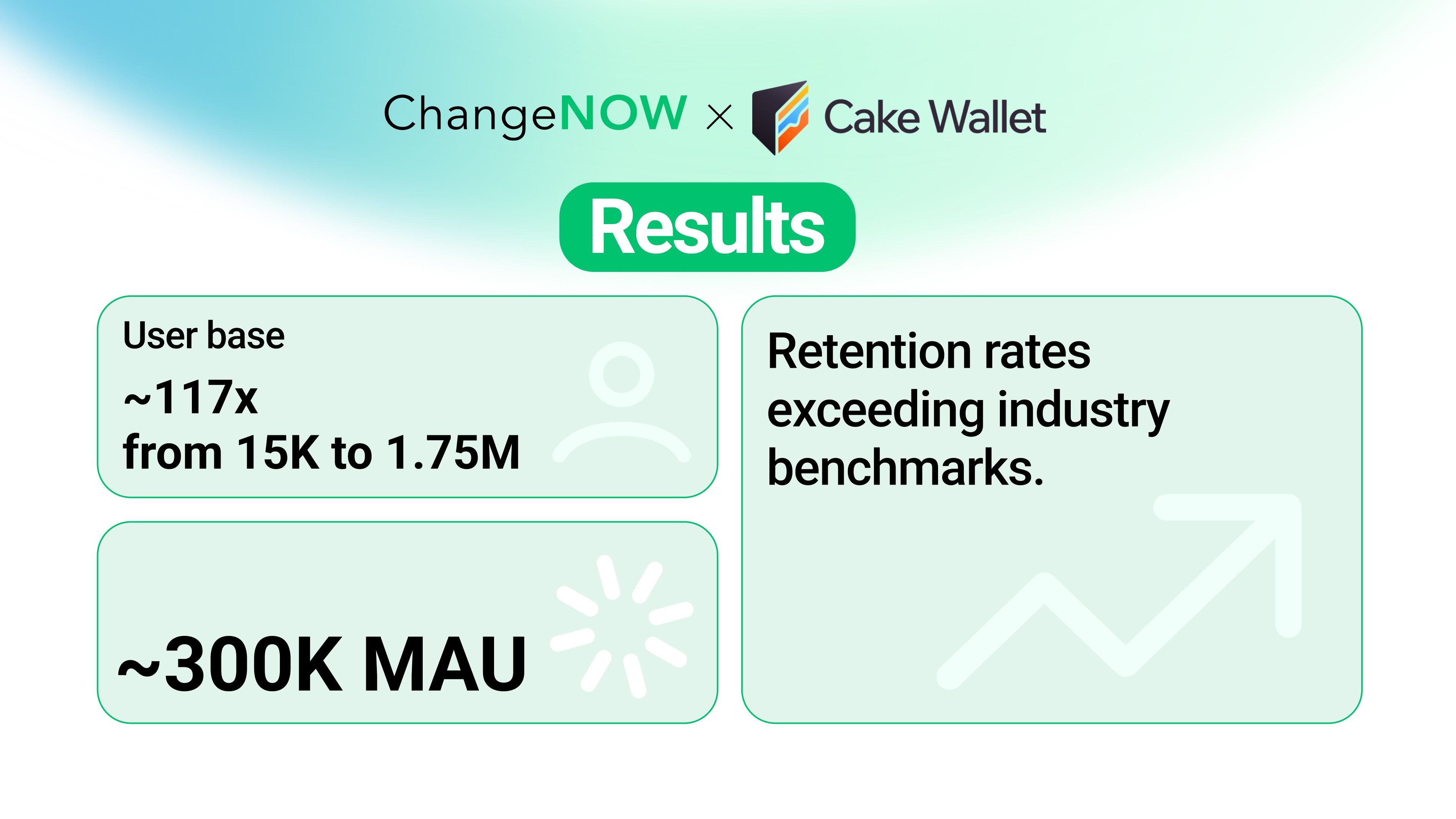
ChangeNOW infrastructure absorbed a significant increase in volume while improving retention rates above industry standards.
Key Scale Metrics:
- Uninterrupted Growth: The infrastructure enabled the platform to expand to over 1.75 million users.
- High-Volume Stability: Processes steady volume from 300,000 MAU with no maintenance required from the Cake Wallet team.
- Session Retention: Users transition from holding assets to executing trades within a single session, eliminating external drop-offs.
The long-term viability of delegating the exchange layer was confirmed by the core team's assessment of vendor reliability:
"After years of trying every swap provider out there, we can definitively say this: ChangeNOW has been incredibly reliable, consistent, and a favorite of our over one million users from the day we integrated. Simply top notch in every way."
The Fast-Track Infrastructure Lever
For CTOs and founders scaling early-stage wallets or Web3 applications, achieving similar growth requires optimizing both time-to-market and Customer Acquisition Cost (CAC).
ChangeNOW’s Free Fast-Track Program functions as a strategic go-to-market shortcut. It helps product leaders avoid the capital expenditure of building custom exchange infrastructure while unlocking immediate, high-value distribution channels.
The Fast-Track Package Includes:
-
API integration support for in-app multi-asset swaps, so wallet teams do not have to build liquidity management from scratch.
-
Co-marketing across ChangeNOW media channels and partner placements, with 300,000+ potential targeted reach.
-
Visibility through major industry events, with access to networks of 15,000+ attendees.
By leveraging enterprise-grade API infrastructure, fintech operators can expand platform utility, maximize conversion metrics, and scale their user base while maintaining zero operational complexity.


