For millions of people who lost access during the FTX collapse, the answer was no. They didn’t do anything wrong, it’s just that someone else was holding their keys.
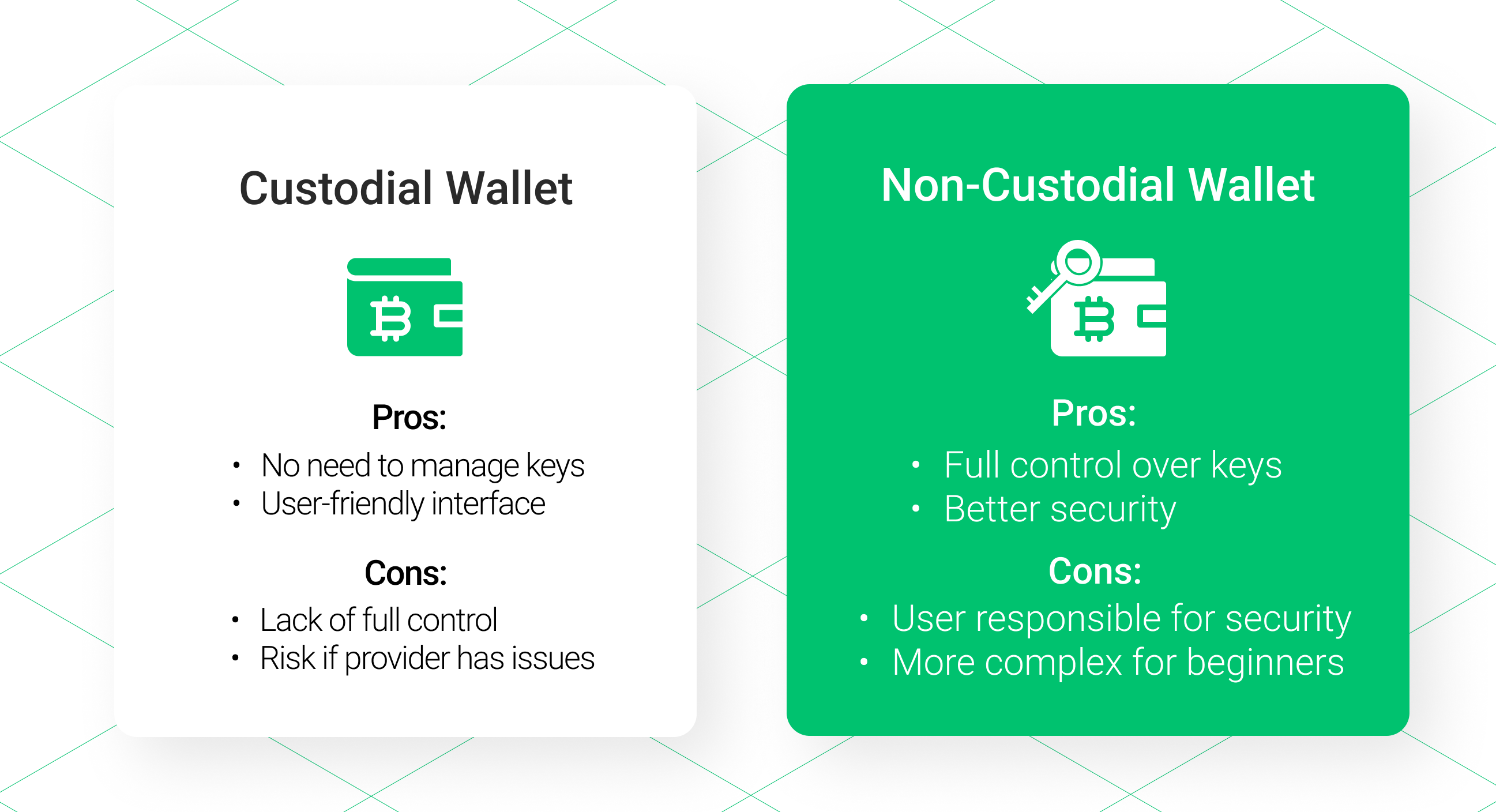
This is the only thing that actually matters in this custodial vs non-custodial wallet debate. At the end of the day, who holds the private keys holds the crypto.
Here's what that means for you in practice.
Custodial vs Non-Custodial Wallet: The Core Difference
A crypto wallet doesn't actually store your coins. It stores the private keys that prove you own them on the blockchain. Whoever controls those keys controls the assets. Full stop.
With a custodial wallet, a company holds your private keys on your behalf. You get an account, a password, maybe 2FA. It feels like online banking, because it basically is. The platform can freeze your account, require identity verification, or limit withdrawals. You're trusting them to act in your interest.
When you have a non-custodial wallet, you hold the private keys yourself. No company sits between you and your crypto. You get a seed phrase when you set up the wallet - 12 or 24 words that are the master key to everything.
Lose it, and there's no recovery. Keep it safe, and nobody can touch your funds without your permission.
What Custodial Wallets Mean in Practice
Custodial wallets are specifically designed to be convenient.
You sign up, verify your email, and you're in. Forgot your password? Support resets it. Switched phones? Log back in. It works exactly like every other app you use, which is precisely why it's the default choice for people new to crypto.
But comfort comes with a trade-off that only becomes visible when something goes wrong.
When the platform decides, you follow. Exchanges can freeze withdrawals, restrict accounts, or require additional verification at any point, often with little notice. During market volatility, this tends to happen exactly when you most want to move your funds.
You're an unsecured creditor, not an owner. If a custodial platform goes bankrupt, your crypto becomes part of their liabilities. FTX users didn't lose access because they were careless. They lost access because the company collapsed, and their assets were gone with it.
KYC is non-negotiable. Most custodial wallets require identity verification. For some users that's fine. For others, it's a hard stop.
None of this makes custodial wallets useless. For small amounts, frequent trading, or simply buying crypto for the first time, they do the job. The problem is treating them as long-term storage, or assuming that because your balance shows a number, you actually own what's behind it.
What Non-Custodial Wallets Mean in Practice
A non-custodial wallet hands you full ownership, and full responsibility. No company stands between you and your crypto. No platform can freeze your account, demand verification, or decide you've hit your withdrawal limit for the day.
When you set up a non-custodial wallet, you receive a seed phrase. Write it down, store it somewhere safe, and never share it with anyone. That's your entire security setup.
You can swap, send, and access your funds anytime. Connect to a DeFi protocol at 2am on a Sunday - nobody's stopping you.
Your wallet works across borders by default. No jurisdiction can freeze a non-custodial wallet the way it can freeze a bank account or an exchange. Your keys exist on your device, not on a server somewhere else.
But the seed phrase is the whole game. Lose your seed phrase and your funds are permanently inaccessible. There's no password reset for this thing.
The other real risk is human error: a person can approve a malicious transaction, download a fake wallet app, or share their seed phrase with someone posing as support.
Non-custodial wallets don't protect you from your own decisions.
Custodial vs Non-Custodial Wallet: Which One Do You Need?
The solution depends on what you're actually doing with your crypto.
You're buying crypto for the first time and plan to hold it passively: A custodial wallet is fine to start. Just don't treat it as permanent storage for significant amounts.
You're actively swapping tokens, using DeFi, or connecting to Web3 apps: you need a non-custodial wallet. Custodial platforms either don't support this or add enough friction to make it painful.
You want real ownership of your assets: Non-custodial, period. If the idea of a platform freezing your funds feels unacceptable, the answer is already clear.
You're holding a large amount long-term: non-custodial, ideally paired with a hardware wallet for an extra layer of offline security.
Most experienced crypto users end up with both: a custodial account for on-ramps and trading, and a non-custodial wallet where actual assets live. The custodial account is the front door. The non-custodial wallet is the vault.
How to Move Funds from Custodial to Non-Custodial Wallet
Switching is actually easy and mostly a matter of doing it carefully once, and never having to think about it again.
Step 1: Choose a non-custodial wallet. Pick one that supports the networks you use.
NOW Wallet, for example, supports 1500+ tokens across 70+ blockchains, requires no sign-up, and stores your private keys locally on your device.
Step 2: Write down your seed phrase. Physically. When you set up the wallet, you'll receive a 12 or 24-word seed phrase. Write it on paper. Not a screenshot, not a notes app, or a cloud document. Paper, stored somewhere you won't lose it.
Step 3: Send a small amount first. Before moving everything, send a small test transaction to your new wallet address. Confirm it arrives. Then proceed with the rest.
Step 4: Verify your access. Before you rely on the wallet for anything serious, try restoring it using your seed phrase on a second device. If it works, you know your backup is solid.
FAQ
A non-custodial wallet is a crypto wallet where you hold your own private keys. No company, platform, or third party has access to your funds. You control everything, which means you're also responsible for keeping your seed phrase safe.
As safe as you make it. The wallet itself can't be frozen, hacked remotely, or shut down by a platform. The real risks are losing your seed phrase, approving malicious transactions, or downloading a fake app. Following basic security habits and non-custodial wallets are significantly safer than leaving funds on an exchange.
Yes, and this is one of the main reasons people use them. Non-custodial wallets like NOW Wallet let you swap tokens directly within the app, without sending funds to an exchange first. Faster, simpler, and your assets never leave your control during the process.
Your funds become permanently inaccessible. Meaning you lose your crypto. There's no recovery option, and no support team that can help. This is why writing it down and storing it securely is the single most important step when setting up any non-custodial wallet.