A firmware bug dating back to March 2021 let attackers reconstruct private keys on certain Coldcard hardware wallets. Since July 30, 2026, approximately 1,850 BTC has been drained from over 5,4400 wallets across four attack waves [1] [2]. And the attack is still ongoing.
If you own a Coldcard, this guide tells you what to check, how to use the RBF rescue window if you're still in time, and what to do if your funds are already gone.
Coldcard hack: am I at risk, and what should I do right now?
Check your firmware version and when your seed was first generated. Mk3 devices on firmware 4.0.1–4.1.9 are confirmed at risk; Coinkite has also pushed precautionary patches for Mk4, Mk5, and Q. Updating firmware today does not fix a seed that was already created on vulnerable firmware.
My BTC transaction is unconfirmed in the mempool right now
You may still be able to save your funds using a Replace-By-Fee (RBF) rescue.
My funds are already confirmed as stolen
They are not recoverable through the device or seed. Move to damage control and prevention immediately (see below).
Should I move everything to an exchange or new wallet?
Yes, but only to a wallet whose seed was generated independently of the compromised device/firmware.
The news in brief
A silent 2021 coding error caused some Coldcard wallets to generate Bitcoin seeds using weak, predictable randomness instead of true hardware entropy. Attackers exploited this starting July 30, 2026, sweeping funds from thousands of wallets in coordinated waves. It is the largest documented theft from "cold storage" devices in Bitcoin's history.
Yana Mar, Head of B2B & Partnerships at ChangeNOW, explains why this case is especially sensitive to crypto users:
"What makes this such a significant story is that it involves a cold wallet, a device that's supposed to be the safest way to store crypto. It is the one typically chosen by users who prioritize security over convenience. On top of that, the attack has unfolded in multiple waves, which means the risk of the vulnerability being exploited again hasn't fully passed."
How to check if your Coldcard is at risk
Open your Coldcard and check the firmware version under settings.
Find out when your seed was originally generated. A seed created on vulnerable firmware stays compromised even after you update.
Cross-check your version against Coinkite's official security advisory for the exact affected ranges, since the list has been updated as the investigation progressed.
If you used single-signature storage with no additional entropy source (no dice-roll input, no BIP-39 passphrase), and your seed falls in the affected window, treat your funds as exposed regardless of balance size.
Search your receiving addresses on a block explorer (e.g., mempool.space) to see if any outgoing transaction you didn't create is pending or has already been confirmed.
How to save BTC in Coldcard wallet: the RBF rescue window
This is the single most time-sensitive part of this incident. During the most recent attack wave, researchers observed that some of the attacker's sweep transactions had Replace-By-Fee (RBF) signaling enabled, meaning they hadn't been confirmed yet and could still be outbid.
What does RBF mean? Bitcoin lets an unconfirmed transaction be replaced by a new one spending the same coins, as long as the new one pays a higher fee. Miners will generally include whichever version pays more. If the attacker's transaction is still unconfirmed, you can try to broadcast your own competing transaction with a higher fee and win the race.
Because the flaw is in the seed itself, you and the attacker both effectively "know" the same private key. That means you can spend from the address too, as long as you move before the attacker's transaction confirms.
Step-by-step guide to save your Bitcoin in Coldcard wallet
Check the mempool status of your address on a block explorer. Look for a pending, unconfirmed outgoing transaction you did not initiate, and check whether it shows RBF signaling.
Set up a new wallet. Do not use the one generated on the same device or firmware version. Use a different hardware brand if possible, or a freshly patched Coldcard with entropy verified via physical dice rolls, plus a strong BIP-39 passphrase.
Use wallet software that supports manual fee-bumping, such as Sparrow Wallet or Electrum, together with the key material you already have access to.
Fee-bumping is the act of rebroadcasting an unconfirmed Bitcoin transaction with a higher fee to speed up (or, in this case, win a race to) confirmation.
Build a new transaction spending the exact same unspent inputs, sending the full balance to your new, safe address, with a fee noticeably higher than the attacker's pending transaction.
Broadcast it immediately. A new Bitcoin block is mined roughly every 10 minutes, so your window closes fast.
Once your rescue transaction confirms, don't stop there. Move the funds again into a fully independent, verified wallet for long-term safety.
Important: This only works before the attacker's transaction confirms on-chain. Once confirmed, the funds cannot be recovered through this method.
Disclaimer: In practice, attackers behind large-scale sweeps like this typically run automated bots that monitor the mempool and instantly rebroadcast with an even higher fee the moment they detect a competing transaction — so winning this race by hand is far from guaranteed, even if you move fast. This method also only applies if the attacker's transaction explicitly signals RBF in the first place; if it doesn't, this option isn't available to you.
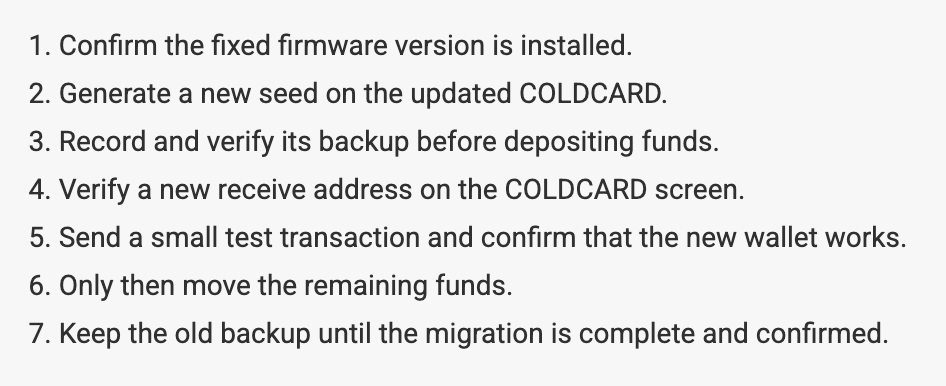
Coinkit published official instructions on asset migration:
If your funds are already gone
There is no way to reverse a confirmed Bitcoin transaction, and the coins cannot be "recovered" the way a hacked account password can be reset. That said, there are still concrete actions worth taking:
Document everything: the affected address, transaction ID, approximate time, and device/firmware history.
Report the address and transaction details to blockchain research teams actively tracking this incident and to your national cybercrime authority. Public tracking efforts have already flagged hundreds of attacker-controlled addresses to investigators and compliance firms.
Immediately audit and migrate every other wallet generated on the same device or during the same time window. A single Coldcard often generates several addresses and accounts; if one was compromised, treat all of them as compromised.
Be on alert for follow-up scams. After any high-profile hack, fake "fund recovery" services and fake support agents target victims. No legitimate service will ever ask for your seed phrase. Stay alert.
What exchanges and wallet makers are doing right now
Coinkite (Coldcard's manufacturer) has released emergency firmware patches, destroyed remaining vulnerable inventory, halted shipments of affected units, and published a public security advisory.
On-chain researchers are monitoring known attacker-controlled addresses in real time and have referred hundreds of flagged addresses to law enforcement and industry compliance teams.
Exchanges and swap platforms typically run AML/blocklist screening against known attacker addresses as a matter of standard compliance practice. It can block or flag stolen funds if the attacker tries to cash them out.
On-chain data shows a surge in small BTC holders moving funds to centralized exchanges for perceived safety. It's the highest volume of small transfers since the FTX collapse in 2022.
How to protect your funds in future: Coldcard lesson
The core lesson of this incident: controlling your own keys is not enough if the process that created those keys can't be independently verified.
"Going forward, I think users will become more cautious about which device they choose and will vet it far more carefully," – says Yana. "Coming back to the first point – a cold wallet still offers the highest level of security of any storage option available. The issue isn't the category itself, it's that not every cold wallet is secure enough."
A few concrete ways to protect your hardware wallet:
Multisig across different vendors. A 2-of-3 setup using hardware from different manufacturers means a single vendor's firmware bug can't drain your funds alone. An attacker would need to compromise multiple independent devices, not just one.
Use a BIP-39 passphrase. This acts as a "25th word" layered on top of your seed. Even with weak underlying entropy, a strong independent passphrase makes offline key reconstruction dramatically harder.
However, worth noting – it does not guarantee safety of your funds. What the community is saying: Bitcoin holders have been actively debating exactly this trade-off on Reddit since the exploit broke. A rough consensus is forming around "buys time, doesn't replace migration":
Verify entropy independently. Where supported, generate part of your seed from physical dice rolls rather than trusting the device's internal randomness alone.
Don't treat "generate once, forget forever" as safe. Periodically verify your setup with small test transactions, and don't assume a wallet is secure just because it's been untouched for years. That's exactly the profile of the wallets drained first in this attack.
Diversify custody. Don't keep all long-term savings in a single hardware wallet. Diversification – from assets you hold to places where you hold them – is everything.
Replace-By-Fee is a Bitcoin feature that lets you rebroadcast an unconfirmed transaction with a higher fee to replace a pending one. It only works if the original transaction explicitly signals RBF and hasn't been confirmed yet.
No. Updating prevents new seeds from being generated insecurely, but it does nothing for a seed that was already created on vulnerable firmware. The only real fix is generating an entirely new seed on patched firmware and migrating funds. Even better – send funds on another clean device.
Multisig significantly reduces risk if the keys come from different vendors and devices. An attacker would need to independently compromise each one. It does not help if all your multisig keys were generated on the same flawed device or firmware.
The most severe, confirmed impact has been on Mk3 devices running firmware 4.0.1–4.1.9. Coinkite has also issued precautionary patches for Mk4, Mk5, and Q devices. Accessory products (TAPSIGNER, OPENDIME, SATSCARD) are not affected.
Bitget has confirmed a major security breach affecting approximately $387.5 million in assets across its hot and warm wallet infrastructure. Private-key compromise has been ruled out.