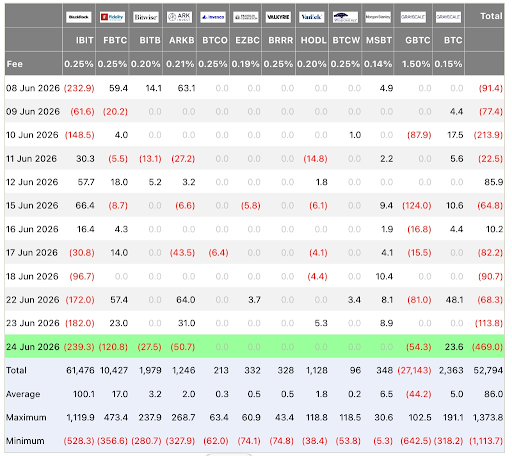
Bitcoin spot ETFs have recorded huge net outflows for more than a month now, the latest one on June 24. In total, Bitcoin ETFs have bled $4.5+ billion.
Traders are starting to worry and seek answers on Reddit. No wonder.
The Fear and Greed Index is at Extreme Fear again.
And yet the funds supposedly to blame for this, like BlackRock's IBIT, are doing just fine. Share counts keep climbing despite panicky headlines.
So either the headlines are wrong, or the scary "outflow" may not mean what you think it means.
Let's figure out what actually moves when a fund posts a negative number, what's hiding behind that number, and why the same $3 billion can mean "nothing" to a Bloomberg analyst and "everything" to a guy refreshing CoinGlass at 2 a.m.
This one post summarizes traders’ reactions and the sentiment in general: a big “red” figure creates uncertainty and confusion.
Here’s how most of us analyze the situation:
ETF inflow means institutions are buying → Institutions buying means the price goes up → The price going up means you're right to hold.
When you reverse that logic, ETF outflow starts to look like a really worrying sign.
Green number - good, red number - bad. That's how it all usually feels, right?
It's actually a faster and simpler way of thinking. Nobody doomscrolling X at night wants to reverse-engineer Authorized Participant mechanics. They want one signal to tell them what’s going on.
And that is how the $171,980,000 outflow suddenly becomes the reason BTC is slowly dying. Again.
Xena Kash, ChangeNOW Blog Managing Editor and former CEO of NOWPayments & NOWNodes, describes this tactic of setting the narrative this way:
"News media often add fuel to the fire by using expressive graphics like bright-red charts with arrows pointing down and all. It's basically a subconscious panic signal for less experienced traders before they've even read the headline. And honestly, the best, most timeless advice here is to stay rational and skeptical about whatever you read in the news, because we all know that media's bread and butter is grabbing your attention. Panic signals and dramatic spin are the perfect way to do exactly that, and rack up the clicks while they're at it."
ETF Outflows: What an Expert Sees
Eric Balchunas, a senior ETF analyst at Bloomberg, didn’t mince words calling $3 billion leaving a $100 billion market is "totally meaningless."
He also said that even when Bitcoin's down almost 50% from its high, the money that came in through ETFs is basically all still there.
But how? Check out this table.
Red numbers you see are basically those very outflows everyone is talking about. Notice how there are black numbers too and those are inflows.
And if you scan two weeks of data really closely, you’ll notice how almost every big red number sits in the same column with the title “IBIT”.
That’s BlackRock’s iShares Bitcoin Trust, and it became the main source of red numbers in June.
In the three days since June 22 alone, the fund lost almost $600 million.
So, is this “meaningless” too? Depends for whom. Someone has to actually sell real BTC to fund all those redemptions, and that sure creates pressure on the BTC price.
Which is roughly what showed up that same week: BTC slid toward $59k on June 24, its worst stretch in two weeks.
Fun fact: on June 24, blockchain trackers spotted BlackRock moving 2,700 BTC and nearly 53,000 ETH straight to Coinbase.
Which means BlackRock didn't suddenly decide Bitcoin was a bad bet. They just did their job: when enough people cash out of an ETF, the fund has to hand over real coins, and those coins have to go somewhere liquid enough to convert into cash. But why "enough people" decided to cash out of an ETF - that's an interesting question indeed.
Also, when actual coins land on an actual exchange dangerously close to the sell button... that makes traders antsy.
Here's how Kirill P, Product Manager at ChangeNOW and market enthusiast, breaks down the likely reasons behind latest ETF outflows:
“I think, as usual, it's a combination of a few things coming together at once:
1. The main trigger was the Fed. They signaled that rate cuts aren't happening anytime soon, and in situations like that, big players typically rotate out of riskier assets into safer ones.
2. Geopolitics, specifically Iran, added pressure across markets at the same time.
3. A technical breakdown. On June 5, Bitcoin broke below the key $62K support level, which triggered $1.5B in long liquidations. That's not a direct cause of ETF outflows, but it amplified the pressure and fear in the market.”
Does this mean you shouldn’t pay much attention to ETF outflows at all? No. You just need to know what to watch and what to ignore.
Expert Takes on ETF Outflows: When Should You Worry?
We asked our product manager Kirill P to list things traders should pay attention to when analysing news about another ETF outflow.
It might be a worrying signal when:
Not just one fund selling. A single ETF bleeding money usually means a single large account rebalancing. But it's a whole different story when outflows show up across several funds at the same time. A bunch of big players sharing a similar portfolio decision? Maybe they know something we don’t.
Price doesn’t recover on calm days. In a healthy market, price usually bounces back a little on the days without outflows because someone else steps in to buy the dip. When that stops happening, that means there are no buyers. No buyers = no interest in the asset.
It's crypto specifically, not stocks. If equities are holding steady while crypto ETF outflows continue, that's suspicious. Big money might think crypto isn't where it wants to be right now.
None of these on their own is a fire alarm. But when all three line up, you may be observing the actual capital walking out the door.
Chronicles of Panic: Headlines vs Reality
Every few months, we see the same headlines in the news: ETFs bled millions, billions, trillions, whatever, and the verdict is already written before anyone checks what actually happened.
Here are some real cases of past ETF outflows and the results they brought.
Case 1: March 18, 2026
The Fed had a meeting, which made the market nervous, and $129 million walked out of Bitcoin ETFs in a single session.
What went unnoticed: that single outflow day followed seven consecutive days of inflows totaling $1.47 billion. If we do the math, turns out that week was still a 91% retention story.
Perfect example of how one bad afternoon doesn't erase a good week, but does make a better headline, though.
How the price reacted: BTC dipped after the FOMC announcement, then recovered within about a week - the usual "sell the news" pattern that's hit Bitcoin after most 2025-2026 Fed meetings.
Case 2: 2024-2025
The GBTC chart had been bleeding out for over a YEAR. The media insisted "Investors Are Dumping Bitcoin."
Grayscale has lost over $22B since converting to a spot ETF. Most of that money correlates almost perfectly with inflows to IBIT, FBTC, and ARKB.
The math is mathing: GBTC charges 1.5% a year, while IBIT and FBTC charge 0.25%. Nobody was dumping Bitcoin. They were dumping the more expensive way to hold it.
How the price reacted: Nothing happened. This rotation ran through 2024 and 2025 while Bitcoin climbed toward its October high. The "exodus" and the rally happened at the same time.
Case 3: October 2025
Bitcoin hit an ATH of $126,272 in October 2025. Then it fell spectacularly.
Crypto X diagnosed the situation instantly: institutions cashing out, smart money leaving, the end.
And here's what the ETF data revealed afterwards: $6.5 billion that left the funds after the crash represented 12% of total $55 billion invested since launch.
Again: 88% of the capital that came in through ETFs stayed exactly where it was.
“The end" was a small minority of holders quietly stepping out or rebalancing while the vast majority just sat there, unbothered, watching the chart do its thing.
How the price reacted: Well, yeah, It fell. With no significant bounce back. However, it wasn’t the outflow that caused the drop. It was the other way around actually. Price fell first, the ETF numbers just measured the aftermath.
Conclusion
So next time you see a loud panicky headline, ask yourself: where did the money actually go?
Sometimes it's a cheaper fund. Or pension rebalancing. And sometimes there really is significant selling pressure.
The thing is the number alone won't tell you which one is correct, but at least now you know what to check before you act.


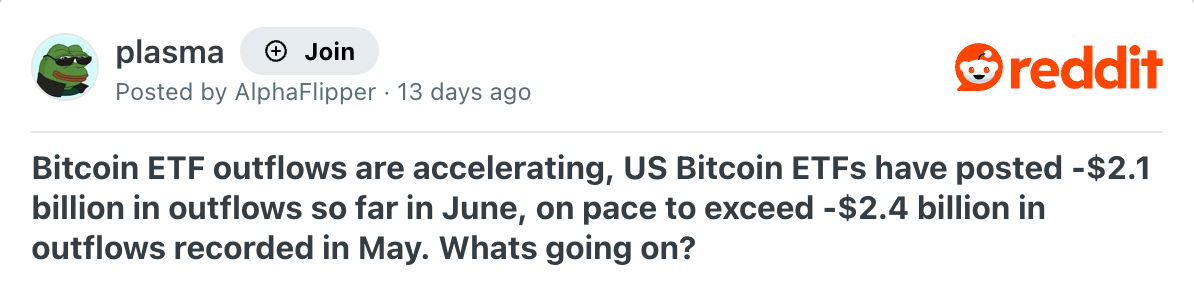 Source: Reddit
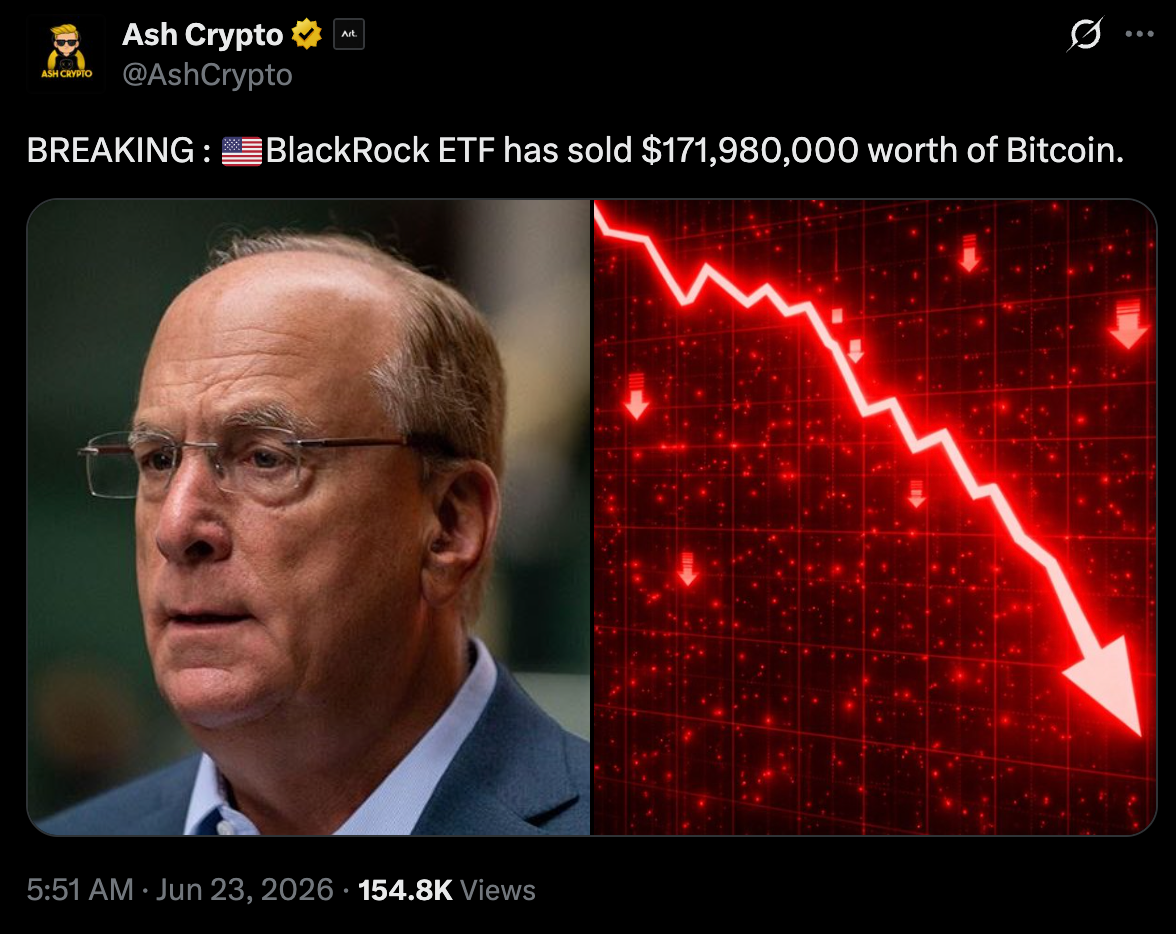 Source: @AshCrypto