Gold has a centuries-long track record of being the embodiment of value. A substance of reputation and weight so solid and indisputable that even in 2026, it's still a worthy asset.
Compared to gold, Bitcoin is an iPad kid. But, as we're all well aware, this iPad kid has shown crazy growth potential since 2009.
The question we're trying to find an answer to here isn't which one is better in 2026. It's more about how these two assets stack up against individual risk tolerance, time horizon, and financial goals.
Disclaimer:This article is provided for informational and educational purposes only and does not constitute financial, investment, or trading advice. Both traditional assets like gold and cryptocurrencies like Bitcoin involve market volatility and regulatory risks. ChangeNOW does not provide investment recommendations. Always conduct your own research before making any transactions.
Key Takeaways
Different jobs: Gold is designed to preserve existing wealth across decades. Bitcoin is a high-risk growth asset built to multiply capital.
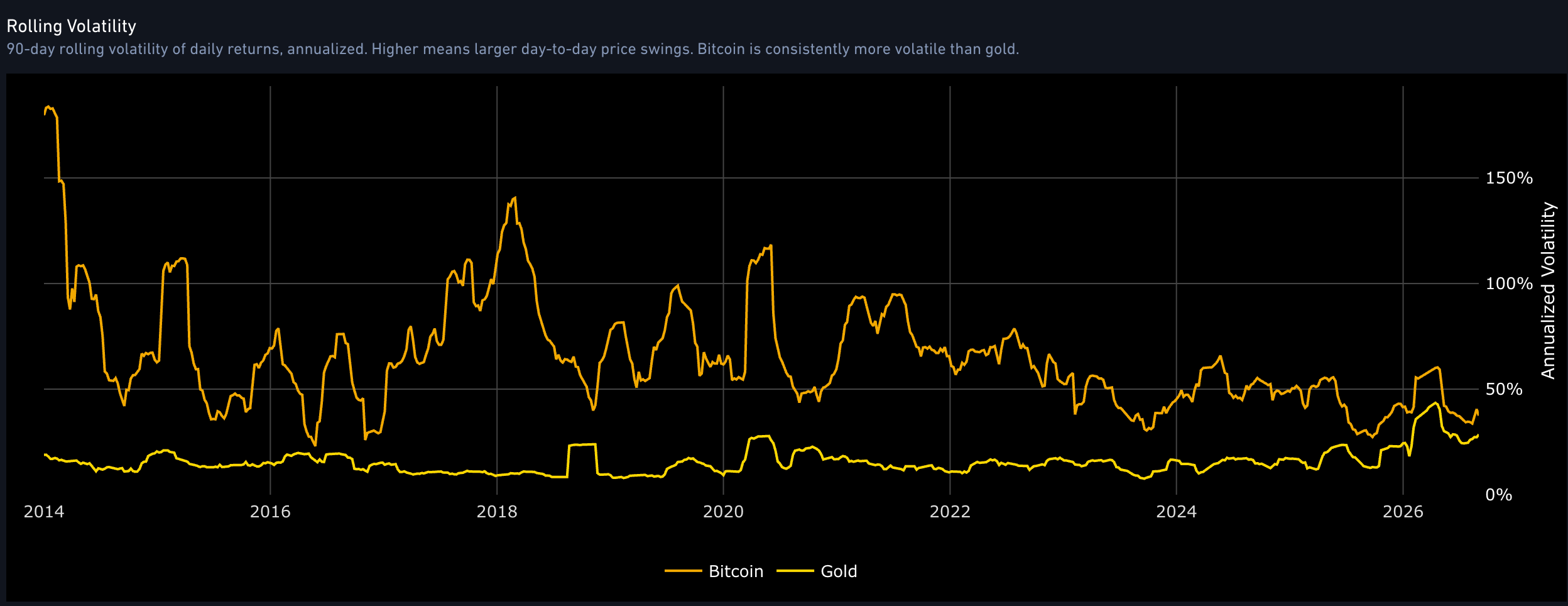
The volatility gap: Bitcoin's historical price swings are nearly four times wider than gold's, requiring a much higher tolerance for deep, multi-year drawdowns.
The tax reality: Neither asset escapes the taxman. Selling at a profit or even spending crypto on daily purchases triggers capital gains events that demand strict record-keeping.
The right choice depends entirely on individual financial goals. Gold serves as a defensive asset designed to preserve purchasing power and anchor a portfolio against severe market shocks. Bitcoin acts as a high-beta growth asset, offering the potential for aggressive capital appreciation alongside the risk of massive multi-year drawdowns.
Gold holds an undisputed track record as a long-term store of value. It reliably protects purchasing power during acute inflation crises and economic downturns. Bitcoin has delivered massive historical returns but acts like a volatile tech stock, regularly losing significant value during the exact macroeconomic stress periods when a true store of value should hold steady.
Gold is fundamentally safer. It carries a low historical volatility rate near 15% and has survived centuries of global financial collapses. Bitcoin operates as a highly speculative asset with historical volatility frequently exceeding 54%, exposing investors to the genuine risk of losing more than half their capital during bear markets.
Rose from near zero to above 50% with gold in 2026; fell from over 60% to ~33% with the Nasdaq 100
*Tax rules for gold and Bitcoin differ by country and by asset type. The rates above are a simplified US baseline as of September 2026 and are subject to change.
The following chart from Bitbo tracks the 90-day rolling volatility of daily returns for both assets since 2014. You can see that gold maintains a steady baseline near the bottom, while Bitcoin swings aggressively, regularly pushing past 50% and 100% annualized readings.
TL;DR:Over the years, Bitcoin has proven to be a more volatile, crash-prone asset by nearly every historical measure - annualized volatility near 54% versus roughly 15% for gold. Meanwhile gold carries a different kind of risk: sharp but shorter drops during historical liquidity crises like the one in 2008.
Old Money vs. iPad Kid
Gold has been money since around 600 BCE. Bitcoin was born only 17 years ago.
Fun fact:Bitcoin’s creator embedded a line from that day's front-page news into the very first block ever mined: "Chancellor on brink of second bailout for banks." A quiet jab at the same financial system gold has outlasted for two and a half millennia.
Every ounce of gold ever mined: be it jewelry, bars, coins, you name it, would still fit into a cube about 22 meters on each side. Bitcoin's entire supply exists as entries in a public ledger nobody can physically touch. Both facts sound weird and hard to wrap one’s head around.
And yet, surprisingly, for a few weeks in February 2026, gold was the wilder asset: its 30-day volatility climbed above 44% (the highest reading since 2008) versus roughly 39% for Bitcoin over the same period.
Market Crashes & Security Risks: 2008 vs 2020 vs 2022
Historically, gold and Bitcoin react very differently to market panic. When Lehman Brothers collapsed in September 2008, funds needing cash fast dumped gold, causing its price to drop 30%—though it fully recovered and doubled by 2011. Bitcoin's most infamous sudden crash came during the March 2020 COVID lockdowns, wiping out nearly 50% of its value in just two days.
During the prolonged 2022 bear market, Bitcoin faced a severe reckoning, losing roughly 77% of its value as interest rates spiked and the FTX exchange imploded. Gold, by contrast, had no equivalent single-year wipeout over that stretch, absorbing the macroeconomic shocks much better.
When it comes to security, Bitcoin's blockchain has never been hacked in 17 years. However, the centralized exchanges holding it have been repeatedly exploited—from Mt. Gox losing 850,000 bitcoins in 2014 to Bybit losing $1.4 billion in a matter of minutes in 2025. Gold's security risks are much more traditional—physical robberies breaking into vaults—and the losses are usually smaller in scale and properly insured.
Gold vs Bitcoin: Historical Returns
A popular story among historians notes that an ounce of gold bought a high-quality toga in ancient Rome. Two millennia later, that exact same ounce buys a tailored suit. Gold as an asset, focuses entirely on preserving purchasing power across generations.
Bitcoin’s timeline is absurdly compressed. On May 22, 2010, a Florida programmer paid 10,000 BTC for two Papa John's pizzas. At the crypto market's subsequent peaks, that specific stack of coins was worth hundreds of millions of dollars.
Fun fact:That transaction is celebrated globally as Bitcoin Pizza Day. The teenager who eventually received those coins sold them shortly after to cover his travel expenses, missing out on the most aggressive financial run in modern history.
Looking at the 2010s provides a distinct behavioral pattern of the two assets. Gold spent most of that decade delivering single-digit annualized returns, acting as a heavy anchor for traditional portfolios. And early cryptocurrency adopters saw their initial investments multiply exponentially during the same period.
Buying at the wrong time hurts regardless of the asset class. An investor who bought gold at its 1980 peak waited 28 long years just to break even in nominal terms. A Bitcoin buyer at the late-2021 top spent the next three years buried in deep unrealized losses.
Simple conclusion:Timing is everything + the faster the returns, the more risks they carry.
Gold or Bitcoin: Which One Survives Inflation Better?
Bitcoin has a strict 21 million supply limit. Investors long assumed this mathematical scarcity would automatically act as a shield against fiat inflation.
2022 provided the first live stress test. US inflation hit 9.1%. Bitcoin crashed 64%, tanking alongside risk-heavy tech stocks as interest rates spiked.
Gold absorbed the shock. The metal ended that same year virtually flat in US dollars and gained value against the euro and the British pound.
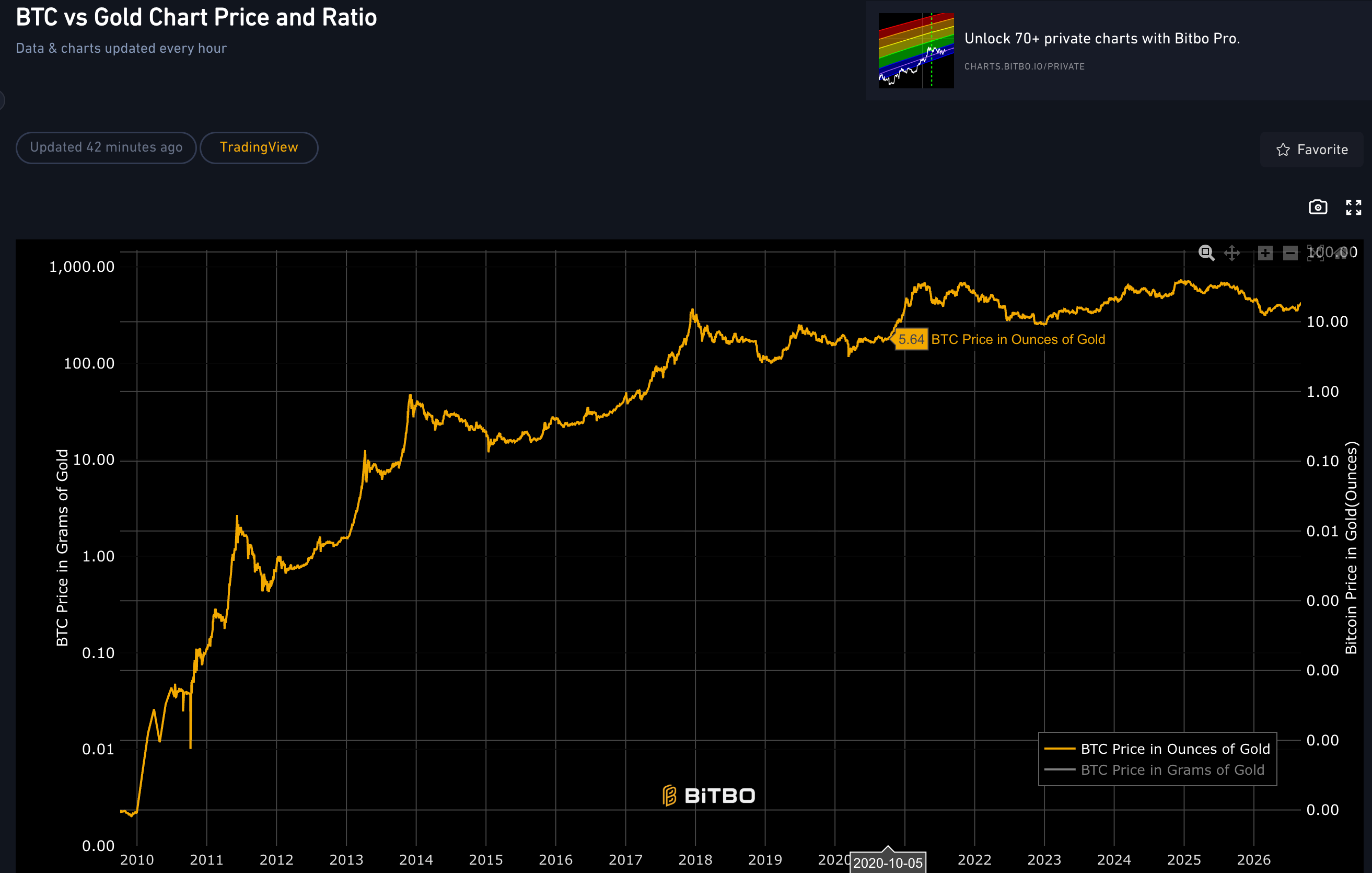
Source:Bitbo chart tracks how many ounces of gold it takes to buy 1 BTC
Verdict:Gold provides immediate stability when consumer prices spike. Bitcoin relies on massive multi-year growth to outpace inflation, offering zero shelter during the actual crisis.
Gold vs Bitcoin: Purchase and Storage
Owning either asset comes down to a single decision: manage the custody yourself, or pay a financial institution to hold it for you.
Custody Models: Physical vs. Digital vs. ETFs
Buying a physical gold coin or bar means paying a dealer markup, typically 3% to 8% above the spot price. Storage requires a secure setup, like an allocated vault charging around 0.5% to 1% annually. Alternatively, Gold ETFs trade like ordinary stocks through a brokerage account. You buy or sell in seconds during market hours, paying annual fees near 0.40%, but ETF investors own shares of a trust rather than physical metal.
Acquiring Bitcoin directly allows immediate withdrawal to a personal hardware wallet. A private 12-to-24-word recovery phrase acts as the sole key to the funds.
Self-custody grants complete control, operating 24/7 across borders. However, losing that seed phrase destroys access permanently, with zero customer support. Spot Bitcoin ETFs offer an institutional alternative inside standard brokerage accounts. Traditional custodians store the coins for annual fees around 0.25%, granting direct price exposure without the need to secure cryptographic keys, though trading is locked to stock market hours.
Blockchain technology created a direct bridge between the two assets.
RWA tokens like PAX Gold (PAXG) and Tether Gold (XAUT) represent actual physical gold stored in audited vaults, but they operate entirely on crypto networks.
This setup provides the price stability of gold combined with the 24/7 transfer speed of Bitcoin. You manage the custody yourself using a standard crypto wallet, completely bypassing traditional stockbrokers, storage fees, and ETF trading hours.
Tax authorities do not view either gold or Bitcoin as everyday currency. Most governments treat both as capital assets or property, meaning selling at a profit triggers a taxable event.
The core rules share the same foundation:
Capital gains tax: Profits from selling either asset above the original purchase price incur taxes.
Holding period matters: Many jurisdictions divide profits into short-term and long-term rates. Holding for over a year generally qualifies for lower tax percentages.
Loss harvesting: Realized losses from bad trades can offset gains elsewhere in a broader portfolio.
Spending Bitcoin on a cup of coffee or swapping it for another cryptocurrency counts as a taxable disposal in countries like the US and UK. Every tiny transaction demands record-keeping of the original cost basis.
Physical gold carries its own unique tax quirks. The US tax code labels physical gold and precious metal ETFs as collectibles, capping long-term capital gains at a higher 28% rate rather than the standard 20%..
Reality check:Moving between physical bullion, spot crypto, or regulated ETFs changes the paperwork dramatically. Consult a local tax professional before booking major gains.
Gold or BTC: Factors to Consider
When choosing between gold and Bitcoin, the final decision should be based on an individual understanding of the balance between volatility, liquidity, and asset control.
So, consider:
Risk tolerance: Gold moves at a measured pace with low annualized volatility. Bitcoin trades with extreme price swings, frequently experiencing drops of 50% or more during broader market drawdowns.
Time horizon: Gold aims to preserve purchasing power across decades and generations. Bitcoin demands patience across multi-year cycles to absorb sharp corrections and capture potential upside.
Custody responsibility: Physical gold requires safes, secure vaults, or insurance against theft. Bitcoin allows direct self-custody on a hardware wallet, but offers zero safety net if private keys are lost.
Institutional status: Central banks hold thousands of tonnes of gold as sovereign reserves. Bitcoin continues to establish its footprint among corporate treasuries and regulated exchange-traded funds.
Portfolio objective: Gold functions primarily as defensive ballast against market shocks. Bitcoin behaves like an aggressive growth asset with high upside potential and equal downside risk.


 Source: