If you used Ethereum during DeFi Summer or the NFT boom, paying $20, $50 or more in gas fees for a swap was not unusual. In 2026, the same kind of transaction can cost cents.
At 0.5 gwei and ETH at $2,350, Ethereum gas fees for a basic ETH transfer come to about $0.025. A swap using around 180,000 gas costs about $0.21.
Rollups now handle much of the activity that once competed for mainnet blockspace. Ethereum has also added blobs for rollup data and raised the L1 gas limit from around 30 million to 60 million. In May 2026, the Ethereum Foundation estimated that rollups handled roughly 95% of Ethereum transaction activity.
Key Takeaways
Ethereum mainnet can now be cheap enough for transactions that users once assumed belonged on Layer 2.
Rollups and higher L1 capacity have reduced competition for mainnet blockspace.
Transaction complexity still matters: a swap can consume several times more gas than a simple ETH transfer.
Heavy L1 demand can still push Ethereum gas fees sharply higher.
How Cheap Is Ethereum Gas Now?
Gas fees for a basic ETH transfer are low because Ethereum has little to execute. An ERC-20 transfer calls a token contract, while a swap can involve several contract operations.
Operation
Gas Used
Cost at 0.5 Gwei
Cost at 20 Gwei
ETH transfer
21,000
$0.025
$0.99
ERC-20 approval
About 46,000
$0.054
$2.16
ERC-20 transfer
About 65,000
$0.076
$3.06
Token swap
About 180,000
$0.21
$8.46
Approval + swap
About 226,000
$0.27
$10.62
The examples use ETH at $2,350. Contract complexity can change the amount of gas used, so these are reference values rather than fixed Ethereum gas fees.
Philip Krause, Builder Growth at the Ethereum Foundation, described the difference from the previous fee cycle in May 2026:
“The 2021 to 2023 fee regime is no longer a safe default assumption.”
The Ethereum Foundation reported standard gas around 0.15 gwei on May 5 and daily averages near 0.5 gwei through April. Its examples use 21,000 gas for an ETH transfer, around 46,000 for an approval, 65,000 for an ERC-20 transfer and about 180,000 for a swap.
FAQ
No. Ethereum charges for computation already performed, so a transaction that reverts can still consume gas.
Yes. Cancelling normally requires a replacement transaction with the same nonce, and the replacement transaction also needs gas.
No. The gas limit only sets the maximum amount of gas the transaction can consume. Transaction priority depends on its fee settings.
Wallets estimate gas fees before confirmation. The gas price can change before inclusion, while the final cost also depends on how much gas the transaction actually uses.
Yes. A wallet sending USDT ERC-20 needs ETH to pay the Ethereum network fee.
Methodology: ChangeNOW calculated the dollar values using the gas estimates above, ETH at $2,350 and the gas prices shown in the table. The figures cover Ethereum network costs and exclude DEX liquidity fees, slippage, bridge costs and exchange spreads. Calculated August 28, 2026.
Why a First Token Swap May Cost More
Some tokens require an approval before a DEX contract can use them from your wallet. The approval and swap are separate Ethereum transactions, so the first swap may include two sets of gas fees.
At 0.5 gwei, an approval using 46,000 gas plus a 180,000-gas swap costs about $0.27 with ETH at $2,350. At 20 gwei, the same pair costs about $10.62.
If the required allowance already exists for the same contract, another approval may not be necessary.
What a 180,000-Gas Swap Costs at Different Gas Prices
Gas fees for the same 180,000-gas swap can move from cents to tens of dollars without the transaction becoming more complex.
Gas Price
ETH Price
Fee in ETH
Fee in USD
0.5 gwei
$2,350
0.00009 ETH
$0.21
5 gwei
$2,350
0.0009 ETH
$2.12
20 gwei
$2,350
0.0036 ETH
$8.46
24 gwei
$2,350
0.00432 ETH
$10.15
100 gwei
$2,350
0.018 ETH
$42.30
100 gwei
$3,000
0.018 ETH
$54.00
Gas use stays at 180,000 in every row. The cost changes with the price paid for each gas unit. A higher ETH price can raise the dollar fee further.
Gas Price Verdict: A $0.21 swap and a $42 swap can consume the same 180,000 gas. The gas price determines what that execution costs.
Why Was Gas So Expensive Before?
During DeFi Summer and the NFT boom, swaps, NFT mints, liquidations and bots competed directly for Ethereum mainnet blockspace. Layer 2 networks carried far less activity, so busy periods pushed Ethereum gas fees higher.
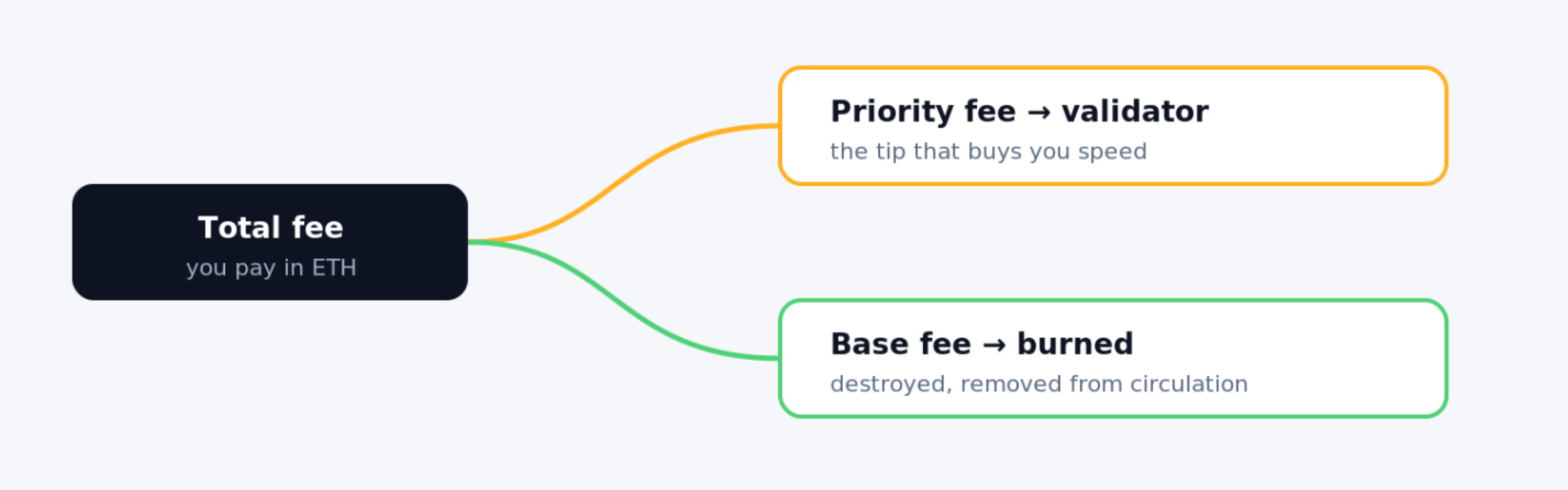
EIP-1559 changed the fee market in August 2021. Each block has a protocol-set base fee, while users can add a priority fee for validators. When blocks use more gas than the target, the base fee rises. When usage falls below the target, it declines.
The base fee is burned. EIP-1559 also made gas fees easier for wallets to estimate, but it did not materially increase mainnet capacity.
What Changed After the Gas Wars?
When a popular mint, token launch or market move sends many users to Ethereum at once, demand for blockspace can jump fast. Users start paying more to get their transactions included sooner, and bots may bid even higher.
Interesting Fact: Gas wars were common during the DeFi and NFT booms, when many users were trying to get into the same blocks at the same time.
Layer 2 Took Pressure Off Mainnet
Arbitrum, Base, Optimism and other Layer 2 networks handle swaps, transfers and contract calls that previously ran directly on Ethereum mainnet.
By May 2026, the Ethereum Foundation estimated that rollups handled roughly 95% of Ethereum transaction activity.
ChangeNOW's Blockchain Integration Team described the effect:
“A lot more activity is on L2 now. Ethereum does not need to run every heavy swap itself. An L2 can do the computation and then post the data back to Ethereum.”
Blobs Gave Rollups Cheaper Data Space
Dencun introduced blobs through EIP-4844 in March 2024. Blobs gave rollups a separate data lane instead of making them rely entirely on calldata that competed more directly with normal L1 execution.
Pectra later increased blob throughput. Fusaka introduced PeerDAS in December 2025, followed by another blob-capacity increase in January 2026.
Upgrade
Activation
What Changed
Effect
Dencun
March 2024
Added blobs through EIP-4844
Gave rollups separate data space
Pectra
May 7, 2025
Raised blob target/max from 3/6 to 6/9
Added more room for rollup data
Fusaka
December 3, 2025
Added PeerDAS
Allowed more blob capacity
Fusaka BPO2
January 7, 2026
Raised blob target/max to 14/21
Added another capacity increase
Ethereum Foundation contributors explain Fusaka, PeerDAS and Ethereum capacity. Published December 5, 2025.
Ethereum Made More Room on L1
Ethereum's L1 gas limit rose from around 30 million to 60 million during 2025. Fusaka's EIP-7935 standardized 60 million as the new default.
At a 60 million gas limit, one block could theoretically fit roughly:
2,857 ETH transfers using 21,000 gas each
923 ERC-20 transfers using 65,000 gas each
333 swaps using 180,000 gas each
Real blocks contain a mix of transaction types, so these figures show capacity rather than expected block composition.
Under EIP-1559, the target is half the block gas limit. A 60 million limit therefore puts the target at around 30 million gas. Blocks above the target push the next base fee higher, while lighter blocks pull it down.
Capacity Verdict: Mainnet has more room per block, while rollups process much of the activity that previously competed for that capacity.
Why Transaction Count Can Be Misleading
Transaction count can be misleading because Ethereum gas fees depend on how much gas transactions use, not simply on how many transactions are included. A block with many simple ETH transfers can require less execution than a block with far fewer swaps or other complex contract calls.
For example:
100 ETH transfers use about 2.1 million gas
100 swaps at 180,000 gas each use 18 million gas
Both examples contain 100 transactions, but the swaps consume more than eight times as much gas.
ChangeNOW's Blockchain Integration Team explained:
“A simple ETH transfer is about 21,000 gas. An ERC-20 transfer can be around 50,000 to 65,000. A swap can use 150,000 to 300,000. So a few swaps can use more gas than a lot of simple transfers.”
EIP-1559 responds to gas used relative to the block target rather than raw transaction count.
How Ethereum Calculates a Transaction Fee
The final fee comes down to two numbers: gas used and gas price.
Under EIP-1559, that price includes the protocol's base fee and a priority fee paid to the validator.
Ethereum transaction fee = gas used × gas price. Under EIP-1559, gas price includes the base fee and priority fee.
Source: Blockscout. Checked August 28, 2026.
Transaction fee = gas used × effective gas price
Take a basic ETH transfer using 21,000 gas with:
base fee: 10 gwei
priority fee: 1 gwei
The effective gas price in this example is 11 gwei.
21,000 × 11 gwei = 231,000 gwei = 0.000231 ETH
Value
What It Means
Gas used
Work the transaction actually consumed
Gas limit
Maximum gas the transaction can consume
Base fee
Protocol fee that is burned
Priority fee
Amount paid to the validator
Source: Blockscout. Checked August 28, 2026.
A failed transaction can still cost gas because Ethereum already spent compute trying to execute it.
Gas limit is not the final bill either. If a wallet sets a gas limit of 90,000 and the transaction consumes 65,000, the user pays for the 65,000 actually used.
Did the Merge Make Gas Cheaper?
No. The Merge moved Ethereum to Proof of Stake, but block capacity barely changed.
Ethereum moved from Proof of Work to Proof of Stake on September 15, 2022. Validators replaced miners and Ethereum's energy consumption fell by about 99.95%.
Ethereum's Merge documentation lists lower gas fees as a misconception about the upgrade. Network capacity barely changed at the time.
The big fee drop came with L2 growth, blobs and a higher L1 gas limit.
Ethereum Mainnet vs Layer 2 Fees
L2 can be cheaper, but moving funds there also costs money.
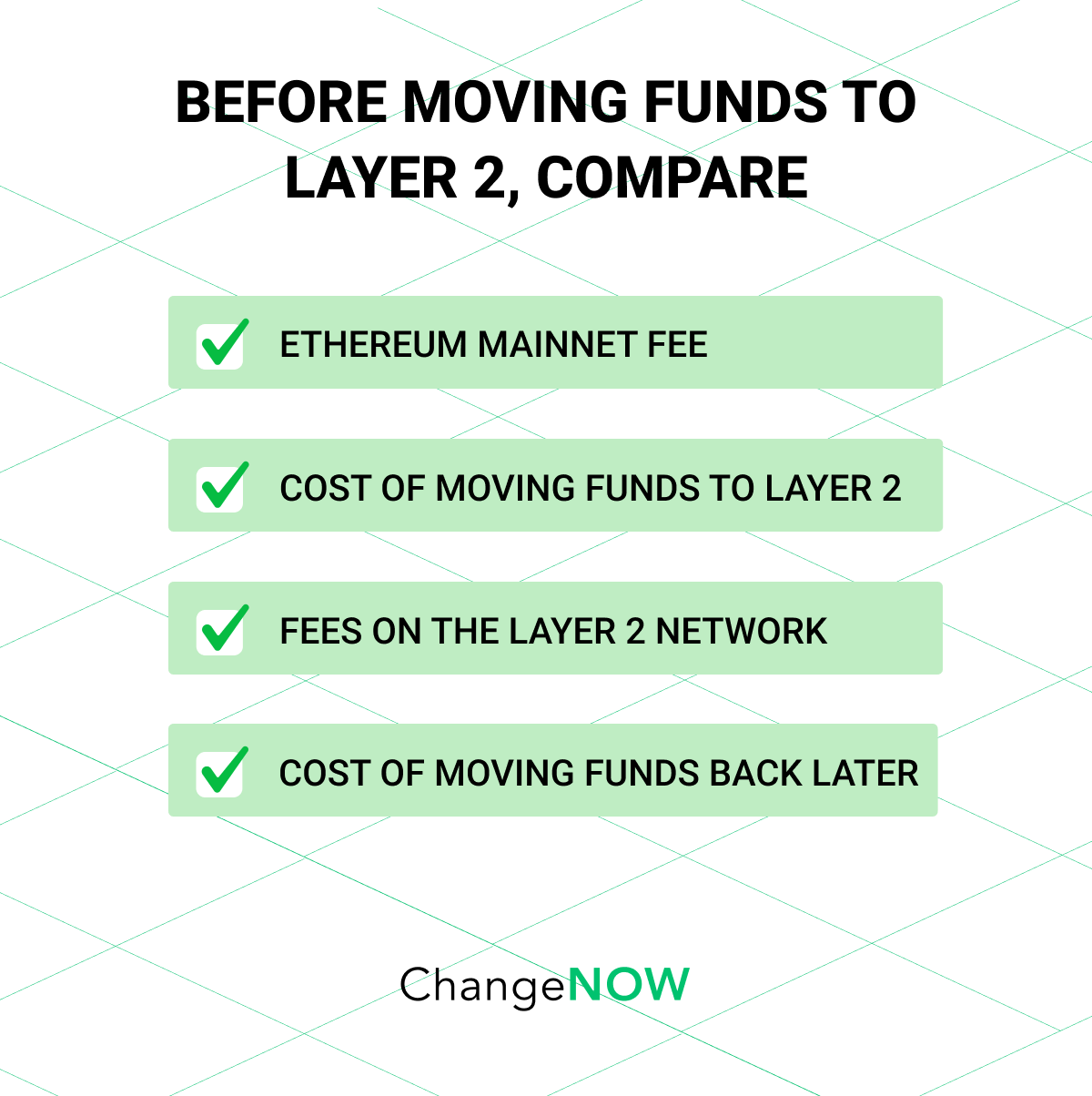
If your ETH is already on mainnet and gas is 0.5 gwei, paying a few cents for one transfer can be cheaper than moving funds to another network first. Moving assets can add bridge or withdrawal costs.
Layer 2 becomes more useful when funds are already there or when you plan to make several swaps and contract calls.
Source: ChangeNOW. Checked August 28, 2026.
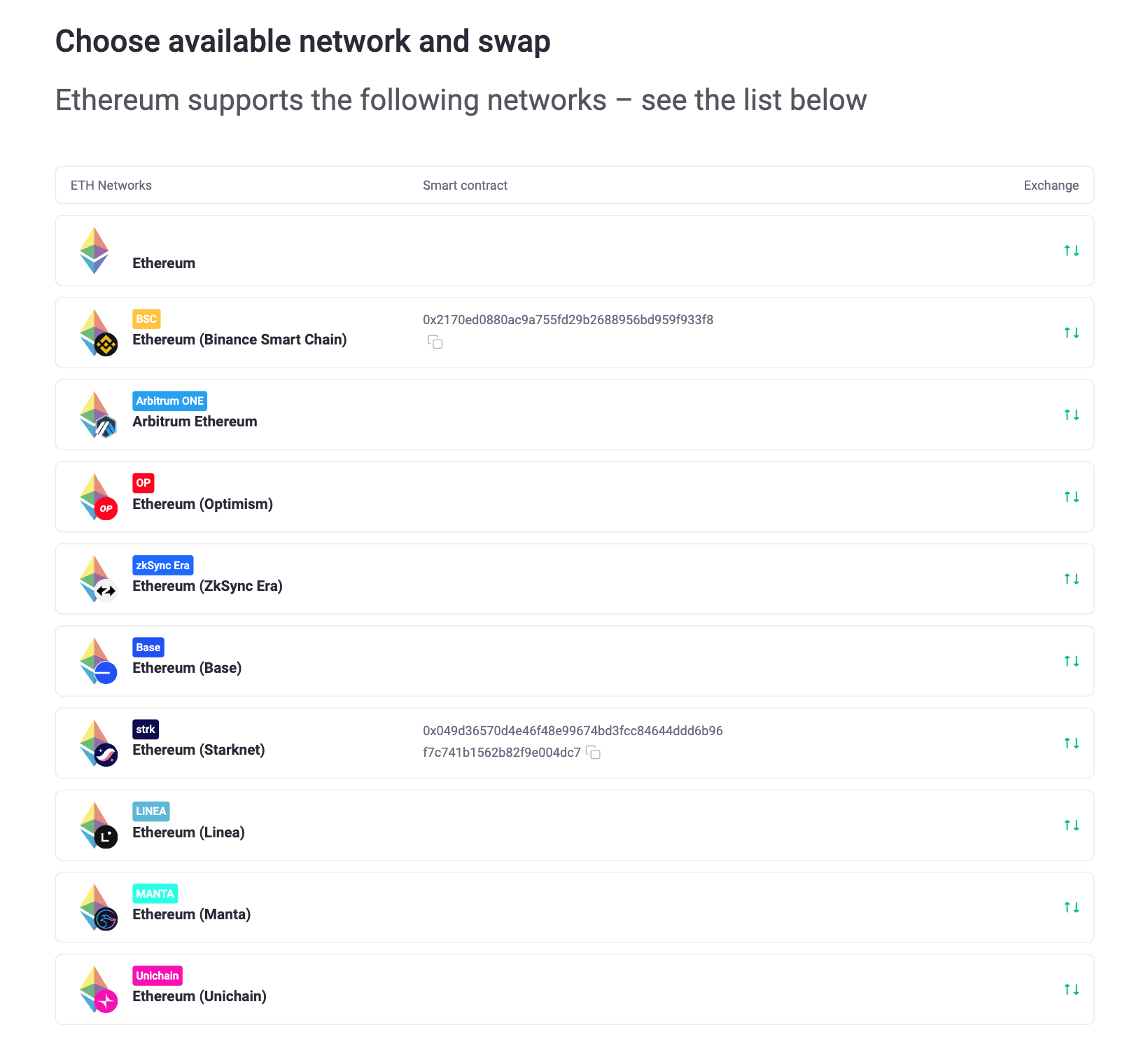
Ethereum is available on ChangeNOW across Ethereum mainnet and supported networks including Arbitrum, Optimism, zkSync Era, Base, Starknet and Linea. Network availability can change.
If you need to bridge first, include that cost when comparing L1 and L2.
ETH vs ERC-20 Network Costs on ChangeNOW
ETH and ERC-20 tokens trigger different Ethereum transactions.
A basic ETH transfer normally uses 21,000 gas. Sending USDT or another ERC-20 token calls a token contract and usually consumes more.
Onchain, a ChangeNOW exchange has two legs: the deposit from your wallet and the payout to the receiving wallet.
Exchange Route
Deposit
Payout
ETH → USDT ERC-20
ETH transfer, normally 21,000 gas
ERC-20 transfer
USDT ERC-20 → ETH
ERC-20 transfer
ETH transfer, normally 21,000 gas
Your wallet pays the Ethereum network fee for the deposit. The payout is handled as part of the exchange, so the table does not mean you pay two wallet fees.
ChangeNOW's Blockchain Integration Team uses the current network gas price in its fee calculation:
“We don't use a separate Ethereum congestion metric. As a sender, the gas price already gives us the signal we need. We sync it from the network automatically and use it in the fee calculation.”
Update frequency differs across EVM networks:
“It differs by EVM network. Arbitrum gas can be pretty volatile: the network gets busy, then quiet again. Ethereum mainnet is usually steadier.” – ChangeNOW's Blockchain Integration Team
ChangeNOW Verdict: ChangeNOW does not use a fixed Ethereum network fee. The estimate moves with the gas price pulled from the network.
USDT ERC-20 needs ETH for gas. If you send USDT on Ethereum, the sending wallet also needs ETH to pay the network fee.
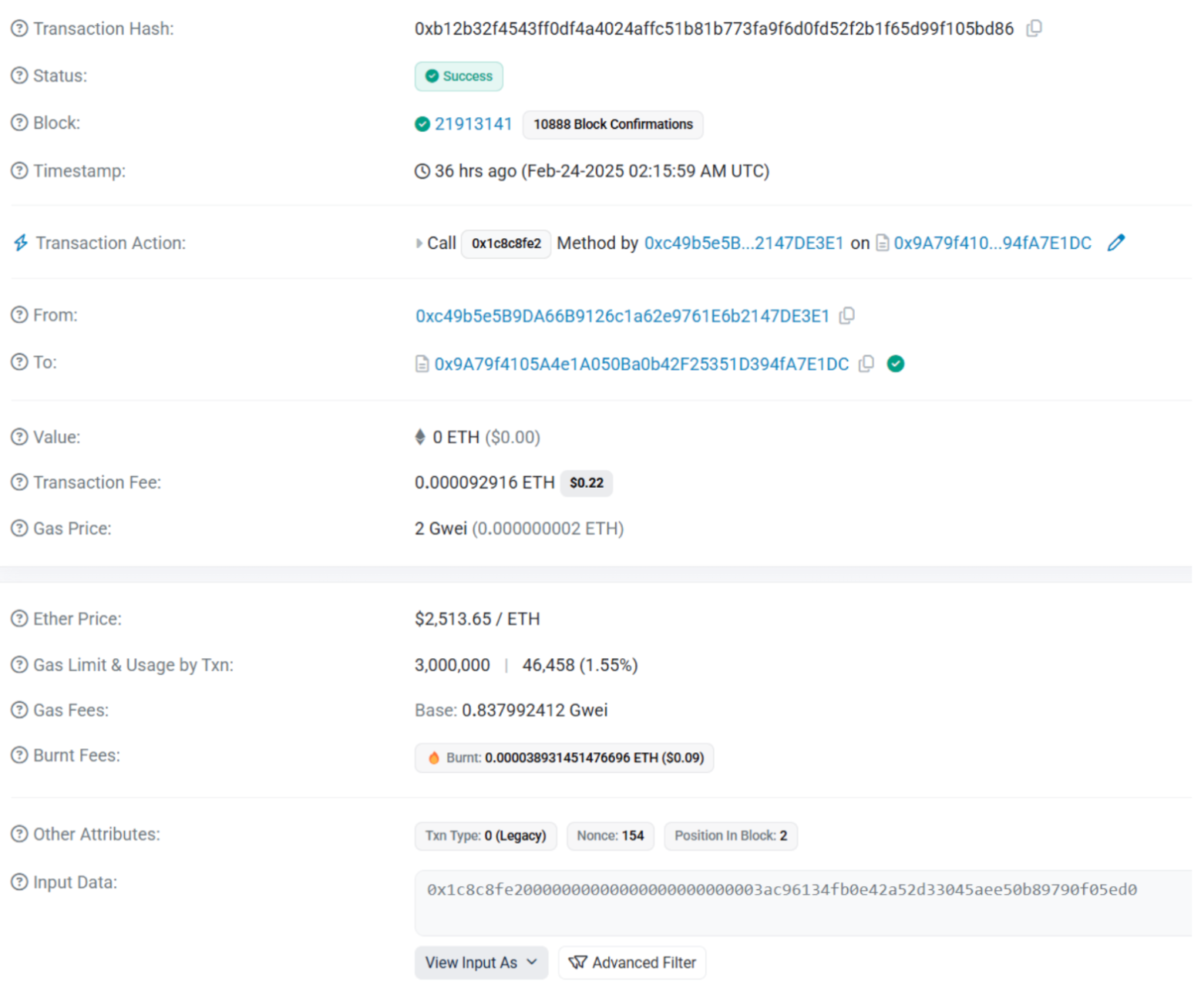
You can check the final fee of a completed Ethereum transaction on Etherscan. Its transaction guide explains the main fields shown on a transaction page.
The most useful fields are Transaction Fee, Gas Price and Gas Limit & Usage by Txn.
Source: Etherscan. Checked August 28, 2026.
In this example, the transaction had a gas limit of 3,000,000 but used only 46,458 gas. The user pays for the gas actually used, not the full limit.
Copy the transaction hash from your wallet or exchange page.
Paste it into Etherscan.
Check Status to see if the transaction succeeded.
Check Transaction Fee to see what you paid.
Open More Details.
Check Gas Limit & Usage by Txn and Gas Price.
Check Transaction Action or Method to see what type of transaction it was.
At ETH at $2,350, a 180,000-gas swap costs about $10 at 24 gwei. At 100 gwei, the same swap costs about $42.
Gas fees can jump during:
a popular token launch
a large NFT mint
a major airdrop claim
a liquidation wave
heavy L1 trading during a sharp market move
ChangeNOW's Blockchain Integration Team said a return to the old fee levels would require much stronger competition for L1 blockspace:
“To get back to $20 or $50 swaps, L1 would have to get seriously crowded again. Users would need to compete for blockspace and keep paying up instead of waiting. It can still happen, but Ethereum has more capacity now and a lot of activity has moved to L2.”
Ethereum now has a 60 million mainnet gas limit, while rollups handle most Ethereum transaction activity. A return to $10 to $50 swap fees therefore requires much stronger pressure on L1 than an ordinary 2026 block.
Fee Verdict: $10 to $50 swaps can still happen when demand for Ethereum blockspace rises sharply.
The Bottom Line
Ethereum mainnet is cheap enough in 2026 that moving a single transaction to Layer 2 does not automatically produce a cheaper route. Check the current gas price, the transaction type and where your funds already sit before choosing a network.
For repeated swaps and contract calls, Layer 2 can still cut costs further. For a simple transfer during a quiet mainnet period, Ethereum gas fees may already be measured in cents.


 Source: Etherscan. Checked August 28, 2026.


