Quick verdict: As a long-term hold, DOGE might not be the strongest choice; however, its tendency to spike on Elon Musk's commentary and cultural moments makes it a viable asset for regular, momentum-based trading.
Disclaimer:Here you'll find facts, verified data, and general market analysis to help you form your own view on DOGE as an asset. This content is for informational purposes only and does not constitute investment advice or a recommendation to invest in any crypto asset. Whether any crypto asset is a “good investment” depends on your individual circumstances and risk tolerance.
What is Dogecoin (DOGE)?
Dogecoin in 2026 is a Proof-of-Work digital commodity which functions as a speculative trading asset and a high-speed payment network.
Consensus mechanism: It shares a network with Litecoin via the Scrypt algorithm. Litecoin miners process DOGE transactions on the side at no extra cost, which keeps Dogecoin secure without needing its own miners.
Coin supply: The network creates 10,000 new coins every minute, adding 5.25 billion DOGE every year. No supply limit DOGE needs new buyers every single day just to keep its price, and it’s like running an endless marathon just to stay at the same spot.
Current application: In March 2026, regulators officially labeled DOGE a commodity. And developers now focus entirely on simple payment tools like GigaWallet and upcoming X Money transfers.
Because the supply never stops growing, treating DOGE like digital gold does not work. The coin needs fresh money every day just to keep its price stable, making a long-term buy-and-hold strategy largely ineffective.
DOGE in Numbers: 2026 Data Snapshot
Dogecoin remains the biggest meme coin by market size, but massive holders now control its price while an endless supply limits its upside.
Price & market cap: DOGE trades near $0.09 with a $15 billion market size ranking it #12 on CoinGecko. It dwarfs newer meme coins, but still sits nearly 90% below its past peak.
The $0.73 All-Time High: Hitting the May 2021 record of $0.73 again would require much more money today than it did back then, simply because billions of new coins have been printed since.
Active supply: Over 150 billion coins are circulating right now. With 5 billion more added every year, holding DOGE means fighting a constant headwind of new supply.
Who owns it: Big money does their usual thing, setting the floor. Wallets holding over 100 million DOGE control close to $12 billion of the total supply. Although retail enthusiasm remains part of DOGE's identity, significant price movements are largely steered by whales.
DOGE Price History
Past market cycles show that DOGE no longer reacts to the social media hype that drove its early growth.
2020–2021: Retail excitement and Elon Musk’s tweets drove DOGE to an ATH of $0.73 in May 2021. That peak was followed by a massive crash and erased ~90% of its value by mid-2022.
2022–2023: The long bear market wiped out everyday buyers. As Pauline Shangett, CSO at ChangeNOW, explains:
"Retail investors who absorbed heavy losses during the 2021 and 2022 crashes are highly unlikely to step into the same river twice".
2024–2026: Old hype triggers stopped working. The DOGE-1 space mission remains stuck in delays with no confirmed launch date. As Shangett points out, if major events fail to push the coin past $0.10–$0.15, reaching $1 looks highly improbable.
Why investors are bullish on DOGE
TL;DR:DOGE stays relevant because huge investors buy the dips, using the coin as a highly liquid trading tool.
The Whale Safety Net
Big wallets provide the main price floor right now.
"Elon gives it the spike, whales give it the floor. It's not a payment asset yet. It's a trading asset that big players don't want to let die."
On-chain records back this up. Wallets holding over 100 million DOGE control nearly $12 billion in supply. When retail sellers leave the market, deep-pocketed buyers step in to absorb the volume.
Legal Safety as a Commodity
In March 2026, regulators classified DOGE as a digital commodity. This decision takes regulatory enforcement off the table.
While many newer tokens face ongoing legal scrutiny, businesses can integrate Dogecoin for payments without fear of sudden securities lawsuits.
High-Volume Liquidity
DOGE easily handles hundreds of millions of dollars in daily trades. Large players need deep order books so they can enter and exit positions fast without slipping the market price. When speculative cash returns to the meme sector, DOGE takes the first wave simply because it has the trading pipes to handle it.
This dynamic turns the original meme thesis upside down. Dogecoin no longer relies on community jokes to survive. The asset now functions as an established market tool where deep liquidity and legal clarity matter far more than social media hype.
TL;DR:Heavy coin inflation, zero native utility, and retail exhaustion make sustained price growth difficult to justify.
Missing Utility and Cold ETFs
TradFi buys clear business cases, it doesn’t really get internet culture.
As Pauline Shangett, CSO at ChangeNOW, points out:
"DOGE lacks clear utility, distinct use cases, and forward-looking tech. Without real utility, institutional products like ETFs struggle to maintain long-term interest".
Regulators opened the door, but big fund managers are not walking through. Some of them are even walking out like Bitwise, for example.
Relentless Supply Inflation
The network mints 5.25 billion new DOGE every year, 14 million new coins daily. That’s a solid route to the dilution of purchasing power. The market needs billions in fresh capital every year just to keep the price flat. Long-term holders likely will have to be very patient waiting for their gains.
Retail Burnout and Faster Bets
The everyday traders who fueled the 2021 peak took heavy losses on the way down. Unsurprisingly, many of them never came back.
The part of the crowd looking for quick gains has moved to networks like Solana with newer, more promising tokens. Dogecoin is now too big to deliver overnight multiples and that fact leaves it caught between uninterested institutions and retail traders who have moved on.
Without utility to attract institutional capital or viral hype to pull back everyday buyers, DOGE struggles to pull itself up and generate momentum.
ChangeNOW Insights: How Users Swap DOGE
Internal exchange data shows how people actually use Dogecoin.
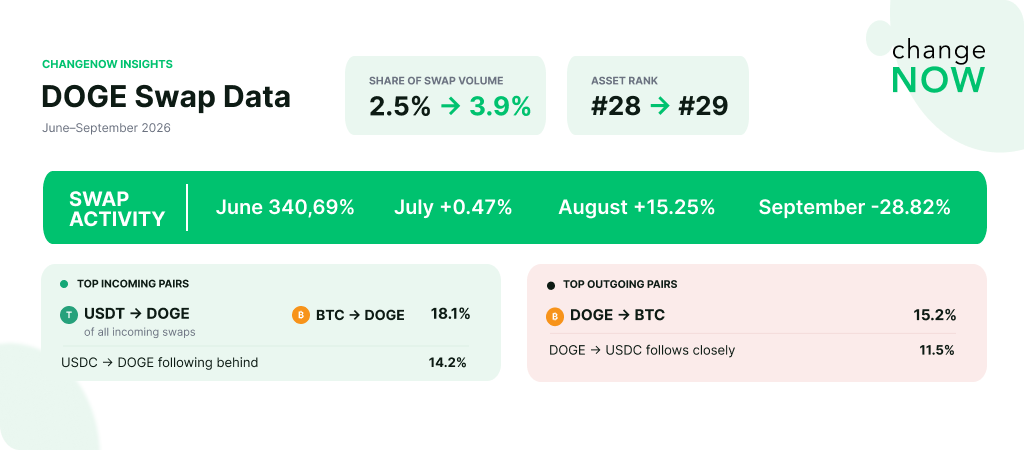
Between June and September 2026, DOGE’s share of total swap volume climbed from 2.5% to 3.9%. Its overall rank barely moved - #28 to #29.
Popular pairs
Over 15% of outgoing DOGE swaps go straight to Bitcoin, another 11.5% to USDC.
Incoming swaps look almost identical in reverse: BTC→ DOGE at 18.1%, USDC→ DOGE at 14.2%, with USDT→ DOGE the top source.
Takeaway: Users seem not to hold DOGE. They are swapping through it on the way to something else. Oftentimes they’re moving to Bitcoin.
Volatile activity
June saw a 341% surge, July was flat, August added another 15% as the broader market picked up, then September dropped 29%, wiping out most of that gain.
The swings basically line up with the market's mood in general, it’s not anything specific to DOGE.
Takeaway: DOGE gets used when the market's hot and drops just as fast when it cools down.
Here is a quick snapshot of the main pros and cons of investing in DOGE:
Pros
Cons
High liquidity: Big trades happen without moving the price.
Endless supply: 5 billion new coins every year keep lowering the value.
Whale support: Giant wallets own $12B, keeping the price from collapsing.
No real use: No apps, no smart contracts, and no native ecosystem
Commodity status: Regulators cleared it, so lawsuits are not an issue.
No big funds: Institutional investors do not buy tokens without utility
Top meme brand: Still the first coin people buy during hype waves.
Tired retail: Burned buyers from 2021 have moved to newer tokens
Conclusion: Is DOGE a Good Investment?
Dogecoin is a strong tool for active traders, but it carries particular structural risks for long-term holding. If you want to trade market swings, DOGE offers the deep liquidity you need to get in and out quickly.
Active traders use DOGE to capture price swings because deep liquidity allows fast entries and exits without large slippage. However, long-term holding faces steady dilution: the network creates 5.25 billion new coins every year. Without built-in utility or cash flow to attract institutional capital, this constant supply expansion creates persistent downward pressure.
A mix of social sentiment, broader crypto market momentum, and prominent endorsements. Unlike smart-contract networks, DOGE’s price action is rarely anchored to complex DeFi activity or developer revenue.
Instead, retail momentum, viral trends, and public mentions, most notably from figures like Elon Musk often act as short-term catalysts. When trading volume surges alongside high social activity, momentum can build rapidly, though it remains predominantly speculative.
Dogecoin issues a fixed 5 billion new DOGE every year with no hard supply cap. Because the issuance is absolute rather than percentage-based, the inflation rate steadily decreases in relative terms over time (currently under 3.5% annually).
However, unlike proof-of-stake networks, you cannot stake DOGE to earn native yields. That means non-active holders face persistent, gradual dilution unless market demand expands fast enough to absorb the new coins entering circulation each day.
The main risks highlighted by market observers include: heavy reliance on sentiment over technological utility, whale wallet concentration (where large entities hold significant supply sway), and relentless competition from newer meme coins capturing community mindshare.
Additionally, because its primary use case remains low-fee payments and tipping, limited merchant adoption outside niche circles poses an ongoing adoption hurdle.
Key resources for objective data:
Blockchair & DogeChain: Block explorers for verifying on-chain transactions, fee levels, and block times.
IntoTheBlock: In-depth metrics on whale concentration, holder profitability, and average holding times.
CoinMarketCap & CoinGecko: Circulating supply, volume trends, and market depth across exchanges.
LunarCrush: Social engagement and sentiment analytics tracking meme-driven volume shifts.
No one can predict future price action, and any guaranteed forecast should be met with skepticism.
Dogecoin has demonstrated remarkable staying power across multiple market cycles, continually proving that community loyalty and cultural relevance hold genuine market weight.
Whether it trends upward in the future depends heavily on overall crypto market liquidity, ongoing merchant utility, and whether social attention cycles return to older, established assets.
You can buy DOGE on ChangeNOW: with a bank card, transfer, or by swapping directly from another cryptocurrency. No account or registration is required for standard swaps. Simply select your payment currency, input your Dogecoin destination wallet address, and initiate the transaction. Always double-check your recipient address before finalizing.
That depends entirely on your financial goals, risk appetite, and portfolio strategy. While DOGE may not fit the conservative profile of a traditional long-term store of value, some market participants actively trade its volatility around cultural and social catalysts.
This guide provides the contextual data to help you evaluate the asset, but the allocation decision rests strictly with you.
Different architecture, different thesis. Dogecoin is an independent Proof-of-Work blockchain built for simple, low-fee payments with steady annual issuance. Shiba Inu is an Ethereum-based token with smart contract utility, decentralized finance integrations, and token-burning mechanics.
Neither is objectively superior. DOGE offers straightforward Layer-1 transaction track records, while SHIB provides DeFi features and ecosystem apps. Both remain high-volatility, sentiment-driven assets.
For a detailed breakdown of tokenomics and technical differences, read our DOGE vs. SHIB comparison.